


JohnMo
-
Posts
13296 -
Joined
-
Last visited
-
Days Won
200
Everything posted by JohnMo
-
 Not sure about that. Most copper pipe sold in the UK is made from recycled stock. Most steel has a large percentage recycled steel in it also. If they were/are installing 1.5 million boilers per year, but instead install 1.5 million heat pumps, the scaling of raw materials new or recycled) moves from one heat source to the other. If there was no commerce there would be no money moving around the world, which is great if you don't want public services (from tax), wages etc. The bigger picture would look at carbon input and compare to the time taken to be carbon neutral. A heat pump lets you use carbon free electric generation, gas, oil, wood etc doesn't. So a heat pump after being installed a short period will have a much lower carbon foot print than almost any other heating system. And the alternative is what? Suggestions on a postcard, well perhaps email, wait a minute, what about the mined silver and gold in phones and computers, just shout it over the hills.
 -
@SteamyTea beat me to it, l got diverted to dog walking. Why? Can require, doesn't mean it does. I'm in the process of installing a heat pump, so far a couple of lengths of 28mm copper tube, a few fittings and a 3 way valve. Heat pump weight wet is 71kg, copper and steel are 100% recyclable, so at end of life can be turned into something else.
-
Mine went in before any walls and then used concrete as screed. I found that way easier than the normal, build the house and fight around the walls. Nice blank canvas to work with.
-
The guidance was updated in 2021, so it may have changed guidance-householder-permitted-development-rights-updated-2021.pdf
-
Just double checked and from I can see that 100m condition only applies to free-standing micro wind turbine (MWT), as no such conditions apply to an ASHP. The wording of the condition is "Limitations 6.18 For MWT, the limitations are that: ■ the installation of a MWT must be not less than 100 metres from the curtilage of another dwelling.
-
Global warming is in fact entirely natural and has already peaked
JohnMo replied to ProDave's topic in Boffin's Corner
Interesting fact not discussed in the video is the temperature spike that is occurring on the natural occurring repeat in the 2000s. The temperature is actually higher than any of the previously recorded spikes. Not sure where he gets the reliable temperature data from circa 2000 years ago. When the thermometer was invented in 1620s, so 1600 years of guess work, I guess. So shite in, shite out, would be my best guess. Making the something fit your argument -
I have gone for antifreeze. But will only apply at about 15 to 20%. Antifreeze valves, if they activate they will allow air in water out, great for protecting pipes, but you would need to bleed the system to get it back online. Antifreeze start up and you have heating. Likelihood of failure on demand, antifreeze is very low. If you live in the sunny south in a town, not sure I would bother with either. I live in NE Scotland and in the country, so feel some protection is required. Antifreeze pretty low cost 10l about £75 from Screwfix. Two antifreeze valves £200. Antifreeze does have a higher pumping requirement and worse heat transfer quality. But system will generally be run sub 30 degrees, so will take the hit. Antifreeze valves are generally exposed and wrapped in insulation so you get a heat loss there , so though one loss balances the other losses.
-
I did mine in the smaller size instead of 22mm. No flow issues.
-
The pipe I used was pert-al-pert from outsourced energy, found it easy enough to use. I used this pipe for most of my plumbing. Hot/cold water is via a manifold. My cold water piping is buried below the floor insulation in the concrete slab, nice cool drinking water. Hot water is the same pipe. Once in a wet room I transitioned to copper pipe. I downloaded loopcad on a free trial. Did room by room based on heat loss and floor coverings. Ended up with 300mm centres. Flow temps vary between 25 and 34 (at -9). Just run the whole lot as a single zone. Once you get to low W/m2, pipe spacing doesn't make too much difference to flow temp. Heat pump generally don't produce hot water below 25 degrees, so having flow temps lower than that isn't an advantage.
.thumb.jpg.e6f5b10749b0a8b28a782f83356b9791.jpg)
-
The full subset of standards that apply to heat pumps including guidance notes, but these could also include some if, what, ifs, and maybe. The permitted development doesn't state anything about the noise standard, just MCS or equivalent standards.
-
Yes for the the same mean flow temperature. Unless there is an air space, reflection does not occur. The aluminium use in these systems are conductors so act as a heat spreader, the thickness affects the heat up time slightly. How these perform will be different, but generally not that different. Insulation and floor buildup probably have a bigger impact. As well as overall insulation standards of the whole house.
-
So going back to your original question, of getting heat pump to the masses A standard equivalent to MCS should exist, to allow permitted development. But using this equivalent standard would expressly not allow the application of any government grants. This standard could mirror MCS but exclude the registration and training requirements.
-
But PD also states it can be an equivalent standard. There is absolutely nothing stopping you or I, writing a standard that is almost word for word the same as MCS, but without the wording stating MCS registered etc.
-
I thought the 2.5m height was at the eaves, not the apex. Otherwise anything other than flat roof would be too low to use.
-
I think there are a good correlation, the typical boiler installation is around 80% efficient, the typical low temp weather compensation gas boiler efficiency is 110%, which is a big drop in running costs, but not many installs are complete so that advantage can be taken, instead the installer uses a Y plan or similar. Living in the sunny south also has some advantages, well insulated here means I only have my heating on for 5 to 6 months a year, instead of on most of year.
-
Only thing to add, is we need a wholesale change of mind set, to accept weather compensation is the way forward, whether that's a run 24/7 mode or an extended running period of 8 hours or so, to cover your days heating. Not the on/off like a yo-yo, loads of zones which seems the mind set currently in force.
-
Isotex HDIII 30/10…16 extra blocks required
JohnMo replied to Field_of_Dreams's topic in Insulated Concrete Formwork (ICF)
That's good to know -
Isotex HDIII 30/10…16 extra blocks required
JohnMo replied to Field_of_Dreams's topic in Insulated Concrete Formwork (ICF)
Think you may struggle with Durisol, they went bankrupt a while ago. Although they have be bought over the factory is being moved from Wales to Scotland -
I used them for a pump and mixer, got what I asked for quickly and at a competitive price. Also used UFH1 and Outsourced Energy, my go to place is Outsourced Energy their pert-al-pert pipe is good to use, manifolds and mixers are Ivar so all good stuff and prices are good. If you want to design a system just down loopcad and do it yourself. It is surprising how little pipe you need in your floor, on a well insulated house. I have less than 600m in a 192m2 floor.
-
You are over thinking it. Reading to much promotional clap trap and believing it. At the same flow temp and area, the only really thing that changes anything with respect to the output of the panels is pipe spacing and foil thickness. Pipe spacing and temperature sets the output, foil thickness has a small difference on how the temp is distributed across the floor. There is a third thing that being floor coverings, but that's a different discussion. UFH isn't a radiator system, if you want quick response, use radiators. UFH is a low flow temperature, high surface area heating system for comfortable background heating.
-
Transform warm air system from Gas to Electric.........possibly.
JohnMo replied to merlyn's topic in Introduce Yourself
Have a search on here, someone did this or very similar not that long ago, thread contains lots of details -
You only need 50mm battens for downlights, if you select the right ones. The transformer comes seperate and will slip in the void and the lights are slimmer than that.
-
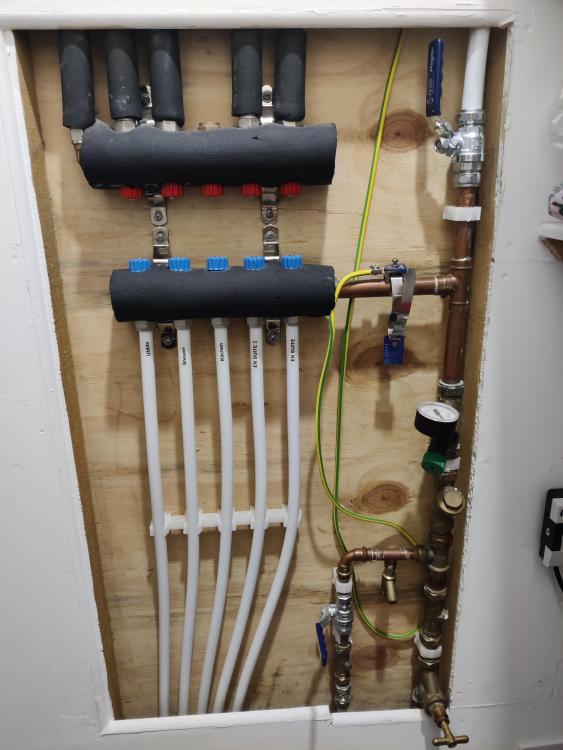
I kept mine really simple, boiler in loft/plant room. Hot from boiler tees off left to kitchen on its own isolation valve, to the right travels downstairs to utility cupboard, where my cold water manifold is. Everything else goes from there. Only have one feed to each wet room. Everything in a room is just just goes to a branch system. Top blue valve is a 22mm feed to plant room, bottom 15mm isolation valve next to stop cock is the outside tap. On the upper manifold the left pipe is the hot water feed from plant room
-
You really need to keep the pipe runs pretty short or you will not get the hot water to the tap before you want to switch it off. Cold main in valve and tee to downstairs manifold and the to boiler. Hot Do you need the downstairs manifold, your runs would be much more simple from the upstairs manifold and
-
That isn't exactly true. A 100W/m2 UFH system, will require 100mm centres and a mean flow temp of around 45 (or higher) degrees, irrespective of system you use. If the system is particularly inefficient your mean flow temps will be higher. So the downward heat losses will pretty high, the higher the flow temp and the less well insulated the floor, the higher the downward heat loss will be. The downward heat loss is a product of U value, area and delta T (difference between floor temp and ground temp). In a radiator house, floor temp will be 19 to 20 degrees, ground temp around 6 (unless your floor is ventilated then it could be -2 or less), so the delta T is, let say 14 In a your UFH, system, with a flow temp 45 (mean flow temp) - 6 (ground temp) is 39 delta T . So downward heat loss for the same U value floor is nearly 3x as much. Depending on floor U value a bigger proportion of heat will be travelling downwards instead of upwards. Low energy input homes UFH is good, but still more costly to run than big oversized radiators, but high heating energy use home UFH, can be very costly to run, due the the losses downwards.


.jpg.87d6d75adaec59a22c40fcf0ea8d2464.jpg)

