


JohnMo
-
Posts
13307 -
Joined
-
Last visited
-
Days Won
200
Everything posted by JohnMo
-

Fan Coil Units for use with a (cooling) ASHP
JohnMo replied to ProDave's topic in Air Source Heat Pumps (ASHP)
Fan coils may drive a buffer as they only hold a litre of water. Plus depending on which fan coil they may have a set or adjustable fan start thermostat, so as you heat pump cycles so will the fan coil fan on and off. So steady flow temps may be an advantage. -
Slow underfloor heating not reaching temp.
JohnMo replied to Stoneblade's topic in Underfloor Heating
You can do either way. I would wind them all a couple of degs hotter than you need for now. Leave the UFH on for 24hrs and see what happens. Just do a set flow temp for now say 35. If the temperature starts to drop after 12 hrs add a couple of degrees to the flow temperature. -
Slow underfloor heating not reaching temp.
JohnMo replied to Stoneblade's topic in Underfloor Heating
No issue with auto balancing actuators with heat pump. But does look like the UFH pipes have very little insulation below. UFH is very slow by nature, mine can run for a very long time to make any difference. I would dump the zones and operate as a single zone, run very long (all day) at low temps. Try to switch on and off at low flow temperature just doesn't work. How do you operate? -
Are you certain of those flow rates, they all sound very low. But if you have a large dT that could be issue. If you add an additional pump, add it to the return leg on a fixed duty, so it doesn't interfer with original pump modulation.
-
You size heat pumps based on heat demand, those that say you size based on your house size, are not people to listen too, for any sort of advice. You need to calculate heat loss first. You need to find out your heat pump minimum output. You then size based on the min modulation output and system minimum capacity and heating requirements. The min capacity is the smallest zone capacity. Would help if you share as much information as you can about heating system, ASHP and house.
-
There is a min flow switch, if you don't meet min flow it trips the unit. The dT is managed by the heat pump it modulates the circulation pump so it's always at target. As dT reduces the heat pump add more temperature to also manage. Work best in a fully open system, otherwise you need to start adding buffers and possibly reducing efficiency.
-
Does the Chofu unit have a double set point? Could you just enable that via a smart relay? Homely doesn't want you having multi zones. It basically a WC system, with some "smart" features. You cannot install Homely without being an approved installer. It is approved to be installed on the Grant unit, so assume it just connects to the modbus.
-
Simply because the flow temperature are low. You can't have a flow temp of say 30 deg, a room temperature of 20 and return temp of 10. The return temp cannot be lower than the room temperature, to get satisfactory heat transfer to the room the return temperature will also be above the room temperature. The more work the heat pump has to do the less efficient it becomes. A low temperature gas boiler is exactly the same.
-
I have just looked at 2 weather apps for my house location. One says it's currently -4 and fog, the other -2 and sun. Both have it part correct. Actually -4 and bright blue sky and sun. Yesterday similar experience, said sleet between 08:00 and 10:00, it was sunny. Then 0% of rain for the rest of the day, but it rained all afternoon and evening.
-
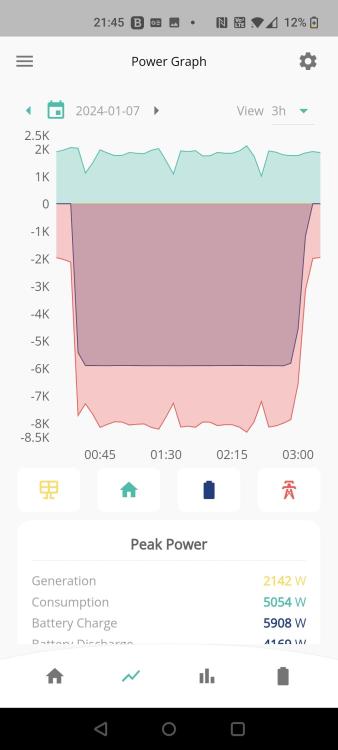
The colours are Green, power going to the house, running MVHR, heat pump etc. this is also represented as import electricity in the light red/pink section below the dark red. The way mine works, during off peak, it charges battery and any consumers take electric direct from grid, not the battery. At the end of the off peak period the battery is at 100% charged, then house consumption comes from battery, until departed to 5%, then grid power is taken by the house.
-
And people pay or even think paying that?
-
GivEnergy AIO charging last night - dark red area, charging 6kW.
-
But if the off peak wasn't viable without the battery, you need to compare to full price normal tariff, i.e. 27p, so the saving becomes 18p per kWh. You cannot self install (GivEnergy AIO) without be trained, you cannot commission without access to the commissioning tools. It does add to the cost.
-
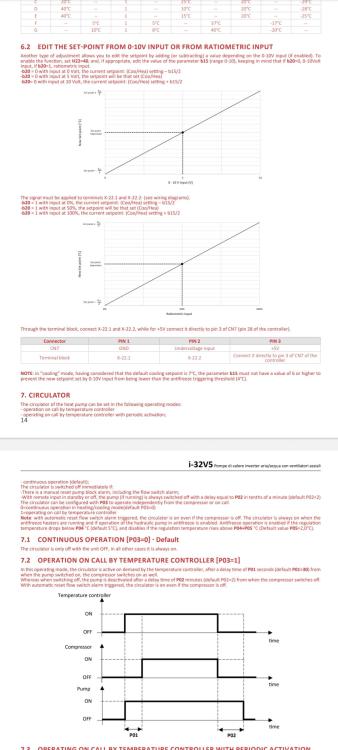
Those at the bottom are graphs referring to operation of circulation pump on-off cycles Just section 6.2 applied, not section 7.
-
Double post
-
Basics are Heat pump will have a defined minimum flow rate. That sized heat pump could be around 25L/min or more. If you are trying to operate without a buffer and you have loops closed, or part closed - then no chance. UFH basics Heat output is linked to the mean flow temperature, the higher the flow rate, the smaller the dT so higher the output. You are stating the opposite? 6 loops will only output only part of the load your heat pump is putting out. Something sounds odd. Can you explain your full system? It is more likely your heat pump is cycling, so not transfering the heat needed. Too big for the duty it's being asked to do.
-
Mine is not warm to touch, but not cold either. Our rooms are around 20 to 21, the floor is only a couple of degrees warmer. Poor insulation (U values) required to get a warm floor.
-
Does your heat pump accept a 0-10v input. An aircon type thermostat can output a 0-10v output, this up to reduce flow temp as required. May not work with UFH due to reaction time, but ok for radiators. This is a screenshot from my manual for a different heat pump
-
Would doubt Brexit had much to do with this subject. You can get ASHP easily enough, you can A2A easily enough also. Suspect as mentioned, grant scheme is the main issue, second Aircon isn't covered under permitted development, so would require planning permission, third, the population away from build hub, wanting Aircon is very limited. Forth the population wanting Aircon and water heating in a single unit is even less of a market. If set on A2A do that, and something like a Dimplex Edel for hot water. Or time of use and direct immersion, some PV would allow most your summer hot water to be free. What are you doing for bathroom heating?
-
There is an ArgoClima agent in London and another in Eire. Their monobloc unit can water fan coils and heat the cylinder via refrigerant. Would say because the BUS grants don't allow you use those type of units, so likely to be small scale sales, so why bother importing? Never heard that before. My UFH has the total of 14 joints all above floor level. So possibly less than a fan coil or radiator system.
-
What extra can he get back that you are not already allowed to claim? Took a couple of day cataloguing my receipts (so cost nothing to claim), but couldn't see any missed opportunities to get vat back. Had nothing rejected either.
-
Why make stuff complex A2W and a few fan coils - done, you don't need to flow much above 32 to 35 so a SCoP of 4.5ish. Or UFH flow 30 or below and better SCoP. You can cool with UFH or fan coils - fan coils are better at cooling, UFH feels better at heating. Keep it simple.
-
Fence Install - do I have a problem?
JohnMo replied to Ferdinand's topic in General Self Build & DIY Discussion
I would just point out that the fencing man, has effectively replaced your fence, at their expense, as it is on your land. Wiggle in a DPC to stop a water bridge, or tell them to get fence man back to fix issue, as it will lead to a damp problem for you and them in the near future. Say thanks for the new fence -
Grant will now work with Homely, they also list smart control also, but sure if it's the same thing. What do you mean by advanced WC? UFH or radiators?
-
Now what do you define as smarter? New build or modify existing?




