


JohnMo
-
Posts
13308 -
Joined
-
Last visited
-
Days Won
200
Everything posted by JohnMo
-
Get another quote, the guy obviously prices as he doesn't want the work. Speak with octopus or other utilities provider they all install heat pumps under MCS.
-
I will jump in on the ventilation issues. You currently have from the sounds of it, an intermittent high flow fan in the bathroom, you shower or bathe and ensure the door remains closed until the fan stops. You have trickle vents in the windows. Plus you run a dehumidifier. First have I missed anything? What other wet rooms (kitchen, utility, toilet, shower rooms etc) do you have and how are they ventilated? What temperature do you keep you house at? Trickle vent as useless on their own at ventilation. Intermittent fans are great at short term moisture clearance issue, but do not really provide a sound ventilation strategy for the whole house. For this you need a continuous supply of fresh air, ideally controlled so you ventilate as much or little as required. It works but continually blows cold air from the loft or outside or heats it via an electric heater element. Not an ideal solution. Cross ventilation has been shown to work well. For this you need continuous running extract either a central unit (MEV) or room dMEV fans in wet rooms and trickle vent in dry room (bedrooms, living etc). Plus door undercuts so air is free to move when doors are closed. Add to this humidity sensing trickle vents and humidity boosting on the fan. Greenwood CV2GIP dMEV fans are excellent, silent in operation automatically boost on humidity require 2-4W electricity. In addition to the above the house needs to warmer than the air it pulls in from the outside.
-
 Simple flow chart to diagnose issue. When was the last service completed? You need to know what you are doing with UVC get a certified (G3) person in to sort it out.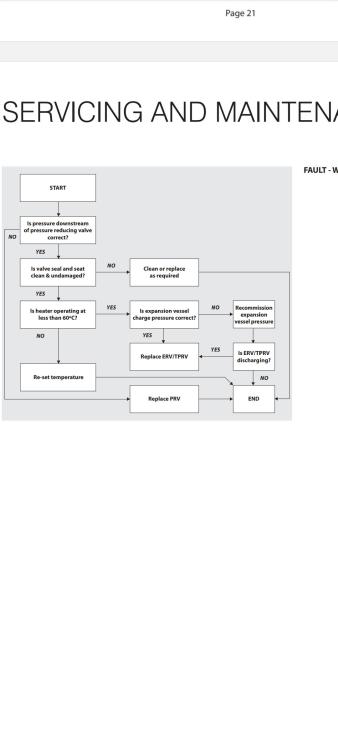
-
Plus even with 100mm insulation you will still be loosing plenty of heat downwards.
-
That's a very good point. May be better buying different lengths than 100m or planning the loop layout, so you get to get 3x100m loops. One of my loops does half the hall, main shower room and kitchen diner. Then you only need to 3 port manifold.
-
Do I need to plasterboard the lofts
JohnMo replied to Chanmenie's topic in General Construction Issues
I didn't and building control weren't fussed. -
Dump the hard wired thermostat and get a wireless one, so you move to best position once you get the system commissioned. Use a 0.1 Deg hysterisis thermostat, like a Computherm Q20RF (from Amazon). Thick floors take many hours to respond. A normal 0.3-0.5 Deg hysterisis leads to big temperature swings. No need for a floor probe, adds nothing if your flowing low temps. If you are going to use a mixer get a good one either IVAR (low temp one) or ESBE electronic. What do you need the isolation valve for? Just switch the pump on/off via the thermostat. The flow is pulled through the mixer, once pump stops so does flow into the floor.
-
Why does this male brass bush leak?
JohnMo replied to Joshua Graham's topic in General Self Build & DIY Discussion
PTFE and screwed connectors have been the biggest area of rework on my house. Have now dumped using PTFE completely and now use Loctite 55 sealing cord. Easy to use seals first time, every time I have used it. -
Woodcrete ICF, used exterior quality tile cement and real stone slips direct to the ICF. Photos were taken a couple of years apart.
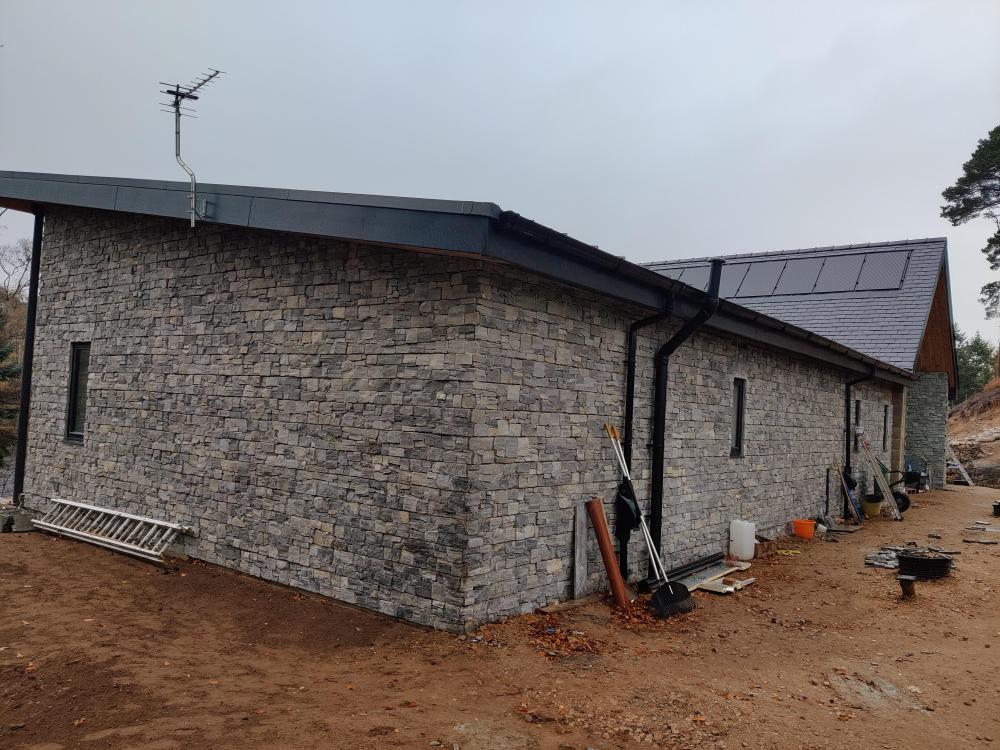
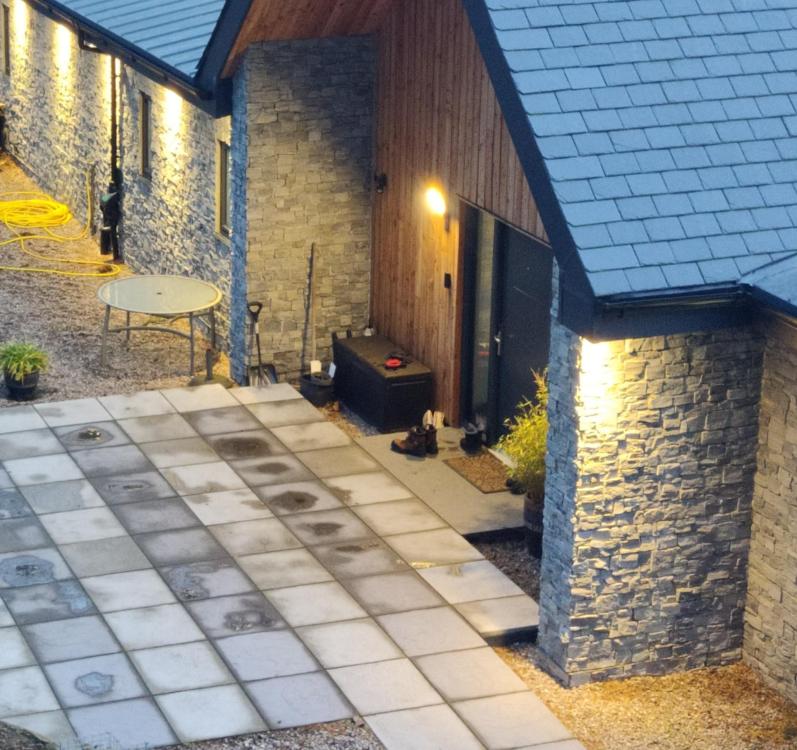
-
Those wins only come if your boiler is short cycling badly in the first place. If it's running reasonable run times currently the saving are not really there.
-
I did my first heat loss calculation on degree days. But it was miles out. The degree days are closer based on 10 instead of 15.5 or 16.5 OAT. That is key step missed by people generally, made way worse by zoning. Winter average temp is somewhere near 7 degs, so around half the heat demand compared to design temp. So short cycling becomes ever present
-
May be written but not true, but it does make export and getting paid reality, instead of hopefully.
-
I found my best efficiency and by the way the lowest running was via charging the floor like a storage heater as a single zone. I could comfortably pour 6 to 8kW into floor via 180L buffer the gas boiler ran continuously for between 6 to 8 hrs. A thermostat was used to switch the heat off at below target, house temp then crept up to target and by an hour or two after bedtime was getting ready to switch on again. Now doing exactly the same with a 6kW heat pump (no buffer), the only wild card with that is defrost extends the run time. It doesn't achieve the best CoP (running mostly at night) but only paying 16p per kWh and flow temp is mostly in 30 to 34 degree range, so isn't really that bad in the grand scheme
-
Immersion thermostat. I found I had to lots of different configurations on the spreadsheet to get anything usable.
-
The calculation should be more like Units × 1.02264 × calorific value ÷ 3.6
-
Where the energy goes Just looking at the operation of my boiler. Boiler demand, a 1 min delay timer starts, I think it does a purge to clear unburned gas. So also doing more cooling and pumping energy to atmosphere. Combustion starts and there is a 30 second delay, to heat the heat exchanger. More energy going no where Then the circulation pump starts and the boiler ramps up. If it then trip after a further minute, most the energy has escaped with flue gas.
-
The condensing is occurring in the flue gas. There is lots of water vapour in the combustion air. You can see a similar example of this in a car exhaust, with water dripping out of the tailpiece when the car is cold.
-
You short cycle when you are adding more heat than can be taken away and absorbed in to the house or a big enough mass of water. My first attempt at running the boiler was direct to UFH with no mixer and 6 zones. The boiler could modulate down to 6kW, against a max house demand of 3.5kW. The cycling was on for about 2 mins, off for 10 mins. Open a boiler and just a metal combustion chamber with heat exchanger(s). Most boilers if the run cycle is too short, have a set period lock out from firing again for 10 mins. That is plenty of time for water and metal temp to drop. So it spends most of its time heating and cooling a slud of water and metal. Bad short cycling will not actually heat the house but use lots of energy. Big difference concerns is the energy price - 7p v 30p per kWh
-
I was regularly getting 110% efficiency against a heat meter with flow temps in 30s. Prior to that with flow temps in the 50s I was in the mid 90s with the same heat meter. What bit do you need explaining - condensing theory?
-
I would agree with that my first quarters gas boiler heating was more than twice the expected. Some mods (huge buffer) later it was as expected. Just short cycling away prior to the mods
-
Reapplied, this time I stuck in the MCS cert I have for the battery install (no MCS for solar install), DNO email for G98 acceptance. Will so what pops out the other end. But computer said yes.
-
Are you sure you have the heating fully switched off? Your making the thermostat call for heat, so its asking the system to switch on, depending how its wired in it may just over-ride. If you don't want it to come on, why make it call for heat, just wind to down to 16 so it doesn't call for heat
-
If you are going for a grant, then the installer is mandated into doing the heat loss calculations. But you can use your measured consumption as a sense check.
-
That's life I am afraid. Just have to factor the cost into the overall costs
-
If that's the case you really should be concentrating on insulation and airtightness. To 'require' that much PV would indicate you barely scrape through min building regs standards.




