JohnMo
-
Posts
13292 -
Joined
-
Last visited
-
Days Won
200
Everything posted by JohnMo
-

Shower enclosure layout choices
JohnMo replied to Super_Paulie's topic in Bathrooms, Ensuites & Wetrooms
You can't choose so ask a bunch of strangers. 1st left is way better than the rest,but I would align everything to to mid line of the large square, so drop the left box to middle line of the larger one. Leave the bottom small box where it is. -
Battery was MCS install, but PV wasn't, so I did the paid Octopus approved scheme for export. They weren't interested in the battery MCS, didn't tick any of the right boxes.
-
I use Predbat so managed battery SoC and import via Cosy and export Agile. Little bit of faff setting up, once done seems to work well.
-
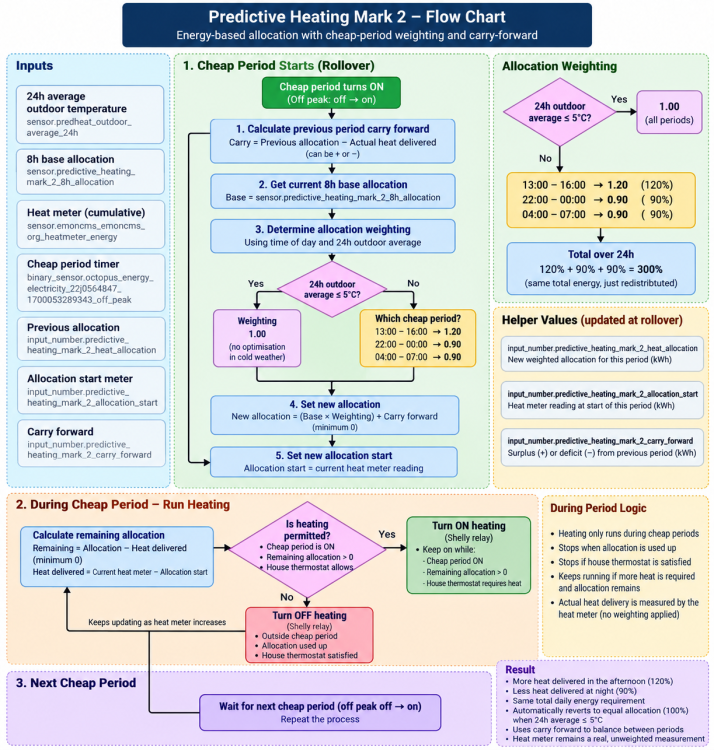
Ours is similar. Find in winter Cosy is generally cheaper, but I have a 13.5kWh battery to lean on. So generally paying currently 13p, was 10.6p last week per kWh. Yep, I just used immersion, leaves ASHP for heating when it suits. All the programming in home assistant is done via template sensors and a couple of automations. Have made another refinement to add more heat during the day and less at night. So 120% of 8h allocation in the day and only 90% to each night slot
-
Triton T80Z Fast Fit Thermostatic Mains Shower
JohnMo replied to John Carroll's topic in Electrics - Kitchen & Bathroom
Has he actually measured that temperature. It a stupidly high temperature, as it strips all the oils from you skin. So are trying to set up something to deliberately scold people? Why would you want a shower at 50 degs output? -
Talking through setting up heating with wife's friend earlier in the week. 4 bedroom 70s house, only have the lounge radiator on flow 75 degs. Set for a couple hours or in the morning and same at night, they are there all day. Boiler just short cycles as it can't get the heat away. Only two radiators engaged. Got them to open most the TRVs to give boiler something to work against, heating on all day and said to keep reducing flow once per day until house doesn't heat up - then add a bit of heat they have a combi. They had typical cold feet syndrome typical of radiators running stupidly high temperatures. Most stupid thing, room sealed modern boiler and their plumbers said they need a vent through the wall because they had a boiler.
-
When you look at the numbers, if you aren't getting the wood for free why would you bother. But then again most boiler heating systems are set up so badly, they burn through gas at way higher rate than they should. So instead of learning how to set them up people buy a lot burner
-
For me if doubt about anything get a HETAS installer out. Make sure the advice,from forums matches the country you live in, English and Scottish rules are similar, but generally different.
-
Yep, 60mm wouldn't bother, get a pretty radiator.
-
Discount Offers of the Week
JohnMo replied to Ferdinand's topic in General Self Build & DIY Discussion
It's just the type of driver in the head. Cars are full of Torx screw and bolts That's where I ended up on our build once I had brought those, I realised how crap most others were. -
Way to many variable, we can light ours it will run at min burn on one or two logs for several hours. We would get through one bulk bag a year at most. So depends on is this your prime heating method, heat loss , where you live - is ab12 referring to Aberdeen (shire) etc etc... We are AB32 but well insulated
-
Plaster-in valves
JohnMo replied to jayc89's topic in Mechanical Ventilation with Heat Recovery (MVHR)
Give a month you will never look again -
Plaster-in valves
JohnMo replied to jayc89's topic in Mechanical Ventilation with Heat Recovery (MVHR)
It does look pretty - but who goes around looking at their ceiling, just looked up from the computer and realised I hadn't seen any of the MVHR terminals since my last service, where I replace the cone the filters in all extract points - can you do that with plaster in valves? -
Raft disaster! Help, advice and likely copious amounts of Gin needed!
JohnMo replied to lizzieuk1's topic in Foundations
Well corrected😸 -
Raft disaster! Help, advice and likely copious amounts of Gin needed!
JohnMo replied to lizzieuk1's topic in Foundations
But only the steelwork and concrete are structural - the insulation is just that, insulation. It does provide support to the wet concrete while it cures so is just form work that remains in place. It an insulated slab at the end of the day. -
Raft disaster! Help, advice and likely copious amounts of Gin needed!
JohnMo replied to lizzieuk1's topic in Foundations
I would look to make your own bits. As mentioned above once you get your head clear of the initial panic, suitable grades is eps and xps and some bracing and away you go. -
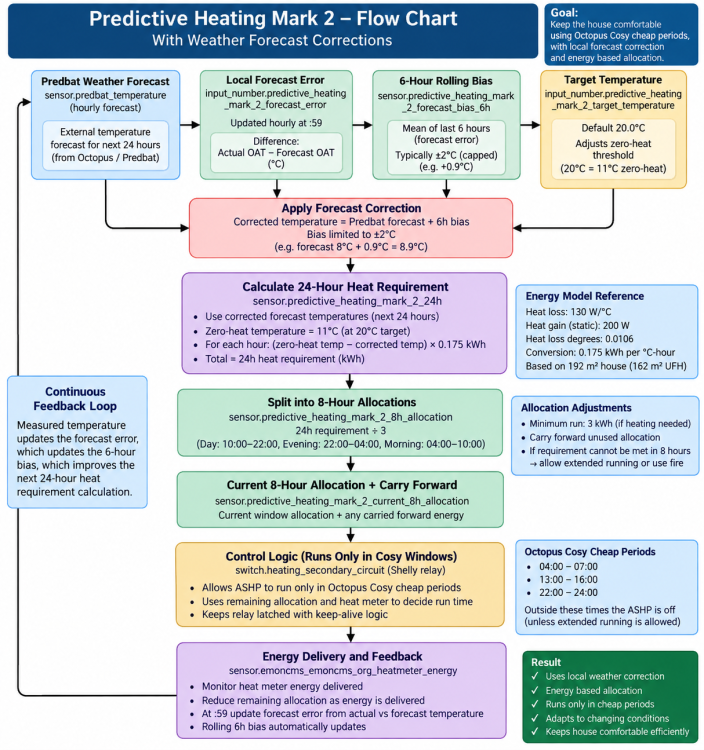
Building on the above. So we built a correction mechanism and this feeds into the start of the process to hopefully limit getting miss calculations of heat input data. We also added an adjustable internal target temperature to some variation in house temperature if needed.
-
Yes pretty normal, we don't make much condensation in summer. It's warm or warm damp air in winter from house being cooled across the heat exchanger, releasing water which goes to drain.
-
Grid flex rhymes with derivatives trading: an observation
JohnMo replied to DamonHD's topic in Boffin's Corner
But people still think ASHP cost more to run than an ASHP and solar is ugly and would never have them. -
Grid flex rhymes with derivatives trading: an observation
JohnMo replied to DamonHD's topic in Boffin's Corner
But will the general population be interested or bother. Example - I am currently on a ToU tariff for import and export and moving our heating to be on during low tariff (low demand) periods as much as possible and have batteries to move the electric usage during cold spells back to the low demand periods. But it takes effort and not all houses are suitable - as they leak heat like a seize. Daughter is just on bog standard rate tariff and is very unlikely to move - too much effort. But I find it interesting watching Agile export rates and how periods of excess grid energy pay almost negative rates for export, while other times of short supply they will pay more than import rates. Then you have Axle that pay you a £1 per kWh again when power isn't readily available. It's worth the effort - compared to last September, our energy bill is on track to 80% lower this year. Just need more people to understand the financial benefits and the environment benefits also come as a direct consequence of the changes -
About 14m at a guess. Mine are fully insulated but most are outside and or underground, I also do cooling. Pipes come through the wall. And are insulated in the house (1.5m long)
-
Depends really if it's communication is just with inside it doesn't make much difference it you need it to talk outside you may have difficulty.
-
Its not easy, if the outside temperature trending has shown to be utter rubbish - weather station being 40 miles away doesn't help, so getting AI to build a compensation system look forward and backwards on an hourly basis. But its all fun for the mind
-
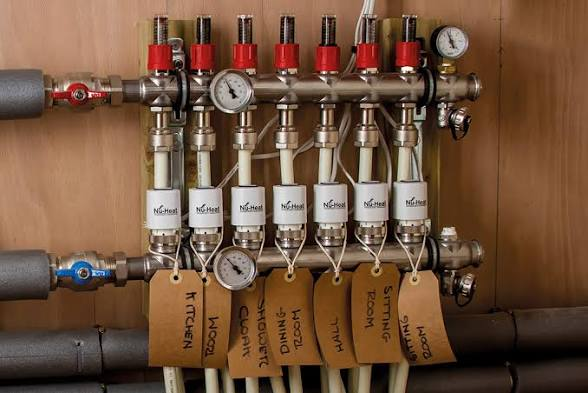
UFH loops connect to manifold. Heat source connects to end ports on UFH manifold. Heat source feeds in and is returned by the pipes on the left, loops are the pipes in the vertical. You can do UFH loops first and connect to manifold. Then once you have the ASHP run the pipes from it. Or you do everything together once UFH is in position, it's pretty flexible how you do it.
-
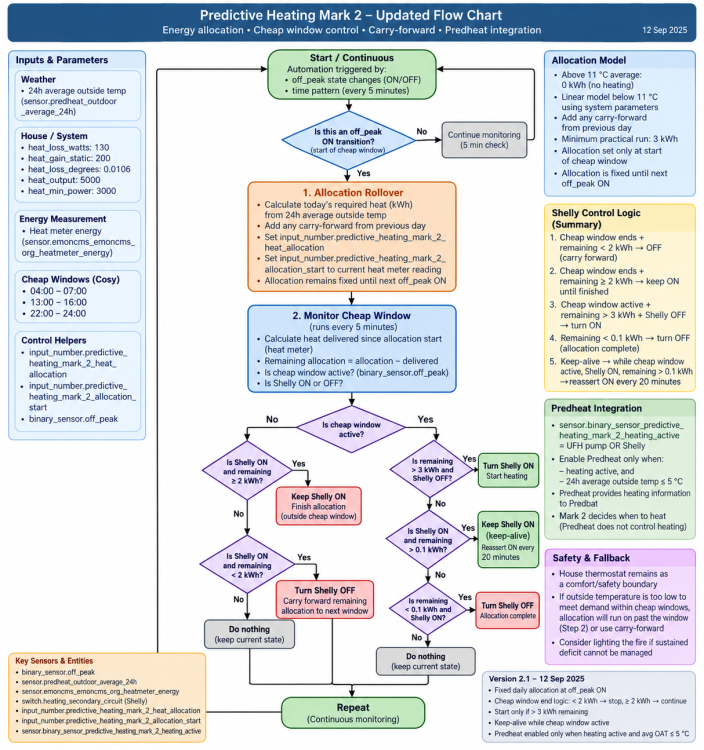
This has been a thing I have worked on and off for a while, but never really got to a model I liked. Had a play with AI and a few iterations later fell on to an energy based system similar to @TerryE but implementing is slightly different. I have an ASHP and heat meter, so came up with a closed loop system. It establishes a rolling energy target for next 24 hours and splits in to 3 chunks, we try to deplete the 8 hours worth of energy in a the Cosy cheap rate window. Down to about 5 degs we should be able to. Below that we allow an over run in to running from battery. We also have a carry over to next cheap slot. If below 2kWh we allow it move to the next slot, if above 2kWh we extend the run time to deplete to 0.1kWh. A flow chart is attached. If this is fails, we loose internet etc or we have issues.in general, a thermostat comes into play and we run on WC. As long as we stay with Octopus the automation stays true, as it's run via the octopus integration in home assistant and we use the cheap rate trigger to define the cheap windows.