


JohnMo
-
Posts
13296 -
Joined
-
Last visited
-
Days Won
200
Everything posted by JohnMo
-
When I first signed up they had all those details on the website, believe they are based in Wales Asked AI UK-based Wonder Watt (the smart charging app) The company appears to operate as a small startup based in South Wales, founded by an experienced software developer (Wim) and a solar systems engineer (James) deegesolar.co.uk . There's no publicly available corporate or company registration details (e.g., Companies House number or legal address) associated with the UK version of Wonder Watt. On Trustpilot, they list a UK contact email: [email protected] , and confirm being a “Software Company” based in the United Kingdom Trustpilot Trustpilot . Conclusion: It’s likely a UK-based private entity, but it does not publicly disclose a registered company address or name on its website or Trustpilot profile.
-
But if a long read, have shortened where I can. Been having a chat with ChatGTP this is what it said: My question. Battery charging and export Costs 12.8p per kWh during cheap rate tariff on Cosy 3x periods per day Get 15p for all export, what is the best strategy for charging and export? I can use WonderWatt for predictive charge based on solar forecast if that helps. House runs a heat pump heating demand at -9 outside is 3.8kW. house base load is 14kW, but cooling can be on when it's sunny or warmer than an average of 15 degs outside ChatGPT said: To optimize energy usage, I’ll suggest charging the battery during cheap periods (12.8p) and exporting during higher-rate times (15p), factoring in round-trip efficiency (90-94%) and battery degradation. Using the 13.4 kWh battery and assuming a baseload of 14 kWh, I'll focus on scheduling to avoid low-price exports. To compute the breakeven for export arbitrage, we look at the cost of exporting after accounting for round-trip efficiency. At 90% efficiency, the marginal profit is quite small (0.78p), and with battery degradation costs, it becomes negative. So, arbitrage isn’t worth it. Best to use the battery for home load and heating. We can optimize the battery by charging it to cover expected non-cheap consumption until the next cheap period, using solar forecasts for predictions. In summer, charge for evening use, while in winter, focus on covering evening peaks. For cooling, pre-cool during cheap periods. The scheduling strategy will help manage this. Done Short answer: don’t “charge-to-export.” Use the battery to cover your own load and heat/cool at the cheapest/easiest times, and only export true surplus. Here’s the why + a concrete playbook for Cosy + 15p export: 1) Arbitrage check (import cheap → export at 15p) Cheap import: 12.8p/kWh Typical round-trip efficiency (η): ~0.9–0.95 Effective cost to create 1 kWh for export = 12.8p / η = 13.5–14.2p Gross margin vs 15p export = 0.8–1.5p/kWh, before battery wear. → Once you include degradation (a few p/kWh), arbitrage is a net loser. So do not cycle the battery purely to export. 2) Self-consume vs export (for solar) Rule of thumb: store PV if your import price you’d avoid later (p_import) is greater than 15p / η. With η≈0.9 → threshold ≈ 16.7p. Most daytime/evening import is above that, so storing PV beats exporting 9 days out of 10. 3) Daily operating strategy Charge in all Cosy cheap windows to a target SoC that covers expected demand until the next cheap window minus expected PV during that span. Target SoC after a cheap slot: SoC_target = (Forecasted load until next cheap slot – Forecasted PV usable) / η Disable/avoid ‘export from battery’. Only export when the battery is full and PV is still pushing (true surplus). Pre-run thermal loads when it’s cheap/sunny: Heating (cold spells): Pre-heat slab during cheap windows; let the slab bridge the expensive hours. Your 100 mm slab helps buffer nicely. Cooling (sunny/≥15 °C avg): Pre-cool during cheap windows and daytime solar so the evening load is minimal. WonderWatt: Use its predictive charge to set SoC targets per slot: Feed it your PV forecast, house baseload and scheduled HP use (pre-heat/cool blocks). Tell it not to backfill charges outside Cosy windows. Export priority: Summer: Battery fills on PV → serve house + cooling first → export only when full. Shoulder/winter: Fill in cheap windows; reserve battery to cover evening/overnight peaks; export only if you genuinely can’t use/store it. The conversation went back and forth getting the assumptions correct etc End recommendations are let’s nail this down so you’ve only got two things to manage in WonderWatt: Baseload (summer vs winter entry in kWh/day) A single set of min-SoC targets that work year-round. 1. Baseload values for WonderWatt Summer (little or no heating): Your true house demand is ≈14 kWh/day (≈0.58 kW average). → Enter 14 kWh/day as the baseload in WonderWatt. Winter (continuous ASHP heating): At the coldest, your house may need ≈32 kWh/day for ASHP. Add the 14 kWh/day base → ≈46 kWh/day total. → Enter 46 kWh/day as the baseload in WonderWatt. This way, in winter, WonderWatt is “fooled” into charging more aggressively during cheap windows, without you having to micromanage presets. In summer, it leaves headroom for solar. 2. Universal min-SoC targets (work for both summer & winter) Since WonderWatt will top up if solar looks poor (and supply loads from grid while charging), you just need guardrails so you don’t run flat. Based on your battery size 13.4 kWh usable: End of 04:00–07:00 slot: 40% SoC → ~5.4 kWh End of 13:00–16:00 slot: 40% SoC → ~5.4 kWh End of 22:00–00:00 slot: 30% SoC → ~4.0 kWh These are conservative enough to prevent a blackout in winter (since WonderWatt will over-supply if needed because of the higher “baseload” entry), but not so high that you block summer solar. 3. How to use it day-to-day Summer: Baseload = 14 kWh/day Min SoC = 40/40/30 % → Battery charges just enough to cover overnight + poor solar days, but leaves headroom for PV exports. Winter: Baseload = 46 kWh/day Min SoC = 40/40/30 % → WonderWatt interprets the higher baseload as extra demand, so it fills the battery harder in cheap slots. On really cold days, you’ll still want to run the ASHP directly during cheap windows (slab preheat). This gives you: Only one SoC preset to paste in WonderWatt, Just flip the baseload entry (14 ↔ 46 kWh/day) when seasons change.
-

What's the case for not getting an ASHP?
JohnMo replied to kentar's topic in Air Source Heat Pumps (ASHP)
Add the two statements together you have your answer. There isn't enough use of the grey matter going on. If they can't get it from the local plumbers merchants - not much chance it will happen. -
This what you need, https://amzn.eu/d/21zDWZQ
-
I do have a slight anomaly in that I can generate more than I can export, on a good day I can generate at a rate near to 6kW, but the system will only export 3.6kW. So charging fully in summer may not yield the best. My thoughts are to continue with solar forecast battery charge, to allow self use as much as possible and excess PV export. But change the settings in the immersion diverter to only start immersion if battery is at above 99% charged AND I am generating more than 4-5kW (need to calculate setting). The likelihood ASHP will be ticking away doing cooling anyway and background house hold demands take car of the rest. If I am generating less than 4-5kW keep immersion off. The other option is to simply set an export window (afternoon say) and export everything when battery is above say 70% (again need to calculate this figure) if I am generating 5kW, 3.6 will be exported the rest will go into battery. Think I prefer this option now I have written it down.
-
Welcome. Think your installer is talking sense. First alarm bells So you are not letting it run and find it's feet. Stopping the heat pump makes it run when restarted a little strange. Firstly it trying to get itself back to target flow temperature, for this it monitors return temperature and delta between flow and return. All these are managed by the controller. So it you have a decent sized buffer and healthy demand on fan coils it never really catches up. The other alarm bell Most fan coils have a design temp of 7 degs that's how they are sized. To run warmer temperatures in cooling mode that need to be big and sized to suit a higher flow temperature. As you only have two to cool or heat the whole house I doubt they would be as big as needed. Once up and running in steady state conditions the heat pumps will modulate to suit the demand. Just because it's rated at xkW doesn't mean it spits out that all the time. Mine kicks out 6kW and over the last 48 hrs has consumed just over 3kW including DHW, because it has no demand, cooler weather and no solar gain. Are you monitoring with a heat meter or something else? Hope this helps
-
Now have export approved, took a while, but got there in the end. Staying on Cosy, difference between import and export payments is marginally with inverter losses. Just had a look at what actually slipped into export and when into diverter to immersion and it sitting at close to 100kWh, and August weather hasn't been that good for solar. So now to figure out Do I charge battery to 100% every cheap period and just let everything export. Fit and forget, same strategy summer/winter leave battery software to look after everything. Continue to self consume most and let some slip into the grid. Certainly don't need to charge based on forecast, so a nominal fixed %. But likely need to faff about between seasons setting different use patterns etc. Writing sounds like a faff. Or something in between?
-
Our living room is oak floor over UFH, it also has a huge rug (not thick and wooly), no issues.
-
What's the case for not getting an ASHP?
JohnMo replied to kentar's topic in Air Source Heat Pumps (ASHP)
That is doable, but I wouldn't, I would be worried about noise/vibration coming though, plus they look ugly on a wall and not easy to access. My heat pump is over 20m from the cylinder its still very efficient during DHW. Why would you need that size cylinder. You size the cylinder for the number of bedroom. So 3 bed needs a 210 to 250L, if your a heavy user you could up that to 300L. A 6kW heat pump takes 45 mins to reheat the cylinder. I schedule mine twice per day, some days (today) it hasn't needed to heat, but will reheat later. A gas boiler is about 85% efficient, so it cost about 6p per kWh plus about 15% for the efficiency losses. You also have a standing charge to pay. Main thing with poor performing ASHP installs, is generally the home owner wanting to use the ASHP the same as a gas boiler. Use it running all the time slowly adding heat to the house. -
Fibre glass or other materials are much and such the same thermally. Some better than others. You can get recycled plastic bottle insulation it's not itchy but a little more expensive. B&Q sell it, other places also. Depth 300 to 400mm. But remember keep the eaves vent spaces free.
-
MVHR plan questions
JohnMo replied to oliviaaa999's topic in Mechanical Ventilation with Heat Recovery (MVHR)
Unless your house is pretty airtight you have uncontrolled ventilation anyway, this heat loss will always be there, you cannot control it. Add controlled ventilation over and above that, you start to add to any ventilation heat losses. MVHR is really designed to make airtight houses healthy to live in, with the added benefit of recovering much of the heat test would otherwise be lost. But it isn't a cheap option. Saving made in a not airtight house house are so small you will never see a return on your money, and the uncontrolled ventilation is still there as well. dMEV is pretty simple to install cheap to run, and if you implement humidity controlled trickle vents your additional heat loss is pretty small. Don't bank on MVHR doing much cooling at night air flow rates are way too small, it's just ventilation removing humidity and replacing with fresh air, all ventilation systems are the same if done correctly, MVHR is just mandatory for airtight houses, because it extracts and supplies air at the same time. (The heat recovery bit isn't mandatory, but balanced supply and extract is). -
Isn't that what I inferred, our lounge has heat loss and solar gain way out of proportion to the rest of the house. Ours house doesn't have a very even heat loss or heat gain. Most is nearly south facing with plenty of glass which is mostly in the lounge. Back of house gets best part of zero sun. As the OP pointed out, once the room is getting solar gain, switching the heating off make no difference, you just cause other issues later and just end up chasing getting the floor again, and while it does, room temperature drops or the heat pump has to run harder. Leave warm water flowing through the floor, as the solar gain diminishes floor just picks up heating again. UFH and room influence, maybe not, true for radiators, but that isn't the discussion here. A decent new build will be flowing sub 32 in any outside temperature, (depending on screed depth) floor surface temps a couple of degrees above room temperature at design condition. Floor itself does the room influence work it doesn't need additional tools to do it. That is very true, but also spend countless hours on here, to assist others from making the same mistakes I did. But the summary of the tinkering is Remove unnecessary items from the system. Ensure I have a suitable water volume to give good run times, so minimum 30L per min kW output of heat source. Train my brain, that simple is actually best, in most circumstances Start with the simple system, no bells or whistles, a simple system that can monitor room temperature to aid commissioning. Only if needed start to add complication, not the converse as I did.
-
But this conversation is about a new build, not a retrofit. All the preplanning I did was design the UFH with loopcad to get a close balance of temperature out the box. Nothing magic there. Followed the rules installed thermostats, tried room compensation. Had a mixer and pump on UFH manifold. The more I stripped away, the lower my gas bills became and the more stable the house temperature became. Doing it again, I would leave all the gunk removed, in the shop and the money in the bank. KISS. So like the OP of this thread. That is definitely not true, our lounge is one wall all glass 6m tall. It's heat demand trumps the rest of the house. Not the first to take the approach of a fully open system and leaving the controller to manage what going on. Isn't that a heat geek mantra. It's been done for years, I chose my Atag boiler because it was capable of it, as running pretty similar to a heat pump with similar dT etc. Certainly not trying make something less clear and harder to understand, especially intentionally. You just don't like my view point, which fine. As title of the thread says simple UFH. 1. Step one design loops to match room heat loss, OP is on that. Etc.. all said above. No point repeating it.
-
Engineered wood floor over PIR upstand (thermal bridging and strength)
JohnMo replied to paro's topic in Floor Structures
You could live with the foam strip as your door frame will be an insulator anyway, in effect no thermal bridge. But is your drawing correct, the frame looks to be below floor level, if you want it all level wouldn't you get a level threshold frame? Would you door actually open and close correctly as drawn? -
Short answer is no. Longer answer is the weld should penetrate both materials. The weld you are focussing is basically sitting on the base material, so offers zero strength. Look at the other weld near the bolt, looks about 50mm long, that is what the full seam weld should look like. It needs to ground out and the weld be done correctly with a correct sized welder and filler material.
-
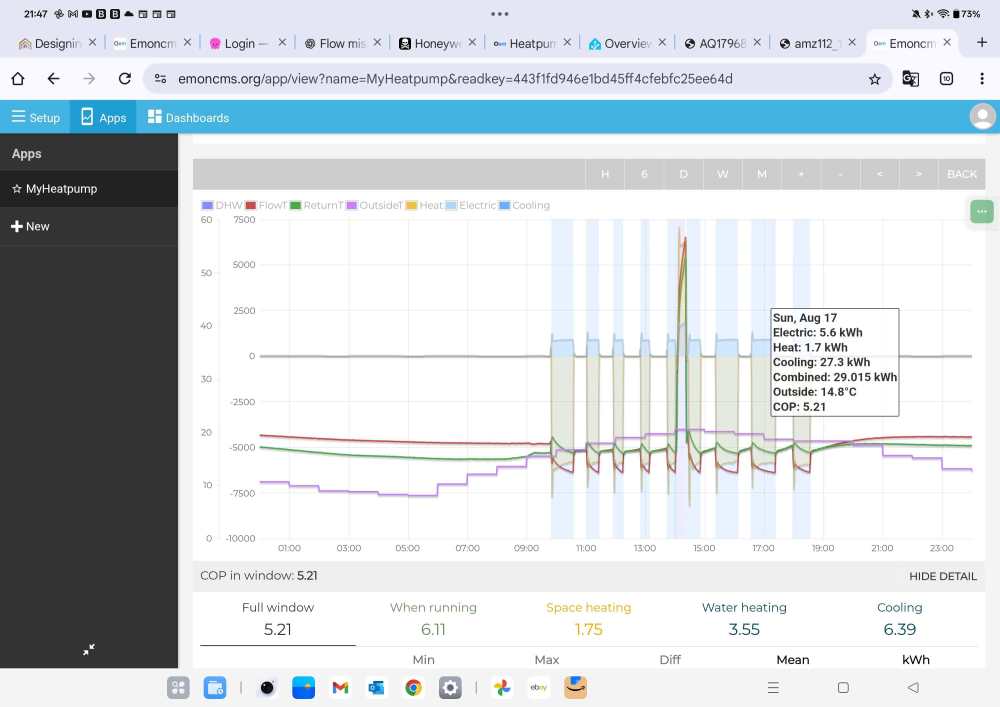
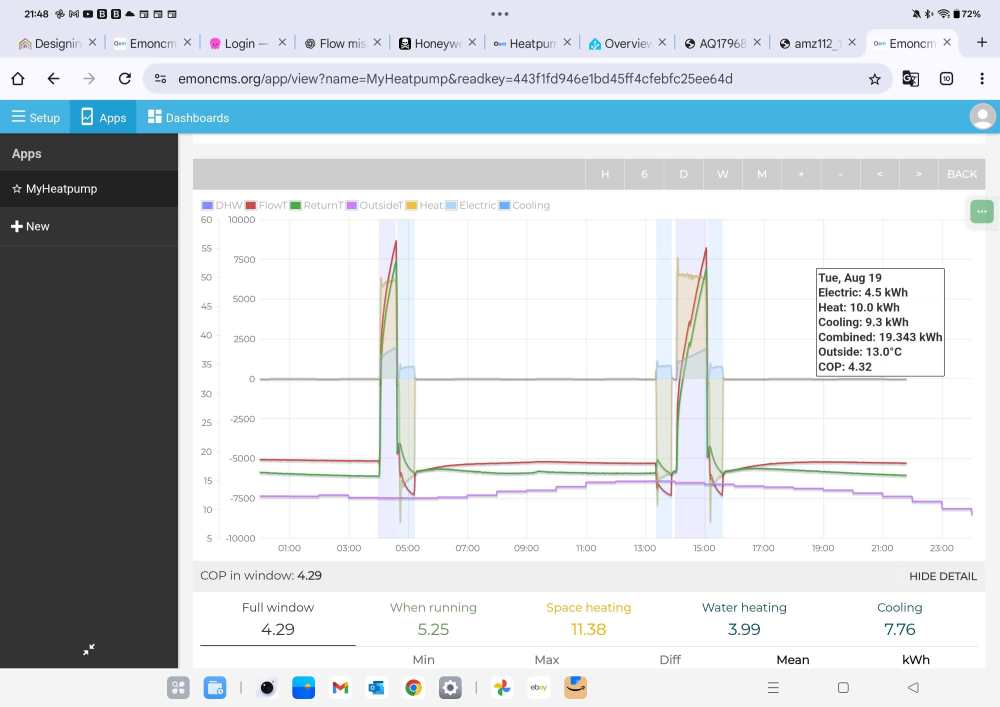
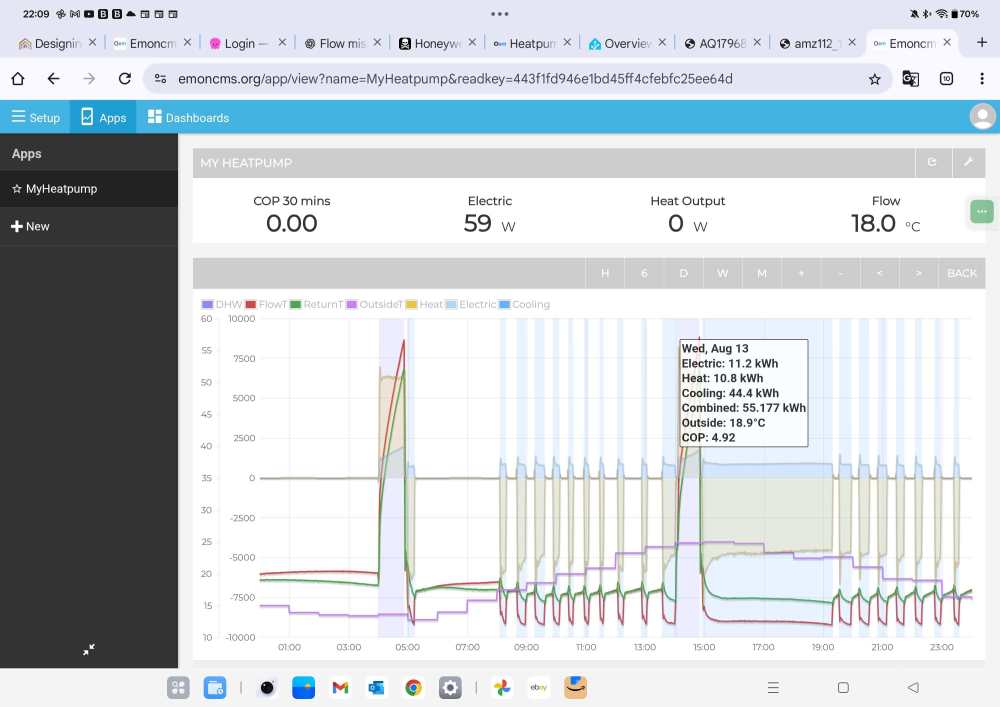
Certainly not what I have experienced. Isn't WC always a calling for heat or cooling? Isn't that whole point its always ticking away adding/removing heat as required. In heating if target flow temp is 26 and dT reduces as a result of higher return temp, the flow temp will increase but only if heat pump cannot modulate down to to manage target flow temp, if it cannot modulate further downwards flow temp does increase, but is limited by compressor shut off hysteresis, so may increase up to to about 0.5 Deg or less and then the compressor cycles off. The only way the ASHP doesn't modulate to min output and the then shutoff, is if you running an algorithm that drives the heat pump count deg minutes, which allows a fair degree of temp overshoot. Running basic WC doesn't do that, and can rely on return temp feedback without additional controls Sorry it doesn't. Two different days this week, doing cooling but the same rules apply as for heating. First shot a couple of days ago, pretty sunny all day - big spike is DHW heating - does 27kWh of cooling Second today, very little sun does 9kWh of cooling There is no control other than what the heat pump senses, nothing in the house except UFH pipes. A week or so ago, plenty sun and heat, does 44kWh of cooling
-
Really the simplest and most pragmatic is - fully open system with room by room monitoring via a good UFH controller. Then if you have issues it relatively easy to plug in an actuator or two. It also assists with system balance, setting up WC and general history of what happens on different days. If you get one with an outside sensor it will also record outside temp, various room temps, so you can overlay the information. Only thing with Stiebel Eltron, you need a second mortgage to buy one, they demand a buffer, so you end up with at least one, possibly multiple additional pumps. All affect real CoP achieved and most are powered from a different power supply, so don't get added to the real CoP advised. But when you delete buffers, the heat pump sees this reduced heat load, without any outside assistance, by a changes in return temp, so it modulates naturally to maintain its defined target dT. Even flowing a fixed temp in cooling, the heat pump senses when it needs to do more work or less, purely from return temp, so output and cycle times change to reflect that. Nothing magic is needed, in fact adding stuff kills this self modulation. Cooler rainy day today heat pump has only fired up once ran for 32 mins, then sat idle except for DHW. No input from anything external. Radiators? UFH is the discussion and TRV don't work on UFH the time to heat or cool is just way to long Exactly
-
We are in Scotland and have no roof battens, the slates just attach to the sarking boards. So couldn't follow the gse instructions, as it assumed battens. I just attached the trays to sarking boards (and with breather membrane between). The gse trays have flashing panels that extend under the slates. So with zinc standing seam, wouldn't you just do the gse trays and flashing the same way and overlay the zinc? Or do away with zinc and cover whole roof in solar
-
Think people get carried away stuff like solar and can spend an arm and leg on the stuff. I have GSE and normal panels, but on a slate roof. Good thing with integrated is you aren't paying for slates or standing seam in your case which can be way more expensive. My cheapest install was on a pergola roof. But big panels are cheaper than fence panels and make a good fence. Pretty easy to mount, easy to replace, easy to DIY. 12m of fence is around 5kWp of bifacial panels. About £2k in materials with a string inverter and isolation switches. A new build you can claim the vat back.
-
Just bought a couple of 500W panels and they were £67 incl of VAT each. It's pretty much irrelevant how they are fixed, the price per kW is currently £134. You are spending £9500 to have them installed. If you self consume all electric produced that's the equivalent of 50 MWh of energy you need to produce to break even. If you are selling at £0.15 per kWh you need to produce 83 MWh. You may as well not bother. Just buy a battery and make use of a cheap rate tariff.
-
Have you got a fence to use, or a flat area of garden to use for ground mount solar? £1200 of panels (or £1k less vat) and around £9.5k to install! Billy bargain - not
-
Just completed some analysis. Both days below are for cooling. June on a similar temperature and amount of sun, I achieved a daily CoP 3.29 (average over 24 hrs) with one DHW heating cycle. For clarity, no volumiser and circulation pump running 24/7. Yesterday, again with one DHW heating cycle, we are at a daily CoP of 5.21. same flow temperature in both cases, same outside temperature. The only changes are, circulation pump switches off 3 mins after compressor stops, deleting ball valve strainer, then adding 50L volumiser and proper heating filter. Small changes big impact on CoP. Circulation pump operating mode was changed last month and made the biggest positive impact. Compressor cycle time has increased and over the day the number of cycles halved. I am seeing a lower dT, seeing 3.6 from a previous 4.7, due to the extra flow rate. This also results in a lower mean flow temperature. For clarity 5.21 is the best CoP ever recorded by me, over a 24 hrs period, no matter what the temperature outside or amount of solar gain I get. So in electric terms Delivered heat 29kWh CoP 3.29 8.8kWh electric used CoP 5.21 5.5kWh. Cost CoP £2.20 a day CoP £1.37 a day So a saving of 83p a day In reality those saving are in standard rate electric, so are way lower on a time of use tariff and with PV providing most the electricity. But it's good not to wasting electricity. Costs to make the mods Circulation pump running was just a setting change - zero cost ESBE valve and actuator I already had in my cupboard. Volumiser (Alpha FlowSmart 50 repurposed) again I had this. Filter was used on gas boiler know decommissioned. All the pipe and fittings I had. Needed to buy a 10 pack of olives, which were a couple of pounds. So £2 to nearly half my electric consumption.
-
Heat pump grant. How do you apply?
JohnMo replied to flanagaj's topic in Air Source Heat Pumps (ASHP)
That's not how the scheme works, anything you buy just will not count towards the grant money. Even the umbrella scheme you get everything from them. Been a Vaillant 5kW heat pump on eBay for a while £1k, add a cylinder £1k. You have most of what you will get from the grant for £2k. -
Heat pump grant. How do you apply?
JohnMo replied to flanagaj's topic in Air Source Heat Pumps (ASHP)
Unless you are in Scotland and the system is completely different after reading up on. The home owner actually gets the money, to make the contractors competitive. -
Most heat pumps will do this as a second set point, would normally allow you to run radiators and UFH at different temps and a mixing valve in between. You harness this part of the system via a zero volt contact. This can via a smart relay if you must or a simple time switch. So it works by adding temperature to normal weather compensation curve. In practice with UFH, the heat added during an off peak window, will make the heat pump shut down for many hours to carry you through a high tariff period.




