


Olf
-
Posts
315 -
Joined
-
Last visited
Everything posted by Olf
-
No, this would actually make it worse, because... ... condensation forms when the air temperature drops below dew point. The higher the moisture content (relative humidity), the higher the dew point, the earlier (at higher surface temperature) condensation will occur. And the warmer the air, the more moisture it can hold. So what you have is high humidity in the bathroom (too much steam generation or poor extraction) or poor window insulation (that includes how it is mounted - my 'FENSA' installers only used mastic to hide the gaps (poorly as well) to close the gaps, there was a cavity at external temperature with cold draught from between the window frame and windowsill) - or both Invest in £10 hygrometer to get some idea of local relative humidity and temperature to start with
-
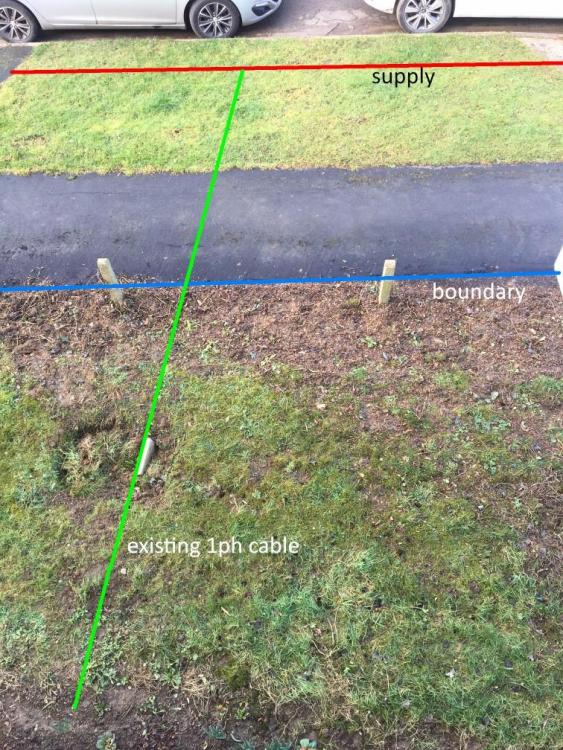
Hmmm I though I was being ripped off, but it seems that they do charge electrician rates for digging jobs. SSE: 3m Unmade £107.04 1m Footpath £195.58 1x Joint Hole STRAIGHT JOINT - Unmade (1.2*1.2) £360.55 The actual electrical stuff Additional 1 Phase Services Without Service Jt (South) £158.63 Service Joint Only -100A 1 Phase off Main (South) £259.95 LV Pot End £143.84 This is for 1 phase to 3 phase upgrade, I dig and prepare everything on my side.
-
@Temp - the photo you attached is what I need - many thanks! The benching and manhole wall repair is little in comparison with building a whole new manhole. I'll let it the groundworks folks to sort out, but I need to know the right way, rather than let them running loose with some botched idea that makes their life easy, and mine hard afterwards.
-
Choosing MVHR - energy consumption angle
Olf replied to Olf's topic in Mechanical Ventilation with Heat Recovery (MVHR)
As above, you might find it that in the summer open window ventilation works better - especially on hot high humidity days MVHR will boost for nothing. At the end of the day what you what is to have fresh air with reduced heat loss, whatever the method. In the summer heat loss is no issue (unless running aircon, loss in the other direction) so if there are no other considerations (noise, smells, safety etc) open windows is perfectly fine Condensation forms when the temperature of a surface (any, but windows have the greatest chance due to relatively poor insulation properties) falls below dew point. That's it. So with some fantastically insulating windows you may end up with no condensation, even if the air inside is 'stale'. -
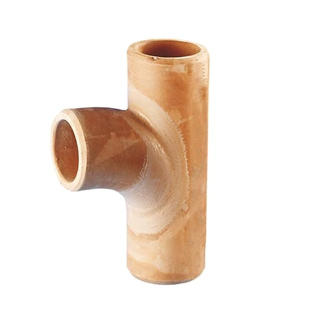
The level is not a problem. But it creates a new issue: do I have to replace the last stretch of my sewer with a 90 degree junction ('square junction') to accomodate the new pipe? If yes, would it have to be open (meaning enlarged/new manhole) or could I get away with something like And how do I marry up existing clay with modern plastic pipes? Application lodged, money taken, waiting for any response. But thank you for pointing this out! Considering all the changes/new connection (like this) are to be done on my 'private' branch, I did not mention such ideas during application. Well it is a proper cowboy stuff, isn't it? But no, the other end can be seen under carport gutter. Funny enough, the carport is in a depression so it gets flooded with every rain anyway- but sorting this out will be for another topic
-
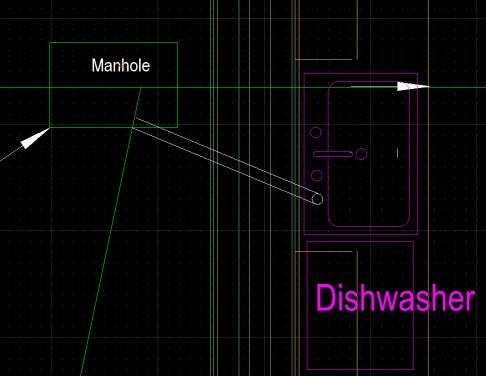
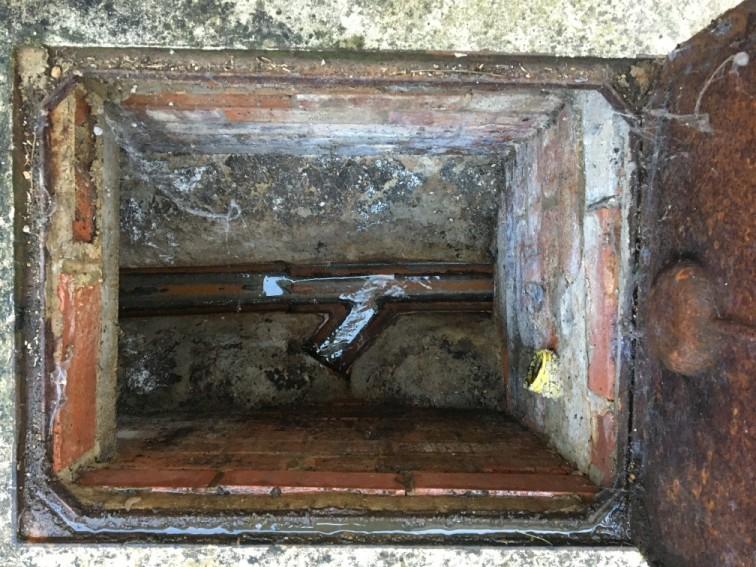
As it happens the extension will be sitting above a sewer (public, we and the neighbour), with the junction right next to - and right where the new sink & dishwasher want to empty to: Can I simply run a pipe with (nearly) 90 deg bend at the end (inside the manhole) so it discharges into the end of our sewer run? Or even the straight (technically public) run? Or will I have to dig a separate junction? Here is the real detail: I admit that I'm partially inspired by the rainwater pipe sneaked into the manhole
-
Overthinking flat roof joists/wall junction preserving airtightness
Olf posted a topic in Flat Roofs
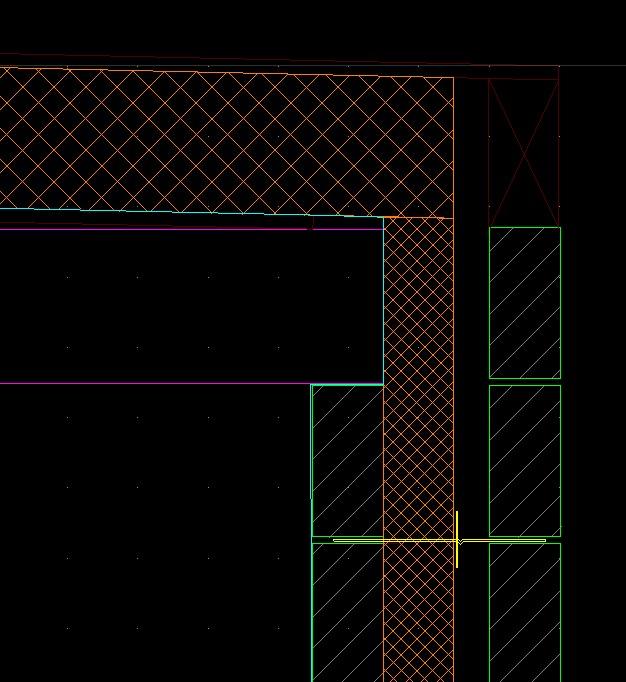
Because on the existing building side there will be an RSJ with infilled bearers and joist hangers attached, I went to replicate the same on the new wall side. That would give me an advantage of easier to maintain continuity of airtight layer (turquise on the drawing) - but looks a bit dodgy, especially the fact that the ledger board would be attached to the last course of blocks. I dialled down artistic vision and option 2, with joists sitting on the wall with 'Tony tray' like detail looks now much more sensible to me. Opinions please?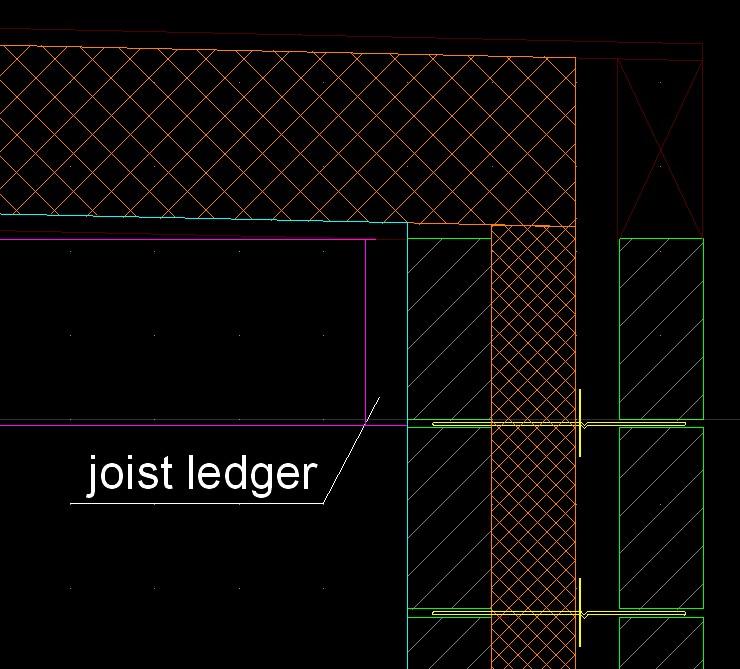
-
Thinner and better alternative to 150mm PIR in cold roof insulation
Olf replied to Adsibob's topic in Heat Insulation
~ U-0.16 ( The thinnest (65mm) option is a match They are made to order, to the exact dimensions - call to enquire seems to be sensible option.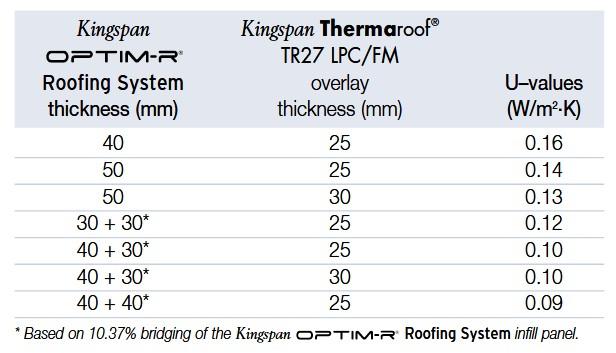
-
Thinner and better alternative to 150mm PIR in cold roof insulation
Olf replied to Adsibob's topic in Heat Insulation
Actually it is possible: https://www.kingspan.com/gb/en-gb/products/insulation-boards/insulation-boards/optim-r/optim-r-roofing-system 0.007 W/mK, totally airtight and well reflective. Oh, and £££ that makes aerogel a bargain - but sometimes there is economy that makes it the right choice, otherwise they would not market it. -
Thinner and better alternative to 150mm PIR in cold roof insulation
Olf replied to Adsibob's topic in Heat Insulation
No. Wood fibre boards in your own numbers are nearly twice worse than PIR - and as a result you need nearly twice the thickness for equivalent conductive heat transfer resistance. Decrement alone does little, it is how it then translates into phase shift - and that only helps if >10h (so the morning heat only starts flowing in the evening, peak midday heat would only spread in the night and is being cancelled), requiring larger thickness than 100mm. On top of that it stabilises heat changes during daily cycle, but does not affect long term heat loss - here low U is still what matters. My advice: - stick to PIR, if desperate go phenolic (0.018) - but that comes at a price - improve air tightness - if there is any void between ceiling boards and insulation you can use reflective film better than the face of PIR boards - but this, like phenolic, gives you diminishing return -
Can you check if the extract fan is actually working at all? At its nominal revs it should be hard for the mould to grow to thick layer (especially at the tips of the blades, having the highest linear speed) and there should be some 'streaks' of the airflow along the surface - and I can't see either. If it's dead, then it acts as flow restrictor only, stopping 'dirty' air from being expelled.
-
Did you try to get planning permission for taller structure first? It could be both cheaper and better than going with the underground struggles. I'm planning something smaller (~4.5x7.5) and as much as settled on wasting 1m space to stay away from the boundary (EWI, EPS not being 'significantly non-combustible'), I will start with attempting to get planning permission for a decent heght. At the end of the day, if I moved just extra 1 m away from the border, I could erect 4m high, 2.5m eaves without asking. I will however keep it under 30 m2 internal (as the size works for me anyway) to save on BC fees and hassle, even though it will be designed and built properly. That's the main point. Also if you plan to add any services suggesting that it might be 'habitable', you're falling under the BC radar
-
For the extension flat roof the SE caluclated 220x75 joists, but left a choice of 254*146 UB or 203*203 UC to support it. Pricewise they seem to be £320 vs £400, so not a lot of impact. However my thinking is that 203x203 will be better choice as easy to conceal, whereas 254x146 would require battens to offset the ceiling boards to go flush under the beam (there is a condition that top of joist to be 10mm above top of steel - what could be the reason for that?). Extra battens and 50mm height added (and so the cost of all the extra wall materials) will cost me much more than 80 quid saved on the beam upfront - am I right?
-
My lender want's to have a say so about extending/referbishing the property they gave us mortgage on (and rightly so), but they insist all has to be dealt via lawyer. Where/how do I find someone cheap (at the end of the day it is moving papers from one envelope to another)? Or if going through all the standard mortgage solicitors/conveyancers, how much to expect to be charged for 'representing' us?
-
The original poster You hijacked the thread, hence the confusion now
-
I used Contega PV to join the membrane to the wall, Solido looks like a different variant of that product line. The fleece holds the plaster well, but the tape is so-so: I managed to remove it easily when made a cockup, something I cannot say about normal tapes (Proclima or Gerband). Regardless, with Solido you'll end up paying big buck and having thick skim to cover it. I'd look for some sealant instead - I use https://www.soudal.co.uk/pro/products/sealants/acrylic-sealants/acryrub-sws/acryrub-sws-310ml around windows, it's airtight and paintable, was about £3 per tub. You can check their Acryrub line for something with less flex, so potentially cheaper. Or other supplier for that matter, CT1 seems to have some good fame here, though not sure if paintable/plasterable
-
General loft, loft hatch and loft access information
Olf replied to eowens90's topic in Lofts, Dormers & Loft Conversions
Unless the roof is flat, there will be an area than needs to be servicable and that you can define as 'loft' Landing, unless layout forces it to be in a bedroom (see below) It depends on roof construction, but you want to place the hatch in, or close to, place where there is the most headroom - or at least enough to access the loft No, but most are designed to fit between joists at 600mm centres, so about 550mm. Length varies and you can pick your own depending on type and space available Upwards if the hatch is just a board in a frame, downwards if hinged. But not impossible to modify the first type to hinge upwards. Don't know the statistics, it will depend on the use: for servicing only - use smaller hatch (easier to fit) and use a ladder when needed; for frequent access (storage, maintenance of devices etc) having build-in folding stairs makes more sense, but comes with size and price Floor usually is flat, but you need to lay it first. For sure there are joists running parallel at regular (and standard: 400 or 600m centres) distance. -
What if the brickie is looking at me in the mirror ? Note that my brick building experience is all based on Lego, hence I'd rather double check how to deal with stuff with no studs!
-
I think nowadays bold move would be to rip the walls for the sake of a physical switch! I had stairs 2 way switch placed 'conveniently' (for the electrician for sure, made no sense to me), moving it would take me a day of chasing/redecorating. I spent maybe 1/2 hour to install 2 wireless PIR sensors and set them up. Added bonus: light intensity set depending on the time of the day, so when doing fridge run at midnight neither I'm blinded by the stairs light, nor alarm/wake up everyone. Obviously that one is the least laborious, especially when you choose 'posh' tall skirting boards and can live with protruding boxes, you may end up with no chasing at all! But tall skirting is a must in this case: I now have standard (~100mm) and I don't like bending so low to plug anything and most of the cables coming off the plugs seem to be forced against the floor.
-
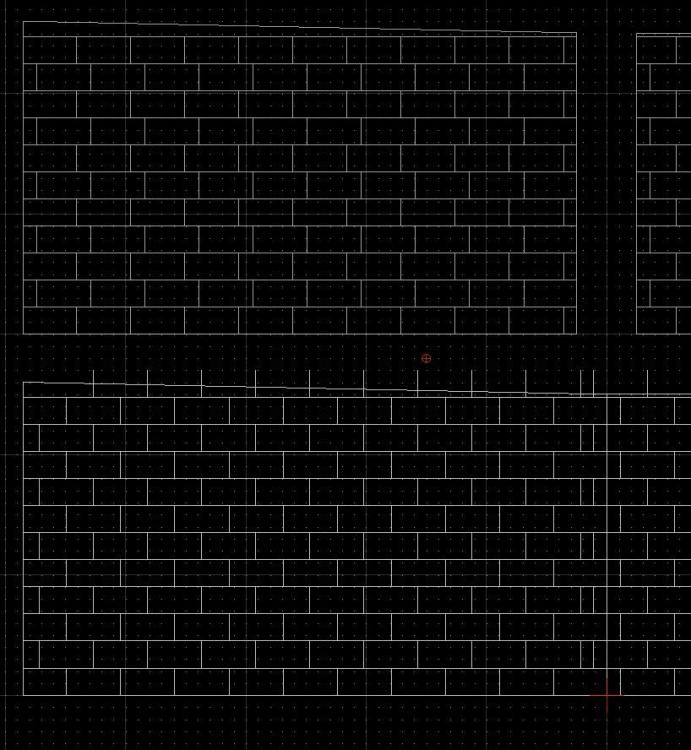
'When detailing masonry panels, the designer should set out masonry units to full or half block lengths where possible to avoid unsightly and unnecessary cutting of units on site. Co-ordinating dimensions will also ensure that the masonry is properly bonded' - so says the manual. I started sketching the layout of the blocks for the extension (mainly to be more accurate with ordering of the materials, but also to save on the amount of cutting ) and that of course cannot be followed: with 100m block + 150mm cavity + 100mm block there is no way both walls can have courses shifted exactly by half. Also such textbook rule immediately fails in any corners! So I started with the external wall (lower sketch) and the half block shift and ended with some small bits to fill on either end. Internal wall looks more sensible to me: every 2nd row does not need any cutting. But simply following the patern dictated by how the blocks meet in the corner, I end up with a shift between the rows of 120mm - so a quarter, rather than half of the block. Is that acceptable?
-
Indeed Brink, Zehnder etc offer those as options (one of many), whereas Vent Axia and similar have that built in as a standard - considering the module costs them probably £10 tops that makes sense (and is a ripoff in other cases). I've got bad experience with such sensor - it would trigger endless boost on warm humid days. Luckily that meant switching the unit off and using open widnows was an option. In normal operation the boost would only activate when humid air from a bathroom, after traveling the distance and mixing with 'normal' air from other places finally woke the built-in sensor up - essentially letting missus to steam the place... Brink and Zehnder for sure offer those (at extra price, but saves you running a drain, that in itself can be a godsend), VentAxia etc source heat exchangers from place that I believe does not offer them. But not sure if that is a massive benefit if even UK supplier does not try to upsell it. PH certification gives independent verification of efficiency and noise claims, without that marketing departments can be as creative, as the paper accepts. It depends on your budget If I was doing a basement in Chelsea, I'd use Zehnder with their nice ducting system (Comfowell) saving some space - it would pay back for itself. In my case, with only one possible (and still very compomised) location to place the unit I was careful of how inlets/extracts run (Zehnder and Brink use opposite philosphy) to not to have to cross and twist the runs - something that is a non issue with dedicated room. Also because of proximity to bedrooms, quietness is high on my agenda. Finally it appeared that over long payback period the total cost levels up.
-
Good point: 2.5 m from boundary and 5 m from a building. Well, more digging and more chances to find some Roman treasure then
-
I've got a hedge of overgrown Leylandii to be removed (both to make space for extension as well as to stop being eyesore) and with a need for some soakaway for extension roof (and planned carport) I thought that once the ditch is dug, I could place the crates there and hey presto, saving me another excavation. Any cons to that? Any fence would need to use concrete posts of course (not an issue really), should I worry about its stability or potential for damage to the crates if being tiped by the wind?
-
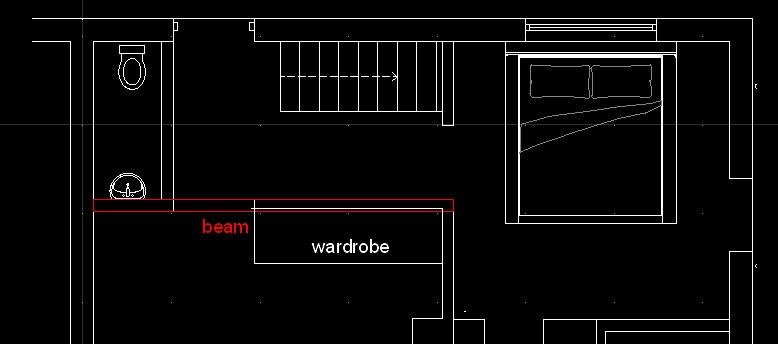
@TonyT - big thanks, 'Structural Thermal Break' is what i need to shop around for. 127*76 RSJ supporting a half of the first floor (marked red). Currently there is 50x50 steel box profile at 0.37m from the central wall (believed to be a temporary support, left hidden inside the wall) and 90x90 wooden post at 1.52m from central wall. To accomodate the wardrobe I need to move the wooden post and SE calcs showed (I trust) that single 50x50 on the side of the wardrobe is enough.
-
I call it a draw And no offence to either of sides - there is a lot of information on thermal properties including how to calculate them, whereas sound transfer is treated more by qualities (the denser = the better), but nothing that could be quantified.



