PeterW
-
Posts
18480 -
Joined
-
Days Won
207
Everything posted by PeterW
-
It’s still not illegal to park on someone else’s drive ... let’s hope the neighbour doesn’t realise that ..! ?
-
Insulated steel box would be preferable.
-
Sorry missed the mu and read gauge..!!
-
Ok I would use 1200 gauge below the insulation, 300 is very thin for a DPM. The 20mm is edge insulation. 150mm below is good for UFH.
-
Not exactly but sort of correct...! Second top DPM can be a 300 gauge thin membrane as it’s only there to stop the screed going through under the insulation. If you’re clipping down then it’s DPM - Insulation - Slip Membrane - pipes
-

Insulating Single Skin concrete block Wall
PeterW replied to mazzlebizzle's topic in Garages & Workshops
EPS is also highly flammable ..! -
Screeding or wall plastering, which first?
PeterW replied to epsilonGreedy's topic in Floor Structures
Screed first - if your boards are too low they can pick up moisture from the screed and swell. Can easily scrape snots off a screed floor. -
..??? how big are we talking ..?? They speed up the laying too so watch for savings elsewhere.
-
The second (top) DPM isn’t really a DPM. It is a slip membrane designed to stop the liquid screed flowing between the insulation blocks and floating them upward. Tape everything and then pin the pipes down, tbh this is why I prefer the plastic trays as nothing moves.
-
So just checked and I would pay £8.18 ex VAT per bag for that. So £410 all in for the liquid screed. Can do the whole lot for half that and no mixing with concrete. It’s a no brainer..!!
-
You’ll pay through the nose for that. You also need to hire a putz mixer as you’ll have no end of issues as whilst you “can” mix that much by hand you wouldn’t want to ..!! There is 4 hours solid of mixing - first stuff will be going off before the last is in, and that’s assuming you’re using a decent paddle mixer. By the time you’ve hired mixers etc, a crew would have that done and laid in a couple of hours. 75mm is also the bare minimum for sand and cement - ideally you would add fibres at that thickness. If you want to DIY quick then just use concrete - leave it 5-8mm shy and top with SLC. It’s less than a cube so £175 on a volumetric mixer.
-
UFH - Multiple Floors - Single Manifold & Pump?
PeterW replied to minicooper13i's topic in Underfloor Heating
Why would you..? deltaT from room temperature to water temperature is what causes the heat transfer - larger deltaT, quicker warm up. -
UFH - Multiple Floors - Single Manifold & Pump?
PeterW replied to minicooper13i's topic in Underfloor Heating
Not needed if you use the Auto Balancing heads as they will balance flow and return to delta 7°C differential. This works perfectly and all you need to do - just put the tees in accessible places so you can service the auto bleed valves. -
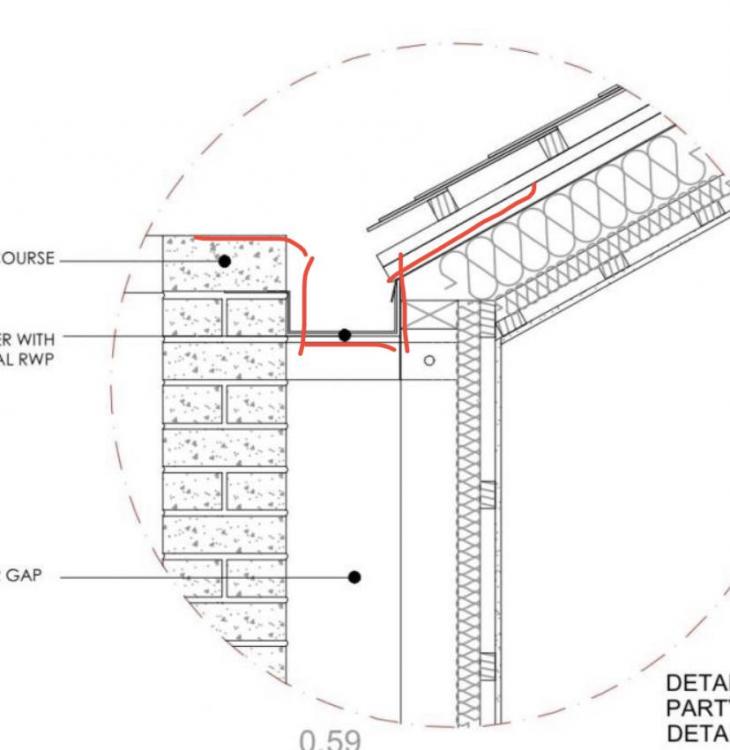
Very poor design .. Water shedding at speed will hit the bricks on the top not the gutter. That also looks a very large roof - I think you will need to check volume carefully as your gutter isn’t very deep. Over 10m, even at 1:80 drop you will lose 80mm or more than a course of bricks. I would create a very deep gutter all formed in GRP. It would be minimum 150mm deep, and lap both sides of the gutter up and under the tiles / slates until level. Ideally then add a coping stone on top of the wall or make an aluminum capping to go over the lot. Very rough picture below ..!! You will also need to insulate that corner properly under the edge of the tiles as that’s a horrendous cold bridge if you’re not careful.
-
Or a 200mm overlap at 1:40 so that water cannot sit on the joints.
-
6m is the widest you can buy so you will either be buying a huge amount of excess if you want a single piece, or will be joining it. Lead would need to be done in multiple bays of 1.5m to allow for expansion, GRP can be done in a single length hence the suggestion. How deep and wide is it ..? Do you have good access to clean it as they are prone to catch leaves.
-
Mortgage completion vs Builder contract timing
PeterW replied to aims's topic in Self Build Mortgages
I think your architect is a little out of touch .. Prelims - so site setup including toilets (£20/wk) Cabin, site security / heras fence are added into the overall costs and paid accordingly. Same with materials, any decent builder is on 30 or 45 days with their merchants - you should see at least some of the benefits of that. As @Conor says, 3% at end of first week would be a preferable solution and also ensure your contract has payment terms agreed - invoices due 14 days after presentation and agreement is my normal stance, gives chance for any queries to be raised but that should be agreed up front. Any main contractor presenting an invoice on a Friday for payment “immediately” when they have a contract with you would be a red flag. -
Ok - so that changes dynamics and I assume your step mother will move from the caravan into the house ..?? Could look at some sort of annexe..?? You may be best applying for a replacement for the ‘van and may even be better for step mother to be named on the application. Does the farm solely end up in your name ..?
-
I’d try and avoid interceptors as they create a settlement point when the flow is low and they are really suited to old flush volumes etc and now you’ve dropped to 4 litre flush volumes the flows are much lower and slower.
-
Welcome. Sorry to hear about your situation How big is the land ..?? That will affect whether you can build on the land and what you may get away with. The good news is that having a static van on site for 30 years you may well have created a permanent residence requirement. You may need to show that the property to be built is predominately to support the business - will you or your partner be fully employed in running the farm..??
-
Floor standing buffer tank for big cylinders
PeterW replied to Moonshine's topic in Boilers & Hot Water Tanks
100 litre buffer mounted on a pair of gallows brackets on the wall will be fine. Resin bolt the frame to the concrete. -
Mortgage completion vs Builder contract timing
PeterW replied to aims's topic in Self Build Mortgages
Why..??? Never pay up front for anything ..! Site insurance is cheap - just get it in place and take the hit on a month or two. You should already have the site insured anyway. -
You old romantic ..!! ?
-
You will pay all the VAT on materials at 20% and only able to do one claim at the end. Builder can claim monthly and zero rate the supply to you. Most lenders will loan on stage basis and assume no VAT so you need to find 20% extra each time yourself.
-
C causes you big VAT bills and cash flow issues. Avoid if possible.