


MortarThePoint
-
Posts
2294 -
Joined
-
Last visited
Everything posted by MortarThePoint
-
Chimney DPCs and damp handling
MortarThePoint replied to MortarThePoint's topic in Stoves, Fires & Fireplaces
If you haven't chosen your flue liner yet I'd suggest considering a 200mm one rather than the 175mm we went with. It doesn't cost more (liner sections tad bit more, but less granular fill around it) and allows more flexibility as to what is connected to it (e.g. could change to an open fire down the line). -
Chimney DPCs and damp handling
MortarThePoint replied to MortarThePoint's topic in Stoves, Fires & Fireplaces
Yes I think they work well. They provide a bit of interest and I think they do accentuate the corbelling. -
Chimney DPCs and damp handling
MortarThePoint replied to MortarThePoint's topic in Stoves, Fires & Fireplaces
Roof pitch is 48 degrees and your correct that pushes up the chimney. That said, the edge of flue liner to weathered surface horizontally is 2.7m, so well beyond the 2.3m minimum. That suggests we could have had it about half a metre lower. I guess it's just one of those things that when I looked at the architect's drawings it didn't occur to me to change it so it must have looked right. There may be some architect's wisdom I am lacking. One scaffold visit for the chimneys. The brickies didn't go up as far as I had hoped before the lift so they had to 'nose bleed' it to start with on the scaffold laying ~450mm below the boards. -
Chimney DPCs and damp handling
MortarThePoint replied to MortarThePoint's topic in Stoves, Fires & Fireplaces
No the pots go on last at the top ? Just kidding. The architect's drawing included a 450mm projection above flaunching. With 225mm of embedment, that left us either going with 600mm or 750mm as there are no 675mm pots of our type. In hindsight, I think we could have had just 150mm of embedment, but I'm happy with how it looks. Your design looks nice and I think suites the taller pot It may be a function of the aspect ratio of the chimney itself above the roof line. -
Chimney DPCs and damp handling
MortarThePoint replied to MortarThePoint's topic in Stoves, Fires & Fireplaces
Thanks. Do you like the approach of having it half lapped and half flush? Viewed from above, it means the tray has to be cut to this shaper where the green portion ends up embedded in brickwork and the orange portion sticks out to then get bend down over the flashing and back gully.
-
Chimney DPCs and damp handling
MortarThePoint replied to MortarThePoint's topic in Stoves, Fires & Fireplaces
Thank you. It has been a challenge to get my head around. Haven't really focused on the cost so much as it feels like such an integral part of the house. The liner system was £1464 for two chimneys. Above roof level: the brickie spent about 4days 1:1 so that's another £1200 or so. Bricks above roof level were about 800+200=1000 so around £650. Blocks probably £150. Below roof level: the brickies probably sent 4 days 2:1.5 so that's about £2200. Extra bricks over being just wall probably around 400+700=1100 so around £700. Blocks probably around £250. Lintels around £250 (Naylor R9 £93 and Supreme R21?£130?). Extra footings probably around 7m3 so around £850. Probably additional truss cost of around £150. Total: £7864 so call it £8k So that's £4k per chimney before even connecting a stove to it. Probably looking at £5-6k all finished. -
Chimney DPCs and damp handling
MortarThePoint replied to MortarThePoint's topic in Stoves, Fires & Fireplaces
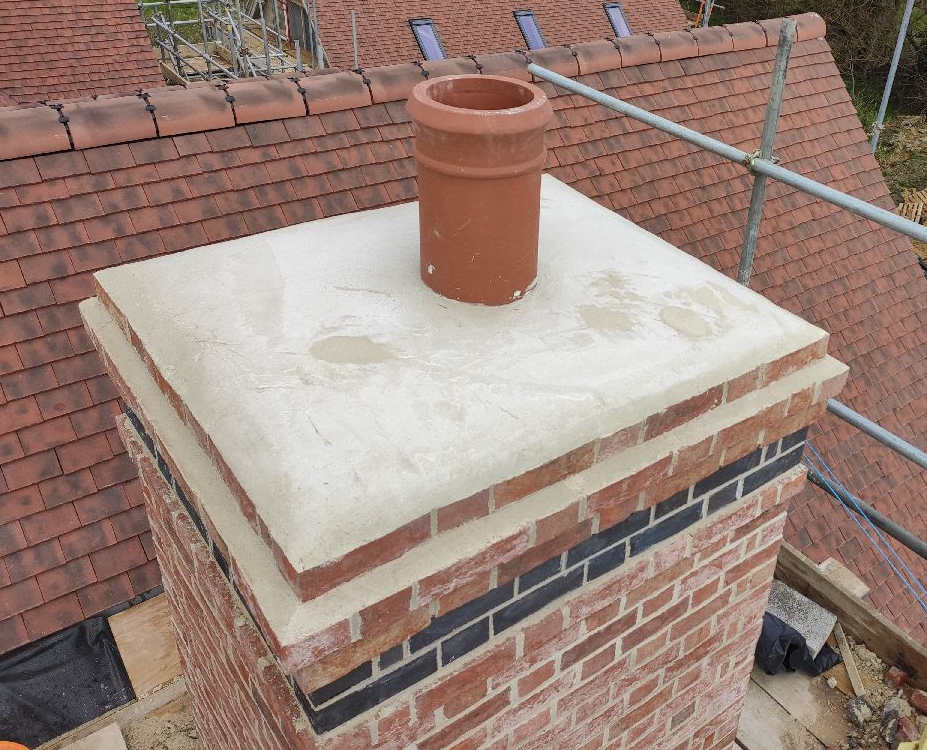
Well the main chimney is finished, then had to rush to try and save the flaunching from some rain which has resulted in some minor damage. A shame, but I guess you seldom see the top of a chimneys flaunching and it's more important that it is weatherproof. Here's a photo after I enacted a repair (approx. 3 hours after the rest of the flaunching was finished and in the half light). The perspective of the photo makes the pot look massively off centre, but it is in the centre. The second chimney is up to the level of the second lead tray. The tray is placed on to protect the brickwork from any rain before it's finished. I'm still liking the hybrid approach of having the tray sticking out around the back and part of the sides (shown red) and folded down over the flashing. Round the front and part of the sides cut back to flush with brickwork.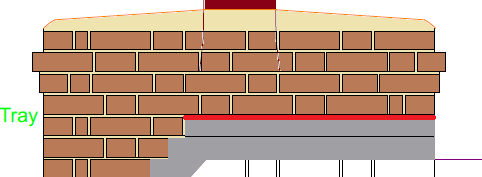
-
Chimney DPCs and damp handling
MortarThePoint replied to MortarThePoint's topic in Stoves, Fires & Fireplaces
Is there anything wrong with using the tray to form the cover flashing? There may not be enough lead to reach down 150mm though, probably just 75mm. This is from the LABC technical manual and looks to be showing the tray forming the cover flashing: I wondering is @PeterW knows if this is OK or if the top flange of the cover flashing can be tucked into the same bed as a tray.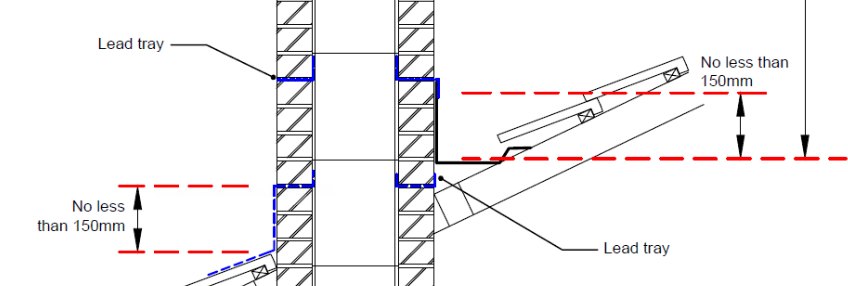
-
Chimney DPCs and damp handling
MortarThePoint replied to MortarThePoint's topic in Stoves, Fires & Fireplaces
Have you had to work this out for your chimney @epsilonGreedy -
Chimney DPCs and damp handling
MortarThePoint replied to MortarThePoint's topic in Stoves, Fires & Fireplaces
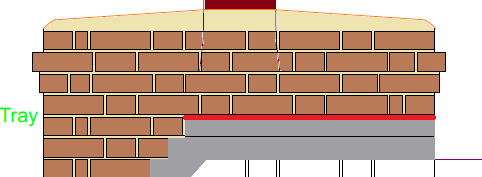
I'm getting confused about the second lead tray on the other chimney now which is going in tomorrow. I have had both trays made large enough to extend out of the brickwork and lap up or down the brickwork by 75mm. I definitely need that for the first tray that is mostly within the roof space. On three sides of the chimney, that first tray will be lapped up the brickwork and on the fourth side it will lap down the brickwork. That puts the apron a brick course below the last bit of stepped flashing on the sides of the chimney. I've convinced myself somehow that the second tray is supposed to lap down the outside of the brickwork. However I have seen various diagrams online that seem to show it stopping at the edge of brickwork so not actually coming out and lapping onto the outer surface of the brickwork at all. Which is correct? I have drawn the two options below as viewed from the side of the chimney. It's a bit difficult to tuck the lead flashing in below the tray in the right hand approach. I guess the tray could come out wherever the flashing meets it, highlighted red here: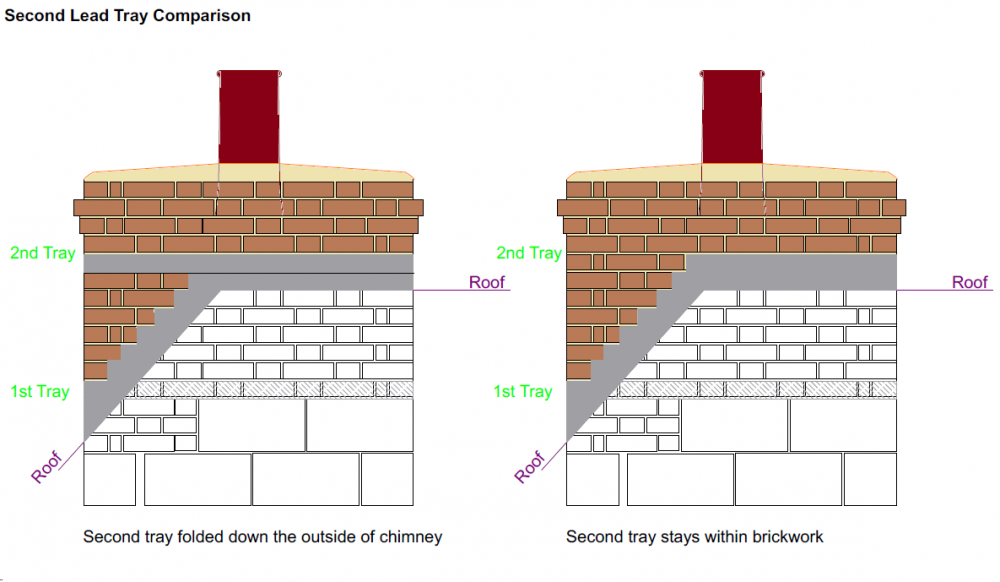
-
Chimney DPCs and damp handling
MortarThePoint replied to MortarThePoint's topic in Stoves, Fires & Fireplaces
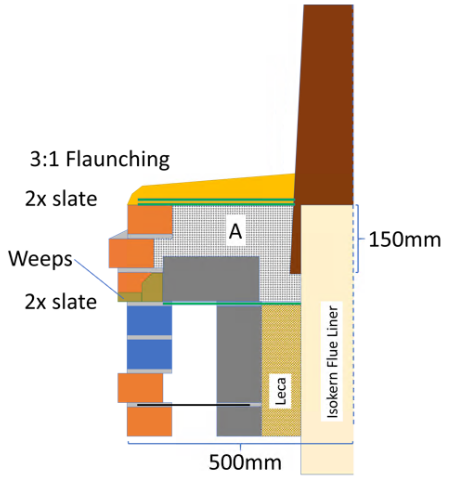
Thanks, I use two cheap tools QCAD and PowerPoint. Very different to the day job, but useful to convey the details. Yes, as conceived the pot is embedded by minimum 225mm. This is embedded 150mm in the cut blocks and mortar ('A'). Most of this is below the upper layers of slate though so will hopefully not get too moist. -
Chimney DPCs and damp handling
MortarThePoint replied to MortarThePoint's topic in Stoves, Fires & Fireplaces
It is on the outside. My second image probably wasn't put into context well. It's a closer look like this: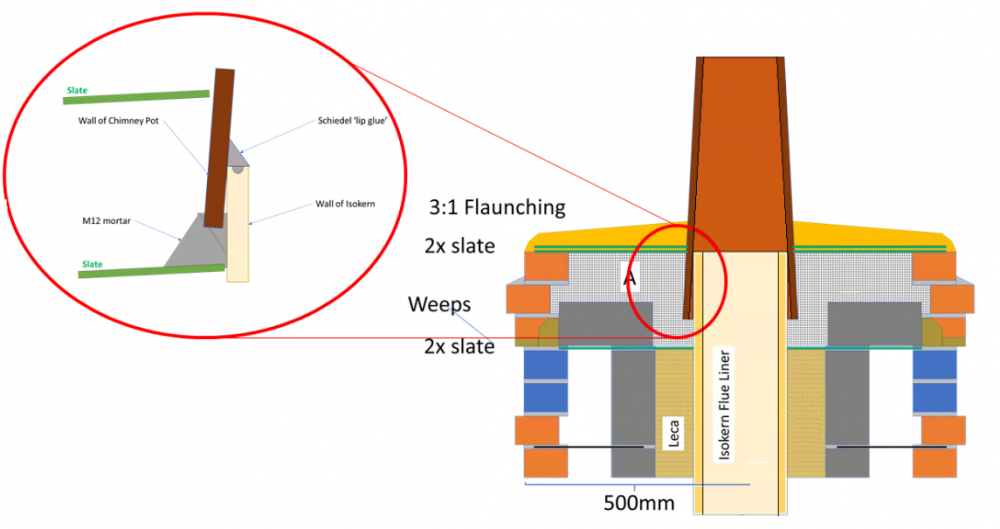
-
Chimney DPCs and damp handling
MortarThePoint replied to MortarThePoint's topic in Stoves, Fires & Fireplaces
Here's a section through the chimney at its top showing the slate etc. I'll ask them to angle the slates ever so slightly to fall away from the centre of the chimney, but that may be easier said than done. The 'A' labels what will be blocks cut and packed with stiff mortar.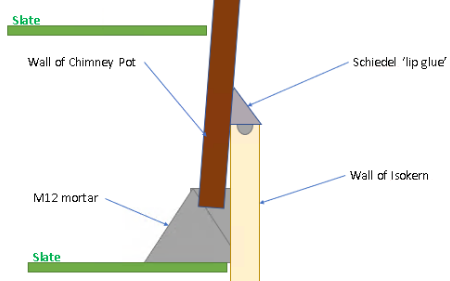
-
Chimney DPCs and damp handling
MortarThePoint replied to MortarThePoint's topic in Stoves, Fires & Fireplaces
That will look nice. My inspiration on it was reading that two layers of engineering bricks could be used as DPC at the top of the chimney. I'm not so much using it as that but it made me think what it would look like and I think it's nice. A note of caution on blue engineering bricks though. Their colour can be very different manufacturer to manufacturer and indeed batch to batch. I loaded about 10 into the boot of the car before I really noticed they were almost purple. I like the type that when dry have an almost metallic grey shine (Wienerberger Terca). Second note of caution if you aren't aware, make sure you keep them dry before laying as they are a pig if wet. If I were to do it all again, I'd use blue engineering bricks at house DPC level as well. Another note: you'll be getting solid engineering I presume, not perforated. -
Chimney DPCs and damp handling
MortarThePoint replied to MortarThePoint's topic in Stoves, Fires & Fireplaces
Well this is what I've produced as drawings: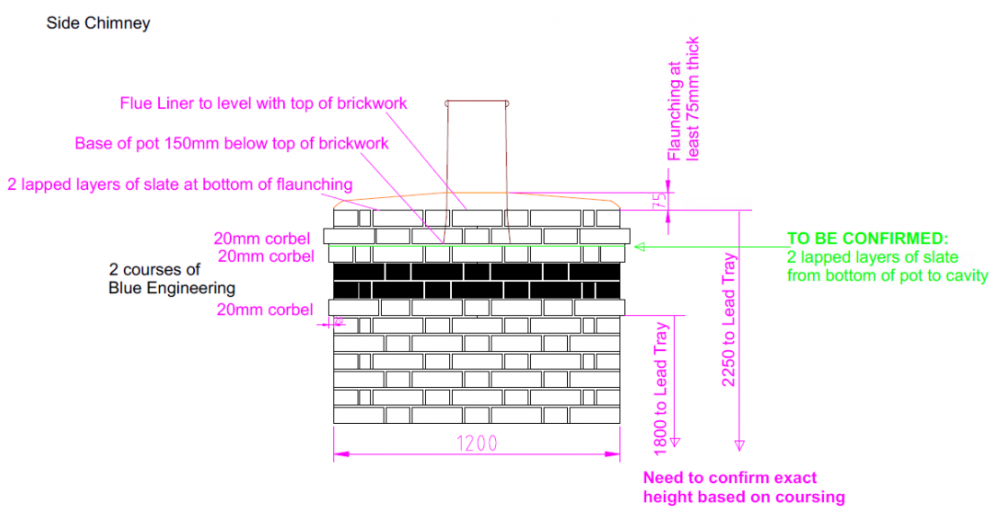
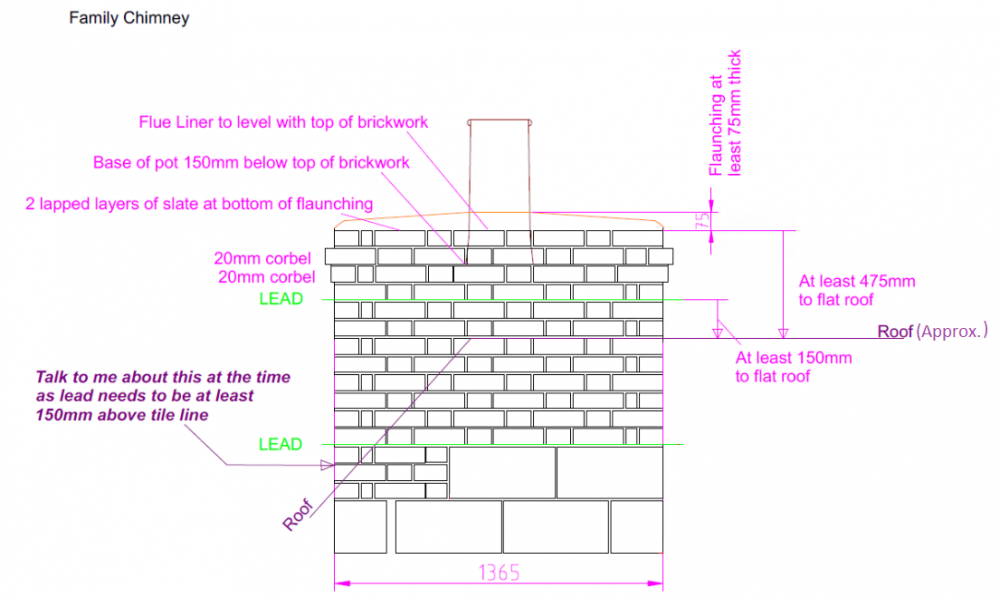
-
Chimney DPCs and damp handling
MortarThePoint replied to MortarThePoint's topic in Stoves, Fires & Fireplaces
Probably so they have full control of the flue path, or because they want the £300 -
Chimney DPCs and damp handling
MortarThePoint replied to MortarThePoint's topic in Stoves, Fires & Fireplaces
Isokern 175mm -
Chimney DPCs and damp handling
MortarThePoint replied to MortarThePoint's topic in Stoves, Fires & Fireplaces
It's a fight I've yet to prepare for but think you're right -
Chimney DPCs and damp handling
MortarThePoint replied to MortarThePoint's topic in Stoves, Fires & Fireplaces
I'll be at the mercy of the brickie so will specify "at least 75mm" -
Chimney DPCs and damp handling
MortarThePoint replied to MortarThePoint's topic in Stoves, Fires & Fireplaces
I had wondered about just using a stainless steel liner some moons back: -
Chimney DPCs and damp handling
MortarThePoint replied to MortarThePoint's topic in Stoves, Fires & Fireplaces
If you just have vermiculite around a stainless steel liner what happens if/when he stainless steel liner has to be replaced? You're correct, the stove installer is saying he wants to fit a stainless steel liner. -
Chimney DPCs and damp handling
MortarThePoint replied to MortarThePoint's topic in Stoves, Fires & Fireplaces
Do you think 75mm high enough for the flaunching on a 1.2m wide chimney stack with one pot? -
Chimney DPCs and damp handling
MortarThePoint replied to MortarThePoint's topic in Stoves, Fires & Fireplaces
I'll try to share some details. Correct about the Flemish bond. -
Chimney DPCs and damp handling
MortarThePoint replied to MortarThePoint's topic in Stoves, Fires & Fireplaces
The flaunching in general or if using with slate? -
My honourary local conservation officer is in the kitchen having a cup of tea and not so keen on that type either



