


MortarThePoint
-
Posts
2294 -
Joined
-
Last visited
Everything posted by MortarThePoint
-
Stiffening subfloor with floating noggins
MortarThePoint replied to MortarThePoint's topic in General Flooring
Noggins also need to be attached to the joists. I've confused matters by calling them 'floating noggins'. They are splints really. The concept has nothing to do with noggins. There purpose is to stiffen the sheet membrane not the joists. -
Stiffening subfloor with floating noggins
MortarThePoint replied to MortarThePoint's topic in General Flooring
I did model it with a glue layer after all and as suspected the peak stress is lower at 0.85MPa. The orange ball shows where that is and the blue ball shows where the peak displacement is (0.30mm). I've used a coarser mesh away from the area of interest and a finer mesh in the area of interest. I've modelled the glue as 0.1mm thick and having a very low Young's Modulus of 10MPa which is probably a bit low, but even with that low a stress of 1MPa would be a strain of 10%, so 0.010mm.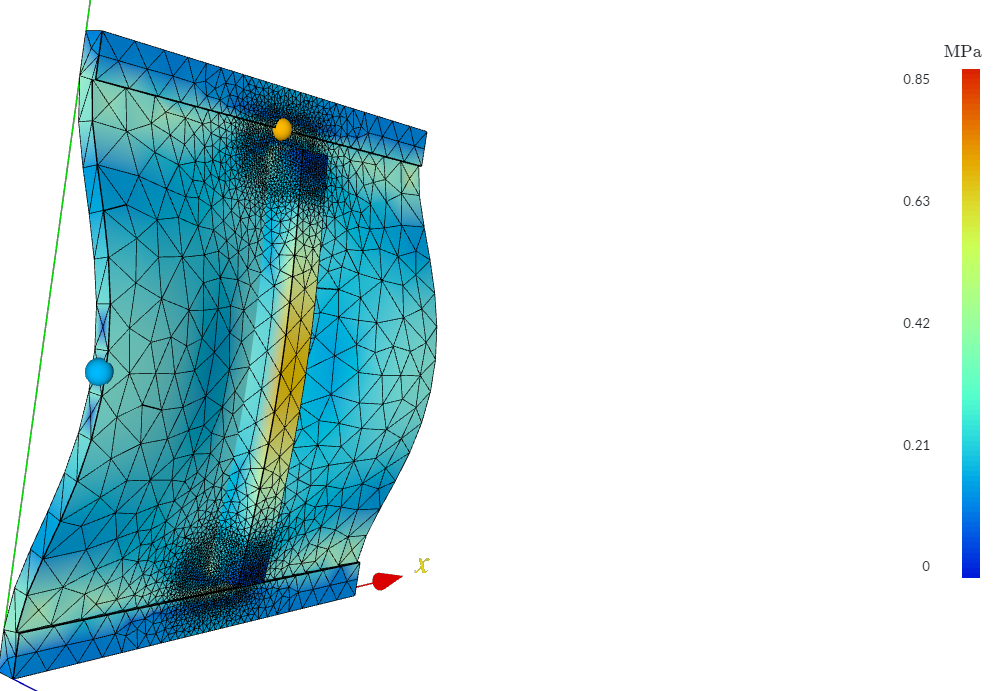
-
Stiffening subfloor with floating noggins
MortarThePoint replied to MortarThePoint's topic in General Flooring
No these are in addition to where real noggins are needed and they must be done properly: "NO SUBSTITUTE FOR WHERE FIXED NOGGINS ARE REQUIRED" I probably should have just called these 'stiffening timbers' rather than 'flying noggins'. As far as I can tell, 18mm OSB3 can be used on 600mm c/c joists: https://www.norbord.co.uk/resources/help-advice/faqs/ https://nhbc-standards.co.uk/6-superstructure-excluding-roofs/6-4-timber-and-concrete-upper-floors/6-4-19-floor-decking/ But I wanted to investigate how the sheet material could be stiffened if desired. I might be calling them the wrong thing, but fixed noggins (or strutting) would clearly help stiffen the feeling of the whole floor, but I thought these timbers could help against any fear of bounciness in the sheet material itself. Clearly, strutting out the entire floor with 4x2 would be better, but much more time consuming. Such strutting would help joists act in unison, whereas this approach would only act on the sheet material itself. Normal noggins (>=2/3 of joist height) would still be needed in all the usual places.

-
I've started a separate thread about stiffening the subfloor:
-
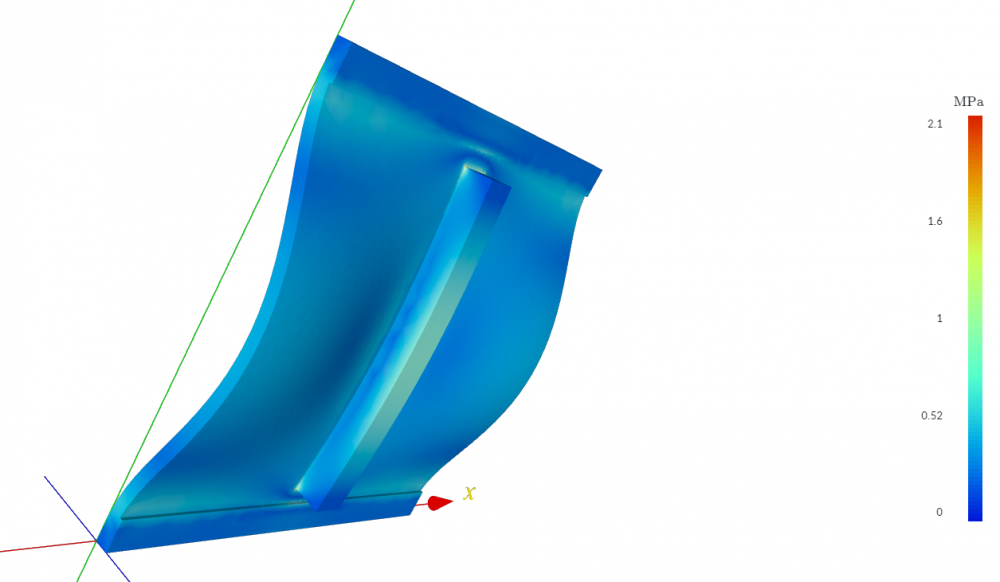
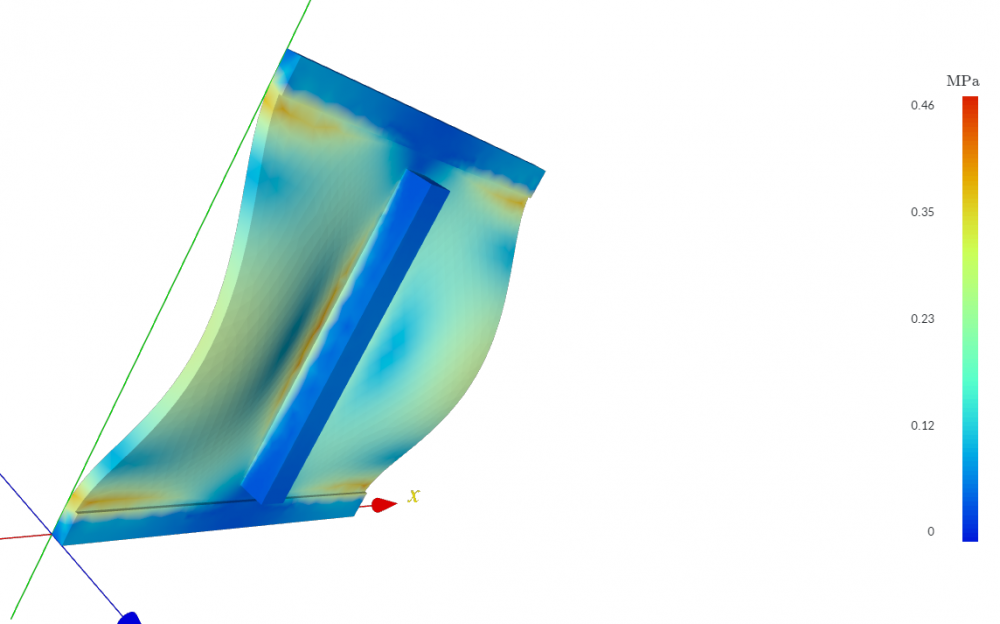
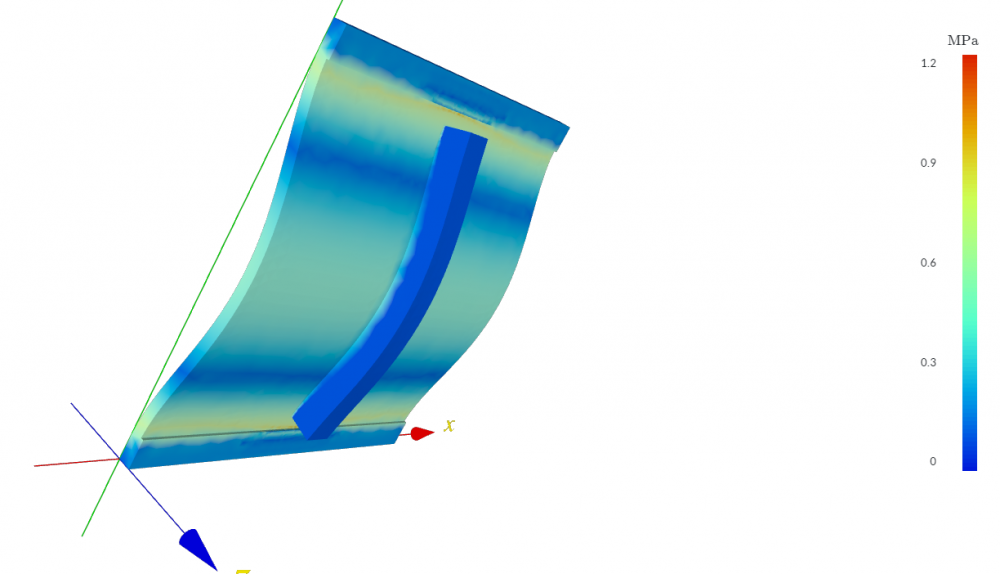
WARNINGS: NO SUBSTITUTE FOR WHERE FIXED NOGGINS ARE REQUIRED. ALSO, IT'S JUST AN IDEA FOR CONVERSATION AT THE MOMENT. Well I love over analysing things and was wondering about sections of timber fixed under the subfloor at 600mm c/c, but not fixed to the joists. The benefit of this is they don't have to be cut to size and it removes the difficulty of screwing a noggin to the joist. I have modelled sticking 500mm lengths of 2x2 timber under 18mm sheet material and 600mm c/c 47mm perfectly stiff joists. I have used a Young's Modulus (MOE) of 2GPa for the sheet and 8GPa for the timber. OSB3 has a major axis MOE of around 2500MPa and a minor axis of 1250MPa. My tool doesn't allow anisotropic materials (could add ribs) so I plucked for 2000MPa. As for the timber, 8GPa is 'typical' of pine I think. I've added a 5mm thickness of the 2GPa material to model the compliance of the joist fixment. The bottom surface of that 5mm is rigidly constrained. Zero X-direction displacement constraints on the ends due to symmetry to model and infinite joist length. My model could be a quarter if the size, but... I'm applying a uniform pressure of 0.002 MPa = 2kN/m2 to the top surface of the sheet. Three scenarios: No noggin: max displacement 0.52mm midway between joists. Maximum stress 1.2MPa in sheet at joist edge. [modelled by making noggin very soft, MOE 0.001GPa] Floating noggin: max displacement of 0.29mm midway between joist and noggins. Max stress of 2.1MPa at edge of noggin bond*. Fixed noggin: max displacement of 0.25mm midway between joist and noggins. Max stress of 0.46MPa** at edge of noggin and edge of joist. * not real as there would be some compliance here. I could model a lower MOE material between the two to represent the glue, bit that feels excessive. ** may be underestimated as mesh size large here. I think this could be a good approach as it is pretty quick to fit having precut a load of 500mm 2x2 pieces. Grab adhesive and 4 screws per ' floating noggin'. It's cheap too as uses 1.38m of 2x2 per m2 so, in cheaper times, would cost less than £1/m2. Is this a done thing, what do people think? Fixed noggin modelled by constraining bottom fact of noggin.
-
I believe you need to do this with all P5 including Egger Protect: https://www.egger.com/get_download/17e6c5ab-960a-4e7d-99ee-c46608c62f3a/Flyer_Advanced_Structural_Flooring_System_Fitting_Guide_UK.pdf Do you have a reference?
-
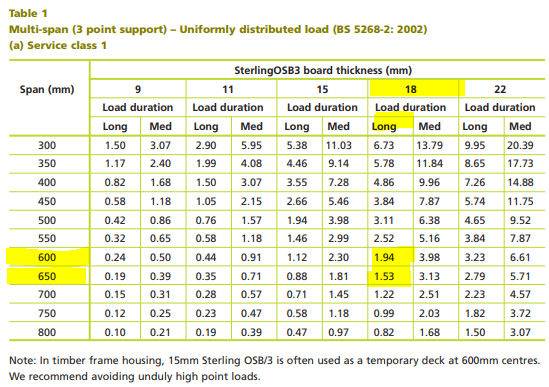
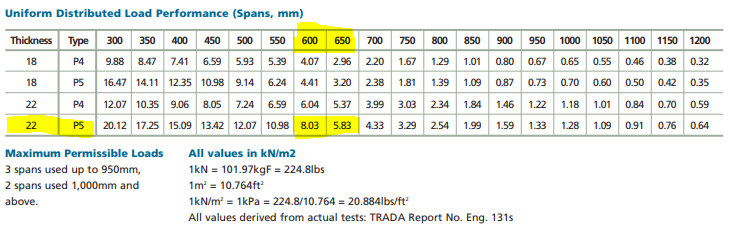
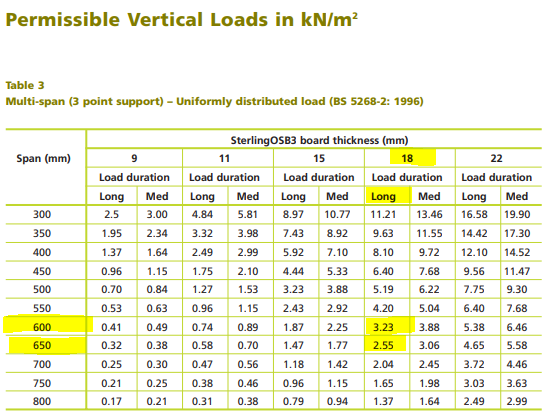
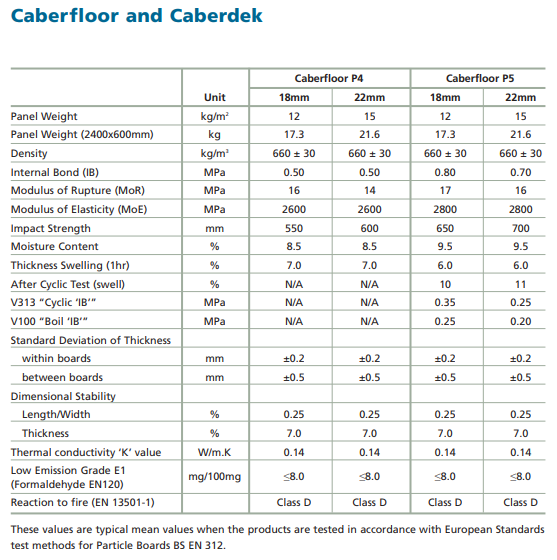
Squareness tolerances are generally quite poor: 3mm/m I'm a bit confused by the tables below as they suggest P5 has much higher UDL capacity than OSB3. The P5 DOP has a Bending Stiffness of 3500N/mm2 and a Characteristic Bending Strength of 11.7N/mm2. The OSB3 DOP has Bending Stiffnesses of 4930N/mm2 along one axis and 1980N/mm2 on the other axis and Characteristic Bending Strengths of 14.8 and 7.4 N/mm2. OSB3 (2008 I think): link CaberFloor P5: link
-
I'd love to hear what you learn, thanks
-
I have a downer on added formaldehyde so am planning to use 18mm OSB in the house. In the garage I have trusses rated to 2.5kN/m2 and so want to put a surface down that meets that. 22mm T&G OSB3 is a rare beast in the UK, 21mm T&G plywood is available though, or I could go SE e.g £25/sh for 25mm sheathing plywood. I've found the thickness of that SE plywood to be very variable though.
-
I'm seeing prices around £14-15 for 18mm OSB3 T&G 8x2 I've been paying £18 per 8x4 for SE sheathing plywood and can see £16 for 18mm T&G 8x2 What do you think of this: https://sheetmaterialswholesale.co.uk/tg-exterior-softwood-plywood-18-x-600-x-2400mm/
-
OSB3 prices are close to T&G plywood now. What do people think of using plywood instead?
-
It's not fun, but done it before. A dead man or lifter makes it possible. Much better and more fun with a helper though. Mass. Resilient Bar still needs to work in unison with an isolated mass.
-
Is that the 4' sizes aren't tapered, just the 8' sides? I guess it's mainly for walls then
-
This is a useful resource that I have just found: Stockist Guide - Construction details. It shows other makeups for ceilings and floors. Some of the other ceilings are surprising less performant than one might expect.
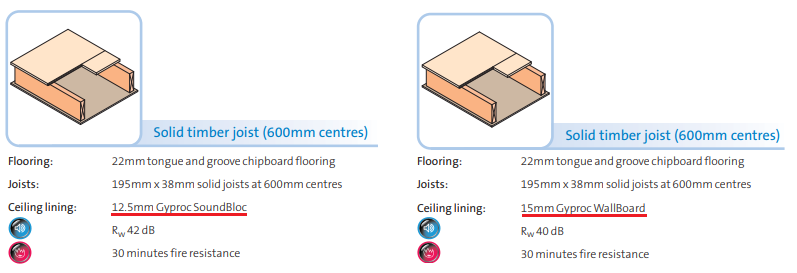
-
No price difference in the boards really. Tapered edge is all about taping, filling and sanding the joints whereas square edge would get skimmed all over
-
900x1800 sheets of WallBoard (9.5mm or 12.5mm) or Fireline are £3.99/£5.80 which works out as 56% of the area for 65% of the cost. Easy handling, more screws and more joins.
-
Condell: 15mm SoundBloc £12.32/sheet 15mm SoundBloc F £12.94/sheet 12.5mm WallBoard TEN £8.32/sheet 12.5mm WallBoard £6.16/sheet 12.5mm FireLine £8.94/sheet 9.5mm WallBoard £6.25/sheet No brainer to step up from SoundBloc to SoundBloc F (+5%) if you are interested in sound or fire. It would be harder work to fit though. 2 layers of 9.5mm or 12.5mm WallBoard are cost comparable with SoundBloc with same or higher 'area density' and lighter but longer installation and more screws.
-
I thought I would record some of my research into plasterboard options and hopefully people can share their thoughts. Each manufacturer has their own equivalents, but I'll consider British Gypsum for ease. They have a useful selector here. Wallboard: 9.5/12.5/15 mm with area densities of 6.3/8.0/9.8 kg/m2. Available TE and SE. Thicker boards available as 900x2400, all available 900x1800. 12.5mm available 1200x3600!! Wallboard TEN: 12.5mm, 10kg/m2, TE only. SoundBloc: 12.5/15 mm, 10.6/12.6 kg/m2. Only TE. Minimum 1200x2400. "higher density core". Moisture resistant option (SoundBloc MR). SoundBloc F: 15mm, 14.1kg/m2, TE min., 1200x2400. " higher density noise insulating and fire performance core" F MultiBoard: 6/10/12.5 mm, 6.0/8.5/10.6 kg/m2. Only SE. Minimum 1200x2400. Fire and impact resistant. FireLine: 12.5/15 mm, 9.8/11.7 kg/m2. SE and TE. Minimum 900x1800. Fire resistant, moisture resistant option (FireLine MR) also available. Moisture Resistant: 12.5/15 mm, 8.6/10.1 kg/m2. SE only available 12.5mm 1200x2400, otherwise TE. "water repellent additives in the core", kitchens and bathrooms. DuraLine: Not Available. Highest 'area density' is 15mm SoundBloc F (14.1kg/m2). 15mm SoundBloc is around £12.30/sheet. Same supplier sells 12.5mm WallBoard for £6.77/sheet. 12.5mm Moisture Resistant is £10.90/sheet. 12.5mm FireBoard is £8.50/sheet. Solo installation and handling of 2 layers of 12.5mm WallBoard may be easier than 1 layer of SoundBloc and have a 27% higher 'area density' for 10% higher cost. I can't readily find costs for 9.5mm Wallboard, but two layers of that would have the same 'area density' as SoundBloc and be much lighter to handle. 12.5mm layers of Wallboard and Fireboard combine to make an 'area density' of 17.8kg/m2 which is 41% higher than SoundBloc for 24% higher cost.
-
Gap between floor and plasterboard
MortarThePoint replied to Wagas's topic in Plastering & Rendering
Excuse my ignorance, but what are the main reasons to dob and dab rather than wet plaster? Does it work out cheaper or is it about using insulated plasterboard? -
22mm CaberFloor states it is 15kg/m2. 18mm OSB3 will be well under. As @PeterW states it's unlikely any BCO will care though.
-
I've found it very hard to find density information. This link suggests Egger Protect has a density of 620kg/m3 which would give an area density of 13.6kg/m2 for 22mm thickness.
-
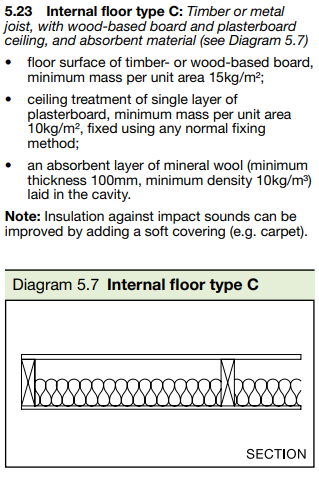
As I read it Part E does apply within a single dwelling. Table 0.1a and 0.1b set out values for 'separating' walls and floors which I presume means between dwelling units (e.g. flats) and the prevailing value for floors is around 45 dB for airborne sound. Table 0.1c sets out values within a dwelling and has a value of 40dB.
-
So if I understand it that document is setting out a valid substitute to the Part E "Internal floor type C".
-
In important consideration in all of this is Part E of building regulations: 18mm OSB3 and CaberFloor are below that 15kg/m2 requirement. I think 22mm OSB3 is also below 15kg/m2, but it is hard to find information on that. I spoke to a technical person at Norbord and they said it may have an issue there. [NOTE: normal 12.5mm wallboard plasterboard doesn't meet the 10kg/m2 requirement either]. Link to document
-
Chimney DPCs and damp handling
MortarThePoint replied to MortarThePoint's topic in Stoves, Fires & Fireplaces
I expect the hydrophobic properties would stop water wicking (capillary action) out of the brickwork wherever it pools, but hopefully there are weeps there to deep with that..




