


MortarThePoint
-
Posts
2294 -
Joined
-
Last visited
Everything posted by MortarThePoint
-
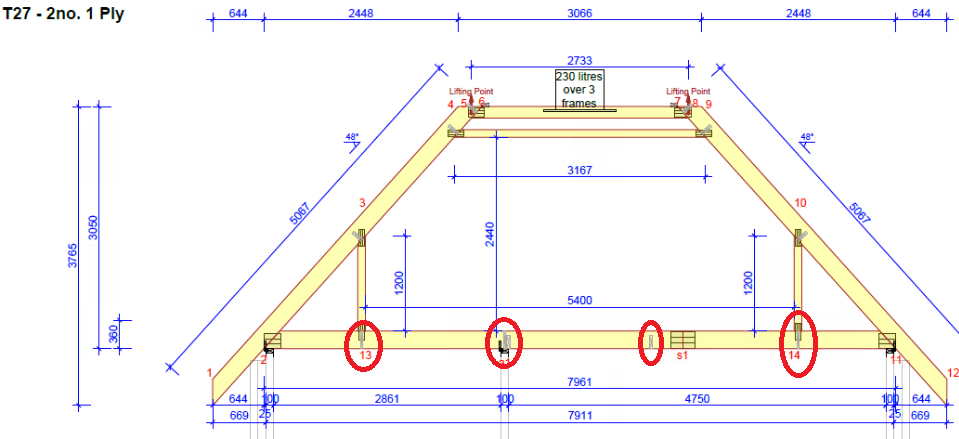
Like @pocster I'm messing about with Noggins, but mine are structural rather than for the plasterboard so I thought I'd start a different thread. We've got attic trusses and the roof designer said to put noggins in at the base of each side wall and then two noggins spaced in between that. I've circled what this ends up as below and the designer has shown some noggins 172mm aligned with the bottom of the bottom chord (222mm). Is that alignment the best choice (compared to flush with top of bottom chord or in the middle)? One run of noggins is basically along the support wall near where there look to be clips. Does it make sense to have them so close to anchors?
-
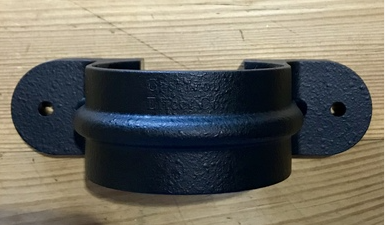
That does look very smart. It's mainly the brackets on the down pipes that look so good. I found these which look good, but not quite as good as where the BM downpipe sections meet:
-
I'd worry about it being pinched
-
Made in the UK apparently. Here's a video of samples: https://www.facebook.com/PVCPAINTING/videos/757936784356603/
-
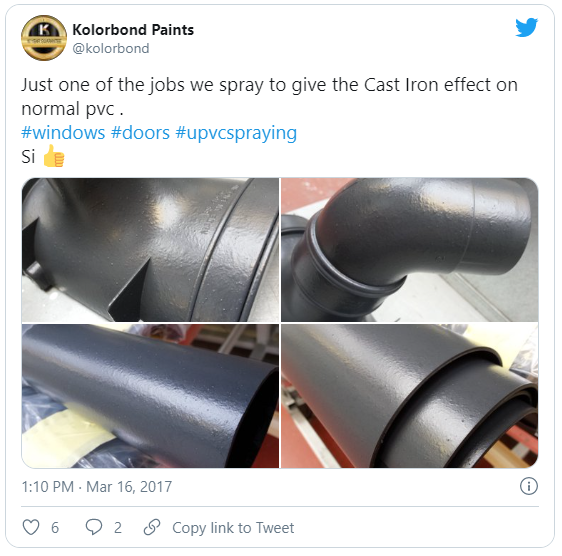
I saw this which looks pretty good:
-
I do think it looks good with light coloured timber cladding, but personally I prefer something darker with brickwork.
-
I've costed up the guttering etc in three different types. I had a full quote for it in Aluminium which was just over £4k, of which 54% was gutters and downpipes so I am scaling the other options on that basis. [NB: 84m guttering and 51m downpipe] Aluminium: inc. 125mm gutters, 76mm downpipes - £4,080 Brett Martin Cast Iron Effect: inc. 112mm gutters and 68mm downpipes - £1,936 FloPlast Cast Iron Effect: inc. 112mm gutters and 68mm downpipes - £1,319 Standard FloPlast: inc. 112mm gutters and 68mm downpipes - £341 It's amazing to see a factor of >10 in the price. On ScrewFix someone wrote in a review of the FloPlast cast iron effect: "This is standard plastic gutter that has been painted with a matt black textured paint to make it look like cast iron." I am tempted to have a go with some textured spray paint and see if I can make something that looks decent. Paint isn't ideal, but if that's what the FloPlast is then same compromise. I'm happy with black but my wife is set against it so painting may be the only option anyway. Is the Brett Martin cast iron effect moulded texture or painted as well? The big cost difference from FloPlast with Brett Martin is the cost of the downpipes as they look to have a connector moulded on.
-
Below are links that suggests there's scope to over specify here. If I follow the logic there is no need for laminated glass if the windows is key lockable and not within 400mm of a door of fire escape window: https://emplas.co.uk/news/2017/over-specification-on-pas24-and-sbd-could-mean-installers-are-losing-business-warning/ https://www.pbctoday.co.uk/news/building-control-news/meet-security-requirements-approved-document-q/26099/ Has anyone had non-laminated glass double glazed windows signed off on the ground floor? For example 4mm/16mm/4mm non-toughened glass (not laminated) with a key lock?
-
Someone may know better than me, but it looks as though if the window is locking it can be 6.4mm laminated glass and meet part Q. Secured By Design (SBD) looks to meet or exceed the requirements of part Q and there is a useful document which goes further than windows here.
-
I'm dubious about the extra cost myself. I just did a tot up and reckon that just the upgrade to 6.8mm laminated glass will cost >£2k for us. We could have a nice alarm and CCTV system for less than that. The next house is a distance away, so any burglar could happily arrive with a ladder and or sledge hammer and take his time. There's always a weak link and I think I'd rather it was the windows. It wouldn't take someone long to enter a house through the roof tiles if they wanted. You can get away with anything with a high vis jacket and a ladder. Added to that burglary rates are in general decline. A rise in home working, as I expect to for the foreseeable future, makes burglary even less attractive. I'm just feeling bitter about the extra cost though. Here's hoping I haven't tempted fate.

-
CheckList for ASHP self installation
MortarThePoint replied to swisscheese's topic in Air Source Heat Pumps (ASHP)
Can you do a DIY installation and qualify for the Renewal Heat Incentive? -
Fitting with tile coursing/gauge makes sense but I think that makes for about 70mm steps in height
-
Its plain clay tile. Is that because it has to fit to tile coursing?
-
Having the bottom of the velux window at or below about 1225mm would allow me to see down the drive whilst sat at a desk which I think is really useful.
-
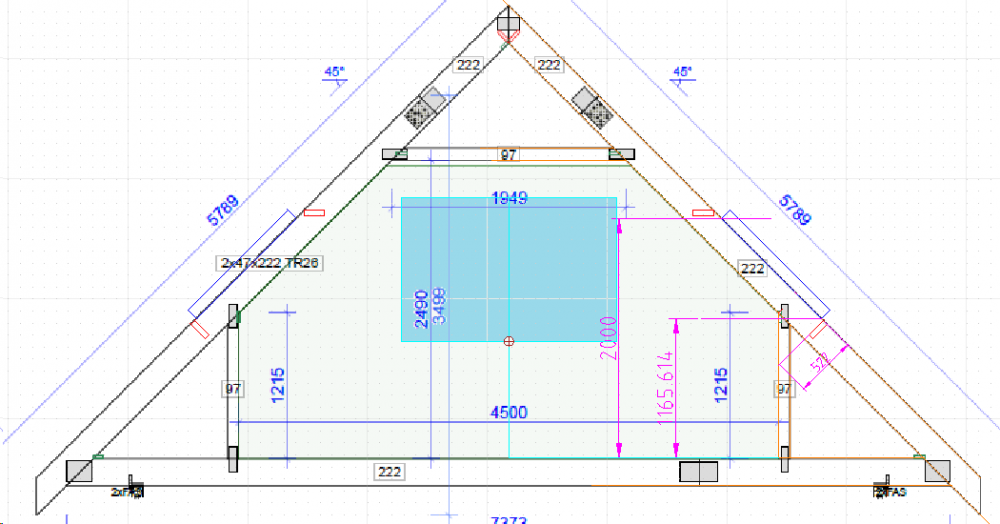
Above the garage we're having a home office with large windows at the ends (1800 x 1200, top about 2175 above floor). The front and rear roof pitches will have velux windows on and I can't decide what height to have them at. If I align the top of the velux reveal with the top of the end window reveal, the velux is pretty high, and the bottom of the glass will be above eye line when sat down. Is it going to look bad to have the top of the velux reveals lower than the end window top as shown below? picture shows velux frame outline in dark blue:
-
An outside shot would help then as different finishes will likely call for different approaches
-
Do you think the water is just penetrating the wall or is there a leaking gutter, roof etc. Waterbutts can create real problems if not done carefully as my inlaws had an issue with theirs. You may want to get a dehumidifier in there whilst you sort something out
-
It always frustrates me that we effectively have to check that what we want to do under PD is OK and the incurs a cost and wait. Feels a bit like asking permission, but nobody wants to get caught out so... If you have some hand sketches you might be able to find someone on fiverr.com that can knock up a drawing for you. I couldn't believe how good the 3D renders I got made for £20 were.
-
Chimney DPCs and damp handling
MortarThePoint replied to MortarThePoint's topic in Stoves, Fires & Fireplaces
The LABC guidance looks to have an aluminium cavity tray lower down: Lots of places I look, except the NHBC guidance, has 2 levels of trays: LABC: We've got a chimney at the wall edge and one at the junction between a flat room and a pitched section that comes down from the flat roof.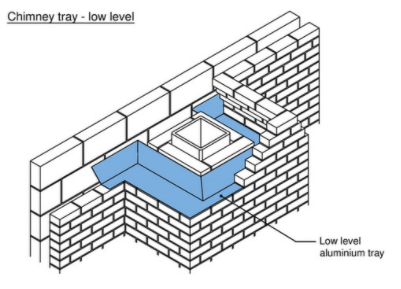
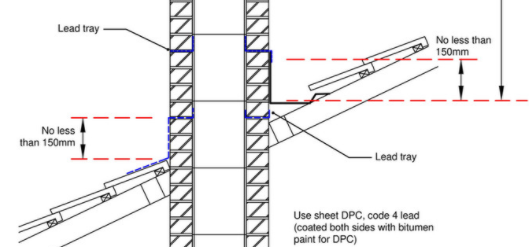
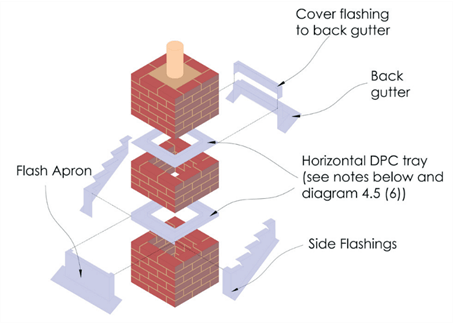
-
We'll have a package sewage treatment plant about 30m from the house and then there are currently two SVP outlet vents specified by the architect. This one is the one furthest from the plant, but the soil pipe will separate at a manhole outside the house. This position is approx 25m pipe run from that manhole and the other approx 12m.
-
Haven't fully known / thought about an AAV before. Floplast have an exterior one. Can they be used anywhere a vent is needed? They only mitigate against a vacuum, not a positive pressure.
-
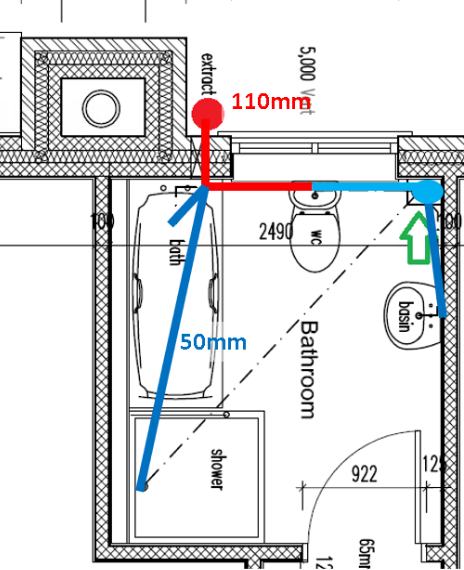
Below is a sketch of what I am thinking of. The red is 110mm soil pipe and the two blues are 50mm(?). If required by the regs, the light blue could be 110mm I guess.
-
It would have to wrap around the soffit/fascia or punch through it which isn't so ideal. Nice to have it hidden really.
-
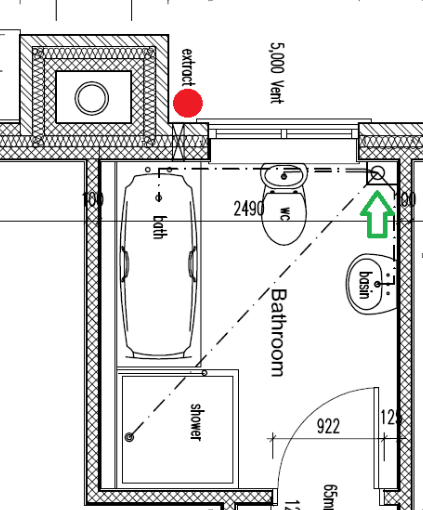
Architect originally had a the waste pipe from the bathroom going down through the floor in the corner (green arrow) as this aligned with a wall below. We have removed the wall below and are moving the waste pipe to the red circle as its tucked away there. The plan is that it is on the outside of the house through the GF and then on the inside through the FF. I'm wondering where to put the SVP tile outlet as having it near the chimney is likely to be difficult. Is it allowed to have the waste pipe in the red dot position and then a pipe leading up to the SVP vent outlet in the original green arrow position. I can't imagine why it wouldn't be OK, but building regs are often a surprise or there may be something I am missing. Can the pipe to an SVP vent outlet be narrower than 110mm, e.g. 45mm?
-
Toilet seat - bad design or am I missing something!
MortarThePoint replied to jfb's topic in General Plumbing
A toilet seat is interesting because it has a bottom on the top


