MortarThePoint
-
Posts
2294 -
Joined
-
Last visited
Everything posted by MortarThePoint
-
Toilet seat - bad design or am I missing something!
MortarThePoint replied to jfb's topic in General Plumbing
You could always splash out on a more expensive one. -
It could double up as a rather enjoyable panic room filled with bottles of wine
-
You might be able to find a cheap second hand tank, but not a septic one ? A plastic tank could have the advantage of providing a mould for the concrete as that is poured around it. Filling the tank with water first would stop it collapsing during the pour
-
The beams of your beam and block are going to have to have something to bear on near the hole so that probably involves pouring something even around the concrete rings. I wonder if you could so anything clever with a plastic tank?
-
I've been looking at the NHBC guidance for all chimneys and hoped someone could help. The page shows three drawings of DPCs in chimneys, two of which are on pitched sections of roof. I am understanding this as two alternatives, not that there should be a damp tray at the top junction and at the bottom junction. The one with the tray at the bottom 'junction' is on the eave of the roof. Can you use the other approach at the eave instead? Does anyone have a preference for which of the two approaches is adopted if it is a case of just one? "In areas of severe and very severe exposure, the following details should be used. In lower exposure zones, the tray upturn may be on the outside of the flue liner. All other details are the same." We're near Cambridge which is a 'Sheltered' exposure zone I believe. Generally I have found understanding damp proofing one of the hardest aspects to get right as some of the best practice / requirements are not so clearly defined.
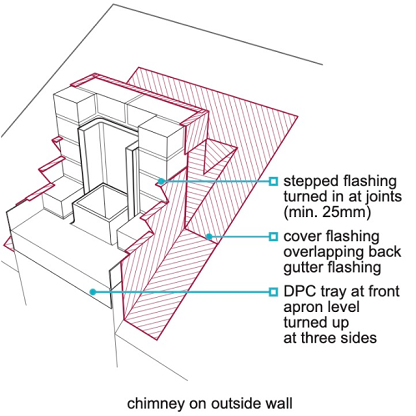
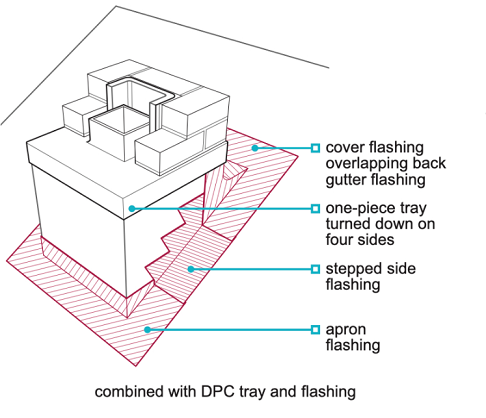
-
That sounds a good rule of thumb. However, I don't think WiFi is the correct wireless technology for home automation anyway. Definitely a sledgehammer to crack a nut (>10Mbps to send essentially 1 bit of data every few minutes at most). I do want to run a lot of Ethernet cable about the place, but that's not regulated (is it?).
-
The walls are mostly 100mm blockwork. I will take a look, but I think Part A limits chasing to "Vertically not deeper than one third of the thickness, horizontally not more than one sixth the thickness of the wall" [1] That's plenty mind you for plastered in wires. Thanks for this. I think (??) you can use conductive conduit outside these safe zones and as such could have it in skirting board if the skirting board was deep enough to enclose conduit, or was itself conduit.
-
We're not using insulation in the first floor make up. The screed will probably be thick enough to bury a reasonably sized conduit. As a moderate commitment-phobe, I'm not so keen on the finality of burying things though.
-
We're not having MVHR so no ducts to worry about there. Wet plaster seems to be OK on the precast:
-
Happy new year everyone! I'm deliberating on where to route my services and most significantly the wiring. Water is concentrated at two ends of the house, so I can do all that routing vertically and via the roof space. Electrical wiring on the other hand needs to go to all rooms. I am considering a very bold move of having almost no wired in light switches and using home automation for almost all lights in conjunction with wireless light switches. The reason I mention that is that it saves routing wires down from ceiling lights to switches and therefore makes the majority of the consideration around sockets. We have precast concrete ground and and first floors, so I see the following main options for routing the mains for sockets: False ceiling, would have to chase down to the sockets Conduit buried in floor screed, would have to chase up to the sockets Chased into wall horizontally and vertically Within skirting boards, would have to have screed conduit for doorways Avoiding a false ceiling has a load of benefits. The architect has included false ceilings, but I'd like to rethink that.
-
I have a crane coming on Monday (07/12/20) and we only need it for an hour or two. Does anyone need the other half of the day?
-
Tips on reviewing roof truss design
MortarThePoint replied to MortarThePoint's topic in Roofing, Tiling & Slating
So does that mean if you have Isokern pumice liner and leca infill like I do you can have trusses very close to the chimney's brickwork? That would be good as otherwise I have to solve a small truss that has gone in at 45mm from the outer skin of the chimney. (my chimney is 175mm Isokern, minimum 95mm Leca, blockwork, cavity, brickwork) -
I'm not worried about it, that's what worried me ?
-
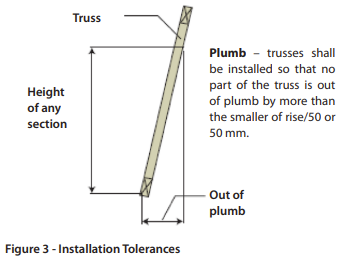
Easy to find Australian guidance suggests up to 50mm out of plumb is acceptable. That's a bit much for my liking, but shows it's not very critical. http://www.hyne.com.au/documents/Feature Documents/TQ_26_TrussInstallation_final.pdf
-
I wondered what people's expectations were for truss verticality. The chippie has got the trusses roughly set and is fine tuning as he fits the trimmers. Being as I am, I can't help but get a level on it. I wanted to check my expectations though. My feeling is as long as the bubble is just touching or inside the lines it is OK. Trusses are made of wood that can be slightly twisted and warped so better than that feels unrealistic to me. You want to be using a 1800mm level for this. If you like numbers: My level is +/-0.5mm/m accuracy which I think means it is +/-2mm between the lines (https://www.leveldevelopments.com/2020/10/sensitivity-accuracy-of-spirit-level-vials/). 2mm/m (0.1degrees) would give a horizontal deviation of 6mm and a vertical deviation of 0.0mm on a 3m truss. To reach 1mm of vertical deviation the horizontal deviation needs to reach 77mm, or ~25mm/m (1.5 degrees). I expect a roof would actually be fine if the trusses were off by 1.5 degrees or more because the trusses are all braced so it's not so much about the trusses toppling. The profile of the roof isn't substantially affected even at 1.5 degrees. The exceptions to these are at hips, valleys and gables as such deviaton would move the positions of these elements that would then affect the profile of the roof. You'd be asking more out of the battens though with 1.5 degree error as the nominal 600mm could become 600+77+77=754mm so about 25% over what it should be.
-
Butt jointing the wall plate
MortarThePoint replied to MortarThePoint's topic in Roofing, Tiling & Slating
I got complements from the brickie so I clearly did an alright job of it. The chippie hasn't turned his nose up at it so that's good too. -
Tips on reviewing roof truss design
MortarThePoint replied to MortarThePoint's topic in Roofing, Tiling & Slating
Get a drawing that shows the trimmer sizes and ideally the designer can generate the cut list for the infill timbers. The carpenter won't necessarily follow the cut list and the truss company will include extra provision for this, but it is useful to see. Double check the chimneys, >50mm clearance to all combustible materials. Check this on site as trusses are installed. -
Butt jointing the wall plate
MortarThePoint replied to MortarThePoint's topic in Roofing, Tiling & Slating
I did the lap cuts and it ends up being pretty quick and accurate once you get a technique going. A full depth circular saw cut into each side of the timber and then a half depth cross cut on the flat of the timber. Hammer and chisel to remove the chunk and clean up. Top tip: don't bother making bits for the gables. I got carried away and made a short section for one gable by mistake ? -
Closing cavity at the top for blown beads
MortarThePoint replied to MortarThePoint's topic in Heat Insulation
I'm leave a 50mm gap between insulation in insulated pitches and the membrane for drape of the membrane (otherwise need counter battens). Does this rafter roll not prevent the required drape? The drape is need to allow water to pass between the outside of the membrane and the battens. -
Closing cavity at the top for blown beads
MortarThePoint replied to MortarThePoint's topic in Heat Insulation
There's some debate on this as I understand it. I spoke to my architect and he said that NHBC now mandate ridge ventilation and that people are starting to doubt the breather membranes and install eave ventilation as well. He speculated that NHBC may mandate eave ventilation in due cause but was going to check LABC and NHBC for details. -
Closing cavity at the top for blown beads
MortarThePoint replied to MortarThePoint's topic in Heat Insulation
What's that rippled black plastic called? I presume it's to create a ventilation gap between insulation and roofing membrane -
Closing cavity at the top for blown beads
MortarThePoint replied to MortarThePoint's topic in Heat Insulation
This is part of the construction drawing. The loft insulation is to overlap the wall plate and cavity insulation.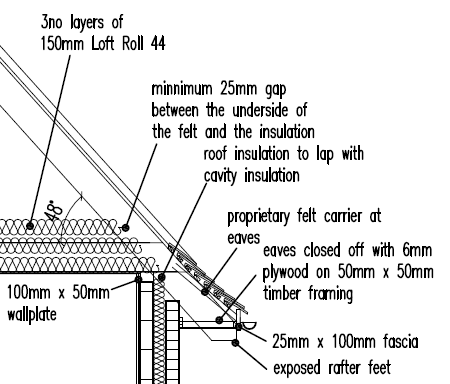
-
Closing cavity at the top for blown beads
MortarThePoint replied to MortarThePoint's topic in Heat Insulation
The loft insulation will come down to the top of the beads, but I was planning to do that afterwards -
We've gone the Isokern route. It is quite expensive compared to just a corrugated steel flue liner, but I was told by many that you can't just have a corrugated steel flue liner on a new build. There is a lot to be said for a simple straight run. Cool arrangement you are having with the BBQ. I always liked the idea of a pizza oven built in to the wall with a door in to the kitchen and a door on to the patio. That got forgotten about when the realities of the building arrived, but I still think it would be cool.
-
Tips on reviewing roof truss design
MortarThePoint replied to MortarThePoint's topic in Roofing, Tiling & Slating
If your trusses are to come in two deliveries, get lists of which trusses are to be in each delivery. Don't just rely on a confirmed request, get the actual truss codes coming on the first lorry. You want the girder trusses on the first delivery.