


MortarThePoint
-
Posts
2294 -
Joined
-
Last visited
Everything posted by MortarThePoint
-
I'm stripping there system back to the actuators and possibly the wiring centres so won't be using their thermostats. I'll then be enacting my own centralised control system with remote wireless temperature sensors. 1500m of tubing, three manifolds (5, 7 and 11) with actuators and wiring centres, clip rail tracks, pump, expansion vessel, design etc for a bit over £3k. If I put together a similar basket at WundaTrade it's £2k, but I can't see an expansion vessel on Wunda so I'm not sure what the score is there (suspect it's this for £54). If the parts are truly equivalent, it's basically £1k for the warranty, design an support. With no experience of fitting UFH before, the design and support could be very valuable to me.
-
Tin hat on as I know there isn't much love to nu-heat around here. I'm considering them just for the UFH, no the ASHP itself. Their initial price was ridiculous, but having basically said I could easily get equivalent parts from X or Y for half the price, an ask the manager conversation narrowed the gap to near reasonable. They have set up a system with lots of zones which I know is debatable, so I'll look into that and see how much it reduces things to have fewer (also remove any UFH for the hall/landing if they've done that). Has anyone actually gone with Nu-Heat and have any direct experience beyond the quote stage? Ultimately, is their product good, mainly the 14mm Fastflo tubing and Optiflo manifolds? Those are the hardest parts to replace. Am I correct in assuming that there is a standardised thread for actuators and so I can swap those easily enough? Nu-Heat's electrics look to be Heatmiser rebranded so no major concern there (?) They seem to use a Wilo Para SC7 pump. I have looked at Wunda and is another key option, but I'd like to understand more about Nu-Heat as there is lots of information on here about Wunda installs (probably for good reason).
-
Do you remember what brand of clip rail track you used?
-
I can't do that directly as the gas membrane is there but hopefully it will stick well. This comment concerned me a bit. Do you think the weight of the tubes will help out?
-
It is quite a new product that is structural and has beam components, but the reinforced web is 50mm. It and the gas membrane are installed, but nothing on top yet.
-
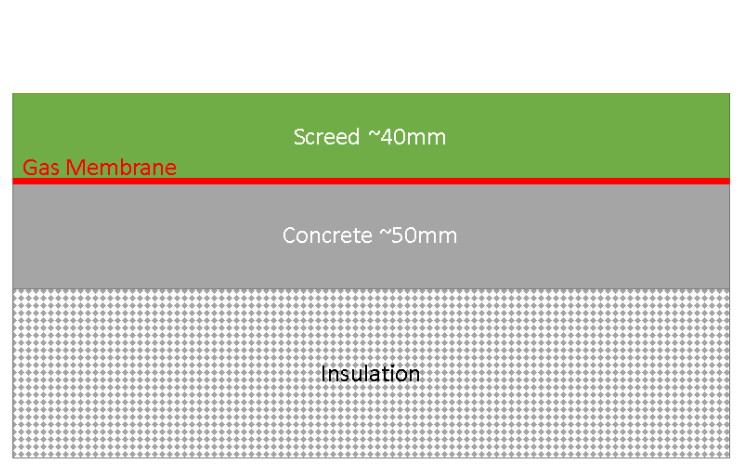
The stack up is: Insulation (325mm EPS) Precast Concrete (50mm) Gas Membrane Slip Membrane (if needed) Screed with UHF (~40mm)
-
I've touched on that in another thread and I'd like to have it on FF as we are likely to use the attic above and I don't want to risk having to have the GF too hot to make the 2nd F nice.
-
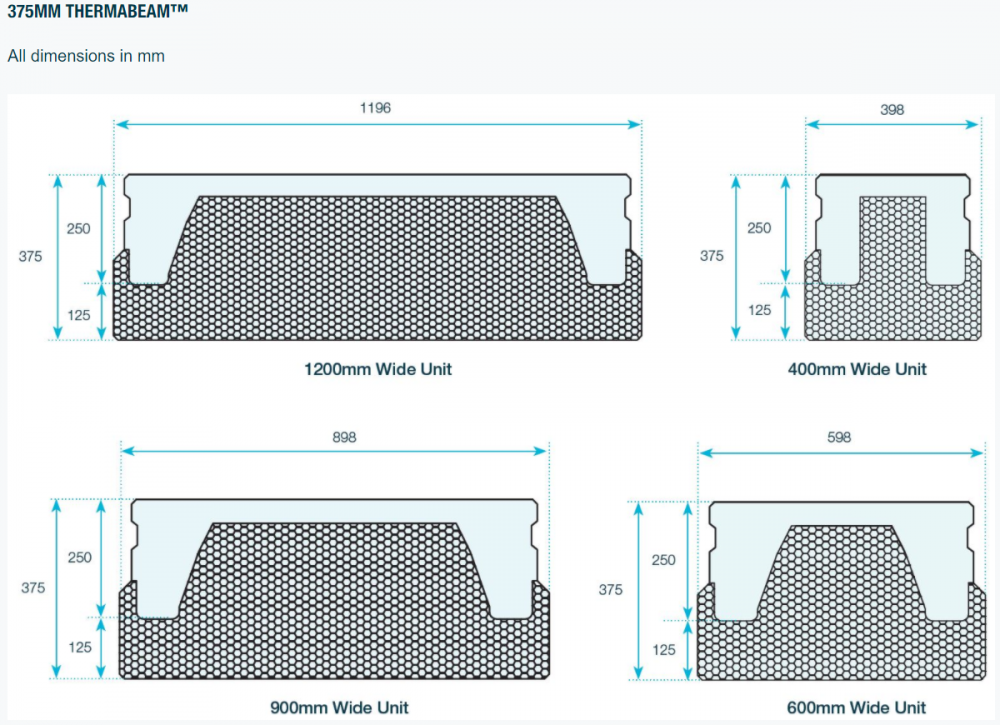
We have concrete* that is going to be directly under the screed with UFH in. On the Ground floor, the concrete is 50mm thick* with insulation below and a gas membrane above. Consequently, I can't use staples to hold down the pipes. I think that leaves the conventional options being: Insulated panels: don't want the insulation or bounce possibility Castellated panels: expensive ~£7-10/m2. seem very expensive when you multiply by the m2 needed. It's about 3x the cost of the pipes themselves which doesn't feel right given the restraint is to last about a day before the screed then holds everything in place. Clip rails: ~£1.90/m2. These feel like a good solution, but on the GF I'd have to rely on the self adhesive backing of the clip rail track. We plan to use a thin Anhydrite screed, 40-50 mm of Thermio+. We are not looking for a highly responsive system as using ASHP. Does anyone have experience of how well the clip rail tracks stick down? I could add screws to hold them down on the FF, but not GF. Do the pipes want to pull the clips off and make it a nightmare? I think I saw somewhere that some lay reinforcement mesh and then zip tie the pipes down. It's around £2.30/m2 for A142 mesh and has a good weight (2.2kg/m2) to it which would help hold the pipes down. * Thermobeam
-
Yes, I found it interesting reading so thought worth sharing
-
Here is a useful link about guttering layout design: https://www.gutter.co.uk/what-we-have-forgotten-about-victorian-gutters-and-drain-pipes/
-
I feel the need, the need for screed
MortarThePoint replied to MortarThePoint's topic in Floor Structures
One complication I'll have is on the ground floor we have a gas membrane, so I'll have to work out how to anchor the sole plate of the stud work walls. That will be easier after screed won't it, or should I be casting something into the screed? possibly the act of casting the sole plate itself in is the way to go. -
I feel the need, the need for screed
MortarThePoint replied to MortarThePoint's topic in Floor Structures
Thanks Simon. Would you mind passing on the name of the supplier (DM you prefer)? I'm really keen for it to be level as that saves a lot of messing about and is one of those signposts that they have taken pride in their work which gives you confidence the rest has been done right. Is there a reason you added Kingspan upstands as well as the foam expansion upstand tapes? Are you then using insulated plasterboard above that? -
I feel the need, the need for screed
MortarThePoint replied to MortarThePoint's topic in Floor Structures
I'm expecting to have to leave the house alone for a week to 10 days and then only do non floor based tasks for another month after that. I guess an advantage of getting the sole plates in before screed is that the stud partition could then be assembled after 10 days rather than possibly waiting the extra month. -
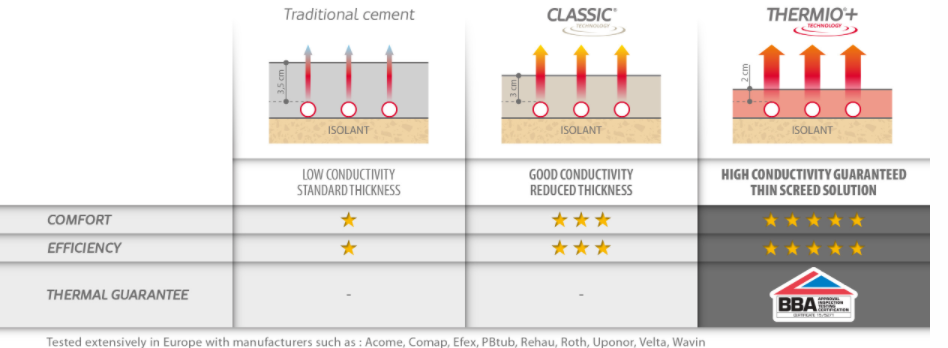
The next big step for me is installing UFH and screed. For the ground floor (GF) we have used 375mm Thermobeam which has a 50mm concrete deck over 325mm of EPS. For the first floor (FF) we have used 150mm hollow core planks. We'll be using an ASHP to heat wet UFH. We had to cut blocks to establish a good coursing on the GF as the Thermobeam height control wasn't very good and so that has pinched 10-30 mm in places. Consequently, and because we have 50mm of concrete as the next layer down, I want to use a thinner screed. I have been looking at Thermio+ which supports screed depths down to around 40mm (20mm above pipes). I think I am sold on Ahydrite liquid screed over the more traditional type, though am open to persuasion. The first floor HCF is much more level, but it makes sense to use the same screed throughout. I had wondered about forgoing underfloor heating on the FF, but we are interested in using the attic space so having two floors without significant heating seems a stretch. Again this would be around 40mm thick. On thing I was wondering was about stud partitions. Should these be established (or at least their sole plates fitted) before applying screed or is it best done afterwards on top of screed?
-
11mm or 18mm OSB for temporary floating floor.
MortarThePoint replied to epsilonGreedy's topic in Floor Structures
Will you have an opportunity to reuse the OSB later on? For example flooring in an attic space. If so bear that use in mind and I suspect the 11mm may fall short of what you'd need for the other use. -
Is UFH for bathrooms worth it?
MortarThePoint replied to MortarThePoint's topic in Underfloor Heating
I've drooled over he Schuter Ditra Heat system as it has thermal decoupling as well as being able to accommodate substrate shift (e.g. concrete cracking) whilst being compressively strong. It's eye wateringly expensive though ~£16/m2 for the egg crate and ~£60/m2 for the wire which is frankly a joke by comparison. -
Is UFH for bathrooms worth it?
MortarThePoint replied to MortarThePoint's topic in Underfloor Heating
That's right. Since then I bought my own wetsuit for open water swimming and have to confess that it's hard to do a 4 hour swim without taking a leak ? -
Is UFH for bathrooms worth it?
MortarThePoint replied to MortarThePoint's topic in Underfloor Heating
Wowser! -
Is UFH for bathrooms worth it?
MortarThePoint replied to MortarThePoint's topic in Underfloor Heating
My sailing club had a dustbin full of bleach to wash your wetsuit in and cold showers to be dodged on the way home. -
Trusses against brick wall
MortarThePoint replied to MortarThePoint's topic in Roofing, Tiling & Slating
Well I have had some numbers back from the truss designer: 2-ply truss 6.3kN (factored) 1-ply truss 4.4kN (factored) ? Must be all that snow on those two days a year we get here. That makes for a total load on a ledger board of 35kN which falls into my scary category. I phoned Rawlplug asking about options. They were very helpful and have since done some looking. "the concrete screw gives quite good loadings 2.3kN recommended load if you need higher loadings then you need to look at Resins". That's not a scary number of screws 35/2.3 = 15, so would be one every 300mm. He shared a datasheet which included this: I guess he is using the 8mm tension figure of 2.3kN, the shear figure is actually slightly higher. His email had a potential killer sign off though "There is no load data for concrete screws and bricks but we have used concrete screws into bricks and they work well the only issue is all bricks vary and it would mean doing on site pull out tests to prove the brick is suitable." My bricks are 25N/mm2 but I don't have the equipment to do a pull out test. I hate having to talk to by Structural Engineer. Of all the people so far, he has been the most difficult to deal with as there's always a vibe of "why are you bothering me with this".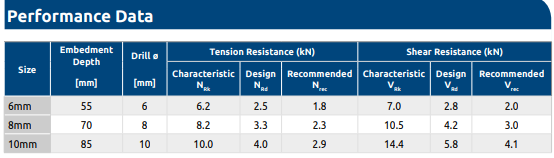
-
Is UFH for bathrooms worth it?
MortarThePoint replied to MortarThePoint's topic in Underfloor Heating
Any idea what the energy consumption is? I expect the thermostat means it's only on a small proportion of the time, but what proportion I wonder? -
Is UFH for bathrooms worth it?
MortarThePoint replied to MortarThePoint's topic in Underfloor Heating
I think I'm sold on UHF for the bathrooms, but inclined to go electric so that it is more immediate heat. I can have it heating up something like 15mm of material with a higher power than a water system would achieve. It does mean better planning is required in terms of when it comes on however. -
Is UFH for bathrooms worth it?
MortarThePoint replied to MortarThePoint's topic in Underfloor Heating
It's a good name from the bill payer's perspective, but sets the tone with the family. Is there a KindDad range instead -
Is UFH for bathrooms worth it?
MortarThePoint replied to MortarThePoint's topic in Underfloor Heating
If you have a link or picture that would be cool as I'm considering options. The most likely approach will be linking it to the home automation system that I am cooking up. I can then use a simple analogue thermostat that has its power turned on/off by a smart switch relay (e.g. something like Sonoff TH16). I'd be embarrassed to admit how many of these I have already as that's part of the day job ? -
Trusses against brick wall
MortarThePoint replied to MortarThePoint's topic in Roofing, Tiling & Slating
I asked them to include a 5.4m length of 47x222 with that in mind. I'm also getting some 47x147 and 35x147 as I had paid before then dropping an exterior area that I want to do in treated timber that they don't do. Do you think 47mm is too thick for the ledger board, do you think 35 would be better?



