


Ian
-
Posts
751 -
Joined
-
Last visited
-
Days Won
3
Everything posted by Ian
-
Currently paying 13.2p/kWh day rate from Pure Planet (all renewables)
-
Corrosion of 316 stainless steel door handles
Ian replied to Mr Punter's topic in Building Materials
@Mr Punter It's not a cheap product but you could try this: https://www.amazon.com/Stainless-Steel-Rust-Remover-Cleaner/dp/B071Y37HND We used it on a commercial job where some SS had gone rusty after the client's cleaners used bleach. It worked really well. -
Corrosion of 316 stainless steel door handles
Ian replied to Mr Punter's topic in Building Materials
if you end up replacing them we've found that polished 316 SS is better than brush-finish at staying corrosion free. It's something to do with the smoothness of the surface. -
normally, any movement has to be contained within the original red line on the planning application site plan. Anything outside that and it's a new application.
-
Optimum U-value - installation cost vs saving on heating
Ian replied to Tony C's topic in Heat Insulation
Mine was Building Regs min compliance 2+ years ago in North Wales (building regs slightly different from England & Scotland) It's a bungalow of 71 sq.m internal space. Area weighted average 'U' value for walls, floor and roof was 0.15 and 3G windows 0.8 'U' value average. No special measures for air tightness and no MVHR. Air tightness at test was 3.7 m3/h/m2 [Edit: 'U' values for each element were 0.1 for floor (UFH); 0.13 for roof and 0.21 for walls] Bulk LPG with combi boiler for all hot water, cooking and UFH Mains electric Blower sewage treatment plant Building is a holiday home and is used most weekends 1200 litres of LPG cost £360 on first fill of the tank and it lasted 24 months before it needed refilling so £180/year + standing charge. Its on a 'frost'setting of 12 degC and boosted at weekends in Winter to normal temperature. The building takes about 3 days to fall back to 12 degC after the weekend Electric usage in 2018 was 1528 kWh Water was about £70 total for 2018 inc standing charge (water in N Wales is £1.3 for 1,000 litres) -
Lindab: does the exact specification matter?
Ian replied to ToughButterCup's topic in Rainwater, Guttering & SuDS
Do you mean Planning Permission? Building control won't care what material your gutters are made out of. You could fit Upvc and they would be happy. Planning is a different issue. -
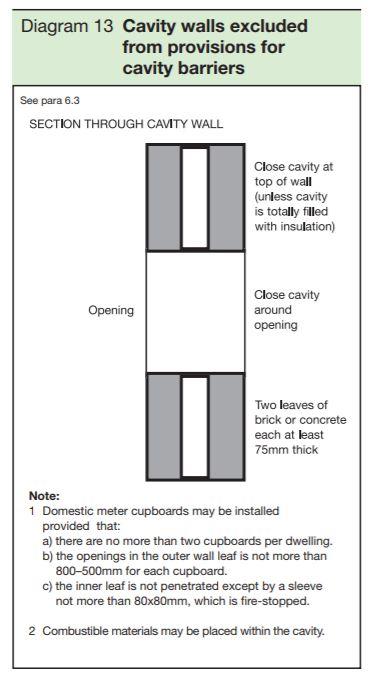
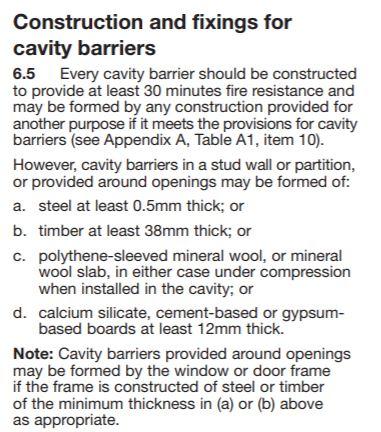
The only requirement in the Building Regs is that the cavity is closed at areas such as windows & door positions. The regs list a wide range of suitable materials including timber that can be used to close the cavity at these positions. Edit to show extract from English building regs AD Part B
-
I'm not sure why you would need fire barriers in a normal 2 storey detached house unless you have an attached garage. In England & Wales they are not required unless you are building more than 2 storeys or building terraced or semi-detached housing where fire separation is needed on the party walls. Timber frame houses are no different from masonry ones
-
Mine was a small 2 bed 71 sq.m timber frame bungalow on a steeply sloping rural site in Wales with difficult access. Building Regs min compliant with average 0.15 'U' values and 3G windows Getting to a stage of watertight shell c/w insulation, roof and wall cladding and windows and all internal walls (but no internal doors) was 50% of total build budget.
-
As a first step I'd ask your flooring contractor if he can organise for a calcium carbide test to be done so that you can compare the results with the hygrometer test results. It's possible that you've been getting false positive readings from the hygrometer testing and carrying out a calcium carbide test will let you know if there's a problem or not with the testing you've done so far. Calcium carbide testing is quick but it involves taking a small sample of the screed which is weighed and put into a testing vessel and mixed with calcium carbide powder - the results of the chemical reaction allow an exact measure of moisture content to be taken and is more reliable than hygrometer testing.
-
sorry, yes 304. A number of years ago I was asked to inspect the suspended ceiling of a large public swimming pool and found that the whole ceiling was on the point of collapse as the 304 SS hanger wire had corroded - you could snap the wire with normal finger pressure.
-
grade 314 stainless steel is often used but it is useless in a high corrosion swimming pool environment as it corrodes from the inside (it ends up full of holes and looking like a Crunchie bar). The grade of SS needed is 316 which is an austenitic marine grade.
-
Vapour pressure will generally be from inside toward the outside so best practice guidance is that the materials on the warm side should have a total vapour resistance of at least twice the sum of the vapour resistances on the cold side (BS 5250:2011). IE in practice if you are using membranes, then the outside one would be a breather membrane and the inner one should be impermeable.
-
Steel stanchions and Durisol blocks and insulation
Ian replied to hallega's topic in Insulated Concrete Formwork (ICF)
It’s the ph13 of concrete that protects the steel -
As @ProDave said PD rights don’t come into play until after the building is completed. Unfortunately, the answer is to apply for a variation to your PP.
-
Building control approval for self build mortgage
Ian replied to Water's topic in Building Regulations
When you speak to the Building Inspector let them know that what you need is the “plans approval” stage for your mortgage. Normally, Local Authority Building Control will not let you switch to a private “approved inspector” once a deposit has been paid. -
@Ferdinand Not personally but through our work as architects we've won a couple inc LABC and Civic Trust awards. I think both of those would be of interest to self-builders. LABC Building Excellence: https://www.labc.co.uk/awards?language_content_entity=en Civic Trust Awards: https://www.civictrustawards.org.uk/
-
That’s what I did. Make sure you clean any dust from the foil face before using the tape.
-
Steel stanchions and Durisol blocks and insulation
Ian replied to hallega's topic in Insulated Concrete Formwork (ICF)
There's no issues in surrounding the steel column in that sketch with concrete. Concrete in that situation would protect the steel from corrosion. Locations where the steel is not surrounded by concrete (eg the face) should be painted to provide corrosion protection. -
The highest risk is during any “hot works”. Usual risk mitigation is to make sure any hot works are stopped a minimum of 2 hours before leaving site and to have appropriate fire extinguishers to hand.
-
That's great to hear as it's probably the most difficult part of any self-build! I'm impressed. I understand you don't know about foundations yet but what is the rest of your build cost coming to out of interest?
-
I still think that you would be best coordinating the whole lot through a Planning Consultant. They would liaise with your solicitor and make sure they incorporate anything that is needed for the legal side of the application. Try ringing Berwyn Owen or Jamie Bradshaw at Owen Devenport - they are North Wales based but will cover Mid Wales (I've no connection with them other than I used them for my own application even though I'm an architect) https://www.owendevenport.co.uk/
-
@NeverEnoughCake Having read through all the thread so far I think your next step in the process is to make your application for Planning Permission. They take a long time and suppliers and builders will be much more willing to talk to you about prices once you have PP. If you need advice about potential build costs for your 10m x 8.5m bungalow ask away and you should get lots of good advice. Mine was also a 2 bed bungalow 13.5m x 6.75m (external dimensions) and in 2016/17 it cost £96k for the finished building, 5k for external works on a 1.5 acre site and a further £7k for other costs eg PP inc an appeal; Building Regs; demolition of a previous building
-
I agree completely with @Christine Walker You would be far better using a local Planning Consultant rather than a solicitor for the planning application. If you are in North Wales rather than South then I can recommend the one I used.
-
It might be worth you looking at this Welsh Government initiative: https://gweddill.gov.wales/docs/desh/publications/090521susdev1wales1planeten.pdf According to a spokeman it is "intended to provide an opportunity for those wishing to live a highly sustainable lifestyle, project a light touch on the environment, and who will be largely self-sufficient in terms of income, food, and energy,"

