andyscotland
-
Posts
638 -
Joined
-
Last visited
-
Days Won
1
Everything posted by andyscotland
-
As you say your spark will need to be comfortable but from my somewhat rusty memory of that aspect of the regs so long as the enclosure is properly rated (including sealed covers over the mcbs etc) there should be issue. If you ever look out the back of a tent at a festival/event/concert you will see an absolute forest of outdoor rated distribution boards, often on very substantial 3 phase circuits. They are usually one-piece rubber boxes with screw -tight lids. I think you would probably need a non-conductive unit as the earthing/bonding arrangements are usually different outdoors so a metal unit could be more complex in that regard depending on the details of location/circuit design/etc.
-
Ahhh - should have been more specific. What I have is 9mm utility board which I think is solid, my recollection is it was much tougher to cut than the fascias I had. I will double check when I dig it out tho. Failing that I'll find something more rigid - perspex maybe? I don't think the loading is huge, even with live loads & snow load included my rough calculation worked out less than 300kg per screw, so if I have my maths right over the joist bearing area it's something like 10 kg/cm2 / 140psi / 980 kPa.
-
Excellent point, thanks. I have some offcuts of uPVC fascia that would probably do the trick for packing the timber off the screw head. I guess I was just thinking with a french drain round the perimeter and then the only major source of water would be from the soil upward so a DPM would trap that below leaving the void above dry other than airborne moisture which should generally blow through the cross ventilation?
-
@Iceverge thanks very much. Do you think definitely a permeable weed membrane? I was planning that but now wondering if a DPM (as per the solum under a suspended timber floor) would make more sense. A drain round the outer edge is a good plan.
-
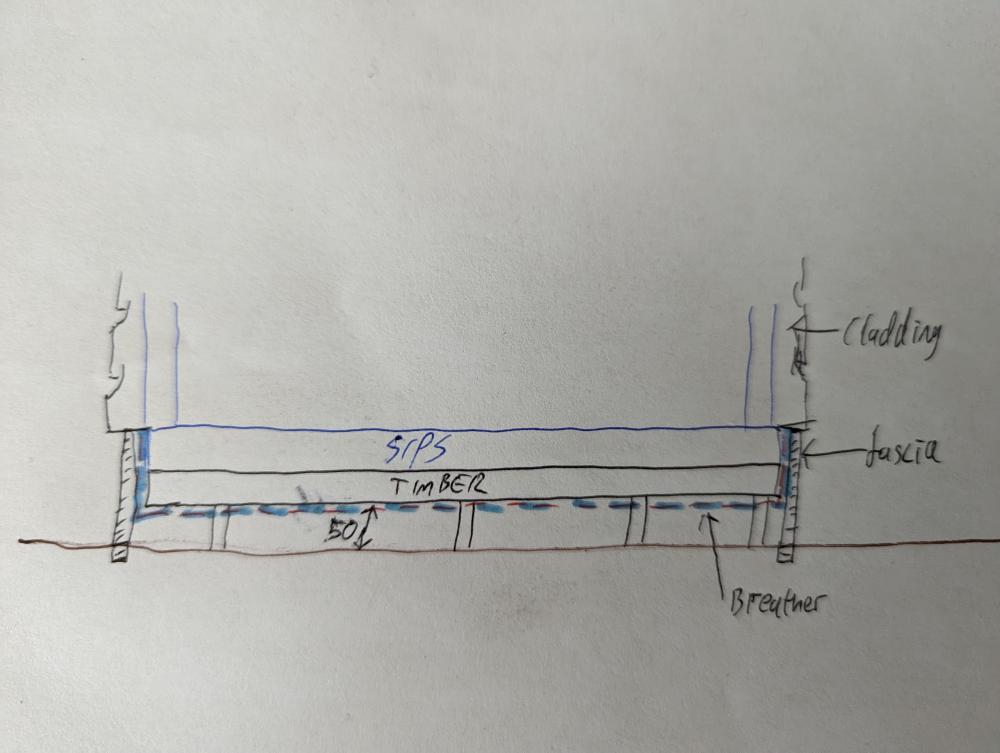
E.g. my plan as per this very rough sketch
-
I'm erecting a SIPS garden office. It's going to sit on a timber subframe on ground screws. I've seen some suppliers recommend a DPM between the ground screw heads & the timber to protect from moisture. But I'd think that could be worse - if any water does get in there (running down the side of the building/condensation) then the DPM would hold it against the timber? I'm thinking it would be better to use breather membrane so any moisture has a route out. The timber will be about 50mm above ground and I'm planning to put uPVC fascia around all sides to protect from splashing water and close the gap. Then drill some holes with insect mesh cover plates to allow airflow through the void. What do you think?
-
Thanks @Dave Jones
-
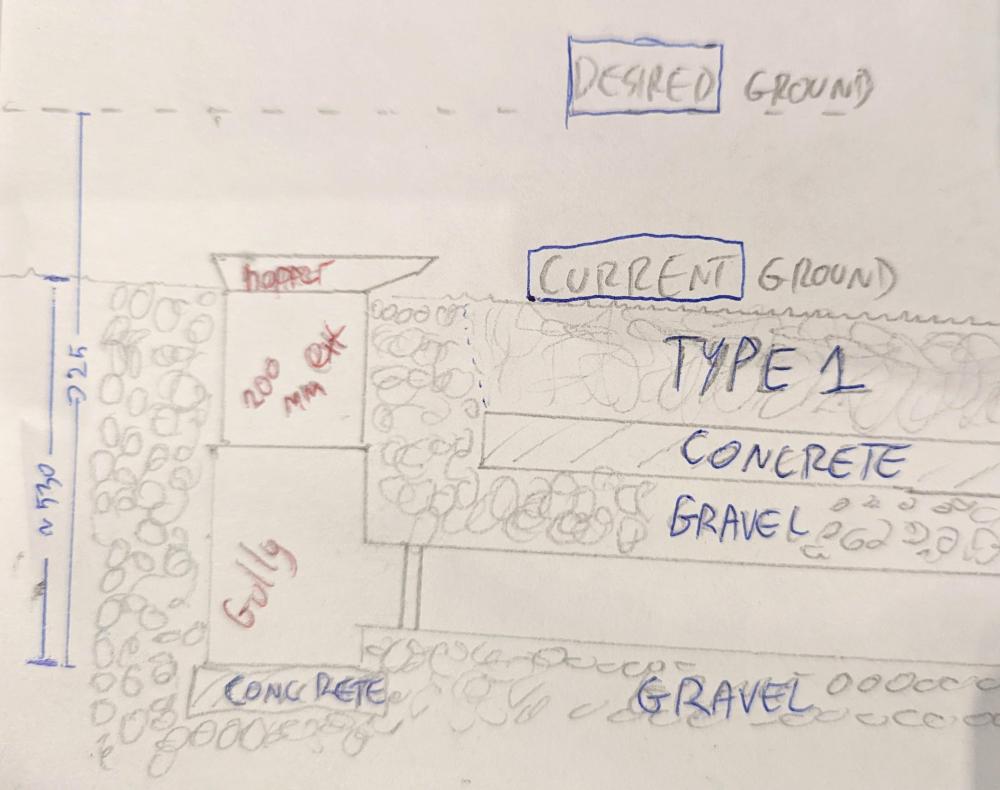
@Dave Jones @Conor thanks for replying. My problem is the gully is already in, at the lower depth, and I don't think I can change that to add a drop to the pipe without quite a bit of hassle. Here's what I have at the moment: The gully can't move horizontally as it needs to meet the downpipe above (not shown). So to add a pair of 90s/pair of 45s to drop down to pipe invert I'd need to break up the concrete capping above the pipe. Obviously can do that if I absolutely have to, but it'd be much easier if I could get away with just putting a second riser between the gully & the top hopper.
-
I have messed up. I laid the underground drainage for my extension as deep as I could (within the limits of fall to the existing drain). But I worked to the wrong height for the finished path surface to the level threshold. The extension is on sloping ground and I think I must have measured from the wrong datum 😬😒 So as it stands, the bottom of one bottle gully will be 725mm below finished ground level. It is taking surface water and a shared rainwater/kitchen drain via a downpipe through the grating. The back inlet is not connected. I know you can get 200mm extension pieces. Polypipe say that you can only use one, but I'm wondering if that's for rodding access if you're using both underground pipe connections. I can't find anything in building regs/approved docs that specifically mentions an maximum depth for a gully. Does anyone know if there is one? I've tested and I can just reach the bottom of the trap even at the new depth. It's also only about a metre from the IC and is easily roddable from there. So from that perspective if I stick a couple of extensions on it should be fine. So I'm not worried about it other than getting it past BC. I'm very jealous of people who can "ask the BCO". My council has made clear that they will not be looking at mine until the completion inspection and "it's your responsibility to comply, we can't provide design advice"... I'd really prefer not to take it up and move the pipe higher unless I absolutely have to. I don't want to disturb the other pipes that run alongside and under the extension, and it's all bedded under concrete slabs as it wasn't deep enough to get the minimum cover.
-
Advice needed on PD and summerhouse build
andyscotland replied to China21's topic in Introduce Yourself
Indeed, I was lucky I found it as of course internet research overwhelmingly throws up guidance for England & Wales. It may be that's why a few of our height limits are slightly taller, to compensate for the difference if the ground is only mildly uneven. My hunch is @China21is in England/Wales as they mentioned Class E and our permitted development classes are numbered rather than lettered. But thought worth highlighting for anyone who might find this thread in the future. -
Advice needed on PD and summerhouse build
andyscotland replied to China21's topic in Introduce Yourself
Assuming you're in England. Weirdly in Scotland the allowed heights are similar but on sloping ground they're measured from the lowest ground adjacent to the building. No idea why we have the opposite rule to England, seems confusingly inconsistent! -
I assume you mean taking the leisure battery through an inverter? The thought occurs that most if not all of that kit will internally be low-voltage DC electronics. The inverter & subsequent power supplies must contribute a reasonable level of losses on a 24/7 basis. I wonder if there's a case for trying to find a way of powering some of it directly from the DC leisure battery supply...?
-
I think PIR below would make it worse : it will bring the "dew point" (the point where it's cold enough for moisture in the air to condense) further in towards the house. So increases the risk that is somewhere inside/between the rafters, rather than above them. In theory it would also (if fully taped) act as a vapour barrier so reducing moisture levels but I wouldn't rely on the foil faces of PIR if there's any doubt, they are easily scratched/punctured. I think Kingspan/Celotex will do you a full u-value calculation including a condensation risk for free if you ask. I've had Ecotherm do them for me before. Though I heard some of the manufacturers were starting to restrict that service to trades/bigger projects - not sure if that's correct.
-
Fused Spur for MVHR with Boost
andyscotland replied to TimCx's topic in Mechanical Ventilation with Heat Recovery (MVHR)
Ah ok, that makes sense. Well yes in that case I guess technically you could use a 2-pole isolator and take the supply to the boost switches from the appliance side of that. Equally I doubt a 2-pole will be noticeably cheaper so it might be worth fitting the 3 as that gives you more flexibility for the future. -
Fused Spur for MVHR with Boost
andyscotland replied to TimCx's topic in Mechanical Ventilation with Heat Recovery (MVHR)
Also worth noting/considering the location of the isolation switch(es). With bathroom fans they're commonly outside the bathroom door, but assuming your MVHR is buried somewhere I would put the isolator by the appliance. If an isolator for mechanical maintenance is not located where the person doing the maintenance has constant sight/control of it, you need a suitable mechanism for them to prevent someone else turning it back on e.g. a switch with a padlock lock-out. -
Fused Spur for MVHR with Boost
andyscotland replied to TimCx's topic in Mechanical Ventilation with Heat Recovery (MVHR)
I don't think the boost line is energised from the MVHR. The first drawing you posted assumes the power supply and boost trigger are on the same circuit. The neutral is shared but the switched live will need to be energised from the switch end e.g. often by looping from a lighting point. The second drawing has the switched live from a separate circuit (e.g. perhaps power supply taken from the socket ring/a plantroom power circuit and the switch trigger run from a bathroom further away). In that case the neutrals need to be split primarily to avoid causing a leakage current that would trip an RCD/RCBO. But the phase conductor is still energised from the switch end. You need to be able to isolate the appliance for mechanical maintenance and the regs for that require isolation in "all live conductors" which includes the neutral. You also ideally need to be able to reliably isolate all supplies simultaneously, so a single isolator covering the power supply and boost line(s). Theoretically you can isolate the power & boost separately so long as you fit a clear & durable warning notice to any enclosure containing live parts from both circuits (e.g. the MVHR and the connection point) explaining how to safely isolate it. But I would always avoid that wherever possible, it's much safer to have a single switch. -
What is Rear Elevation?
andyscotland replied to Jonathan M's topic in House Extensions & Conservatories
I am not by any means an expert in this area. But I am pretty sure they can't just decide to "deem it part of the original house" unless it meets the specific legal definition of that term. Unless as Ferdinand says it's actually an original part of the house that just looks like an extension. It is probably worth checking the history of your property before taking this any further (whether pushing back on PD or applying for planning). Did the drawings you sent in for the lawful cert application make clear what you consider to be the original house? It is possible the planner has missed that detail. -
What is Rear Elevation?
andyscotland replied to Jonathan M's topic in House Extensions & Conservatories
So in that case it seems the key question is whether the stepped line of the extension follows a line of some pre-existing part of the original house, or whether the extension was on "new" land. "Original house" is I'm fairly sure a defined term in planning law, it means as first built or as it was at some specific date in the past (1948?) if the house is older than that. -
What is Rear Elevation?
andyscotland replied to Jonathan M's topic in House Extensions & Conservatories
Which UK country are you in? - the planning rules are a little different. In Scotland, in what I think is the current legislation, it says: "rear elevation” means the elevation of the original dwellinghouse that is opposite its principal elevation; https://www.legislation.gov.uk/ssi/2011/357/schedule/made So to my untrained eye I think they've got that wrong. Assuming of course that the utility room is not on top of something (an attached garage?) that was part of the original footprint of the house when first built. -
Rear extension permitted development in Scotland
andyscotland replied to Y555SLD's topic in Planning Permission
And as far as I can see that matches the legislation (I'm pretty sure https://www.legislation.gov.uk/ssi/2011/357/schedule/made is the current rules for extensions): The projection limit is only specified in clause 2b, and would appear fairly definitely only to apply if the boundary condition is triggered. I guess that does make some sort of logical sense : you can put an outbuilding at any distance from the house, and there is no limit to the length of it so long as it doesn't cover 50% of the curtilage. So if legally you'd be allowed a long thin shed all the way to 1m before the back fence, there wouldn't be much difference putting an extension on that footprint.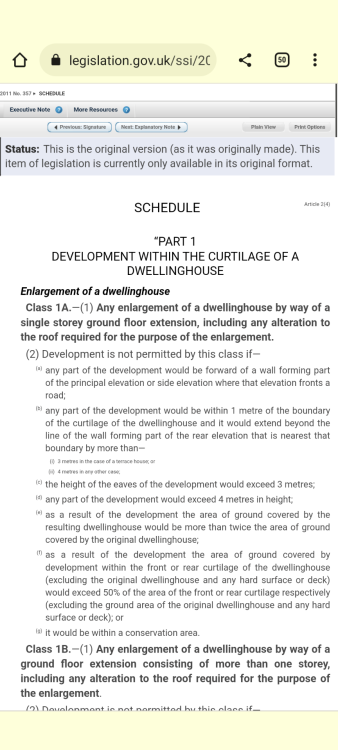
-
Fused Spur for MVHR with Boost
andyscotland replied to TimCx's topic in Mechanical Ventilation with Heat Recovery (MVHR)
You can get fused 3-pole fan isolators e.g. https://www.tlc-direct.co.uk/Products/CLCMA3020.html although more often the fan is designed and cabled to cope with a 5/6A circuit protective device and just runs directly off a lighting circuit without needing a separate fuse (and/or is internally fused to protect the appliance's own components and connected to the circuit with cable of sufficient size for the protective device). The manufacturer's instructions mention "other means of connecting the unit...see notes on the next page". Do they specify an un-fused option? If the manufacturer specifies that the 3A fuse is always required then you'd need to achieve that. However there's no reason you can't connect a normal unswitched fused spur in series with a normal 3 pole isolator if you can't source / don't like the look of any of the all-in-one options. Personally, I'd put the isolator first and then the fuse plate second so you can easily de-energise the supply (without putting the lights out) for added safety when changing the fuse - in theory that's not necessary but in practice sometimes the fuse carriers can snap & expose terminals so I prefer the safety net of having the supply isolated as well. If the mvhr is accessible you could put the spur plate at the appliance and use a flex outlet plate for the final connection, or you can put it by the isolator and loop in/out with a rear outlet spur plate. You just need the cable between isolator & spur plate to be the same as the circuit supplying it. Of course I would also always advise clearing your proposal with the electrician that will be inspecting & testing as ultimately they're the person that needs to be happy with the details & layout of your circuit. -
Outward opening windows on ground floor building regulations
andyscotland replied to DC5's topic in Building Regulations
It may be worth checking this with Building Control. Some of the requirements like that are aimed more at multiple occupancy buildings (blocks of flats etc) than private dwellings. That guidance you linked says if the projection cannot be avoided it must be guarded, then goes on to say that guarding is not required within a dwelling. If the path is within your private garden and the window therefore unlikely to affect anyone bar you & your family it may be that BCO will be happy with that. Remember that the technical handbooks are approved guidance that you can comply with to meet the regulations, but building control have some discretion to consider other arrangements if they're happy that the overall reg is satisfied - in this case that "people in and around the building are protected from injury that could result from fixed glazing, projections or moving elements on the building". Arguably the fact that residents will know the location of the window & the path, and if the path is lightly used then quite a low chance of someone opening the window at exactly the same time someone is walking past, may be considered sufficient protection. I know that my mother in law recently completed an extension with multiple windows and a door that open out onto the path around the house and nobody raised any concerns. I'm pretty sure I've seen other projects around here with similar setups. Obviously if your path has any public access that would change things. -
I do like that idea, on the one hand much more straightforward/realistic than an EPC. But could introduce a lot of problems. I suspect we - family of 4 and both working from home - use a lot more energy than the old lady down the road (with identical construction) who only heats one room with a radiant heater when she feels a bit chilly, is only using hot water when her carers wash her, and eats mostly microwave meals. It would be very hard for a prospective buyer to figure out what was going on with either of our houses (and how it would correlate to their own likely usage) without understanding quite a lot about who is living in the house and how, I think? And that becomes even more of a problem if you're trying to compare neighbourhood figures. Ours is a move-here-young-then-stay-till-you-die area so the variation between types of neighbours is huge and changes all the time. This is very true, although I think there would be ways of presenting the energy in a comparable/understandable way if that was prioritised.
-
This is a fair point. I think in Scotland the plan is to make it that you can't sell a house without getting it up to an EPC C, with funding available to support those that have financial need, which may help. Agreed. The other idea floating that may help there is for everyone to get "affordable" energy up to a certain reasonable limit, and for cost to rise significantly as you go above that. Which partly works with the concept that without the high-demand users, the rest of us could probably manage more of the time with renewables and with existing/lighter-weight grid infrastructure. So the premium on choosing to have an inefficient property starts to reflect the incremental cost of supplying power to it, rather than that being averaged into everyone's bills.
-
I think probably only incentives. In my experience, the wealthy love a bargain/free money. From a financial fairness point of view, it sticks in the craw, but from an environment/energy point of view I think you just have to have an open-access fund to subsidise/reward costs of energy saving enhancements to existing buildings with the only conditions being on the nature/level of energy savings. I would also make any scheme allow for DIY self-install (maybe with a quick inspection/photos before and after) for simple things - there are loads of folk who could just fit some draught strips/loft roll rather than paying for a contractor & their markup. The other advantage of a universal scheme is it is then much easier to market nationwide and that is likely to help uptake. The one saving grace of paying the rich to improve their mansions is that if it reduces peak demand so that we don't need gas backup as often that will in theory make everyone's bills cheaper.