Dan F
-
Posts
1431 -
Joined
-
Last visited
-
Days Won
2
Everything posted by Dan F
-
Really hard to know from a single cross-section like this. They have a design tool that you can use to give you a good idea, it is fairly conservative though and is only 2D, not 3D. Depends what you want to use Ubiquiti for: - If you just want wifi then you need access points, something to power them with and somewhere to host the controller software. To recommended way to power them is from a PoE switch, which means they can just run on the other end of your pre-installed ethernet cable and don't need ay power adapters. The controller software to manage the wifi networks can be run anyway (including a PC or a raspberry pi etc.) but the "dream machine" products have it pre-installed so you don't need to host it. - Another thing you might want to use Ubiquiti for is as a router. If you do, then the "dream machine" products are also routers. Alternatively you might want to use a ISP supplied router or a product from an alternative manufactuer. - If you also want to Ubiquiti for CCTV, the "dream machine" products (particualry the ones that accept hard drives) can be used and an NVR. They can go anyway. Ours are in ceiling voids. But there will be some amount of impact on sigan`l if you hide them away too much. so you do need to be aware of that.
-
If your supply is 5 bar and you have a 3 bar static PRV then dynamic pressue after PRV will be impacted by pressure loss through PRV and be lower than 3 bar. On the the other hand, if you have dynamic PRV set to 3 bar then, as long as supply can support it, dynamic pressure after PRV will be 3 bar regardless of the flow rate. Dynamic PRV's sound better, but the downside is that static pressure isn't limited and can creep up so they aren't suitable for some applications. (That's how i understand it anyway)
-
@fezster Is your PRV dynamic or static? The 2.5bar dynamic pressure you see is due to losses either before or through PRV. The best way to confirm this would be to test dynamic pressure just before PRV. The fact your dynamic pressure doesn't increase above 2.5bar when you increase PRV to 4bar simply points to a limitation in dynamic pressue of supply IMO. The pressure drop in the PRV is dynamic pressure before - dynamic pressue after, not the difference between static and dynamic values.
-
Also look at https://greatwater.co.uk/. Couple of models with 1-inch connections and pretty good flow rates. Cheaper than Harvey and Kinetico AFAIU.
-
We used a single length of pre-insulated Rehau Rauthermex duo for this. It was 8-10m and we took it down thorugh the slab, under EPS and then up in the ASHP install location.
-
ASHP help needed with my daft questions…!
Dan F replied to Tim S's topic in Air Source Heat Pumps (ASHP)
ASHP-specific curves will also clarify the output you can expect. Generaly the headline kW is nominal, and the ASHP can actually output more, depending on temps. With some brands you might be able to size just based on the nominal kW, but with others it's worth digging into the details. Our ASHP for example is a 7kW model but can output up to 12.3kW A7W35 with COP of 4. -
It's typically a function of the kitchen manufacturer carcass size, plinth height chosen, and the worktop you choose not something that is that easy to adjusted on-site. So I woulnd't really put this onto the architect, even if he was there, as this height would have been defined before things got to site. In our case 100mm+780mm+12mm = 892mm. If we wanted higher then we would have needed a 150mm plinth or thicker worktop, but 892mm is perfect for us. The germans tend to use 780mm carcasses, other kitchens we saw had 830mm carcass and we had to rule these out as it was going to make worktop height 920+ To make it higher you'd need to: - Use a thicker worktop (but this had probably already been ordered?) - Increase the plinth size and find a way to raise height of all units. You might be limited by plinth sizes though e.g. if you go from 100mm to 150mm then worktop may become too high. Unless they cut down plinths, but that's more work of course. What ae your plinth, carcass, worktop heights?
-
Some HA bits to give away for freeee (KNX/Dali/modbus)
Dan F replied to joth's topic in Networks, AV, Security & Automation
The one thing I forgot to mention is that, with the 4-channel version, you need to get hod of a DALI power supply for each channel. Something like: https://www.meanwell-web.com/en-gb/dali-ultra-slim-bus-power-supply-output-18-7vdc-at-dlp--04r -
Will take a look. EEBus is very easy, especially from Loxone, where ebus is really quite low-level. I wonder if this is something in between. It seems it works with VR921 (sensoNet) according to docs.
-
Using an ebus coupler? Let me know how you get on with this as I'm interested to do the same given i) no modbus interface available ii) EEBus works well but is limited.
-
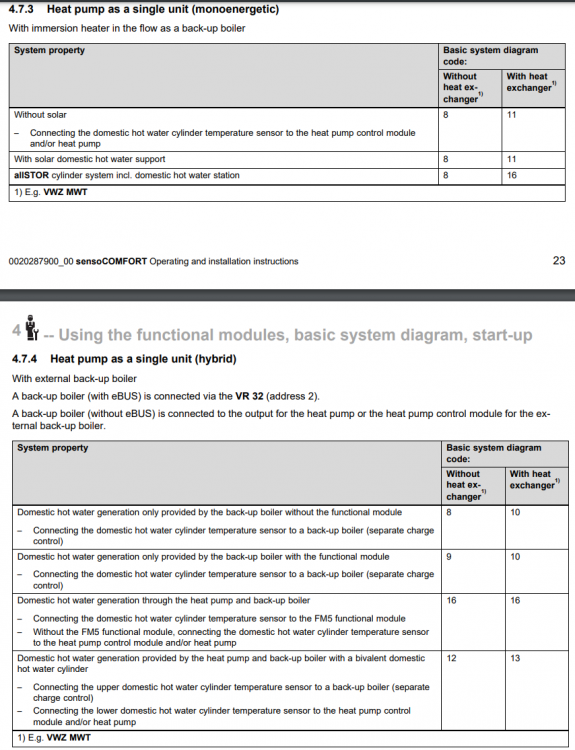
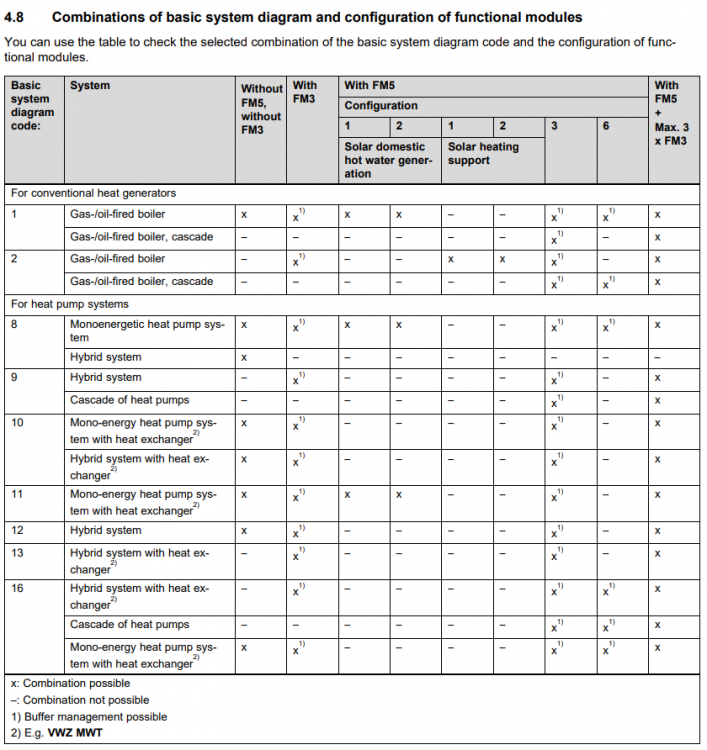
Look in SensoComfort manual:
-
@Bruno Could the "system diagram" values in the schematics be wrong? The manual I have clearly says that "8" is ASHP system without a heat-exchanger and "10" is for a ASHP with a heat-exchanger (HEX). It also says that buffer management is available with both "8" and "10" but that it depends on you using a FM3 or FM5 functional module. From your first post it looks like you don't have a HEX, correct? My setup (hyrdaulic station + 25L buffer with no HEX or glycol even) has been setup with, and is running perfectly, using "system diagram 8".
-
Oh, so that's how it works. "Environmental yield" isn't clearly defined in anything I saw.. so assumed it was output.
-
That's COP of 1.56.
-
Sorry @James94 I was just sharing what our electrician used previously, @PeterW is right. I guess our electrician used 4mm because he was considering the 2.5mm 17A minumum rating (?). If you look it up though, this only applies to 60C rated cables, so they were being fairly conservative. With a 32A hob though, it seems 4mm is cutting it fine (would required 90C cable). If you give your electrician the Bora X Pure specs, he should know what to do. It's likely just a case of him assuming a hob with a lower rating.
-
Have you seen Lunos? They have various options incuding MVHR, none of which use any ducting, with really good efficiencies. https://www.partel.co.uk/lunos-decentralised-ventilation-systems
-
I tried to insist on 28mm to the UVC but heating engineer argued it was pointless because the monobloc outlet was 22mm (which isn't really true, but still). That said 22mm isn't bad, if it's just hot or just cold. The 22mm monobloc is terrible for pressure loss though and a 28mm dedicated PRV version is quite a bit better! There is a slightly longer story behind this as I currently have 28mm PRV and a 22mm monobloc PRV in series, producing 0.8bar pressure loss when just flushing a toilet! We have improved things by having the first one set at 4bar and the monobloc set at 3.5bar, but getting rid of the monobloc is the best solution. (The first PRV was added to allow for a gate valve between supply water (before softener) and balanced cold while still using the monobloc supplied by with UVC. We wanted fully softened hot water, but only semi softened cold water as it impacts rinsing ability)
-
Calculate your heat demand and then model it in loopcad with different spacing. This will give you power output for different flow temperatures. If using 150mm centers means you can use a lower temperature then it may be advantagous. In a very highly insulated house 150mm is typically too close though, and even 200mm you can run at <30C, so it depends on house and heat demand.
-
Thanks! Is this based on observation, or is this behaviour detailed somewhere? I installed one on one loop last night just after posing on buildhub (i closed all other loops) and have been trying to understand it through observation, but so far it just seems to just be fully open all the time. The weather-compensated flow temperature is currently 26.5C. What would you expect it to do if return temperature is i) >23.5C ii) <23.5C?
-
Internally I have a mix of pipe sizes. I used the online calcuatora to trade-off pressure loss with the time it takes for hot-water using shower manufactuers PQ charts. What I didn't account for in these calculations though was the pressure loss due to the PRV! While the PRV is set at 3bar (static) it has a pressure loss of 0.5bar+ (depending on flow rate) which I hadn't taken into account. I have a 28mm supply which is reduced to 22mm (primarily because the monobloc is 22mm) which then splits off into 22mm for UVC and 22mm cold from the monobloc. What I think I need to do is: i) Get rid of the 22mm monobloc and replace it with standalone 28mm PRV (which will have lower pressure loss than the 22mm monobloc) and add in a standalone 6bar pressure relief valve. ii) Ideally use 28mm all the way unti the point that hot/cold split.
-
Yes, definitely get those upgraded. Easy now, not later. Yes, between per-appliance isolator and appliance. In terms of back to your consumer unit, they don't all need their own dedicated circuits nesecaily i don't think (although they often do) but there are limits/guidelines and you cant put everything on one either i don't think. Hopefully an electrician on the forum can coment on this..
-
Ovens/hobs are suppsoed to be radial, with dedicated isolator and i think breaker too. What is the rating of the hob. Ours needed 6mm form what I remember. Edit: Our Bora hob is 7.6kW. It has 6mm wiring, dedicated isolator in the kitchen and its own 32A breaker (or RCBO, can't remember) in the consumer unit. Radial for fridge, dishwasher, freezer etc. is a good idea as it allows you to have a grid of isolators for all appliances in one place.
-
A lot of the new ones do have pyrolytic cleaning and/or fast heating modes though, and therefore are up to 3.7kW (16A). If you don't know what oven you are getting yet, you should ensure he allows for 16A. I would personally expect, and insist on, 4mm for anything that may be up to 16A. That is what our electrician has used.
-
Does anyone know what happens with these actuators if, for example: - The flow (from mixer) is 26C - The return temperature is say 23C Do they keep closing in an attempt to achieve delta-t of 7k and if/when they can't achieve this there is no flow? Or what happens in this case? The reason I ask is because when when using a low heat-curve and it's not particualy cold outside our controller keeps things ticking over but at lower flow temperatures anyway. Currently (21C inside and 6C) outside it's using a target of 26C. I don't currently have the Salus actuactors installed, but I was just wondering what would happen in this scenario once they are installed. I guess I could try one on one of the loops, but just thought someone may know.
-
Yes it's all logical and I went through a similair process. What I did with the overheating and condensation concerns though, was to quantify them by getting the numbers to the cooling load and the cooling power of UFH, before deciding what else to add in. When I saw that the cooling load was just 300W and UFH could suplly 3.5kW without any condensation that put me at ease. I then turned my attention to how to best avoid the situation where the first floor is a couple of degrees cooler or warmer than downstairs (which is often reported) and looked at MVHR heat-battery vs. fancoils. Ended up going with the heat-battery as it's a single unit next to UFH manifold, rather than needing one unit per room and a lot more plumbing. MVHR can't deliver very much cooling at all, but given I knew the demand was so low, this wasn't an issue. On the heating front, given UFH output way exceeded heat demand (2.5kW) on the ground floor, and I knew the MVHR heat battery could be as needed to delivery an additional 1kW to the first floor if needed, it was clear that using UFH on the first floor was completely unnecesary (have used electric mats in the bathrooms though). What would I do specifically with your design? It's hard to say without some calcs, but would probably: - Drop first-floor UFH for sure. - Drop ground-floor fancoils (or put in pipework for future-proofing instead). - Keep first floor fancoils (rather than explore MVHR-based approach) if you want to be conservative. - See if you can run DHW/UFH/Fancoils of a single ASHP to simplifiy things and reduce costs. (there are some very good pre-insulated underground ducting products that can be used for for longer distance with minimal losses, which are used in europe for district heating systems.)