Dan F
-
Posts
1431 -
Joined
-
Last visited
-
Days Won
2
Everything posted by Dan F
-
Boosting helps increase the transfer, but transfer will still happen at standard flow rates. Our first-floor non-boost flow rate is 145m3/h which should equate to 1.5kW/1.8kW cooling/heating. If this is "useful" or not, will depend on the specific build and your goals. Our whole-house cooling load is just 330W so, along with UFH on the ground floor, 1.5kW is enough to "trim" things on the first-floor on the hottest days of the year. Our total heating load is around 3.5kW, which can easily be covered with UFH but having some output on the first floor helps avoid befrooms getting chilly on the coldest days of the year. What we found this winter is that even with MVHR on low at night the air suppy (after heat exchange) is enough to lower bedroom temperature to 17/18C even when ground floor is a nice 21C. This approach was based on feedback from others with MBC builds that were very happy with just ground-floor UFH as primary source or heating/cooling, but commented on the fact that on the hottest/coldest days of the years bedrooms could be a few degress higher/lower than the ground floor which wasn't always ideal.
-
Yes I probably need to call Zehender and see if their technical team can give me any pointers. Without the heat-meter it would be very hard to know what was going on. I didn't think the Comfopost was particularly expensive, it does means you have to insulate all your first-floor ducting though.
-
Just one MVHR unit (Zehnder ComfoAir Q600 ERV). The supply splits for the ground floor and first floor, with the ground floor manifold in the plant room and the first-floor manifold in the loft. The Comfopost is in the plant room on the first-floor branch. This doesn't present any issues with balancing the system, no. There will be a small amount of pressure loss through the ComofoPost, but if the system is balanced/commissioned with the Comfopost in place this won't be an issue. I've been proponent of Comfopost for "trimming" first-floor temperature when overheating has already been designed for via overhangs and automated shading, and I still beleive this is a realistic approach in combination with ground floor heating/cooling via UFH. But, in practice, for some reason the heating/cooling power to Comfopost (measured with a heat meter) doesn't appear to come close to what was in our M&E spec or the manufacturers data-sheet. I'm not sure what the issue is and need to look into this further, but the delta-t is very low .
-
Anyone any idea roughly what I should expect to pay for two concrete pads 1000x1000x600mm deep (400mm below finnised ground level) with a 400mm deep trench between them and and blockwork up to ground level? South-east prices unfortunately.
-
Landing, stairs and corridors are Class 1. Balconies, julliete balconies and "edges of roofs" are Class 2. Our BCO and window supplier were both consistent is saying that low-level first-floor windows (with no roof flat roof outside) fell into Class 2 and not Class 1. That table you copied isn't particulalry clear, take a look at this for example, which adds more colour: https://techhub.uk.saint-gobain-building-glass.com/sites/default/files/document-files/Guards %26 Barriers 2A - Applied Loads - 17-09-2018.pdf
-
You should insist they provide this documenation. Or have you already done this and got nowhere? Right. I had a similair issue. In my case it was no no such tables for triple-glazing in your case your glass make-up isn't listed. I agree, if you just use this table then you need 6+6, but the reality is that your units are almost certainly fine, it's just a paperwork issues. What is you cill height for the largest 1.026x1.448m windows? This is important as the line and area loads need to be calcuated 1.1m from floor level.
-
Sticking to the 1m is still advisable, but my understanding is the same as yours; if the ASHP is clearly marked in your planning application and your application is approved then this is what counts. In our planning application our architect added the ASHP and stated "ASHP to be installed in accordance to MCS 020 Planning Standard in relation to acoustics and habitable rooms". Our planning drawings show ASHP 1.20m from the boundary, but in practice we've ended up closer given the ASHP needs 250mm breathing room making the total depth required 700mm rather than 450mm.
-
This is a guarding requirement for first-floor low-level windows. This, is not AFAIK, a requirement for ground-floor low-level windows. Instead ground-floor low level windows simply need to "break safely". To prove safe-breakage they need to comply with EN12600. Are your windows ground floor or first-floor? If they are anything like out BCO this won't be enough if they want "design loadings". But again, "design loadings" should only be required for first-floor load level windows. What you need to fully satisfy this requirement (if they are first floor windows is): - BS1680 compliance. - Design loadings calculated to using EN 16612 which show they meet 0.74kN/m requirement as specified in BS1680. Our supplier was unable to get this paperwork from the european manufuactur and our BCO didn't insist in the end. Our glass is triple-glazed with all three panes toughened. One thing that helped put his mind at rest though was the report I generated, for the same glass unit make-up using the AGC calculator. What size are the glass units in your case?
-
Have you seen my thread from couple of weeks ago when our BCO visited?
-
I had another look and we do have the intumescent seals which came rebated into the frame. We also have the same double silcone seal. What the BCO wants to see is something like this, which is completely unnecceaary given the double silcone seal and airtighness classification. https://www.pyroplex.com/fire-sealing/fire-door-seals/fire-smoke-seal-pile/
-
Where exactly did you install the intumescent seals? Did you need to rebate the door or frame for this? It might be easier for us to install a standard intumescent smoke seal that BCO is used to seeing, then trying to get paperwork to prove EN 13501-2 "smoke tightness" compliance of the Moralt/Lathams supplied product.
-
How did you deal with this in the end @joth. Our inspector hasn't said anything about intumescent strips, but is insisting that the door is supposed to have "smoke brush seals". Like you, the airtightness should make these both redundant, especially as the smoke requirement is at ambient temperatures only, but I need something to be able to give him. I've rung Lathams to see how they can help, but not heard back yet. I'm hoping if I can get an airtighness certificate of some sort from them (EN 12207) this will help, but we'll see.
-
Right. I wasn't using average. I disagree - that is assumption is NOT a given. Fair enough, but without modelling it, I do think it's fairly obvious that it would be more efficent as the flow temperature wouldn't be 65C for the whole time. I has an initial 15min ramp as ASHP kicks-in and the top of the tank is brough up to 55C, but after this there is 1hr+ at 67C almost fixed. This is a direct result of the Mixergy design and the way it keeps the hot top by spraying in cold water from the bottom of the tank. Yeah! At a flow temp of 55C I was fairly convinced the top-up would outweigh the improved COP. But at flow temp of 67C this starts to become very questionable. If i reduce the mixergy temp to 50 (and therefore flow temp to 62), it might start to make a little bit more sense though as COP be more like 2.5+, rather than 1.9. Heating to 55C the mixergy way is around 1.9. Heating to 50C the mixergy way should be closer to 2.5. Hard to know what the traditional way would be, but I'd expect closer to 3.5+ given A12W45 at 50% compressor is COP 4. Showers are not close to UVC so wasn't really practical. Also at the time I was assuming I'd be using "top-up" (didn't realise it would require 67C flow temp) and other approachs for WWHRS would have messed up the stratification I think. The set up I'm using still provides significant amount of recovery, just not if DHW is at 45C of course. Yes I can monitor this easily as I have heat meter on UVC and flow meter on cold water, so it's a case of looking at the ratio of cold/hot by substracting these flows rates. The other approah is to look at the instantaneous kW output from UVC required for 41C shower at different UVC temperatures. I'd need to sit down and write up some test scenarios though. DHW Modes Normal: Max. compressor speed 120 rps possible. Eco: The max. compressor output is reduced to 50 rps (S+M)/40 rps (L). The speed limit is lifted at air inlet temperatures below -7 °C. Balance: If return temperature in the cylinder charging circuit, is equal to or below 45 °C, the full max. compressor output (Eco) is enabled, while at temperatures above that, the reduced max. compressor output is enabled.
-
The configurable variables are: - pump speed (50-100%) - DHW mode (eco, balanced, normal) - DHW target temperature - DHW offest (flow temp = target+ offset) - Max reheat time. (was 2hrs, but i've turned this off now) It is outputting just over 5kW. Compressor speed is 50%. (minumum output at A12W65 is 2.3kW at 25%) The primary coil is at the top of the tank and has around 1m2 surface area if the guy on the phone remembed correclty. The PHE is equivilant to a 3m2 coil, which is what most HP coils are. DeltaT (from coil:water) is actually 13C. Yes, using PHE (equivilant to larger coil) means rehating cyclinder at once, albeit more efficiencly because i) lower max flow temp ii) flow temp ramps up rather than almost constantly being at 65C. No, not at all, just I liked the "top-up" approach Mixergy provides give we don't need 300L of water most of the time. Agree. I could try to model both scenarios and see which makes most sense. There is an additional complication in the model in our case though; WWHRS. The WWHRS units (at least i the configuration we are using) are a fair bit more efficient when the UVC temperature is higher. With a UVC temperature of only 48C they are ineffective simply because the cold flow rate through the heat exchanger is very low.
-
Yes, just that it goes 20C beyond the max temperature configured in this case.
-
Yes, I know this was unconvential but I also knew that it would work with the aroTHERM plus (Mixergy have tested this setup) and it would come down to efficiencies, so decided to give it a go. Yes, but you have to heat the full cyclinder, so while the COP is better, you're using more electricity to heat the tank and have increased losses, so it's not quite so simple. The Vailant controls have three modes: eco, normal and balanced. I'm not exactly sure that the different is, but these use different strategies that trade-off efficiency with reheat time. I haven't done this, but I'm pretty sure I know what will happen. The controller use a flow temperature of around 8C above the the UVC temperature, but once the top of the tank is already hot this delta will increase to around 13C in an attempt to maintain delta-t of 5k. I've played around with the UVC temperatue that the Mixergy "resistor switch" simulates and tried initial 26C that installer configured and also 45C. This was in case the controller had some smarts that increase flow temperatue further when it through the tank was expecially cold, but this doesn't alter the ASHP behaviour in this scenario. It's not the Mixergy smarts that's the issue I don't think, but rather than small top coil. Even if I turned off the smarts I'd have the same issue I thnk. The solution if I want lower flow-temps and higher COP I think is the PHE, and yes the disadvantages us loosing the hot-top and partial charging. Agreed, a heating circuit might modulate differently and do a better job at respecting configured flow temperatures, but if it does this then reheat time would probably be impacted. I'd give this a go if it was easy, but it would need some replumbing.. No need to swap the tank. They come "heat pump" ready and allow a PHE assembly to be fitted externally. This was always the backup plan. I think I'll reduce Mixergy setpoint to 50C and see what efficiency I get at 63C flow temperature first though.
-
Are you using Mixergy + Vaillant? So, even with with a gas boiler same can happen to a lesser extent.. interesting. Yes, this is what I was starting to conclude. I had wronly assumed (when Mixergy is configured for 55C) I would get flow=60C, return=55C and top of UVC=55C. But, the actual observed steady state (now I've renabled eco mode) I observe is flow=67C, return=62C, top of UVC=55C. This must be because there isn't enough heat-transfer at just a 5C teperature differential with the top tank and 12C is needed. I don't understand the mechanism, but the ASHP is clearly choosing to increase the flow temp, beyond it's own target temperature, rather that do anything else (reduce flow rate?) to deal with this situation. A PHE is the solution if I want to heat the tank more efiiciently at a lower flow temperature, and Mixergy sell one which can be retrofitted. The advantage of using the primary coil (which I knew was a bit of a risk) was the battery-like "top up" functionality, which works suprisingly well and means you aren't always heating the whole tank,
-
Does your PV inverter support this, or it needs a seperate inverter? I've been trying to get hold of a Powerall, but haven't installed one yet. Also, not entirely convinced by how configurable Powerwall is .
-
@joth There is a Loxone template, yes! This should make it easy. I think it might be already included in Config, but if not there are details here: https://library.loxone.com/detail/solaredge-inverter-127/overview Beleive it or not, after telling you about this I never actually got it up and running on mine yet!
-
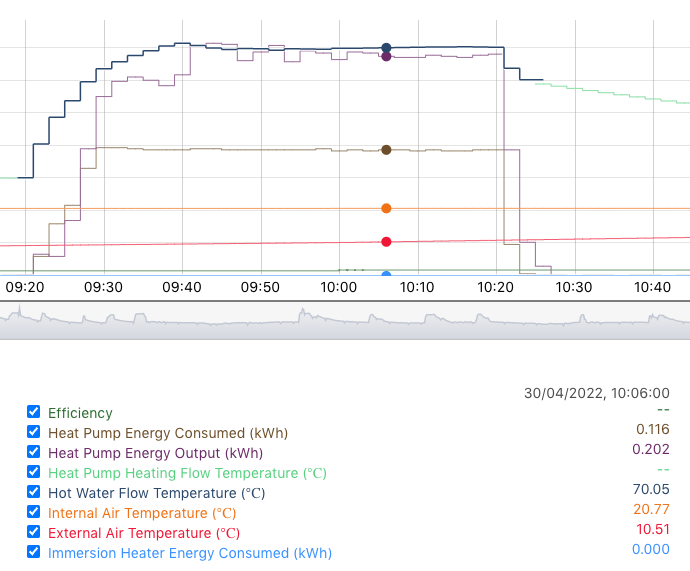
For reference the way Mixergy works in my setup (using indiect coil) is this: 1) Mixergy signals DHW demand using it's own controls. It does this using a "resistor switch" which simulates UVC geing below target temperature. 2) The ASHP flow heats the top of the tank using the indirect coil to 50C. 3) Once the top of tank has reached 50C demand is not satisified, but rather a pump turns on which sprays cold water (from the bottom of the tank) into the top of the tank. 4) The ASHP flow continues to maintain the top of the UVC at 50C and pushes the termocline. 5) When the Mixergy is at a desired %, the resistor switch is flipped to simulate the UVC being at 60C and ASHP DHW turns off. I don't expect ASHP to behave in the same way as with a standard HP coil, where flow temperature gradually increases over time (with higher efficiencies to start with) and only hits 55C at the end of this period. But, I do expect a fairly constant 55C flow (once top of the tank is at 50C), rather than 70C.
-
The refigerant means it can heat up to 70/75C, but as with all heat-pumps efficiency is impacted at such high temperatures. This heat-pump at 7C external is supposed to give COP of 3 at 55C and 2.4 at 65C. I get around 1.9 at 70C! I don't think there is any way to change the flow rate, not so that it impacts DHW only, anyway. The ASHP should modulate as required. My only theories are: - The DHW mode, by design, doesn't try to constrain flow temperature and instead assumes that the flow temperature follows the whole tank temperatue and that demand will be satisfied (via temp probe) when this temperature is reached. - The ASHP doesn't see the UVC temperature increase over time (it's fixed due to resistor switch), so it inceases the flow temperature in an attempt to make it increase. - The (shorter) Indirect coil at top of the tank means return temperatures are higher than with a standard HP coil lower down in the UVC. The higher return temperature pushes up flow temperature (which is not constrained) as the ASHP attempts to maintain a certain delta-t. (it could also be a combination of these)
-
Our 7kw aroTHERM is working great, but I have one issue I can't resolve; no matter how low I configure the DHW flow temperature and DHW flow temperature offset, the ASHP ignores what is configured and uses 70C I currently have the following configured: - DHW Temperature: 55C - Cylinder charging offset: 0C - DHW Mode: Normal - Max cyl charger time: 120min The ASHP Hydraulic Unit and sensoComfort controller both show a target temperature of 55C, but the actual flow temperature ignores this. I do have an abnormal setup, but I'd hoped I could still constrain the flow temperature - UVC is Mixergy and I'm using primary coil and not the external PHE. - Mixergy controls DHW demand via a resister switch that simulates demand by faking the DHW temperature sensor. Initially it was using 26C(on)/60C(off), but I've now adjusted to 50C(on)/60C(off) and see no real difference in behaviour, not in "normal" mode anyway. Using DHW Mode "Eco" seems to help somewhat and it sticks around 62C for the first 50min and then climbs to 67C, but it's still ignoring the target of 55C. COP I'm getting at 70C is around 1.9 wheras a flow temperature of 55C should give me around 3 if it's 7C+ outside. @J1mbo@Bruno What do you see with yours? Any ideas?
-
Design loadings of first floor low level windows
Dan F replied to Dan F's topic in Windows & Glazing
@craigOur BCO is not insisting on further documentation on this occasion, but he is right that EN12600 is only about "safe breakage" and not "containment" and that documentation should be available to show that design-loadings comply with BS1680, in the same way that this is required for balconies. The complication is that BS1680 is a UK-only standard and the design loadings required are also UK-specific so it's not easy to get this from european manufacturers. There is generic guidance, which @Nick Laslett linked to, but none of this covers triple-glazed units directly so isn't suitable. The one thing I was able to use to make BCO a bit happier was the AGC Glass Europe online "glass thickness calculator" which uses EN 16612 to calculate loadings/delfection and shows that a 4Tc+4T+4Tc does meet requirements BS1680 point/line/unform loadings for the size of our glass units. Our glass is Saint Gobain, not AGC, but toughened glass is pretty much the same whoever makes it. -
Blinds that are compatible with Loxone
Dan F replied to Dunny1234's topic in Networks, AV, Security & Automation
@HazzyD Very comprehensive list. I used Option 2, simply because I didn't pre-plan this and just let our electricians just ran a 5-core cable to each blind location. In our case we have external Blinds (Elero JA Comfort) and interal curtain tracks on some windows (Somfy Movelite WT). Some of the other options provide some additional functionaity, but they all cost more and none of the extra functionality adds that much value. (e.g. position feedback from the blind). Did you compare costs of the different options too? Few minor comments: - Option 2 has a variation where, instead of the home run, you can could use a more localized tree relay. - The controls by time actually works really well, even for venetian blinds where slat position is important. - Another advantage of having a permnanent live is that some curtain motors support "pull to open". - Maybe obvious, but an advantage of wireless options is a remote control. With other approach you can do this using a Loxone Air Remote though. I looked at SMI briefly at one point. What I didn't realised was that it was RS485, and assumed I'd need Loxone->KNX->SMI. -
Moving from self-build insurance to standard house insurance
Dan F replied to jamieled's topic in Self Build Insurance
Can you get high-street insurance without completion cert? My understanding was your couldn't, or at least no guarantee a claim, if building related, would be sucessful. In your case, was there any reason you delayed completion until landscaping was complete, was this for VAT reclaim? We want completion cert. sooner rather than later to get onto a standard residential mortgage as soon as possible, but haven't starrted landscaping yet. This will just mean that we'll need a lanscaper who can zero-rate, and won't be able to DIY.