


Dan F
-
Posts
1431 -
Joined
-
Last visited
-
Days Won
2
Everything posted by Dan F
-
Design loadings of first floor low level windows
Dan F replied to Dan F's topic in Windows & Glazing
The complication seems to be that our BCO wants BS6180 loadings for first-floor low-level windows, in same way they would would require them for a balcony ballustrade, as technically low-level first-floor windows also come are considered "guarding". The EN12600 pendulum test certifies impacts resistence, but doesn't give any loadings. I've sent through the EN12600 (class 2) certification regardless though and we'll see what happens. -
All I got from gate supplier is that gates are approx 150kg each.
-
All our first floor windows have sills at 450mm meaning they are considered "critical locations" for building regulations. Also, because these are on the first-floor, they are supposed to confirm to "guarding" requirements too. Our BCO is asking for "The design loadings that conform to BS 6180", but so far I haven't been able to get hold of anything that shows this. Have others had this requirement, and if so, what type of documentation have you provided in response? - Loadings. - BS 6180 approval - EN 12600 category. (pendulum test) - other The windows in question are triple-glazed with all three panes thoughened 4ESG-18-4ESG-18-4ESG.
-
Gates are hinged. Posts use a goalpost design with steelwork (which also acts as a conduit) between the two posts. Posts are fixed to the top of the pad. The gates are 1.8m x 1.8m each and made from 50x50 SHS with Iroko infill. Ground is good. I guess they should be able to answer some questions on weight at least, if not loads too. I'll try to ask them 3ft square and 3ft deep is even bigger than groundworker suggested!
-
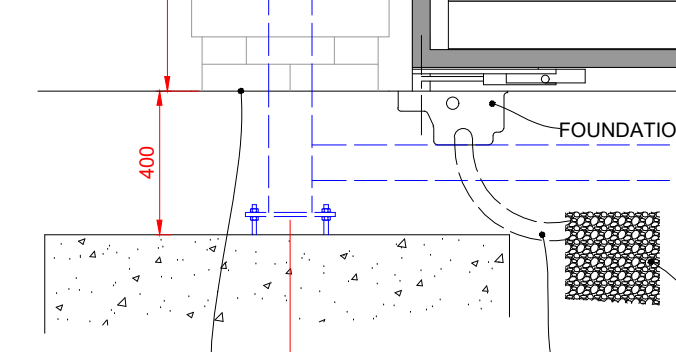
We've ordered some automated gates, and the drawings show concrete pads 400mm BGL which the gate post steelwork then screws down into. Is there a rule of thumb as to the size these pads should be and/or if they should incorporate any rebar or mesh? The gate supplier doesn't specify any of this, and groundwokers has just suggested 600mm deep 1x1m pads with no steel or even mesh. Do I need a strucutral design for these, or are there some general rules which can be followed? Thanks!
-
In the ceiling for downlighters in our case. We have a 5-core cable which daisy chains all DALI downlights, each with their own local driver. It may be different with DMX though. Drivers for other low-level constant current fitting and tracks are all centalized (in loft or plant room). LED drivers are a bit more of a mix as the fact that are constant voltage mean cable length is limited, so we have various locations around the house that have a 5-core (power + DALI) feed with a bunch of LED drivers co-located.
-
@Thorfun We used these for a similair application. Great little fittings, and come in various beam patterns and finnishes too. Lighting designer we used swears by lightgrahix. https://www.lightgraphix.co.uk/prod?product=LD43W / LD43A They came with a 500mA constant-current driver which is good for up to 14 fittings connected in series. In our case we are using DALI drivers which work fantastically with the raspberry pi hat that I got off of amazon that supports 256 devices. Is she specify specific fittings (I'd hope so)? In our case our designer specified fittings and then worked with supplier to get things quoted up (with more of a discount we would have got direct). We then simply paid the invoics. Brand-wise, we've used Iguzzini, Orluna & Lightgrahix for everything (aside from the tunable white LED tape). To answer you initial question, downlights are typically always supplied with a driver per-fitting and therefore you need power + control (DALI/DMX) to each driver. Technically, you don't always need a driver for each and every fitting, but that is how all ours were supplied. All the other types of fittings (low-level, uplighters, track-lighting) we have though, all came with a single driver for a series of fittings. In this case it's the driver that needs power/control, and then you just have 2 low-voltage cores from fitting to fitting.
-
Excess PV to drive heat pump DHW not immersion heater.
Dan F replied to Jwenty's topic in Air Source Heat Pumps (ASHP)
This works, but isn't ideal either given the sun comes and goes a lot in the U.K climate and is of course manual. If you want to use excess PV to drive a ASHP, while avoiding importing electricitiy, you really need a buffer and and some logic. What you'd do is fire up the ASHP (for a minumum amount of time, x) based on i) Average PV generation over a period of time ii) Battery state of charge. This condition would then be revaluated every x to determine to determine if the ASHP should stay on or turn off. It's not trivial to set up, but this would allow you to consume smaller/intermittant amount of PV generation and still leverage your ASHP COP. -
Blinds that are compatible with Loxone
Dan F replied to Dunny1234's topic in Networks, AV, Security & Automation
Installed, but not used them yet. These are curtain motors rather than blinds. According to technical details online the WT has automatic stop at the end of the track: https://aluproff.dk/wp-content/uploads/2020/01/Movelite-35-Technical.pdf The DCT one is also a good option and allows for pull-to-open as it has a permannt live and is configurable (not sure why this is needed though). In our case we only took a 5-core cable to each blind though, not 3-core + control. -
Blinds that are compatible with Loxone
Dan F replied to Dunny1234's topic in Networks, AV, Security & Automation
I can't beleeive thats the case, no. But of course, everyone wanta to sell you the smart version of their products and tie you into their ecosystem. I have 230v exterior blinds (Elero) and the stops on these are mechanical and came pre-set with the windows. -
To apply for RHI you need i) EPC ii) MCS install certificate, you don't needing building control completion. Do you have EPC/MCS? If you do go online and start the process and it will guide you though, I don't beleive you need to have occupied yet.
-
Is that same inverter as for your PV, or a seperate battery inverter? If you were doing his again and there were no availabilitu issues, would you use powerall only, solaredge batteries only, or use a mix?
-
Thought you had powerwall? I haven't looked at SolarEdge battery, but I beleive not supported by most existing inverters.
-
Should be able to, but it's bit messy if VAT reclaim has battery but not PV. (PV was supplied zero-rated).
-
Our ASHP has a built-in 6kW back-up heater for if the compressor fails, but I think the idea that you need another fuel source due to failure/inefficiency is mostly FUD, unless your electiricaly supply is unreliable. If your house is very well insulated and airtight, then a couple of cheap/simple oil-based heaters radiators are very effective as back-up heaters. We used a couple of these to help heat the house before ASHP was commisisoned.
-
Have a quote that expires today for 8600+VAT including gateway, surge protection and install. This supplier wants to charge VAT though and can't zero-rate as I already have PV installed by someone else. This is why I haven't proceeded with them yet, but now the 60% rule looks like it's going away I'm less concerned about claiming this back. Still won't be trivial though as PV was zero-rated from one supplier and powerwall would be a vat reclaim and from a different supplier but should go through I think.
-
Yeah, I think it's just going to be a temporary situation so will probably proceed with Powerwall before prices go up and while I can still hopefully avod the 20% VAT. Even with Powerwall, I'm pretty sure that Octpus Go/Intelligent isn't going to make sense for me (apart from in the winter months), as I think I'd loose more to reduced export costs than I'd save by importing the minimal additional needed at a reduced price at night. If only there was a way to model this! Octopus Compare app is great for comparing import tarrifs (and the load shift simulation is really neat), but this ignores the fact that you choice of import tarrif impacts if you can/can't use agile outoing which current gives much better rates than standard export tarriff. Last week we imported 139.28 kWh for about £28 and exported 164.09 kWh for around £34. On Go, and assuming we could load-shifted 100% of imports (likely impractical with use of oven/hob) we'd have poid £10 for import, but only got £7 for export, so £9 worse off. As days get longer and solar output increaes, this difference will increase. The flexible tarrif is about to increase of course, but while agile outgoing prices are high, if you have a fair amount of unused PV, I think it's hard to justify Go. I think it's only 4.1p if you are on Go/Intelligent isn't it?
-
I always planned to install Powerall (or two) but given we're currently paying 21p to import and on 18-25p to export, it currently makes no sense at all! Import price is about to go up to 28.5p, but still, there isn't enough difference to justify storage currently. Thing is, I'm sure this isn't always going to be the case, and when I do want a battery in the future it's going to cost me an additional 20%in VAT! In the past batteries have worked well with Octoups Tarrifs but currently: - Octopus TEP would require I install two powerwalls at great expense to get net metering, which I (albeit only temporarly pherhaps) already have. - Octopus Agile rarely drops below 35p recently, so is a lot more expensive than the standard variable rate. - Octopus Go is still attractive if you have EV and/or battery, but if you sign up for Go they kick you off of "agile outgoing" and you so our exports would drop from 18-25p to something like 5.5p.
-
Blinds that are compatible with Loxone
Dan F replied to Dunny1234's topic in Networks, AV, Security & Automation
Unless you have very big/heavy curtains most cost effective option I found was the "Somfy Movelite WT". The "WT" version is simpe 230v 4-core (up, down, common, earth). To control these you can use: - Central relay - Nano 2 Relay Tree Alternatively you can use a more expensive motor with fixed 3-core power and dry-contacts for control. But you'll still need a relay for dry-contacts, so you don't save any relays. The one advantage of this approach though, is the "pull to open" funcitonality not available with the standard "WT" motros. -
Have you looked at Sonnen? Good battery technologies, extensible and they even have an all-in-one 3-phase solution, but I'm not sure it's available in U.K yet. https://sonnen.de/stromspeicher/sonnenbatterie-10-performance/
-
The problem is they introduced a 60% rule in 2019. So, unless the total materials cost is less than 60% of the total solar/battery install cost, it's not eligible. If the guidelines are followed stictly, it's therefore unlikey that any powerwall install would qualify I saw something about this 60% rule potentially being removed though,,
-
@Thorfun Have you looked at getting hold of a Powerwall yet? What have you been told regarding lead time? Battery systems aren't on the governments list of "Energy-saving materials" and therefore technically can't be zero-rated. This is also why they attact 20% VAT and not 5% (0% now) when retrofted. I think what some suppliers are happy to do though, is consider the battery to be part of the of the PV system, and zero-rate it this way. My PV installer is happy to zero-rate Powerwall(s) but has a very long 9mth lead-time. I've found another supplier with better avaailbility, but they aren't happy to zero-rate 😞
-
We just had a final air test done and result was a fair bit worse than last test after first-fix. Thinking about this last night, it is almost certainly all the AAV's we have! We have 4x50mmm AAV's in the warm loft and couple of mini-AAV type things in the plant room for condensates and a pressure relief valve.
-
It works via pressure-differential though. It can open to admit air when a toilet flushs and the pressure in the drainage is lower than in the house where AAV is installed. It's therefore logical that when you pressurize the house, as part of an air-test, that this pressure-differencial is replicated and the AAV opens, resulting in air leakage. Clearly, with a test that depressurizing the house the AAV's will stay closed.
-
For those of you that used AAV's; what, if anything, did you do with these during airtightness testing? During depressurization they will naturally be closed, but during a pressuzation test surely there is a point where which they open and this results in leakage impacting results? I can't find anything online about if they can/should be sealed during a pressuzation test. Anyone else had any experience?
