joth
-
Posts
2918 -
Joined
-
Last visited
-
Days Won
5
Everything posted by joth
-

MVHR - Self install!?
joth replied to richo106's topic in Mechanical Ventilation with Heat Recovery (MVHR)
Ours was £1500 for the installation (151m2 floor area; 12 room radial system), I thought our main contractor would have done it themselves but they took this install quote from the supplier instead to reduce their own hassle. £4-£5k seems steep - is that a new build or to retrofit it, including gaining access into walls etc and making good?? -
I've been looking a bit at Emporia too, as I'm underwhelmed by the emonpi I currently use. 1. The UK instructions only seem to have one 200A clamp. The versions with 2 main clamps i think are the USA deign and they have split-phase supply there, so it just happens to have the 2 clamps out of box. Looking at the install manual seems to confirm: they have one clamp on red, one on black, which is the L1 and L2 two-phase hot wires in USA. (White is neutral). 2. Yes, this is step 8 in the above manual 3. They also sell a solar suppliment, not sure why that would be needed maybe just if you have >16A of solar. 4. ?? The HW supports it, but it's up to the app used as to how well it displays it ? 5. The clamps need to go over the L wire only, not the L and N as they will cancel each other out. Inside the CU is the only place where the wires should (reliably) be individually accessible in a standard install. Else you'd need to split open all the T&E to pull a core out and clamp, which would be non-comformant 6. Yeah that's a lot of stuff on a single circuit. Ours is split across 3 (ASHP outdoor unit, heating controls, MVHR). 7. Fairly safe, but there is still live power going to the main switch, non-RCD protected. It's better if you have an upstream 100A breaker for the whole house at shut that off. Apparently some supplier meters include a main switch. Probably the main risk is you disturb something and cause a hazard when turned back on. It can get very crowded with all these CTs in a UK style CU. (USA breaker panels are much more spaced out) 8, zero. See #5 FWIW I'm not interested in using the Emporia cloud/app function and would only use it if I can get it working local connection only. It is possible but bit of a hack. As this jolly guy says they should just support this out the box:
-
This only really helps if you leave it unused on standby for days at a time (i.e. don't use it for DHW, or for cooling in summer). Otherwise I've found 10s granularity logging much more useful. (I have a home assistant sensor setup for my ecodan)
-
For those following along at home, a glossary maybe useful AHU = Air handling unit ASHP = Air source heat pump :) CW coil = chilled water coil. DX coil = Direct expansion coil, for heat exchange to/from a refrigerant circuit. [FCU = Fan Coil Unit] FWIW, my ecodan ASHP can go down to 5°C flow temp, I set it to 8°C and my FCU only has a couple degrees drop across it, I've clearly not yet got the water flow speed and sizing very will calibrated for the HP.
-
Perhaps not much cost in materials, but the time is an issue, it's yet another project I could do without right now! I was pondering that option this morning. It's a premade timer hatch casing and ladder so fixed dimensions. It's annoying as the available joist opening is 1180x750ish. I wanted to put in a Dollar Hobby ladder which needs 1200x700 opening - just 2cm too large! So our builder went for the next size down (Lyte LELW3) which requires 1130x 550 opening, and only has 510mm clear width inside the casement. I could temporarily remove the hatch I guess but I the it will result in a lot of making good. Ho hum. Let's see what the return shipping cost is and maybe I'll suck it up
-
Additional electricity load on home with GSHP
joth replied to 8Coops8's topic in Consumer Units, RCDs, MCBOs
I expect you mean kWh, not KW, for those two numbers, if that is annual consumption? -
Fair enough except to main heatpump in contention, the ecodan, has a hermetic scroll compressor, but still needs the very power hungry preheater. (And so helpfully described as not having a crankcase compressor, but using the "resistive method" instead, by the datasheet posted a few pages back). So I think @ProDave's advice to ask for a guaranteed standby power draw is the best bet, rather than try and guess based on the design.
-
The saga continues. I decided a 4 port buffer was more versatile than 2 port so ordered the Kingspan Albion 150L instead. Arrived last week. Boom. It's a few inches too wide to fit through the aperture of my loft hatch. So enquiry made about returns. But if anyone needs one and can collect from Herts I'll do you a deal. Oh how I hate plumbing.
-
This was my first thought too, but you need to ensure it seals well (airtight) when closed. We have a passive house certified skylight high up in the vaulted roof that I use as an automatic air vent. It works excellently for night time cooling. However I think @JohnMo is on point here - this is about automatically discharging air from the water circuit to the heat exchange. Is it possible "externally" means to release air externalize it from the water pipes? There's absolutely no need for a heating system AAV to vent outside the building.
-
No new info to add as delivery of the SolarEdge Energy Bank is moved out to August at the earliest. (And, the SE8000H FW update to support it doesn't seem to be release yet either) I thought this new one (Energy Bank, not StorEdge) does support charging from grid. https://www.solaredge.com/uk/products/solaredge-energy-bank#/ says: "" Charge from the grid and make the most of Time of Use tariffs "" Yeah me too. It will require more G99 shenanigans than DC coupled, and slightly less efficient, but at least I'll know what I'm getting. Pylontech+Luxpower was my starting point.
-
Agree filters should be factored in, but probably not the capital outlay as most people prefer to reason about it in terms "years to payback", so the £5000 ours was (design + supply + install) would be 7 years payback for example. (ignoring both future energy price increases and the capital outlay opportunity cost) All this said, their dashboard numbers do seem a bit high. It's only a 151m2 house. In PHPP annual heating demand goes up by about 2200 kWh/yr if I zero out the heat recovery efficiency, so the Zehnder stats seem at least double the expectation. I've really not dug into why at all.
-
New builds are ineligible, except for self-builds which can claim the grant so long as certain evidence is provided https://www.gov.uk/guidance/check-if-you-may-be-eligible-for-the-boiler-upgrade-scheme-from-april-2022#self-builds If you own a self-build property To be eligible, a self-build must have: been built mainly using the labour or resources of the first owner not been owned by a business or organisation You will need to provide proof to your installer that your property is a self-build, for example a copy of the title deeds.
-
Octopus Energy and Ilke to build self powered homes
joth replied to Adsibob's topic in General Alternative Energy Issues
You mean 6 MWh ? -
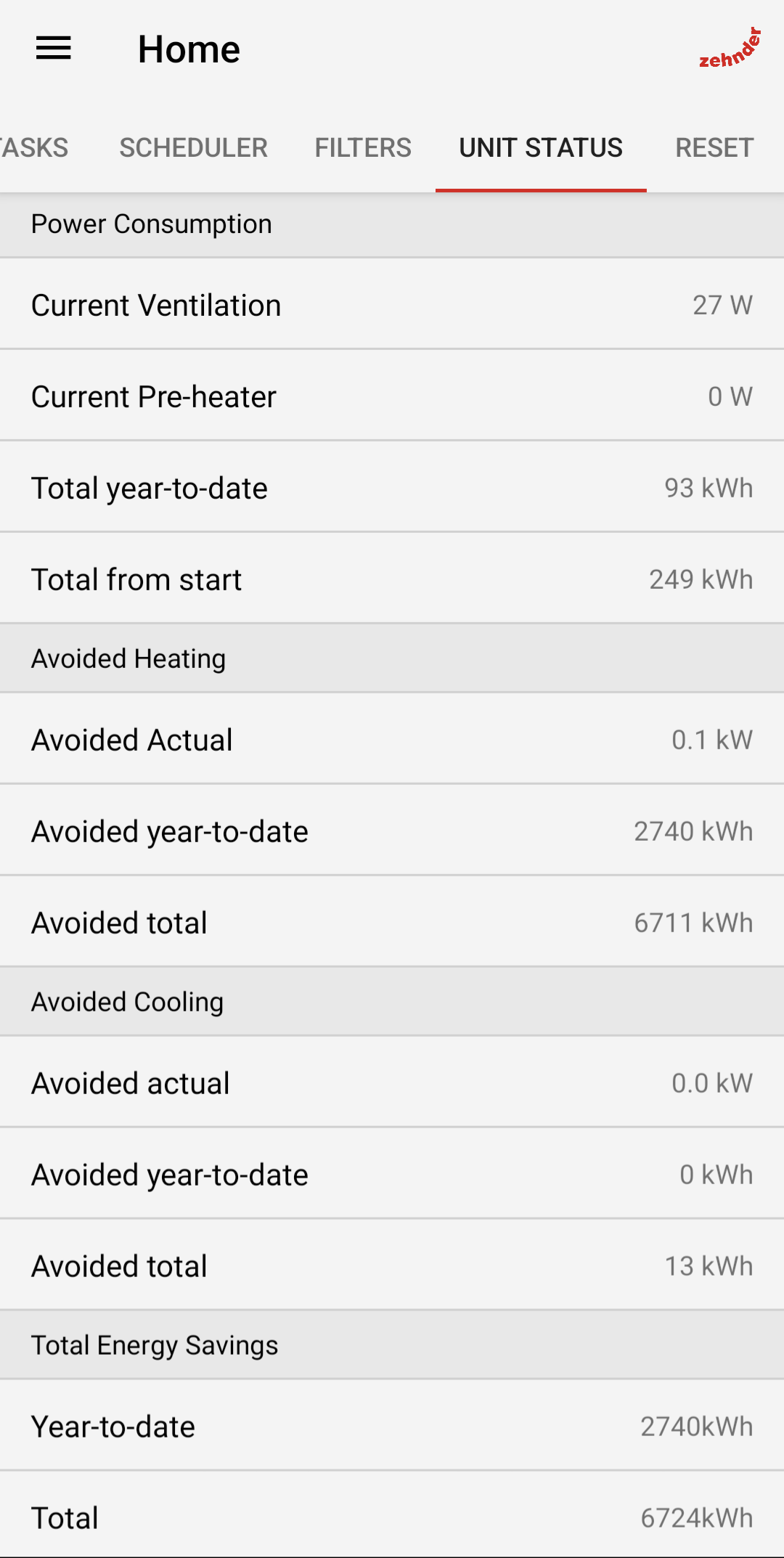
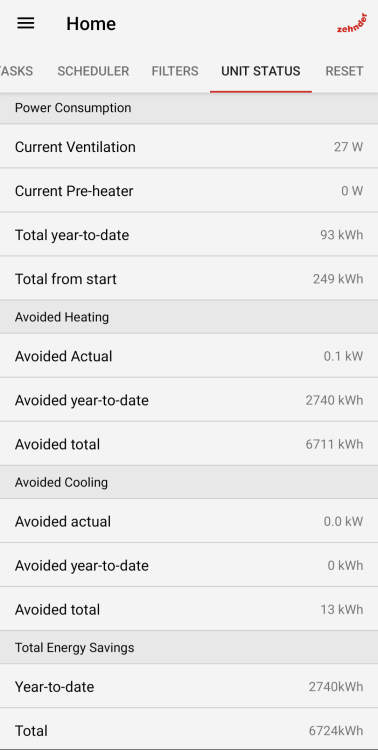
Ours was installed a bit over a year ago and here's the stats from its built in data logging. 249 kWh consumed running the ASHP 6724 kWh energy saved through heat recovery. So about £700 saved over one year and a bit (assuming our ASHP COP 3 would have provided the heat otherwise)
-
General advice for refurb project on large property
joth replied to Jimlad's topic in Other Heating Systems
Large property and large walls: a couple questions come to mind: 1/ what is the usage pattern? Are all 385m2 in use 24 hours a day every day? How many occupants? Any seasonal variation? Any scope to change usage patterns? 2/ Are the 400mm walls all external, or any large internal partitions too? Any natural lines under which you can zone the system into "warm" living areas and colder transit areas (halls, corridors). And disused bedrooms etc. Together, this maybe a good case for a smart control system that only heats the rooms actually used, and for the times of day/year they are used. Notwithstanding the very good point JohnMo makes above that the reheat times will be very slow given wall sizes, so this would need to be planned in a considered way. Also what fabric upgrades have been planned? A friend has a similar sounding "country pile" can got a very long way by adding secondary glazing and thick insulated curtains (in addition to smart zoned controls) -
We have a Quooker Combi (7L tank to supply the kitchen DHW as well as boiling) and yes it looks like it has a larger element: 2.2kW vs 1.6kW And yes, I misremembered: looking at the dashboard ours draws 2.3kW (slightly over its rating) when reheating, not 3kW Agree. We settled on it pre-pandemic. Now there's always someone working at home, and often 2 of us, it's even more appreciated. And possibly even pays back, in terms of working hours saved!! In the context of this thread, yes: the lower the peak power it draws, the more easily it be satisfied from the battery or PV inverter (so cheap / free cuppa). The more it draws peak, then more of it will on average will have to come from the grid. Over a whole year it draw about 90kWh in background load (keeping the tank warm) plus whatever you use in hot water.
-
actually it does: the quooker blasts on its 3kW load immediately after you pull each and every cuppa so it has the same issue. TBH I wish it had an eco mode where it just used 1kW to slowly reboil after a cuppa, and only cranked on the 3kW element if you pull several litres from it. And for periodic reheating, even more so: having a 500W element to gently re-boil would be far more efficient throughout a dreary PV day than short-cycle blasting 3kW into it. As it stands it's actually really inefficient if we're heating water for pasta etc, as we pull boiling water from the quooker then put it straight on the inductions hob, resulting in them both being on simultaneously, making a 6kW+ load which very likely pushes over the inverter output.
-
This might be referring to the MMSP optional part of the old RHI scheme https://www.ofgem.gov.uk/environmental-and-social-schemes/domestic-renewable-heat-incentive-domestic-rhi/applicants/eligible-heating-systems/optional-monitoring Long term real world monitoring has got to be part of the industry wide process to prove how efficient (or not) these things are over the long term. The PDF is interesting. The 1/3rd on duty cycle reflects my own measurements, except I see 27W peak draw not the 54W it mentions. Which is exactly double my measurements. Their idea that electricity is 11p/kWh is out of touch with reality. the xxxYHA models have much higher peak background draw, ~250W, which does seem to line up to a degree with some of the reports in this tread (except folks here are seeing that continuous, not with a 1/3 duty cycle). So the VHA vs YHA model seems an important contributor.
-
And there's more variations above that, e.g. for 2-pipe, you can connect it up in parallel or in series with the emitter. I've not heard or seen an example of the 3-port schematic, do you have an example?
-
If you have a spare 110V site transformer, hook up a 3kW element on the secondary side of that and it'll draw about 1.5kW
-
I assume that's a meme off the internet, not @pocster's own tool failure They're both imperial only, so presumably a USA meme.
-
Interesting. My FTC6 is on a separate circuit to the outdoor unit, so I've not actually measured the power consumption of it, only the outdoor part. The outdoor heatpump is pretty consistently drawing 5.5W _average_ background load (about 25W peak background load). I'll have to measure the draw of the indoor part. IMO 24W is believable but excessive for FTC6 on its own.
-
Move over MCS, a new certification scheme is here. And it has a ridiculous name https://www.flexi-orb.com" by Cert-fi schemes" Looks like they'll cover PV and ASHP and other generation tech. Already recognised by several PV export SEG tariffs, and presumably by the new ASHP install grant too. I can't see any mention of enabling DIY installations, but at least membership is free (with proviso installers need qualifications and insurance) so possibly will help encourage a bit more competition in installation costs. Dunno how it compares for manufacturers. https://www.flexi-orb.com/membership-enquiry/ Edit: I say "new" but their blog goes back to 2018 so perhaps only new to me. https://www.solarpanelprices.co.uk/articles/solar-panels/best-smart-export-guarantee-tariffs/ just started including them in the SEG requirements table
-
I guess the rationale is the UK is a small market and not worth the faff for them to deal with making bespoke country specific hardware for.
-
Wow. I think this "second rule" is new? Don't think it existed when we started our renovation in 2020. We had to pay full rate VAT as we moved in on completion. We lived there for 15 months before starting the reno. We only later learnt from neighbours the property had been empty for several years before we bought it (the estate agent said it was one year - that was just the probate period, it turned out). With the second rule, if we'd squeezed the timeline down to 12months, we could have saved several tens of k in VAT. Of course, the planning application and making a highly energy efficient (PH certified) design was over half of that 15month period. Love how they make these arbitrary limits to encourage half baked and rushed projects.