joth
-
Posts
2861 -
Joined
-
Last visited
-
Days Won
5
Everything posted by joth
-
It's an SE-x000H of some sort. Do you know how many kW the inverter is? That determines the 'x'
-
So this thread already answers one question we had: it seems that yes the SE energybank can be charged from AC grid, as well as from DC PV system. Good:) Do you have it installed with any off-grid capability? Not sure they've enabled that for UK (or EU) regs yet. What inverter are you using it with? Mine was due for delivery this month, but now delayed to August. Let's see if it transpires
-
I ended up mostly using: https://bownetcms.co.uk/ for CAT6A www.futureshop.co.uk for QED QX16/4 speaker cable random places for coax I had to try a few crimpers and RJ45s before finding a combo that worked with CAT6A. I can dig out what I settled on if that's helpful
-
you can buy a cheap unmanaged PoE switch to power your IP cameras etc but yeah it's really annoying about the need for a new mains outlet by your AP locations. I don't know about Netgear (or TP-link) but when setting up other people's Nest (actually older Google Wifi) APs I have successfully used PoE to USB-C adapters like https://www.amazon.co.uk/DSLRKIT-Splitter-IEEE802-3af-Ethernet-Raspberry/dp/B07TJ3ZNJ4/ which gets out of that pickle very nicely. In ascii art: [modem] --- [Nest Router] --- [PoE Switch] ------------ [PoE splitter] ---usbC+RJ45---- [Nest AP]
-
ubiquiti are still sitting strong in the "prosumer" category. There's plenty of alternatives but it depends if you want something (i) more professional powerful, or (ii) more consumer friendly, or (iii) more open to home tinker. Which of those is more important to you? Going out on a limb I'd say consumer friendly is your priority (but of course, with excellent performance), so I'd say have a good look at Nest, Netgear and TP-Link before setting your heart on ubiquiti https://www.tomsguide.com/us/best-mesh-router,review-5191.html The benefits of ubiquiti over those systems is having a managed layer2 network, allowing virtual lans, flexible network segregation and firewalls, multiple SSIDs, and ability to have all wifi APs powered over the ethernet cable. Aside from the PoE which is a dream, most of those advanced features give me a some kindof headache when I use them, and I'm a software engineer that's worked on IP stacks and I've been tinkering with home networking since 1995. If your goal is really good fast Wifi in every room, a consumer mesh network with wired backhaul seems a much better bet. Go uniquiti if you want many PoE devices, run your own servers, into home automation or Homelabs etc or generally want to spend a lot of time tinkering. (Or happy to pay someone else to do that for you). I'd say if you like Google Assistant go Nest, else go Netgear or TP-Link .
-

What energy companies are you using for your ASHP?
joth replied to martian's topic in Air Source Heat Pumps (ASHP)
I'm on https://octopus.energy/go/ it's 7.5/unit for new sign ups, but I'm still on 5p/unit until the end of the year. With a COP of 3.5 that is barely more than 1p per kWh of delivered heat. Not a bad deal! HOWEVER this only works because we have extremely low heat demand and an oversized ASHP, so even on the coldest day I could get all the heat I needed delivered during the 4 hour offpeak window. for a more conventional install the best advice is to leave the ASHP (assuming UFH) running 24/7 so then the offpeak rate doesn't help you so much. -
Yes that thread left us all feeling a bit salty.
-
relatedly, do any water mains or (more likely) combined sewers run through the rear gardens? Check your home buyers pack. It will put the willies up other neighbours to hear that they could be held to ransom over a potential future drain block or water leak, if precedent is set that there's no right of way for the water company or private contractor to get in there to repair it. Overall, yes if you can turn it to an N vs 1 battle I think the case will start looking pretty bleak for the plaintiff. big kudos to @Adsibob for wading in pro bono
-
Zehnder ComfoAir Q450 vs Brink Flair 400
joth replied to Adsibob's topic in Mechanical Ventilation with Heat Recovery (MVHR)
Looks like most enthusiasts skip the brink WiFi module and connect directly to it via modbus. Easily done with an ESP32 https://community.home-assistant.io/t/brink-flair-325-heat-recovery-unit-esphome-modbus-integration-5/423182 Certainly saves a few £250 vs the zehnder option -
You probably want to speak to a supplier, ideally one that will do the design for you, rather than the manufacturers. e.g.https://www.bpcventilation.com/free-estimate The Zehnder Q600 is one of the largest available which claims to support properties up to 350m2 so seems worth a look.
-
Zehnder ComfoAir Q450 vs Brink Flair 400
joth replied to Adsibob's topic in Mechanical Ventilation with Heat Recovery (MVHR)
Via https://www.home-assistant.io/integrations/comfoconnect/ It's not perfect as it writes log entries to HA at the rate they arrive from the ComfoConnect, which appears to be at about 100/sec, which swamps the home assistant history view rather quickly (GBs of use). I think this is a short coming of both HA and the plugin that it can even do this, and there's no simple way to set a global rate limit, but meh that's what you get for relying on free stuff. [this is where someone points out the obvious hidden setting I've been failing to find all this time] -
Not a specific recommendation, but as another datapoint the Ecodan supports this out of the box in the standard controller too. Search the FTC6 install manual for "boiler" for schematics and setup instructions (Dip switch SW 1-1, inputs IN4 & IN5, output OUT10, thermistors THWB1 THW10) https://library.mitsubishielectric.co.uk/pdf/book/Ecodan_FTC6_PAC-IF071-3B-E_Installation_Manual_BH79D843H03
-
Zehnder ComfoAir Q450 vs Brink Flair 400
joth replied to Adsibob's topic in Mechanical Ventilation with Heat Recovery (MVHR)
(Our Zehnder is thankfully wired ethernet not Wifi, but same diff for this question) I didn't think I'd want it but did add the ethernet bridge after a while for two reasons - convenience / laziness. We have the remote display in the kitchen, but it's not that good whereas the phone app makes it really easy to see all the controls, status, and installer setup menus - logging and home automation. I use the temperature & humidity sensors as additional inputs to the house automation system - it's my most reliable measure of outdoors and whole-house average indoor temp. And I control the boost function (4 levels) depending on what's going on in the house Neither of these are must-haves, but I appreciate them enough to not entirely resent the ludicrous £250 outlay. I'd not recommend it to anyone else unless they're a real nerd though. -
The quick summary answer to your last question is, if you have a SMETS2 smart meter, the net import/export metering is guaranteed to work across phases as you would like it to, both by the SMETS specification and numerous people on here have now confirmed it working in practice. "Polyphase" is the magic search term to find previous discussions on this. If you have a non-smart meter, it's anybody's guess. Probably depends on the supplier, the specific person installing it, day of the week.... To the former question, at the start of the year people were 3ph getting meters installed by Octopus quite reliably but the last update I saw was that even they (octopus) are recommending you go to a "big supplier" (e.g. British Gas or EDF IIRC) to get it installed then do a supplier transfer to them. A benefit of this approach is you'll have the big suppliers own engineers do the install (certainly will with BG) rather than the sms-plc who contract to most the smaller suppliers and are, frankly, terrible to deal with.
-
yeah I got a box of 2NICE, which work perfectly with tuya-convert I have a couple UK style wall sockets running tuya I need to try and convert some time. this will bring a few more interesting items under control. But as you see, vast majority of stuff I want to monitor is hard-wired so really has to be CT clamp or expensive (and space consuming) din-rail mounted energy monitors.
-
The reason for more CTs is to track actual annual stats on energy consumption, it would be nice to gather for the passive house DB and people are always asking. They typically want to know about energy used in heating, lighting, generation, and everything else. So if doing it properly, this would be monitoring for: - ashp - heating controls - electric floor mats - towel rads - immersion heater - lighting (4 circuits but could jam 3 of them in one CT) - ovens and hob (3 circuits, although I've evil jammed them into one circuit) - quooker (I have this on an tuya/ESPHome smart plug) - car charger - PV inverter - (battery when we get it) - everything else. I don't deny open SW and HW stack is worth a lot, and I don't regret any of the £ I have thrown them over the last 2 years towards supporting that. Just as I'm thinking forward to help other setup similar systems, I feel due diligence is comparing the field a bit more first.
-
We should have installed air conditioning… now what?
joth replied to Adsibob's topic in Other Heating Systems
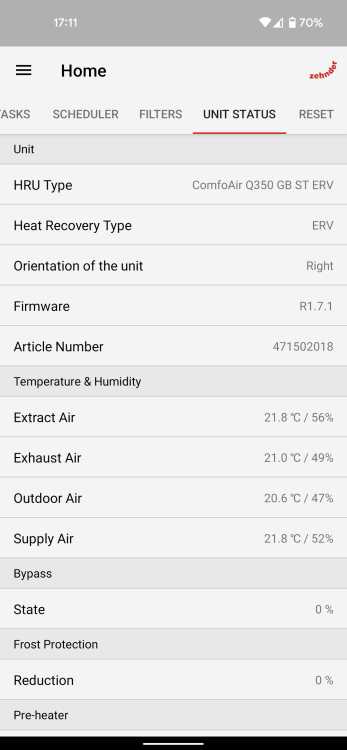
No idea! What make/model is it, and what does the manual say? For reference here's the app for mine, around midday when it was still coolish outside and now later afternoon it's got too hot for bypass to be useful Bypass= 100% or 0% is fairly clear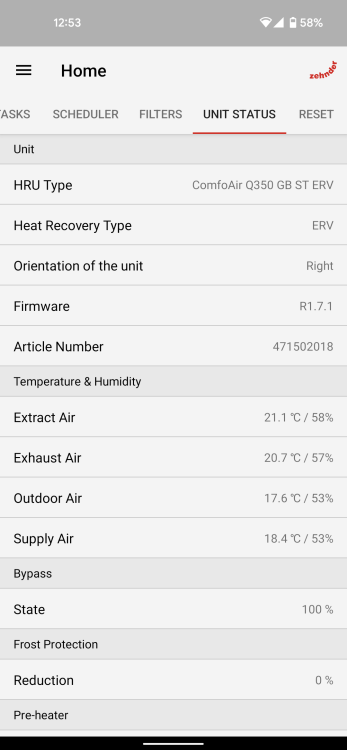
-
The emonpi SW stack and HW looks nice, but just been a long battle through small niggles. - limit on number of circuits, and expensive to expand - emonTX being the best way to expand but still only 4 circuits and insists on an unnecessary and unreliable wireless link - the sampling frequency of the emonpi is slower than I expected (not fast enough to control PV redirect, really) - it's possible to increase frequency but requires manually flashing the embedded micro-controller and it's really easy to get micro-controller and pi stack speaking incompatible versions - after doing the micro-controller manual FW flash any Pi SW updates break it. - the graphical editor for managing data feeds and measurements always catches me out and i have to mess with it multiple times to get it to do what I want it to - I don't really want my logging inside a pi, as it wears the SD card, so I do most the real work on a bigger machine with Raid drive and influx+grafan anyway, making the Pi rather overkill for my needs - (slightly related) I also got the OpenEVSE which came with a duff wifi board (ESP32) that was a bit more hassle to repair etc Absolutely no point is unfixable, but for what I thought would be a fairly easy plug and play setup, it's taken a heck of a lot more tinkering than I had expected when I set out, whereas everything I've put ESPhome on has been simpler than my expectations for effort needed, hence feeling attraction to the Emporia.
-
1. Yes, that's what I did. Loop-at-switch wiring is also a reasonable choice Assuming you're installing conventional wiring initially. If you want to dive right into something more advanced like DALI lighting you can skip this centralised approach. 3. Technically only needs to be metal if it's also acting as the consumer unit i.e. has the RCBOs in it. If you keep the consumer unit separate you have more flexibility
-
We should have installed air conditioning… now what?
joth replied to Adsibob's topic in Other Heating Systems
I activated it on Tuesday. Maybe I should fiddle with the settings, but I didn’t think it could do much more than lower internal temp by a degree or so? I forget what Tuesday was like, but if it's hotter outside than inside you want to turn OFF the summer bypass. This way the heat exchanger is activated "in reverse" to cool down incoming air by "recovering" coolness from the outgoing air. Summer bypass should only be active when the indoor temperature is above target AND the outdoor temperature is lower than indoors. Happily for me my MVHR handles all that automatically. Otherwise I'd have used Loxone to automate it (basically same algorithm as I already made for skylight automatic stack venting control) -
DIY Fitting of used ashp for cooling and heating.
joth replied to Simon Brooke's topic in Underfloor Heating
Correct, MCS (the scheme) does not and has never had any restrictions on cooling, it was RHI that had that constraint but it was lifted several years before RHI was withdrawn completely. OTOH finding an MCS installer familiar and competent with installing a system for cooling can be tricky. My experience was I had to oversee most of the cooling aspects myself: - ensuring all pipes and equipment properly insulated against condensation (and put right when they got it wrong) - purchasing and planning ducting for the FCU install - specifying a buffer tank sized for the FCU rather than assume UFH is always in use - insisting on an electronic rather than thermostatic mixing valve for the UFH circuit Installers don't do this often, and I don't know if MCS sets any standards related to it, hence the lack of experience in many installers -
MVHR - Self install!?
joth replied to richo106's topic in Mechanical Ventilation with Heat Recovery (MVHR)
Ours was £1500 for the installation (151m2 floor area; 12 room radial system), I thought our main contractor would have done it themselves but they took this install quote from the supplier instead to reduce their own hassle. £4-£5k seems steep - is that a new build or to retrofit it, including gaining access into walls etc and making good?? -
I've been looking a bit at Emporia too, as I'm underwhelmed by the emonpi I currently use. 1. The UK instructions only seem to have one 200A clamp. The versions with 2 main clamps i think are the USA deign and they have split-phase supply there, so it just happens to have the 2 clamps out of box. Looking at the install manual seems to confirm: they have one clamp on red, one on black, which is the L1 and L2 two-phase hot wires in USA. (White is neutral). 2. Yes, this is step 8 in the above manual 3. They also sell a solar suppliment, not sure why that would be needed maybe just if you have >16A of solar. 4. ?? The HW supports it, but it's up to the app used as to how well it displays it ? 5. The clamps need to go over the L wire only, not the L and N as they will cancel each other out. Inside the CU is the only place where the wires should (reliably) be individually accessible in a standard install. Else you'd need to split open all the T&E to pull a core out and clamp, which would be non-comformant 6. Yeah that's a lot of stuff on a single circuit. Ours is split across 3 (ASHP outdoor unit, heating controls, MVHR). 7. Fairly safe, but there is still live power going to the main switch, non-RCD protected. It's better if you have an upstream 100A breaker for the whole house at shut that off. Apparently some supplier meters include a main switch. Probably the main risk is you disturb something and cause a hazard when turned back on. It can get very crowded with all these CTs in a UK style CU. (USA breaker panels are much more spaced out) 8, zero. See #5 FWIW I'm not interested in using the Emporia cloud/app function and would only use it if I can get it working local connection only. It is possible but bit of a hack. As this jolly guy says they should just support this out the box:
-
This only really helps if you leave it unused on standby for days at a time (i.e. don't use it for DHW, or for cooling in summer). Otherwise I've found 10s granularity logging much more useful. (I have a home assistant sensor setup for my ecodan)
-
For those following along at home, a glossary maybe useful AHU = Air handling unit ASHP = Air source heat pump :) CW coil = chilled water coil. DX coil = Direct expansion coil, for heat exchange to/from a refrigerant circuit. [FCU = Fan Coil Unit] FWIW, my ecodan ASHP can go down to 5°C flow temp, I set it to 8°C and my FCU only has a couple degrees drop across it, I've clearly not yet got the water flow speed and sizing very will calibrated for the HP.