joth
-
Posts
2861 -
Joined
-
Last visited
-
Days Won
5
Everything posted by joth
-
 I went to a Bricolage in France to buy retractive switches compatible with EU back boxes - I used Schneider but quite a few options there. The big square button still very common on the continent. It's a bit dated style here I know, but me reasoning is it's somewhat in keeping with the Loxone touch style. (And, our house has a kind of mid century feel that this doesn't feel alien in) Else everything on this store is EU compat I believe. https://www.swtch.co.uk/finish-dark/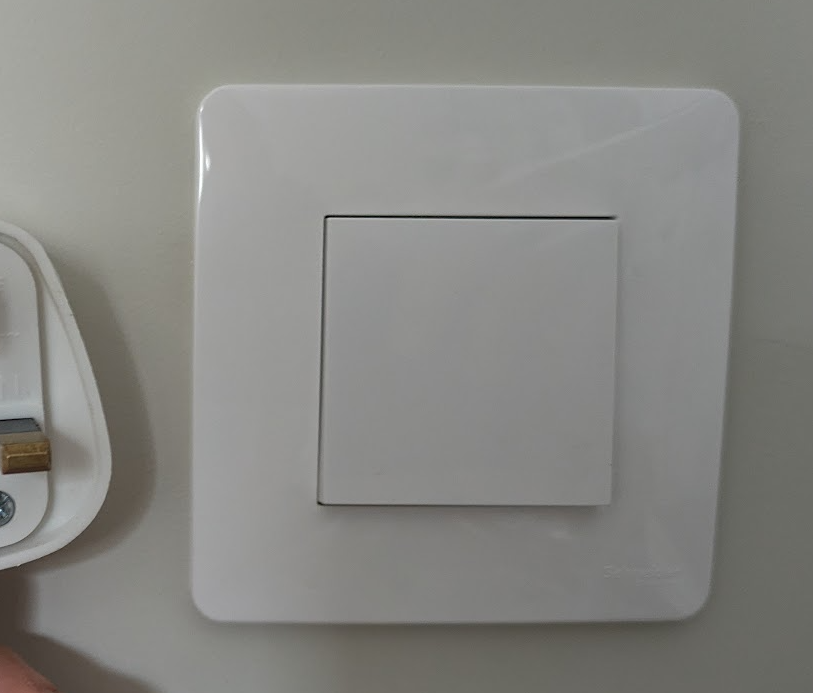
-
Fan Coil Units for use with a (cooling) ASHP
joth replied to ProDave's topic in Air Source Heat Pumps (ASHP)
Another alternative is a (large) FCU with custom 4-port manifold. I've useed https://www.ductstore.co.uk/acatalog/4_Spigot_Plenum_Box.html a few times to make up bespoke plenum box. You then need electric dampers on each outlet duct, and some logic to control the (single) shared fan speed plus the 4 dampers. OR just run the whole lot together and do so manual balancing (e.g. using manual adjustable room outlet dampers) to get the whole lot running and a relatively balanced level, which would be the simplest overall control (single hot&cold room stat somewhere fairly central) Note 7kW is probably not too large, as that'll rated at a fairly cold flow temp transmitting to fairly warm air (8C vs 25?). For ASHP running closer to target room temp (e.g. 16C vs 22?) then delta-T is smaller so a larger heat exchanger and higher throughput fan will help compensate. I used insulated flexible ducting: https://www.ventilationland.co.uk/en_GB/isodec-thermally-insulated-ventilation-hose/1142/ perhaps quicker to install but not as neat end result as your proposal. -
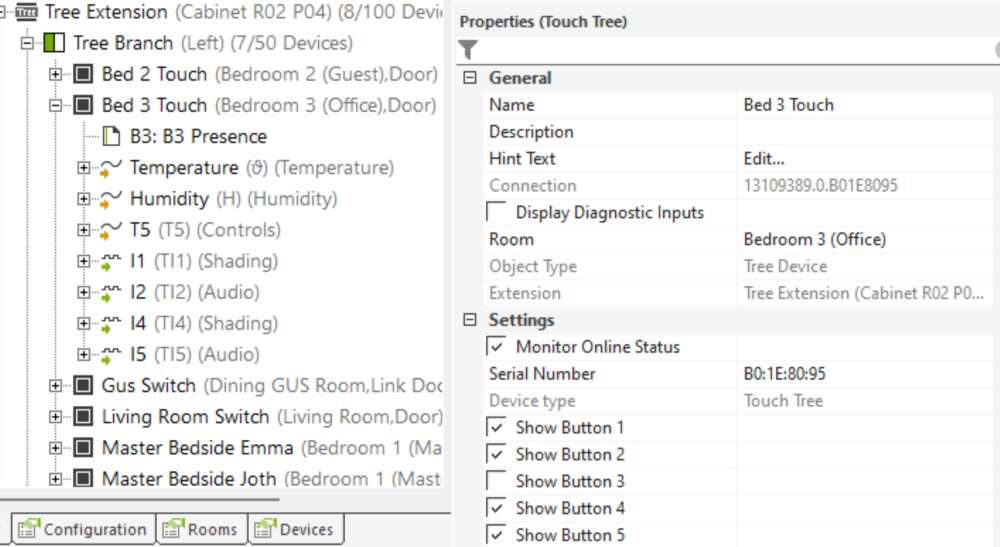
You need to enable the "Show Button 1-5" check boxes in the settings for the Touch switch. You then get I1-I5 inputs which you can use as standard retractive button input to any other logic block. Here I have all of them except I3 enabled, as I3 is the big center button which I use via the standard T5 input to a lighting controller.
-
To clarify, you want the circuit permanently powered, ie. unswitched? Most obvious answer is to have the electrician permanently power it, not via a relay or dimmer or whatever. But if you want to do it in loxone config the most robust way is to create a "constant" object, give it the value you want (i.e. 100) and connect that to the dimmer output. Another option is to use the "correction" feature on the output putting 100 as both the "target values" so any and all value going into it gets corrected to 100 output. hth
-
If you have any thoughts of using the UFH for cooling then not insulating the upper floors has additional benefit for those loops being effective in cooling the lower floors. Only snag in my experience is it's the upper floors that over heat first, and the UFH won't be so effective in cooling those but that's true either way.
-
probably not a good match for SSRs - ASHP controls tend to need a dry contact input for the call for heat or whatever - UFH manifold actuators tend to be extremely small load and don't draw enough current for the SSR to actually turn on You can certainly use them for any circulation pumps you maybe driving directly from loxone though
-
Double decker for twin and earth, triple decker for anything taking 3-core and earth e.g. blinds with 2 switched lives for up/down drive
-
12V batteries for Loxone Power Supply and Backup
joth replied to Thorfun's topic in Networks, AV, Security & Automation
Not my house but I installed a PS+B for someone else. I went with Yuasa REC36-12 36Ah -
the output value correction @Thorfun already found up thread I'd exactly to solve this: The dimmer will either be 100% on or off with that applied. The reason for 24v dimmer driving an ssr is purely cost saving, but as a bonus the ssr allows you to do rapid or pwm control of the load that would be inappropriate if driven from a mechanical relay. the loxone blind controllers have a built in time for running up or down, try increasing that parameter to see if it runs longer (sorry for delayed reply. I'm in Porto tastings Porto and you're not a paying customer lol)
-
Right, that's what I was suspecting when I said " Most often it's the room is too bright (if you have the Br brightness input wired up)" 👍🏼
-
Mitsubishi ecodan better control system
joth replied to eniacs's topic in Air Source Heat Pumps (ASHP)
Pricey! LOL ACC-BEMS-A1M https://www.saturnsales.co.uk/Mitsubishi-Electric-ACC-BEMS-A1M-Modbus-Interface.html Really designed for BMS in larger commercial installations, but works on the domestic sized A2W monoblocs -
Good job! You have light switches and some lights working - that deserves a beer. Most likely thing for DMX is getting the signal pair + and - inverted. I do this every time regardless how methodically I follow it through. Also try just having one device on the DMX bus to start, plus the terminator resistor, then add more things once that one is working. Daisy chain, not star. For the motion sensors, I can't remember which brand you used but it sounds like you're seeing the digital inputs trigger in live view when there's motion? Just the lights don't automatically come on? In the loxone app go to the lighting controller -> History and that tends to give a little explanation why it did or didn't do something. Most often it's the room is too bright (if you have the Br brightness input wired up) or something is asserting the DisP input which disables all presence-based lighting
-
Ok in this one I only used 2x 1.5mm via a double entry ferule but you get the idea. The two black wires on the left route to two - terminals on the PS+B
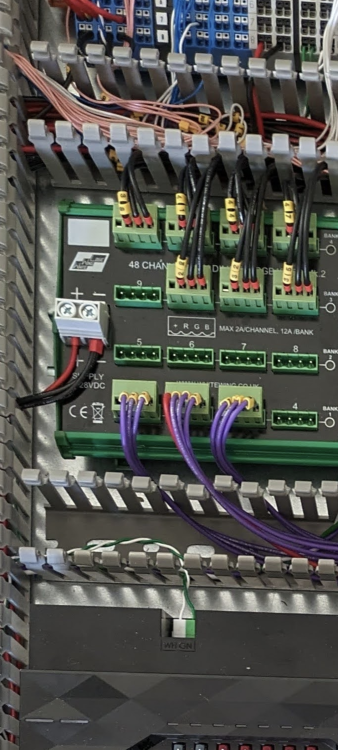
-
In the PS+B all The grounds are commoned together, so it doesn't matter which one you use for what. (Unlike say Rcbo where you need to strictly match circuits to use L and N from the same breaker) Obviously best practice is to keep your 24v circuits clean and match + and - connections as pairs in the PSU wherever you can, for maintainability However for the rgbw dimmer I slightly broke this and connected the negative terminal of the dimmer to all three of the corresponding- terminals on the PSU. It'd work fine with only one connected, but may hit current for a single wire / terminal. Happily the rgbw negative terminal is huge so easy to stuff 3 lots of 1.5mm2 into it. (I think I used one large ferrule for the whole lot) If you do this keep all the black wires the exact same length to encourage current to spread across them all. If one is shorter it'll favour that one (lower resistance)
-
In case you didn't figure it out, the Loxone DMX search only(?) works with Loxone DMX devices, which they don't make any more(?) so tldr don't bother trying to search for DMX devices. It's super simple protocol though: set the base address on the device (via dip switches on all the Whitewing stuff) then create the output actuators in Loxone offset as appropriate from that pre-chosen base address. I normally put the 24V PWM dimmer at base address 1 and then addresses 1-48 maps directly to all those channels. Put the Mains dimmer at base 49 so it will be addresses 49-64 inclusive. Etc.
-
Note only one core should go through the CT, and in the correct direction. If you put the whole cable through the two cores cancel each other out and you'll always get a zero current reading
-
I find softened water fine for drinking, I actually prefer it for filling bottles and especially if boiling it up for tea. We put softened in the quooker, works great There's a few areas in the UK that the water is so hard that wras recommend against drinking it, but in most areas the salt added is so low it's not considered a risk Likewise I use softened water to fill the heating system. Couldn't find any advice either way but seemed worth trying to avoid getting limescale in there
-
I get that from time to time too. Much more on feeld, sometimes on grindr, certainly more than a single person. More seriously, the aqara looks neat. I've been using Steinel TruePresence KNX on the recent project, which are ok after a fashion but can't give a body count. Shame it's Bluetooth, my Loxone server now has Matter integration (and ZWave and Wifi of course) - I really don't want to add BT to the mix
-
Not quite unless you're lucky enough to have the EV charger on a separate CU downstream of the PV + immersion CU. If it's all into one CU you* can play clever tricks by folding the immersion diverter cable (for example) through the EV charger's CT clamp in addition to the meter tails, so the EV sees the sum of what's being imported and what's going into the immersion, and will only start charging when the sum of both crosses below zero e.g. https://greening.me.uk/2020/12/05/current-clamps/ * - doing it in a regs compliant way is tricky as you need to do it all inside the CU, and unless you have a large / 3ph DB there tends to be a lack of space in UK CUs.
-
Mitsubishi ecodan better control system
joth replied to eniacs's topic in Air Source Heat Pumps (ASHP)
This sounds a bit like the situation we ended up with: 2 story house, bedrooms upstairs tend to overheat even in winter. UFH on the GF only keeps living room/kitchen etc a lovely temp year round, but heat rises and gets trapped in the bedrooms. Not helped by: 1/ us having cats we don't like in the bedroom at night, so doors kept closed, and 2/ busy(ish) commuter train line and road nearby so we like to keep windows closed. Part of the original attraction of a passive house was thic walls and windows to keep noise a air pollution out... My solution has been to instal ducted fan coil units in the bedrooms that passively cool them in winter (just force circulate air around picking it up from cooler place in the house and dumping in the bedroom) and then actively cool the bedrooms in summer (cool water from the ASHP). This works well but quite complicated both in terms of the retrofit disruption and and control systems needed. Originally I manually switched the ecodan from heating to cooling, then I set a schedule in melcloud app. Now I have the ecodan Modbus interface and have heating/cooling fully automated controlled from Loxone server. (It looks at the temperature of every room inside, the 48hr average outdoor temp, and makes a decision where to heat / cool. It really should use the forecast data too as it has it, but isn't quite that smart!) I have electronic dampers that control airflow to select which room air intake comes from for the main bedroom, to select the coldest air available indoors and use that as the cool air source. I'm debating punching a hole in the MVHR external air intake duct an T off that as a cold air source of last resort! (Effectively converting the FCU into a room-specific MVHR boost+bypass fan). -
I worked on a PH project last year (south of England) where the clients decided against any heating and it's been on an ongoing effort to retrofit it ever since. They also based the decision on talking to other people that live in Passivhauses and claim they only turn on the heating twice a year. Be very wary of those sort of claims: the people making them are often highly invested (financially and emotionally) to push the performance of their building. Also just because one PH building does not need active heating it means nothing for the next. ASHP is a bit of a red herring. The question is, do you need heating, and if so where and how much, and then ASHP is one possible solution to that. What is the max heating load and annual heating demand in your PHPP model? This is key. The project I mentioned before had a heating load of 3kW. This can be provided by a plugin 3kW heater - but then they baulked at having 3kW heater on 24/7 through the cold parts of winter (£25 per day). Mains gas or a heat pump are the options to reduce that cost.
-
The main error in their diagram is showing the switched wires from SSR to load as red (hot) colour, they should be neutral colour if it's illustrating switched neutral. But as you've already done them in brown I'd keep with switched live, which effectively means just swap the N and L labels on their diagram. Use brown for everything on the live side on the load, blue for everything on the neutral side of it. Switched live is more common in UK as it means a light bulb that is off does not live at it's (handily finger sized) bulb holder, etc. Switching neutral is just as valid electrically, but I think what makes more difference for making them electrically quieter is that they are zero-crossing switching
-
Supporting the insulation rather than the pipe?
joth replied to garrymartin's topic in General Plumbing
FWIW if you're using an A2W ASHP for cooling as well as heating, then you pretty much have to do this to keep warm air away from the cold pipes to avoid condensation build up. Can't comment on the regulation side, but It's a shame it's not standard practice in residential, it's pretty much standard practice in commercial M&E works. -
No this is wrong. The SSR should have all brown (or all blue) wires on the 240v side, not a mix. Assuming you use them to switch the L rather than N then it should go: BROWN.= Rcbo L -> SSR common in -> SSR switched out -> TB -> load L BLUE= Rcbo N -> TB N (interconnected) -> load N
-
Passivhaus in St Albans for sale
joth replied to TheMitchells's topic in General Self Build & DIY Discussion
Yes this is a good point, when money gets more expensive, "green" features are likely to be the first thing to get dropped