


Hastings
-
Posts
290 -
Joined
-
Last visited
Everything posted by Hastings
-
What is the right way to weathertight a new timber frame shed wall, clad with horizontal boards, joining onto an existing rendered old stone wall? Should I install a lead flashing turned into a slot cut into the render, and turns 90 degrees to run behind the cladding? Or (easier for a DIY'er): Fold a PVC DPC into the corner, concealed behind a vertical batten fixed to the rendered side? As per this post The shed is a small 2mx1m lean-to to house a house water pump and water treatment kit. Soleplate will sit on single row of concrete blocks, so it is 200mm above ground level. The site is very exposed (Scotland) but the occasional minor leak won't harm anything inside so I'm thinking the 2nd option is the way to go (and I don't have a disc cutter to cut the slot in the rendered wall).
-
Internal door knobs/handles regulations Scotland
Hastings replied to Hastings's topic in Doors & Door Frames
Thanks @craig but there is nothing at all I can find referring to door handles in the tech guide apart from one instance relating to fire escape doors. For something that gets used more than light switches and sockets it seems odd to leave it out of the guidance. -
The 4 phases from Rainwater to flushing the loo
Hastings commented on Marvin's blog entry in Rainwater Harvesting
Your initial separating tank is using a vortex so this may not be relevant but the common way to design the inlet pipe going into a tank is it extend vertically down to near the bottom of the tank and terminate with a U-bend, forming a so-called 'calmed inlet'. This causes less stirring up and keeps the top surface layer, where bacteria and floaty things you don't want congregate most, as well as the bottom sediment from being disturbed. -
In a new build in Scotland are there regulations available to view online somewhere? I can only find reference to BS docs, and nothing on this forum. I want to put traditional round knobs on traditional (new) frame and panel softwood doors to bedrooms at height of 850 where the main door rail is.
-
Ours (Uponor) does not allow 3rd party timers. There's a control box unitiinvolved. Uponor technician I spoke to insisted it was more efficient never to have off periods, which is not true if you are running off a boiler rather than heat pump.
-
Wholeheartedly agree. We renovated our kitchen (old uninsulated listed cottage with rads, modern oil boiler) and now regret adding an UFH circuit for it and are about to abandon it (because it has broken yet again) and put in a radiator. Having the boiler come on at 3am to get the kitchen warm by 7am is really annoying. UFH has more components to go wrong and in our case something fails every 3 years or so. The timer for it does not allow to set any OFF times, it forces you to have it on continuously and only allows you to set reduced temperature periods and that reduction factor (a few degrees C) is not adjustable, another reason why it comes on at night. We can only stop the night time heating by turning the room thermostat down last thing before going to bed. I have nothing good to say about it.
-
@ProDave I have only just learnt that a drains test needs to be submitted with our completion application and wondered exactly what the paperwork is that BC required for your sign-off and who can perform the test? The drains were installed and covered 2 years ago. Annoying they didn't mention it as part of our agreed inspection plan in which they just require photos of main structural stages instead of inspection visits.
-
How did you get on? I am approaching the need to submit everything for completion and wondering what is possible and how to avoid the cost of those fancy 3d drawings in the Glasgow School of Art 'Good Practice Example'.
-
Have a look here https://www.schiedel.com/uk/products/additional-ranges/protect-box/ I have just installed a 150mm thick Ignis Protect by them, for a wood stove flue going through a 150mm insulated stud wall at 45 degrees, but it isn't fully airtight. Good enough for my build (a nearly airtight house conversion). I heard about it from someone else on this forum but then my supplier also came up with it as they supply the Schiedel flues.
-
I believe we would still require a building warrant even under permitted development as it will be >8sqm. We will need it to be accepted as a Porch also.
-
@ProDave Should be no issue removing it from drawings as we already have other stuff not built like a detached garage, a second stove plus we have replaced the composting toilet with a standard flushing system etc. Yes, I think we will complete without the greenhouse. So you think we would be covered by the original building warrant if we build it after, even though it is strictly non-compliant?
-
Correction to my first post: there is a definition of Porch: "Porch means a building attached to and providing a covered entrance to a dwelling. " Sounds exactly like what I want to build. A big porch and not a greenhouse "used primarily for growing plants".
-
Thanks for all the ideas everyone. I suspect now there will be other non-compliance issues that emerge when they come to inspect what is built. Does anyone know my 'rights', if any, when it comes to them finding fault with elements of the build that were shown on the approved building warrant?
-
@ProDaveBeen building for 4 years with the warrant, approaching completion mid-Nov without the greenhouse. Haven't been able to get it built in time. Was on the point of paying a deposit on a greenhouse for installation next year when I thought I should check with BCO it didn't need engineering approval as it was visually identical but not structurally different (no RSJs) to the one on the approved engineer's drawings.
-
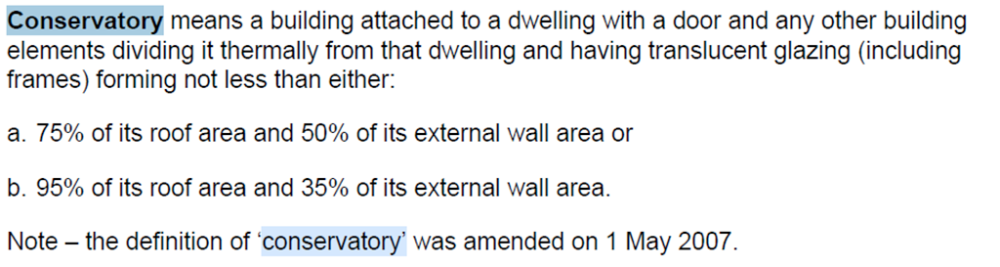
BCO says it cannot be a greenhouse (access from house) and therefore must be a conservatory and must conform to the 'Conservatories Guide' document, which states full insulation (d/glazing, walls and floor) even if not heated. Maybe I argue it is an ancillary building, not further defined in the regulations.
-
BCO said the one on the drawings is not compliant and we must submit an amendment for approval before building anything. I asked if he could look at the whole warrant to check for any more compliancy mistakes and he said no, that it was not their job to check.
-
There is a new external grade door between the two. They say it is due to the definitions (in the domestic technical guide) of a greenhouse and conservatory: They say it has to be one or the other. But I don't agree, because there is no definition of 'porch' in the regulations.

-
Has anyone here got a Greenhouse that has direct access from their house? Just been informed by building control that this is not allowed even though it is in our building warrant (approved by them 3 years ago). We want the added thermal properties a greenhouse will give to the house but we don't want the additional expense of a conservatory (full insulation). There is already a concrete slab in place left over from the demolished extension that we can re-use.
-
Inspection eyes at changes in direction of new pipe runs
Hastings posted a topic in General Plumbing
Could someone explain what this means please? It is referring to internal plumbing and written into my drawings and spec for our house build (Scotland) so presumably is a regulation and I want to check it is being done by the plumber. -
Thanks Nick. I can see the merit in bonding/foaming the insulation down onto the concrete at the stage of laying the floor but I am too late for that now and if I do it now to just the tray area of floor by cutting out a section I loose all the support strength from the surrounding deck while depending even more on the compressive strength and long term dimensional stability of the insulation under the tray. One thing I didn't understand please: "when fixing it to the studs" When fixing what to the studs?
-
Be aware that plastic has many times higher temperature expansion coefficient than copper. I learnt this from experience when plastic heating pipe was laid underground (insulated and in a 110 pipe) in a straight 10-15m run from my house to a garage office room. When hot, the pipe lengthened by about 20-30mm and caused a leak at the first 90 elbow at the garage end because the next section of pipe was fixed very firmly to a wall. The solution was to remove one wall fixing to allow the 90 degree pipe to move away from the wall and relieve pressure on the 90 joint. In Alaska where above ground oil/gas pipe lines are set on posts run alongside roads for 1000s of miles they form it into a 20m ('ish?) square 'U' shape every few kilometers to act as a sort of expansion/contraction spring.
-
The joiner who built the 3 timber frame walls around where the shower tray will go says it will be fine but I am nervous that in time the tray will drop a little and stress the tanking/join between tray and walls. The stud walls are supported on timber floor plates directly fixed to the concrete subfloor. I plan Classiseal tape for the tray (fitted to outside of tray before tray is put into position), overlapping and joining the Classi membrane tanking on the MR plasterboard walls. Should I cut out all the 22 chipboard flooring, polythene slip layer and the insulation and bed the tray on sand and cement directly onto the concrete subfloor? My worry with that is there is no route for the mortar dry out except for down into the concrete where it will be trapped.
-
Exactly my experience too.
-
The trouble with asking BC is 1/. it can take weeks to get a reply, 2/. the reply is sometimes wrong (they don't know the regulations and don't have time or the inclination to look them up themselves) or the reply is unclear. As I don't need to do the work until next week I will probably just put in a question now and if there's no reply by the weekend do it all to be safe as it isn't a huge job (hasn't been taped and filled yet).
-
Could you expand? Not quite sure what you mean. Thanks.



