


Hastings
-
Posts
290 -
Joined
-
Last visited
Everything posted by Hastings
-
Does anyone have any experience of the Interflush device, fitted to cisterns to save water? It seems like a great idea, as I don't believe dual flush really works in practice as it makes naive assumptions about human nature. It seems to be designed for the lever action flushers which I don't see on offer any longer.
-
Internal wall insulation 600mm masonry wall - condensation risk
Hastings replied to Robbie's topic in Heat Insulation
@jake Pavatex is the system. Natural Building Technologies is the UK distributor. -
Celotex installed in cavity block wall build
Hastings replied to Hastings's topic in Heat Insulation
I just looked again at the site and the PIR sheets are not t&g edge, just standard edges. Would building control approve such a poor design? Edit: Just heard from the architect that it was specified because it's easier to install than the T&G version (due to the cavity ties) and BC approved it, therefore no problem. There is no hope for humanity. -
Internal wall insulation 600mm masonry wall - condensation risk
Hastings replied to Robbie's topic in Heat Insulation
You are right - my mistake - I just talked to the Pava distributor and the VCL is not a total barrier but a breather type, (sounds very similar to roofing membrane) which makes sense. They also confirmed it goes on the outside (cold side) of the insulation. -
Celotex installed in cavity block wall build
Hastings replied to Hastings's topic in Heat Insulation
Thanks everyone - very useful info. -
I have just seen an extension under construction where the celotex is being fitted with no taping of the joints. It is being installed against the inner one of two 4" concrete block walls, just like you would fit glass wool bats - each sheet resting on or against the next at the edges, allowing draughts through. Surely a mistake?
-
Internal wall insulation 600mm masonry wall - condensation risk
Hastings replied to Robbie's topic in Heat Insulation
@Mr Punter and sometimes fitted to the cold side, depending on the system design? -
Internal wall insulation 600mm masonry wall - condensation risk
Hastings replied to Robbie's topic in Heat Insulation
Why? -
Internal wall insulation 600mm masonry wall - condensation risk
Hastings replied to Robbie's topic in Heat Insulation
@A_L Thanks - i didn't appreciate that breather layers can be air tight also. I will be using a vapour barrier NOT a breather membrane, to stop moisture travelling from outside into the insulation. "...do not use a VCL on the cold side of 100% of the insulation" - I think that depends on the detail. My understanding (taken from my architect, the insulation distributor and agreed by Building Control) is that it applies with non-breathable insulation like Cellotex but if using breathable insulation combined with MVHR then VCL on the cold side is the way to go. -
Internal wall insulation 600mm masonry wall - condensation risk
Hastings replied to Robbie's topic in Heat Insulation
Hi Jake, I don't think breather membrane is an option due to the need for aritightness (MVHR). The studwork will be as close to the wall as possible but the walls are not perfectly even so air gap is unavoidable and will vary a lot, around 25mm average perhaps. I am going to put bigger vents through the walls underneath the downstairs windows where the wall is much thinner, to reduce having to make so many holes through the full 600mm wall elsewhere - hoping BC will understand. -
Internal wall insulation 600mm masonry wall - condensation risk
Hastings replied to Robbie's topic in Heat Insulation
@Robbie If it's any help, I am about to start a similar internal insulation refurb of a west coast traditional Scottish house with 600mm rendered stone walls. Building control approved the following wall design (0.29 W(m2k): 25mm vents through stone walls, cavity (open at top to cold roof space), vapour barrier, 95mm wood fibre between studs, 30mm wood fibre over studs, lime plaster. Having MVHR is important I think. -
@dogman says he has worms living in his: It must depend very much on the exact conditions present.
-
Scary info about air quality
Hastings replied to richi's topic in Mechanical Ventilation with Heat Recovery (MVHR)
Death while sleeping is certainly more common in smaller spaces - eg. holiday cabins. I worked for periods out of a converted shipping container in Antractica that had a Propane heater and an air vent in the door. The trouble is, the vent needed to be screwed closed when the cabin was unoccupied, in order to prevent snow blowing inside, so that left the possibility of not opening it, going to sleep with the heater on (temps dropping to -30C made that very tempting) and not waking up again. -
Scary info about air quality
Hastings replied to richi's topic in Mechanical Ventilation with Heat Recovery (MVHR)
If you go to sleep in a sealed room, does the human body naturally react to the CO₂ build up by making you wake up? Or is it the same result as when CO builds up - you die without waking up? -
Scary info about air quality
Hastings replied to richi's topic in Mechanical Ventilation with Heat Recovery (MVHR)
Vlogging stunts like the youtube video above need to be taken with a pinch of salt. There seem to be quite a few big and possibly misleading generalisations made in it but it did make me want me to learn what is Really going on. Mainly I wanted to know whether it is elevated CO₂ or the (presumed) lowered O₂ inside the tent and inside those US studied classrooms that impares brain function? Isn't O₂ level also rather important to brain function too? Why no info on those levels inside and outside the tent? My personal experience of reacting to needing more oxygen in my lungs is frequently to feel sick and light-headed - it's caused by physical excercise and apparently it's good for you. -
New build - heat and energy considerations
Hastings replied to Tyke2's topic in New House & Self Build Design
Thank you @ProDave. Scouring a more extensive installation manual I have found that there was a T-38 thermostat that allowed setting both Comfort and Economy temps but these aren't available any longer. Why didn't they tell me about that one a few years back when I asked for a solution? I will contact the manufacturer again in case there is a current unit that will work with my system. Thanks. Might well be my best option. -
New build - heat and energy considerations
Hastings replied to Tyke2's topic in New House & Self Build Design
Uponor T-37 3108 1000536 T-37 IP20 T50 'FLOOR' pot Seems to be to do with limiting temps in the floor if a suitable sensor is fitted in the floor. 'ROOM' looks interesting. All I can find from the manufacturer is: -
New build - heat and energy considerations
Hastings replied to Tyke2's topic in New House & Self Build Design
Thanks, that sounds ideal. I just removed the cover of one of the room thermostats and discovered more controls that look like they might help with the issue but I can't understand what they do exactly. The lowest pot (purple POT 1) is the main temp control. Any ideas please?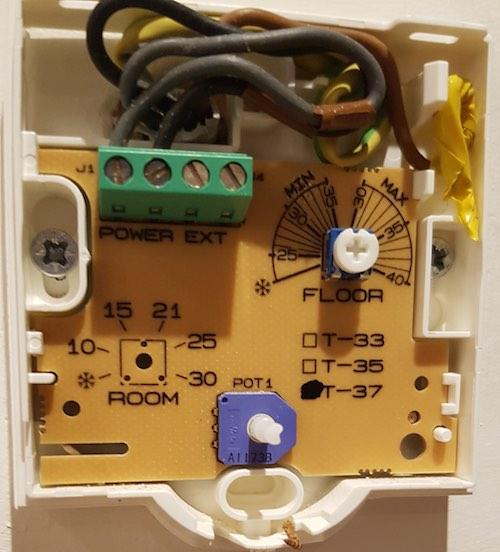
-
New build - heat and energy considerations
Hastings replied to Tyke2's topic in New House & Self Build Design
I can't set a particular temperature at all. The only temp control is a via physical dial (marked with lines but no numbers for degrees C) on the thermostat in each of the two rooms that has the UFH. I then hang a thermometer by the thermostat to discover what I have set it to. There is a progammable timer that controls both zones and lets me set 'Comfort' or 'Economy' periods, never 'Off', for each room. In the absence of any information confirming that I am saving energy by leaving the downstairs heating on 24/7 I think I will go ahead and try and modify the controls. I wondered about just installing a switch that I can time, that simply interrupts the power to the thermostat, that would effectively create an 'Off' period for the night. -
New build - heat and energy considerations
Hastings replied to Tyke2's topic in New House & Self Build Design
When I asked Uponor who supplied our (old house, listed cottage, single-glazing, ground floor insulation with UFH, rads upstairs, loft insulation, oil condensing boiler) UFH system controller why there is only "set back" and no way to time heating to OFF, they insisted it was more efficient to lower the night time temp a bit rather than turn it off completely. I find this very hard to believe. Can someone please confirm/explain? -
I have just one toilet, on ground floor in lean-to extension. No basins etc upstairs. So if treatment plant has a vent on it then just one AAV in the WC/shower room ground floor is all I need? No need for any "roof level..." or in-loft vent?
-
That sounds ideal for my airtight low energy renovation. But my architect says I need a vent stack pipe at roof level on the longest run (of foul drain pipe) plus AAV in every room connected. Could that be wrong? He doesn't know the regs 100% and the foul drainage has not been passed by BC yet as the warrant (Scotland) passed is for a waterless closet (now abandoned). Is your loft AAV positioned outside the thermal envelope? Do you also have AAV in every room connected?
-
But is there not a vent stack pipe at roof level at the house that allows air into or out of it?
-
I lived for years (until mains drains came to the street) very close to a Biodisc Klargester we shared with another house. It had no dedicated air vent, so it received enough oxygen via the outlet pipe to the stream and inlet pipe from the 2 houses it served, and it never smelled. Therefore I am puzzled as to why any treatment unit should need a vent at all. My unit will be in a very windy exposed spot in the Hebrides where lack of enough oxygen entering the tank will not be an issue.
-
£4650+VAT for the 8pe Clearfox.

