


TerryE
-
Posts
3826 -
Joined
-
Last visited
-
Days Won
30
Everything posted by TerryE
-
Ian, sorry to hear about the hip ops. Doing a self-build is body-damaging. My general health took a significant step down because of our build. I held it together until we moved in, but by then I'd used up all my reserves, and pretty much collapsed with exhaustion. Old age fighting slow recovery. Not sure which is winning. All I can say is that rest and recovery is more important than dotting i's and crossing t's.
-
Ian, I think that you are losing the plot. 🤣
-
This might be overkill for what you want, but this is what we did:
-
The point here is that the pavement is part of the public highway (if the way is adopted) and outside your curtilage, so it isn't your curb; it belongs to the local authority. The LA will typically retain active control on any works done to their highways. They will grant permission to do reasonable crossing works so long as the requester is willing to foot the bill, but they will want to cover admin costs, and limit execution of the work to one of their approved sub-contractors. That's just how it works. If you ignore the rules and do this work yourself, then you might get away with this, but you might also piss off the LA and be forced to foot the bill for any remediation work to restore to highway to its original condition.
-
Off-peak energy storage for cheaper heating
TerryE replied to Originaltwist's topic in Other Heating Systems
Nope. We are in the "sustainable" core of our village and the planners like every new change to be sympathetic to the street scene. So PV on our street-facing roof (SSE aspect) was considered a no-no. There's no point in having an additional heat battery for us as our whole house intrinsically works as its own heat battery, but my thought is that this approach might be more appropriate for a retrofit or more traditional build-style. Any form of heat battery should allow you to time-shift heat generation and storage from periods where the unit price of electricity is low and decouple this from consumption demand. -
Why should I care about some naff formula? I own my house outright and don't intend to sell it. Maybe the EPC version dated 2035 might be more relevant. It's our comfort and the actual running costs that are important to us.
- 54 replies
-
- 1
-

-
- underfloor heating
- passivhaus
- (and 1 more)
-
Off-peak energy storage for cheaper heating
TerryE replied to Originaltwist's topic in Other Heating Systems
A 1,000 ltr tote buried in hole in the garden wrapped in say 400mm EPS 100 storing water at 60°C would leak heat at about 50W. If you don't want to "waste" that heat, then stick a greenhouse or shed on top. This should be good to store around 40 kWh heat for dumping into UFH. Just an off the wall idea. -
Yup. We are of an age where we are facing that. It's what life does.
- 54 replies
-
- 1
-
-
- underfloor heating
- passivhaus
- (and 1 more)
-
Off-peak energy storage for cheaper heating
TerryE replied to Originaltwist's topic in Other Heating Systems
This is all a lot easier if you are doing a new build that is optimised for heat storage. In our case we have a warm slab -- that is a concrete raft foundation where the insulation is on the outside of the raft so we have ~70 tonnes of concrete inside our thermal envelope and we have 30cm cellulosic filler in our twin-wall timber frame. Whilst this doesn't have as good an R-value as PIR, it has a far higher specific heat and so a high decrement-delay time constant. What this means is that we can dump the heat into the slab pretty much anytime the energy is cheapest. The house cools about 1°C / day in the winter without any heating. We use a 2.88 kW heater to heat our UFH and no other fixed heating. We seem to be be paying about 4-10p / kWh this month for our heat on the Octopus Agile tariff because we only draw this down when the price is cheap. It was even cheaper in Feb / Mar and we had a few days where we were paid to heat the house. We don't have an ASHP, because I can't make an investment case for installing one. Our system has no expensive moving parts; no ASHP to maintain or replace. Just the electricity running costs. -
I am not sure that you can 2nd guess future buyers potential thoughts, especially if you have no plans to sell your house. In our case we have no rads, no gas, no ASHP; just one 2.88 kW Willis -- plus 6+ years of logged temperature data and daily electricity use and costs. Our current electricity bill thanks to the Agile Tariff and spot electricity prices is the lowest it's ever been.
- 54 replies
-
- 1
-
-
- underfloor heating
- passivhaus
- (and 1 more)
-
Even though sleeping platforms like that are quite common on the continent, with UK Bregs that's nothing more than a storage space. The headroom is inadequate and access breaches safety considerations. I would be very concerned about my grandkids (or their friends) sleeping up there. That's a 2½m drop and access isn't kiddie-safe, so the chances of someone getting seriously hurt are just too high. Most Regs are there for very valid reasons. If anyone fell using that space, then the house owner would be liable. Not a good idea.
-
I have often pondered about this one. It was first pointed out by JSH referencing the manufacturer installation instructions, and IIRC he got a bit heated about this point. Why? The primary use of the Willis is to act as an external heater on a copper vented (unpressurised) H/W cylinder. Here we have open-loop heating constantly replenished mains-fed water. This carries an element of dissolved air which will tend to come out of solution during heating and build up in inverts -- hence the recommendation to fit the Willis inverted. TBH, even if I was redoing my CH system, I would still use a Willis and I would still fit it heating element up, because this issue doesn't apply for this use: the water is a small closed volume running in a pumped circuit. In our case I filled our UFH loops 7 years ago, topped up with inhibitor / unfreeze, and then pressured the closed system to 1 bar. Occasionally over the next month or so, I bled the system at the manifold to let out any air coming out of solution. In the process the tiny amount of water lost when bleeding was taken up by the expansion tank dropping the pressure to 0.8 bar or so. I then topped up the system back to 1 bar, and that's it: 7 years later, the system is still at 1 bar. There is no more air to come out of solution. So air build up is just not an issue here, and the Willis works happily in any orientation, and I am happier with the wiring and thermostat setting on top where I can see them and have easy access. So yes, for me heating element up works best.
-
Well the old Tungsten bulbs were rated at a nominal 1,000 hours or about a year at 4 hrs / day. How many bulbs have you got? The weakness with these is that the cheap capacitors(s) in the voltage drop-down circuit can blow. Big Clive on Youtube did a teardown explaining the failure mode.
-
MVHR and windows open
TerryE replied to Trw144's topic in Mechanical Ventilation with Heat Recovery (MVHR)
You could make the same point about the central heating. Is that as valid? We fitted our MVHR ourselves. It cost us less than £3K, IIRC. When I did the heating calcs the air recirc losses on the top 2 floors meant that we would have definitely needed some form of central heating solution for these upper floors without it. This would have cost us a lot more than the install cost of the MVHR. We just leave ours running 24 × 365. The running cost is in the noise compared to the heat recovery energy savings during net heating days. And as @dpmiller points out: fresh air and no damp year-round. And yes, in the summer we open windows as and when desired or needed. The MVHR still keeps the wet rooms and unused bedrooms fresh. -
Just started a self-build in Dorset. Exciting times!
TerryE replied to NailBiter's topic in Introduce Yourself
We also set our reveals at 60° see -
Your UFH risers are coming very close to the side door. Make sure that you have enough clearance to get the manifold assembly in.
-
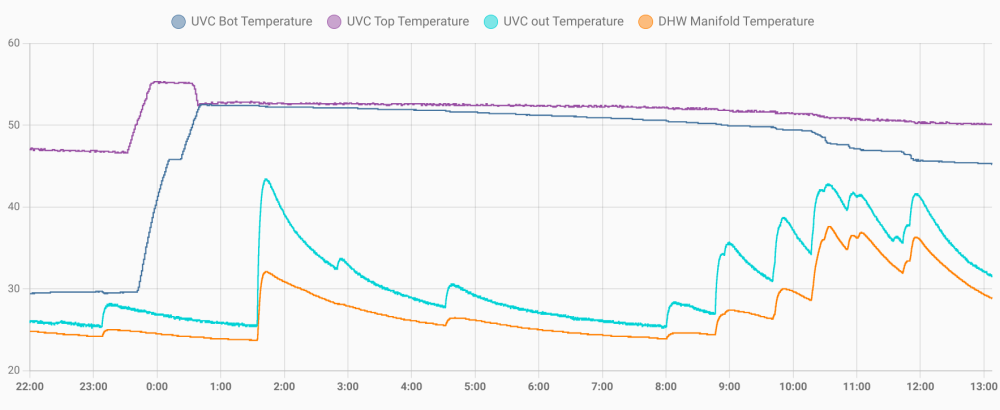
@JohnMo we are talking classic trade-offs here. Dropping pipe diameters significantly reduces both mass-in-pipe and unit-length pipe mass and therefore heating lag. I did my manifold design 7 or 8 years ago and it work well so is not worth replacing. Heat lag on flow-from-cold just wasn't an issue that I considered. TBH even now that I am aware of it, I am not sure how I would change things. I use closed cell insulation for HW pipe runs from the tank to manifold, and the HW manifold itself is in box that is packed with lagging. The system leaks are ⅓°C / min at 40°C as you can see from the plot below of the UVC top and bottom temps, plus the out from the UVC to the manifold, and inside the Manifold itself. You can see when someone ran the hot until "hot enough" at around 1:30, plus a few other mixer runs where there was some hot draw but not enough to reach the tap (e.g. a quick hand-wash after a pee in the night). Jan was doing stuff in the kitchen 10-12:00, enough to get the hot to mid 30s but not enough to need to run hot. No showers or baths in this period. Total heat loss isn't really material. It's just that we don't use H/W that much but when we do want hot, it takes 30+ sec to run to a decent temp. This would have been better if we'd used 15mm main runs but then this would really limit peak flow times (e.g. running a bath or 2 showers on the go at the same time). The one thing that I would have done differently is to drop all low flow hot runs from the manifold from 15mm Hep2O to 10mm.
-
As I mentioned in other posts, I have replaced my SunAmps with a UVC. All done, but one consequence is that there is now an extra 3m of 22mm copper pipe between the storage unit (the UVC) and the DHW manifold. This has introduced a noticeable additional lag in the time to run hot from cold when I run a H/W tap. The total amount of heat absorbed by the pipe is quite small (1.5 Kg Cu pipe × 0.385 kJ/Kg°C specific heat Cu × 30°C) or 17.3 kJ or roughly 1/200 kWh per "run from cold". Given that we only run from cold maybe a dozen times a day, this heat loss is quite small -- especially as for half the year we are doing heat top up through the slab and this can just be considered another form of radiator. It's the increased delay in flow response that is noticeable. So I thought to myself: would replacing this copper pipe by HEP2O make a noticeable improvement? So I ran the numbers for PeX. PeX pipe is over 4 times lighter but the specific heat of PeX is actually over 5 times higher than that of copper so the heat absorbed works out still more. However the HEP2O barrier pipe also includes an Aluminium layer which drops the overall figure back again. Even so I estimate the heat absorbed to raise the HEP2O by 30°C is still around 18.5 kJ so the bottom line is almost counter intuitive (to me at least) that I am better off (in terms of thermal responsiveness) using copper than HEP2O for these runs. I thought that some of you boffins might be interested in this observation.
-
A passing scrap metal man noticed the steel and copper / fittings piles and popped in. All gone. Jan is a happy bunny. Sorry @oranjeboom, you timed out.
-
👎
-
Microcontroller based power switching revisited in 2024
TerryE replied to TerryE's topic in Boffin's Corner
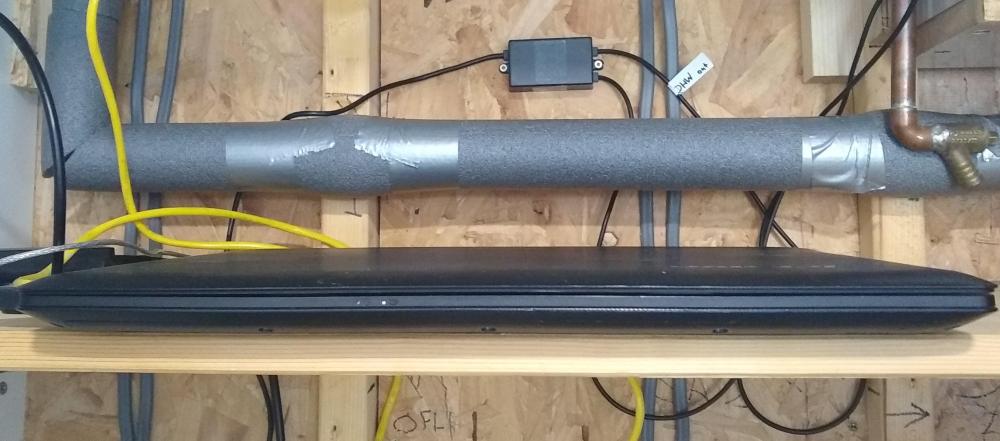
So here is what my CH / UVC Immersion control setup looks like finished: The RH Consumer Unit is as-installed by my electrician. I've repurposed some of the circuits: CH, SunAmp 1, SunAmp 2 → Immersion 1, CH, Immersion 2 (I swapped the CH to the 20A circuit, though this could be downrated to 16A.) These radials are routed through to the adjacent small CH on the left. This contains AC→24VDC and 4 Finder 240V / 20A relays(UFH Pump, Willis, Imm1, Imm2). These 4 run radials to fused DP wall plates, and on to the pump / heaters. The small box underneath the relays is a commercial off-the shelf unit discussed in a previous post the runs on 24 VDC and switches the 24VDC input used to control the power relays. This runs standard Tasmota Software (albeit configured with a local autoexec to add a local rule that forces the Willis to turn off (if on) whenever the pump is turned off). The Tasmota firmware is controllable via MQTT. Incidentally above the CU are my BT Infiniband modem, 100Mb Enet patch panel and Wifi hub (this meshes with 3 other Wifi APs to give strong 54Mb Wifi on the 1st and 2nd floors and garden. The CH+DHW upper control used to be hosted in the RPi3 to the right of my Wifi hub, but it is now run on a virtual container on my home Proxmox server (a repurposed Lenovo Laptop which sits on a shelf in the service cupboard that contain my DHW+CH manifolds and used to contain my SunAmps). A bit like a NUC, but with built-in battery backup. It just sits there always closed, as I manage everything over my LAN using SSH and the Proxmox Portal. This hosts a VM running Home Assistant, and currently 8 other containers (LXCs) including Pihole, VPN Portal, IoT stack (MySQL, NodeRED, Mosquitto MQTT server, Zigbee2MQTT), an FTP service for my external cameras, a couple of web-servers and 2 test containers. Above it, the small box is one of my DS18B20 IoT devices, but more of that on a separate post.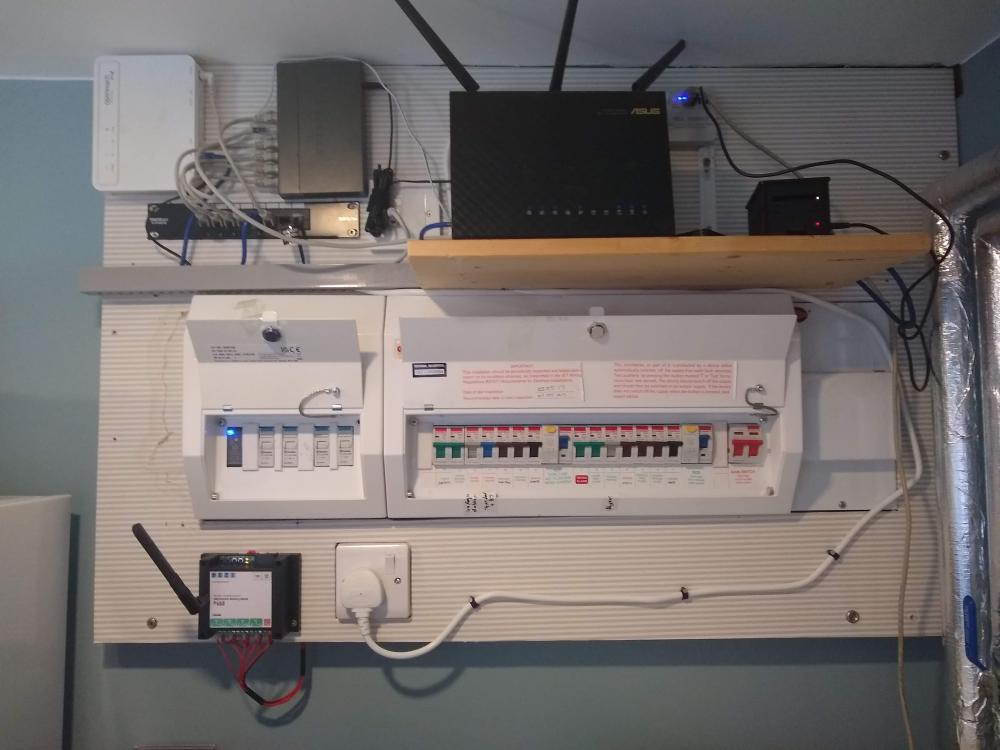
-
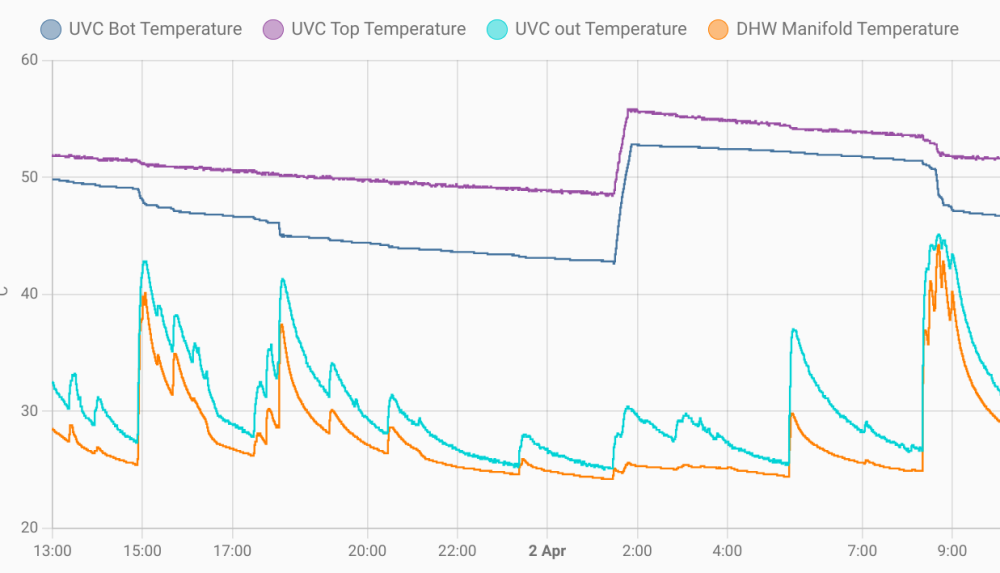
@Tom, thanks for the heads-up. I'll double-check the manufacturers datasheet and discuss this with my plumber. If necessary, I will source a compliant alternative and get him to refit it. I'd need a double failure that is of both the following for the UVC to risk venting: so I don't view this as an immediate fix needed: A failure of one or both of the tank thermostat switches My CH / DHW control system will only power the Immersion circuits if the tank temperature (taken by a separate digital thermometer next to the tank thermostat) is below a configured set point. Yes,, these DS18B20s can fail, but I've never had one still respond to a reading request but suddenly start to report a value 30°C lower than previous readings . Moreover if the top of the tank was nearing boiling then both sensors would have to be miss-reporting. So on the scale of risk, I am a lot less concerned about this than flying on a 737-MAX 🙃 BTW, here is a brief plot of my HW sensors:
-
I've got ~150 Kg of food grade Sodium Acetate Trihydrate to get rid of -- assuming Orangeboon doesn't want to take a couple off cells my hands. It can happily go down the drain in small quantities. I was wondering how good a block paving cleaner / weed deterrent it would be. 🤣
-
Aaaagh. Literally hours to late, but seriously if you have a SunAmp PV and want a spare then resurrecting one is straightforward plumbing if you have the energy / inclination. I would far sooner it go to another member than scrap. Also if you need to extend the operating life that you'd probably want various spares like a couple control boards, inline heater, PMW pump, etc. Jan put some of the foam in the black bin. If you are interested @orangeboom then let me know by return and I'll sort out a complete set of bits tomorrow.
-
Well, the pallet with 2×SunAmps is no more. I now have a small pile of steel scrap, a smaller pile of copper scrap, a small pot of eWaste and as with @Cooeyswell a row of 4×SAT Cells and a stack of vacuum panels.



