


TerryE
-
Posts
3826 -
Joined
-
Last visited
-
Days Won
30
Everything posted by TerryE
-
Fabric and ventilation heat loss calculator
TerryE replied to Jeremy Harris's topic in Heat Insulation
I suppose you are right: we have been living in "cloud cuckoo land" for 7 years now. And very comfortable it is. 😱 🤣🤣 Models are tools with limits and uses. What you seem to forget in this polemic is that many of us live in builds that were the designed were tuned using such tools, and they worked for us. -
Nah, the biggest fubar was that they decided to build a reservoir on the island sized to sustain a 7-year drought. To save maybe 5% of the budget they decided the geology meant that they didn't need to line half. It leaks badly so is never more than about 5% full (Google Earth, here). The German construction company declared bankruptcy after screwing up more than a dozen water schemes across the Greek Islands.
-
I was thinking of doing an "Uphill Poo" topic when I saw this one. By way of background we have a cottage on a Greek Island where we live in spring and autumn, about 4 months of the year. There isn't any centralised sewage here so every house in the old village has its own cesspit or "votra"; ours (like most) is a ~1m wide covered "stone well (in shape at least)" dug into the path immediately outside the cottage. This works well because the village is on a hill about 300m above sea level and about 2 km from the sea. There are so many fissures in the rock plug that the village is built on that liquids rapidly drain away, and the poo (no paper allowed) is a valuable resource to the local flora and fauna, and so is quickly carried off or absorbed, so absolutely no smells at all and AFAIK it has never been emptied in the 50-100 years that it has been there. The grapevine covering our top terrace thrives on it. There are maybe 1,000 dwellings on the island, most of which use a similar approach though the large and newer ones have proper septic tanks. The Local Authority has just secured EU funding to replace this distributed solution which works well by a central problem one. Step one is to put in a sewage system designed by politicians not engineers and to fund local LA workmen. They've trenched the main road between the old village and the port to add a 160mm main sewer with access manholes next to every house and junction. The main problem with this is that the pipe is buried about 0.6m below the road surface, and the road is not downhill only as there are often 30m dips over a few hundred metre sections, so the fall gradient varies between about 12° and -5°. Poocrete plugs and popping manholes will abound. So @G and J it could be worse, you could live on Alonnisos! 🤣
-
Fabric and ventilation heat loss calculator
TerryE replied to Jeremy Harris's topic in Heat Insulation
IMO the PH certification is OTT. We wouldn't get it for our house. Our planners imposed a cottage style to fit in with the village street scene, so no solar on roof and smallish windows on principle (SSE facing) elevation and no windows on gables because of overlooking neighbours, so very little solar gain. However, with now 7 years in the house, I actually think they were right: we like the look and feel of the house. What is more important is that house has low energy loss, and a high internal thermal capacity, so it works well as a single zone and we can keep the whole living space at a pretty constant comfortable temperature 24×7. No zones, no zone controls and valves; nothing complicated, pretty much no moving parts to go wrong and therefore no maintenance costs. In my case I have 4 power relays in my Consumer Unit Expansion and a Grundfos circulating pump, all of which are simple and cheap to replace on failure. The system works well with Octopus Agile so the house is cheap to heat using resistive heating. Having an ASHP would save me maybe £400 a year -- less the £200+ maintenance contract -- but the discounted cost of procurement and installation would be at least 30× that of the annual saving, so doing this makes no economic sense. I do have 3 oiled filled <1kW electric rads (~£60 each) that I do use for time dependent top-up in the worst winter months and these are controlled by my HA through Tasmota smart plugs (~ £15 ea). Again my HA handles these automatically to make best use of cheap Agile rates. The running cost of these is in the above figure.- 204 replies
-
- 1
-

-
- heat loss
- ventilation
- (and 4 more)
-
Fabric and ventilation heat loss calculator
TerryE replied to Jeremy Harris's topic in Heat Insulation
BTW "Internal" refers to the inside dimensions of the external surfaces: the walls, floor slab, top ceiling or warm roof. The main reason that your totals are greater than mine is that your house is quite a bit bigger than mine. My internal floor area is under 80m2, though we do have 3 floors as my son's bedsit is in our warm loft space. -
In my way of looking at it, in a fixed price contract, the supplier gets some value in that they are locking in customer loyalty for a fixed term, but they are also selling energy futures which comes at a risk and this comes at a (insurance) premium which you have to pay for. We can afford to self-insure for future price risks, so in our case this doesn't make sense. Also because our house spec and heating solution (lots of posts elsewhere) half-hourly pricing works really well for us. Since moving to Octopus (Agile), our bills have roughly halved.
-
MBC and at least a couple of other specialist passive house suppliers use warm-slab construction as standard. The MBC SE knows his stuff and he has probably designed over a thousand such slabs. BTW, it's not just any EPS; it's a special construction grade, designed for load bearing. There is typically EPS 300 under the ring-beams and EPS 100 under the main floor pan. It our case there were two load-bearing cross beams so the main 100mm pads only spanned some 3½m and had an extra 100mm (i.e 200mm deep) cross braises every 2m or so. Have a search on YouTube: there are some really good time lapses of some MBC builds. Incidentally, I mate of mine had a house in Texas in the Houston Bay on what was essentially reclaimed swamp. This type of reinforced slab is the standard construction technique in his area.
-
Pretty much any builder in the UK knows how to dig a 600×1000mm (or whatever depth is used for local soil types) trench-type foundation and fill it full of concrete. Making an insulated slab is still (in the UK) really a specialist exercise, so the crew needs to know what they are doing and have a true quality work ethic. The actual sequencing of the build and pour is very tight so the crew need to be on the ball. In our case, the concrete was a little wet and the weather cold. The concrete is power-floated to finish and level to 1-2 mm across the entire base and the time window in the set where it is firm enough to walk on but still workable is quite narrow. If you don't do it during this window, then you might end up having to power plane the finished slab. Our crew foreman stayed on site over night and started about 3 AM! The approach doesn't fit well with some soil types, especially if there is a change in type across the pad. Tree roots running near or under the pad are an absolute no-no. You need to have a pukka soil survey including cores across the site and this is probably around £3+K today. The SE uses to spec out the sub-base. But we went from a hole in the ground that 100s of birds were using as a shallow lake to a finished slab complete with UFH loops fitted in just over a week. It was amazing to watch the process.
-
(My A, B, C) Re A) MBC use a reinforced slab construction, rather than the poured concrete trenches. The latter is the norm in the UK, but the former is commonly use elsewhere. Each method has its strengths and weaknesses. The MBC approach used a compacted layered Mot 3 sub-base, 50mm fine levelling sand, followed by structural EPS insulation / concrete formwork, and the rebar cages and floor reinforcing laid inside the EPS with the UFH pipework tied to the rebar grids. A deep core soil survey was mandatory and this was used by the SE to calculate the sub-base depth. IIRC ours was 450mm compacted in 50mm layers. I am not sure what you mean by B. My local contractor did the site prep with me doing site survey validation. The MBC crew turned up on the agreed day to start the sub-base, the sand, then EPS, then UFH, then concrete pour, and 8 days later (IIRC) we had a complete insulated slab with the sides diagonals and levels accurate to a few mms. There was a 3 week back-off to allow slab to cure and then the framing crew arrived. IIRC the big crane was the road unloading cassettes off on-road artics on day 1, then a smaller crane worked on-site for days 2-4 or 5. Until the Internorm crew came to fit the windows on day 8, the MBC framing crew was the only team onsite. At day 10, we had an externally complete TF complete with windows and doors that I could lock normally. Since MBC subcontract these crews (but work with preferred subs) this process could be hit and miss depending on the actual crews. There was one member that I recall had a bad experience, but most were like me and were really impressed with the quality of the work. Re C. The topic is about MBC TFs. How many MBC TFs have you worked with? I have only built one, but what I can say is that we had no probs with (lack of) squareness, and not a single plaster crack in 7 years in our entire house. Other members here with MBC frames have made similar comments.
-
As I discussed above, our ground floor slab and room layout was on a 3×2 grid with the slab dressed to flat within a few mm level across the entire slab. The TF was then erected on the set slab. We decided to tile the entire floor with a dressed slate before second fit. Our slater said that he'd never tiled anything like it in his career. He started out at a gable side of our living room and worked through the internal doors to the gable side in the kitchen and out of the rear kitchen patio door. He only used parallel cuts, and everything was square to the mm. It took him more than a day less than he'd estimated because everything was so level and square, so he threw in slating all our external door plinths gratis.
-
About a month or so back I did a post about reconciling my as-measured slab performance to a theoretical treatment. In short you consider my MBC slab in terms of either the 100mm slab area where the UFH loops run (say 10 tonne), or the total slab volume -- that is: including the load bearing 300mm ring and cross beams, plus the 200mm cross-bracers (say 17 tonnes). In terms of overall heat retention and release the best fit approximation was about 90% of the higher figure: the whole slab effectively acted as a heat battery and not just the areas with UFH looping. Even though the specific conductivity of concrete is relatively low, there is a lot of rebar in the slab and it is an extremely good conductor (see this post for numbers) and over the hour to few hours timescale, the heat is spread throughout the slab, and v.v. is the UFH is off and the heat is being slowly radiated into the living space.
-
How? What measure of efficiency? You've lost me here. @Nick Laslett MBC have been doing this with their slabs for a decade.
-
The max flow temp depends on average heat flow into the house. For example for our Passive-class house in Dec-Feb, we need about 2 kW heat input into the environment peak to sustain temps. IIRC our radiant floor area is about 72m2 × ~ 7 W/Km2 or ½kW/K so we need the slab surface to be on average ~ 4 °C warmer than the internal temp. A more typical modern build might need 3× this delta. So if I was using a 3kW ASHP then it would be running at a mark:space ratio of 2:1, and as @JohnMo says you could probably get away with 300mm centres. IIRC ours are at 150mm, but we use a Willis with block heating at the cheapest Agile half hour slots. Even so our manifold out into the slab rarely gets about 30°.
-
Have a look on YouTube and HA forums for more detail. Most of these IoT devices use an ESP processor to connect to one or more sensors / relays, etc. Traditionally they would be preloaded with vendor-supplied firmware that would connect back to a vendor-supplied cloud service. Tasmota and ESPHome are open-source projects to provide a configurable firmware that you can download onto IoT devices so you can use them without depending on some closed-source (usually Chinese) vendor-supplied firmware or having to write your own. Amongst other things these can use MQTT to control the device, and both have Home Assistant integrations so you can do pretty much everything through HA. E.g. Google "AliExpress Athom smart plug Tasmota". I bought 6 for around £60 IIRC and they came in about 2 weeks. Tasmota and ESPhome connect to your home router using TCP. The other option is to use ZigBee devices which use the ZigBee protocol and use a ZigBee dongle on your RPi with ZigBee2MQTT so that you can also control them using MQTT.
-
@JohnBishop, I personally avoid using any which depend on vendor supplied apps. As @Wil suggests have a look at HomeAssistant. It runs fine on an RPi4 with a min 2Gb. Use USB3-attached SSD as your main storage device. HomeAssistant has a load of "one-click" add-ons and integrations, such as the Mosquitto MQTT Broker, MySQL, Zigbee2MQTT, ESPHome, Tuya, Tasmota, and these take away most of the configuration pain. I have a load of Zigbee sensors. All of my smart switches use Tasmota. I also have some custom Wemos D1 mini Pro set-ups to handle my DS18B20 temperature sensors and these run ESPHome. Everything is integrated through MQTT and all runs on my LAN. I buy everything on AliExpress and wait the extra 2-3 weeks to arrive. OK, I don't use RPis anymore as all my services run as x86-64 VMs / containers on an old laptop that I use as a server and this runs ProxMox host, but that my personal preference because I am an IT geek. A single RPi running HassOS will work fine for most users.
-
The issue is that a typical UVC stores 200-300 ltr of very hot water under 2-3 bar of pressure. One of those going pop could badly scald anyone next to it, so it has to be installed and regularly maintained by an appropriately qualified engineer.
-
@LA3222 you have an Ecodan ASHP don't you? I download the Ecodan PUZ 5 kW installation manual a few years back and it said that the unit was delivered not prefilled, and so needed a F-Gas certified engineer to do the install. I guess things have moved on since then. Sorry for the confusion.
-
@JamesPa, I agree with most of what you say and you explain more coherently that I have. Certain control regulations mandate the use of appropriate experts who must be approved and registered for certifying work carried out, e,g. electricals, gas boilers and fittings and who then issue an appropriate certificate. For replacement windows, control is effectively delegated to a FENSA registered fitter. Using one isn't mandatory, but if you don't, then normal building control applies. There is a similar situation fitting log burners, etc. In the case of ASHPs most seem to use HFCs as the refrigerant and most monoblocks are not prefilled and so must be installed by a Part F certified gas-safe engineer. MCS installers have this as part of their training / qualifications. I think fair to say that using an MCS approved installer is mandatory if you want an ASHP installed under PD. The installer "signs-off" on compliance with regulations and in practice there is no need to get separate Building Control engagement. Without PD, you have to make a planning application. AFAIR, successful Notices of Decision invariably make sign-off conditional on BC sign-off, so you have to register the work with Building Control. Or are you saying that there is some path where you can install an ASHP without using an MCS approved installer, whilst also avoid getting the bureaucracy of getting the LPA and BC involved? If so, then can you explain how in simple terms? If not, then we agree on the turd; it's just that you are putting a different polish on it. 🤣🤣
-
There is possibly one thing worse than having an ASHP outside and the neighbours complaining about the noise. That's having it inside the house and all of the occupants complaining. In most weather conditions the temp drop across the ASHP air flow will be higher, maybe more like 5°C but the heat demand is also higher so the ASHP still needs to move tonnes of air per hour across the heat exchanger. You need large exchange areas and big slower fans to keep the noise down.
-
Thanks, IIRC the Planning Portal says that any ASHP installation can fall under Permitted Development if the installation complies with MCS 020 and part of this standard requires that the installation must be carried out by an MCS approved installer. Without a PD exemption, normal planning and building control applies. This is all a lot simpler if the installation is done as part of the initial build and part of this planning and building control approval, but in our case that was over 6 years ago. As a post sign-off install, this control itself introduces a shed load of bureaucracy and costs. In the case where the proposed ASHP is to the rear and within the property curtilage, you would need to demonstrate to BControl that the installation complies with gas-safe, positioning and noise regs. In this last case it would be practically impossible to get BC sign-off of your calcs unless the ASHP unit is an MCS approved model. BTW that Trianco unit has a heat output of 3 kW and a nominal power draw of under 1 kW.
-
Thanks. I've just checked BUS Property owner guidance, version 3 and you are right: to be eligible the ASHP must provide both space and water heating. The ASHP model and the installer must also be MCS certified. That's the big stumbling block for me. As I said in an earlier post I've already made our house "ASHP ready" during the build about 7 years ago. I really only need a small, say 3-5 kW unit with output flow at ~30°C driving direct into our warmslab or via a PHE. About the same amount of work that @JohnMo described above for adding DHW support. Maybe £3-4K work and bought-ins, if I did this myself and depending on what ASHP deal I could source. Entirely fit for purpose and just about achieving my 10 year payback constraint, but this would not achieve MCS certification and therefore this approach would not comply with Planning / Building Regs, so a no-no as far as I am concerned. The MCS installers that I talked to wouldn't touch this approach or some variant thereof with a barge pole. They'd want to rip our entire system our and based on the size of our 3 storey detached house, replace it with standard template based on something like a 11 kW ASHP, buffer tank, new UVC, etc. at maybe £15+K (OK, less BUS grant); all to save me maybe £400 p.a. Crazy.
-
First, since we have absolutely no intent of selling in the near future, this isn't really an issue for me. Next, I have a real issue with talking about monthly run rate as if it is the absolue goal. Surely we should be talking about LCoH from a consumption perspective. Our house is passive-class and has high thermal inertia. If some putative new owner simply switched to a timer based E7 tariff then the house would still be for more cosy than most new houses and it would still be very hard to make a proper payback case for installing and ASHP. Many members also seem to assert that using your ASHP for DWH is a must. Why? As I said in an earlier post on this topic we spend about £150 p.a. on water heating. Why go to all the hassle of extra buffer tanks, dual level ASHP control, dropping the overall CoP by maybe 20% just to save £100 a year (or even 3× that if we used a lot more HW): you have more kit to install, to have an annual maintenance contract and to discount the extra installation costs over the expected equipment life? The numbers just don't add up for us. Sorry. The SAP calc should not penalise any form of renewable heating solution. It should penalise fossil based heating solutions. Our's is not a typical mass build; it a passive-class house designed and built to a high spec. Actual performance is what should count in this scenario.
-
Remember we did our as-built EPC in 2017. The detailed stuff is back in the UK and not to hand, but IIRC we got marked down for using resistive heating and ended up with a C EPC, but still good enough to make BReg requirements. That being said, I regarded the whole SAP exercise as a paper one needed to get sign-off. What I really care about is real-world performance and total levelised cost of heating. Given that we use renewable electricity only, the total doesn't worry me and I suspect that going forward the scoring system will penalise fossil-fuel based heating more than direct electric.
-
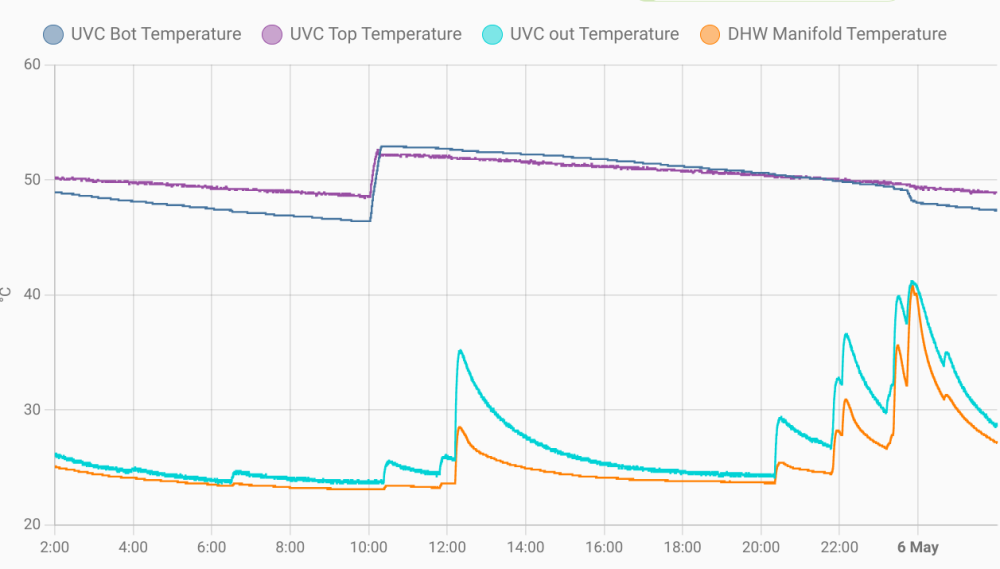
We have an OSO UVC which is heated by dual immersion. I also have a couple of digital thermometers on the inner tank, one next to each immersion. My Node-RED heating control system does a day-ahead heating calcs at 23:00 GMT each night. We have Octopus Agile and the daily half-hour (HH) pricing runs 00:00 - 00:00 C.E.T. As far as DHW goes, the CH calc takes the average tank temp to work out a slight overestimate of kWh needed to bring it up to 55°C and this get scheduled at the cheapest HH slots with a cut out at 55°C (though at the mo the Immersion thermo cuts out first). We are on a Greek island ATM, so the HW draw is only from one occupant; our son who lives with us in his bed-sit on the 2nd floor. The screen capture below show the last 24hr history for Home Assistant. (BTW, the bottom scale is in local Greek time, sorry.) He hasn't used much hot water today (mainly just a quick shower, I guess). The OSO is really well insulated but even so most heating here is loss replacement. Checking my eventlog table, the total DHW heating used was 1.6 kWh costing 20p (The north sea is dead calm ATM, so the daily low price is quite high at about 13p.) Over the last few months since we commissioned the OSO it's been a lot windier and even though we use more HW with 3 of us in the house, the HH price for DHW has been averaging around 5p so we typically spend maybe 50p a day on DHW.
-
I have a passive-class house with a 70 tonne MBC "warm-slab" within the heated fabric of our build. I went for the deferred option of putting in the 6mm radial from the CU to an outside wall box and a insulated double pipe run from the UFH cupboard to where I would put the ASHP, but held off installing an ASHP and used a 3kW Willis as an interim means of heating the UFH loops so that we could size the ASHP based on a year or two run rate. The issue that we have is that going from using the Willis (plus Oil filled rad top up Dec/Jan) on an Octopus Agile optimised heating schedule to an ASHP at an average CoP of 3½ say might save us perhaps £300 p.a. in electricity costs. (We have a handful of days a year when we put in more than 30 kWh heat.) I'd want at least a 10 year payback so would want my install costs to be at most ~£3K. And then you have the issue that the typical life of an ASHP can be ~10 years. It's just easier to pay the extra £300. 6 years on, and I still can't make the investment case.

