

.jpg.c21f3ac78c9b7efd90cbdcb312744dc5.jpg)
jack
-
Posts
7460 -
Joined
-
Last visited
-
Days Won
41
Everything posted by jack
-
.jpg.c21f3ac78c9b7efd90cbdcb312744dc5.thumb.jpg.7adcad4c0e384f5ecd7d56b0618df6e5.jpg)
Level door access disaster. Advice needed
jack replied to Paene Finitur's topic in Doors & Door Frames
As I understand it, all houses require it. It's possible there's level access around the side/back where you can't see it - it just needs to be accessible from a parking spot. There's no requirement for you to maintain level access, only for it to exist at the time it's signed off. Do something cheap and temporary. Get hold of some bits of wood and build a ramp on top of what's there. Or lay plastic over your existing ramp, and lay down some cheap (even second hand) pavers in a weak concrete mix (or even just siliconed/glued to bits of wood of the right thickness underneath). Be creative - you might do it for something close to free. We did something similar with ours when the inspector noted the absence of level access on his final visit. We bodged something up with some concrete council pavers we had lying around, sent him a photo, then dismantled it as soon as we got the certificate. -
It's a huge shame about the last minute delay (and other challenges along the way), but your parents must be chuffed to bits with the result. They should be proud of you.
-
Where is the kWh price heading in 2022?
jack replied to epsilonGreedy's topic in General Self Build & DIY Discussion
Report the post, then in the comments section of the report say that you'd like it deleted/edited. One of the mods will take care of it. -
We were advised to ask for 8.5 kW (the most we could fit on the roof) 7 years ago, and it was granted without question. I was surprised. Wow, is that typical? I mean, it's been an awfully long time since we applied (mid-2015 I think), but I don't recall paying an application fee.
-
Our plant room walls are Fermacell. Annoying to fit, but very strong, and allows some quite heavy things to be mounted to it without the need for a plywood backing. I think a single screw can take something like a 30 kg vertical load. I've never had anything move once screwed to Fermacell (we have it in some other places in the house too). Floor is cheap cork tiles (on sale at Wickes when we bought them) over concrete. Do think about having both heat and smoke detectors installed.
-
Does your heat pump have a sump warmer or a drainage tray defrosting circuit? Both of those will use resistance heating.
-
At 327 W average, this is less than the average by which I reduced my energy consumption during this trial (bearing in mind the issues I had with my wife choosing this period to do vacuuming etc). And that's for 300,000 homes - there are 25 million homes in the UK, so we'd need 75 of these installations to provide the same level of storage for everyone. Fair bit of time, resources, and money required before we can get anywhere near that level of storage. As I've said before, I'm firmly in support of building out storage. Unless and until we do that, reducing energy consumption is one thing we can do to improve the situation. All we seem to be arguing about is whether there's any point trying to get people to reduce their consumption when peak consumption overlaps with reduced output, and if so, how.
-
That number is what I saved on that particular day. Why are you extrapolating that number to the rest of the country ad infinitum and assuming it will stay like that no matter how the implementation changes? This isn't "the long term solution". It's an experiment around one particular element.
-
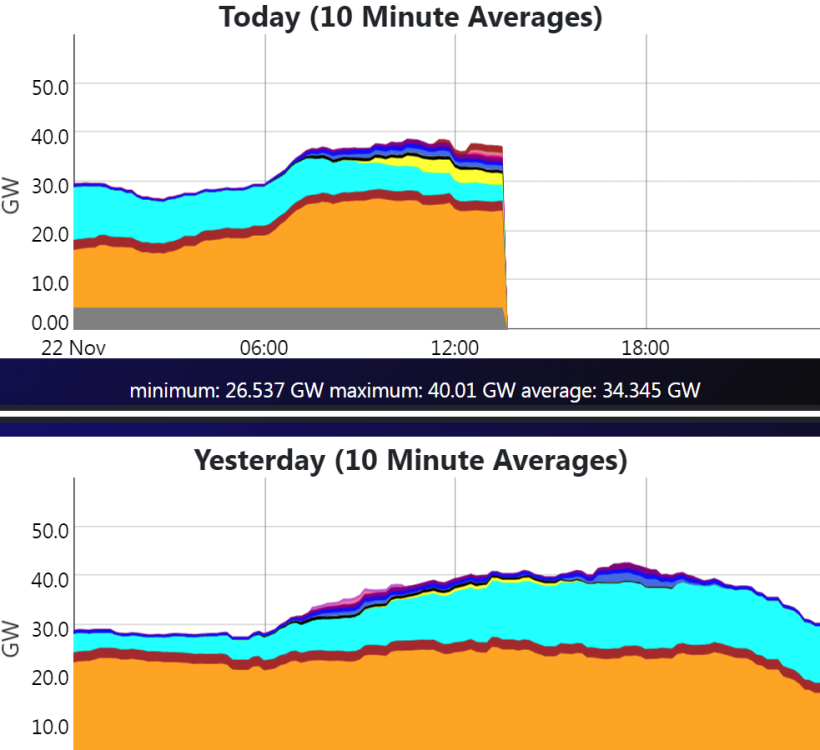
Again, that's not the focus of these sessions. If you want to discuss total energy consumption, this isn't the thread. Exactly. And when there's predicted to be a period of low renewable power available relative to demand, reserve capacity is expected to be placed under strain. I assume that making up the anticipated shortfall requires importing expensive energy from other countries and/or firing up dirty sources such as coal plants or diesel generators. You can see on gridwatch that the average contribution from wind power (light blue) has been falling continuously since yesterday: We were exporting energy to France until just after midday today but now we're importing. I haven't looked at the rest, but it's clear that local/cheap capacity is already starting to come under pressure now, wind output continues to fall, and the evening peak period is still hours away. Let's see what happens between 17:30 and 18:30 tonight. Decades is a long time to operate a system that according to you doesn't work.
-
You keep analyzing this trial in terms of total energy saved, but the explicit aim is to reduce consumption during peak periods (presumably at times where there is predicted to be lower renewable energy available), not save energy in absolute terms. Also, I'm surprised that a scientist is so negative about doing preliminary experiments to see what happens. This isn't the end, it's the start. If the experiment proves successful enough to go further, then they can try adjusting charges, incentives, periods, etc, to see what works best. If it doesn't, fine, they know what doesn't work and maybe they'll try something else. People understand money, not kWh.
-
I have absolutely no idea what's going on. £1.11 is roughly half a kWh, which suggests an average of 2 kW during that period for the previous 10 days. The heating and DHW aren't on at that time of the day, and a lot of the time we don't start dinner until after 18:30. I know there was a bit of unusually-timed car charging in the preceding week, but 17:30-18:30 is still an unusual time for us to have been using a lot of energy. I may dig into the numbers when I get a chance.
-
Correction: I can only assume we managed this because there was a lot of cooking going on during this period in the lead-up to the saver session. Let's see how tonight's session goes. We're using the slow cooker during the middle of the day while the sun is out, so hopefully we can beat the number above.

-
Welcome to my world. Surprise, surprise, but it appears we didn't get a payment for the last one. Will see if I can do anything about tomorrow (possibly helped by the fact that our atrocious result during the last period will contribute to the average against which the next one will be measured).
-
Given your budget, have you ever considered doing something smaller but higher quality? I know some people on here don't like architects, but the right one working together with a good interior designer and landscape architect could potentially give you a barn conversion that would be an absolute joy to live in. Think along the lines of better fixtures and fittings, hand-crafted built-in furniture where appropriate, a proper budget for interior design and the garden - all the stuff that people working to (and often beyond!) an already tight budget often don't have the luxury of considering. You mentioned in your first post that there was more than one barn. I'd also be thinking about smaller outbuildings for things like a garage, gym, workshop, storage, etc. Friends of ours have a small barn in their back garden with a kitchen, pool table and big TV. They use it for entertaining, parties, their kids having friends over - all sorts of stuff. Personally, I'd rather a perfect 300 m2 house than a 500 m2 house that's just good. @Ferdinand might have some thoughts.
-
I increased my temps slightly, and have increased temperature compensation. From memory, I now have something like 26 ºC for temps above maybe 8 ºC, with weather compensation kicking in below that to a high of 29 ºC as the temperature falls to around 0 ºC. I'll likely be increasing these temps a bit further now that I'm going to try squeezing more of my heating into the Octopus Go cheap period. Also, it's worth bearing in mind that the ASHP stops heating when the return temp reaches the flow temp. That will be well before the slab temperature reaches the flow temperature. I know you're saying this approach to heating puts a cap on room temp, but unless there's a lot of solar or incidental gains, the room temp is very unlikely to reach anything like the flow temp. As an example, I ran our ASHP open loop through two winters without a thermostat (just relied on flow temp control), and I don't believe we ever got the room temp above about 22 ºC. True for high humidity at low temperatures, but when it's mild I assume higher humidity also means additional efficiency due to energy gained from condensation of water vapour. Presumably there's also energy extracted from the phase change to ice, but that's more than balanced out by the corresponding need to defrost.
-
Not sure about the Zehnder, but I'm sure several members have installed VentAxia units. Google "vent axia buildhub" and you'll get loads of info. You could try the same with Zehnder.
-
This is one of the reasons our architect gave when we asked why the per sqm rate didn't fall on larger houses due to economies of scale. That and the fact kitchens and bathrooms are the most expensive rooms to build, and larger houses tend to have more of them, taking up more floorspace per room, with more expensive tiles, appliances, worktops, etc. Looking at your other post, part of the problem may be that you're doing a barn conversion. Perhaps counter-intuitively, converting an existing structure can be more expensive - sometimes considerably more expensive - than knocking down and starting again. There are a lot of unknown and potentially pricey risks involved with conversions, plus it can be a lot more effort working within the constraints of existing structures even if there are no such surprises. One way to approach it might be cost plus pricing: This gives the contractor some protection against unexpected costs, meaning they won't be padding their quote to cover expensive potential unknowns. The risk, of course, then falls to you, but that shouldn't be an issue if you can afford the higher rates being quoted at the moment. I imagine you'd do need to be a lot more on top of what the contractor does day-to-day if you're paying like this.
-
How to get an extra 2 SAP Points?
jack replied to Andeh's topic in General Self Build & DIY Discussion
I believe the drain at the top dumps water into the (much larger diameter) downpipe at something of a tangent, which causes the drain water to form a film over at least a reasonable proportion of the inner wall of the downpipe. The drain and incoming water are counterflow, which would set a theoretical maximum of 100% - not that you'd get anything like that in the real world, of course. Based on the admittedly basic test I did (temp of water in the trap after a shower) above, I don't think you lose that much heat to the tray etc after everything warms up (first few tens of seconds, maybe). The installation diagrams linked above show several installation options, all based on ordinary hot-and-cold-fed showers. To reach the higher claimed efficiencies, you have to connect the unit to preheat both the cold feed to the shower(s) (up to two is recommended with the model I used) and the cold feed to the DHW tank. Agreed that adds to the plumbing faff, but it's a couple of extra runs of pipe and you only do it once. Of greater concern might be how long the pipe run with preheated water needs to be to get to the shower and the cold feed to the DHW tank. -
I mentioned that her timing was terrible and she said that "at least the house is clean" and asked if I wanted to turn to dryer off. I mean, we did discuss this yesterday, so she was aware it was going on.
-
My wife just turned on the dryer. And the washing machine. I am not joking.
-
As 5pm ticks over, we're using something like 1.3 kW, which is more than we've used all day. I'm working on something urgent for a client, so I can't turn my PC off. Also, my wife has suddenly decided that now is the time to get the house ready for family coming over on Friday(!), so there's cooking, vacuuming and god-knows what else is going on in the background. I know better than to object.
-
I always use a desktop when photos are involved, so perhaps yes?
- 23 replies
-
- 1
-

-
- upvc window
- window sill
- (and 18 more)
-
Alternative broadband supplier questions
jack replied to ProDave's topic in Networks, AV, Security & Automation
I'm the same, but I don't think I'm alone about being serious about what goes on in my house. You don't need to start aggressively. Ask nicely once, instruct more firmly the second time, and then all bets are off if it keeps happening. 50 Meg is fast. We typically only get 32-34 at best, and I don't think that's at all unusual. What I don't understand is how a 50 Meg connection is being dominated like this by one device. My kids have had an xbox for 5 or 6 years and I can't remember once having any issues with it hogging bandwidth. Admittedly they don't do a lot of games downloading, but still, I'm surprised it's never been an issue based on your experience. Still, it seems like something could/should be handled on an out of hours basis. That's the main thing. I took from your earlier post that words hadn't been had, which is what I was reacting to. -
Alternative broadband supplier questions
jack replied to ProDave's topic in Networks, AV, Security & Automation
I suppose it depends on how interested he is in continuing to have an xbox at your house. Why did you time him for that long? At 10 mins, get your daughter to tell him he needs to get out of the shower. If that fails, turn the water off at the mains. I'm a complete pussy about a lot of stuff, but I won't accept disrespectful behaviour from guests in my home. -
Alternative broadband supplier questions
jack replied to ProDave's topic in Networks, AV, Security & Automation
@ProDave, I'd have stopped looking for a technical solution once it became clear that my hardware couldn't do traffic shaping. Tell him to only download at times when others aren't using the internet. He can change the settings on the xbox so that downloads don't happen automatically.
.jpg.c21f3ac78c9b7efd90cbdcb312744dc5.thumb.jpg.7adcad4c0e384f5ecd7d56b0618df6e5.jpg)


