


kxi
-
Posts
140 -
Joined
-
Last visited
-
Days Won
1
Everything posted by kxi
-
 @Ferdinand https://planningregister.ryedale.gov.uk/caonline-applications/applicationDetails.do?activeTab=summary&keyVal=PGMVS8NOI9400 I've not read it yet. Long odds on it simply saying "They have invoked the genius loci! By ancient law we must obey!".
-
A new paragraph 79 residential development has just been approved in Yorkshire https://ruralsolutions.co.uk/para79-landscape-ampleforth/ And I think it is interesting to see the approach the planning consultants & architects have (successfully) taken in order to get this kind of 'modern country house' style permission; Planning consultant application https://democracy.ryedale.gov.uk/documents/s45692/11 - Planning Statement-.pdf Architect's design statement https://democracy.ryedale.gov.uk/documents/s45797/Item 6 - 0.pdf They have weighed heavily on both the unusual design and the proposed sustainabilty features such as an interseasonal heat bank and trombe walls. I'm torn between feeling 'good for them' and frustration about the apparant difference in planning consideration given in grand schemes like this vs that applied in 'normal' planning when it comes to weird/interesting modern design and innovative/unproven sustainability features. In my very limited experience, our local planners did not care about sustainability features for one second (other than an overwhelming desire to reduce car usage) and unusual design was absolutely the last thing they wanted to see. I'm sure this is a well worn topic, but it appears the planning system is geared to resist innovation except for the super rich. In terms of the individual sustainability features proposed, I'm interested to see the effectiveness of an interseasonal heat store, here apparantly driven by ground-mounted solar thermal collectors. Though it is odd that despite this heat storage, and the trombe walls, they also plan to supplement with IR heaters. I'm not clear why a conventional ASHP or GSHP wouldn't just be better either as a supplement or replacement? Is their approach that sustainable if they opt for a 1:1 electrical heating top-up? Is this a genuinely effective sustainability proposal, or is it a means to a planning end, bouyed up by 11 kWh of PV? The sustainability statements focus entirely on energy generation and recovery, and nothing on fabric first, presumably reflecting the buttons they know to push from a planning point of view.
-
Bio-pure or ClearFox sewage plant feedback wanted, please
kxi replied to Julian's topic in Waste & Sewerage
We didn't go for sewage treatment plant in the end, but from a recent check of what's out there, if best quality output is desired, the Graf one2clean looked good. With claimed results similar to the good (claimed) performance of the WTE Vortex. Graf one2clean: BOD 7, SS 14, NH4-N 0.5 https://www.graf-water.co.uk/wastewater-treatment/wastewater-treatment-systems/one2clean/one2clean-one-tank-system/wastewater-treatment-system-one2clean-one-tank-system-ped.-loading.html I believe @Barney12 has one and is happy with it. There is also an 'advanced' / 'plus' version of the one2clean with add-ons to further reduce pollutant content in the output and even a UV sanitiser to remove microorganisms. Full brochure https://www.graf-water.com/fileadmin/media/Catalogue_Wastewater_Treatment_Solutions.pdf Some comparisons / buying guides: https://www.wte-ltd.co.uk/choose_wastewater_treatment_plant.html They supply the Vortex and others, so perhaps not an objective comparison and the results list does not include all available plants https://www.owlshall.co.uk/sewage-treatment/comparison-guide/ (solidio installers so biased to that I suspect) http://www.spsdrainage.co.uk/page_2904020.html https://homeseptic.co.uk/sewage-treatment-plants/buying-guide/ (graf installers so biased to that I suspect) Regarding no-power ones like Bio-rock, filterpod, etc I noted @Jeremy Harris 's skepticism about whether they could achieve same performance as powered ones, but wasn't able to verify this. https://www.viltra.co.uk/products/sewage-treatment/oxtec was also mentioned on the forum as interesting. I found @Home Farm 's video of the WTE Vortex helpful https://myhomefarm.co.uk/our-small-sewage-treatment-plant as it gave a realistic indication of the noise (too much for my liking) and also highlighted the visual intrusiveness and potential hazard of the large above-ground lid. This is not something I would want children to be around. If that noise is typical I'd definitely have looked more into no/ultra-low power ones. -
FWIW I've found this digression interesting, and empassioned tangents are IMO part of BuildHub's charm. Ad hominems however are not either of those things. From a quick check of https://en.wikipedia.org/wiki/HMS_Sheffield_(D80)#Sinking this thread provides additional detail that might be proposed as edits.
-
Graf waste water treatment plant, any thoughts?
kxi replied to joe90's topic in General Self Build & DIY Discussion
@Barney12 Hello, how is the Graf one2clean performing after 2 years? Are you happy with it? Anything you would do differently? -
Last year kingspan told me over the phone £68/m2 for 150mm Quad-Core roofliner, but almost certainly it can be had much cheaper if having via supply and fit from a contractor. This was the case with their prices for RW1000 panels.
-
MVHR in large volume New Build
kxi replied to Triassic's topic in Mechanical Ventilation with Heat Recovery (MVHR)
@Triassic We also had a quote suggesting 2 x 350m3 units, and TBH I just rejected as appearing to be unecessarily expensive and complicated. However, it would be interesting to find out if there is a good rationale behind these odd recommendations. The obvious answer is they want to sell 2 x (unit + ducts + installation + comissioning), but it would be worth hearing their justification. If "it's a big house" is the only level of detail they are willing to give, I wouldn't be confident in their design anyway. Re. branch vs radial ducting. In our case, branching was going to be a problem due to our build method & house design. We have: - a warm roof i.e. ducts can't go in loft - the roof beams are steel so can't accomodate a 200mm duct through them - concrete first floor - ducts can't go in the floor This meant a large branching duct would have to run through most of the rooms. We like an industrial look, but that would be too much. Instead we are running the 90mm radial ducts through multiple holes in the roof steel beam webs (SE specified...), which keeps it all out of the way: This was the primary reason for radial. But other advantages over branching that we felt were relevant: - Eliminates risk of cross-talk noise between rooms (which might be small but wanted to be sure) - More control over each arm i.e. room - Continious pipes so no airtightness problems at joints over time - Supposedly cheaper to install (according to https://www.heatspaceandlight.com/difference-between-branch-radial-duct-which-better/ ) Radial is less efficient due to greater internal surface area of the piping, but we didn't see that as a big issue.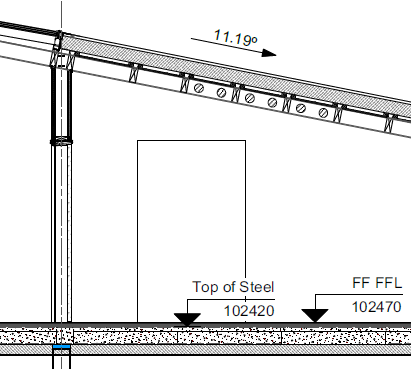
-
MVHR in large volume New Build
kxi replied to Triassic's topic in Mechanical Ventilation with Heat Recovery (MVHR)
We have GFA 350m2, which Enhabit calculated required 378m3/hr on boost, and are going with their recommendation of a single zehnder Q600 (600m3/hr), with radial ducting. I wonder whether the suppliers recommending 2 units are doing so due to additional factors to size e.g. issues with ducting in a 380m2 house over 4 floors? Or some perceived issue with using a larger unit? -
N.b. the kingspan panels have to be supported on purlins or rails, which may then need further support, so the 150mm doesn't give you the full required thickness. Though you can leave this open to some extent if you don't mind the internal face. The panels provide little sound insulation (or decrement delay...), so you may want to cover them internally for other reasons.
-
We are using the KS1000RW Kingspan Quad-Core panels as the outer shell (walls and roof) in our build. A single component that provides insulation, water-tight shell, and a reasonable degree of airtightness (though this will need some additional taping). It is on a heavy steel frame. We are using the 150mm version giving 0.12 u-value. Thermal breaks in the column floor junctions handled with armatherm FFR structural thermal breaks. With a lightweight steel frame you probably wouldn't have such an issue since it could all sit on an insulated slab. The internal face of the panels we couldn't stomach so will be covered to give a deep service void. There are one or two examples of it used on domestic buildings, but mainly modern barn conversions, i.e. they were a panelled shed that someone turned into a house. @Simon Brooke has used the KS1000RW for the roof of their dairy conversion, which seemed to be successful.
-
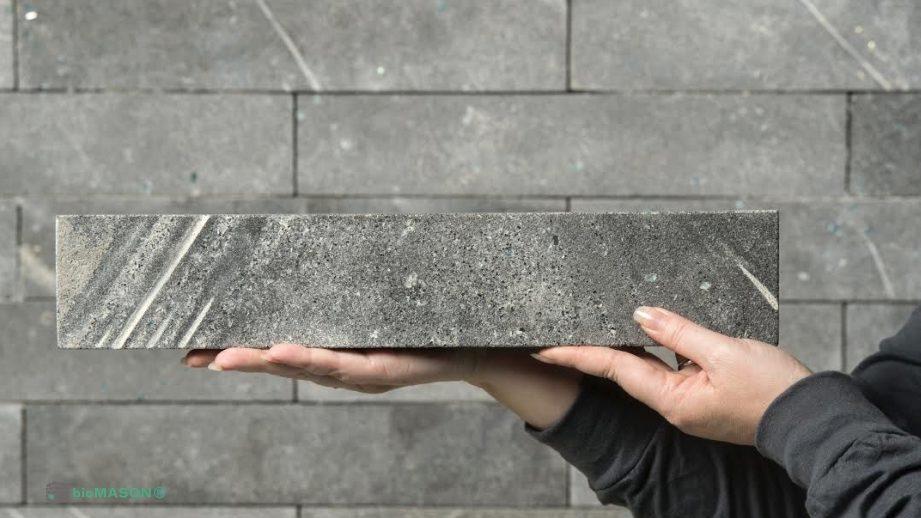
On the subject of alternative blocks https://biomason.com/ 'bioMASON’s technology uses microorganisms to grow biocement™ based construction materials. The Company’s products include proprietary manufacturing processes and materials used by licensing partners for incorporation in existing facilities or on-site manufacturing. The strength of biocement™ materials is comparable to traditional masonry, and is used as a green alternative. bioMASON’s products are produced in ambient temperatures using locally available materials. bioMASON enables savings in energy costs and zero carbon emissions.' Looks awesome. Presumably rather expensive. If you are really keen, they just opened a $18M funding round https://www.wraltechwire.com/2019/12/10/rtp-startup-biomason-launches-18m-fund-raiser-lands-first-5m/
-
- 1
-

-
Some more block examples ordered by density (not comprehensive and updated last year) https://docs.google.com/spreadsheets/d/1FKs4IIEIqb-KFJl63zsR0uj2BXAnEJMyyQbyeiZNylc/edit?usp=sharing @Oz07 expanded clay examples: fibolite, fibo 850, aglite ultima
-
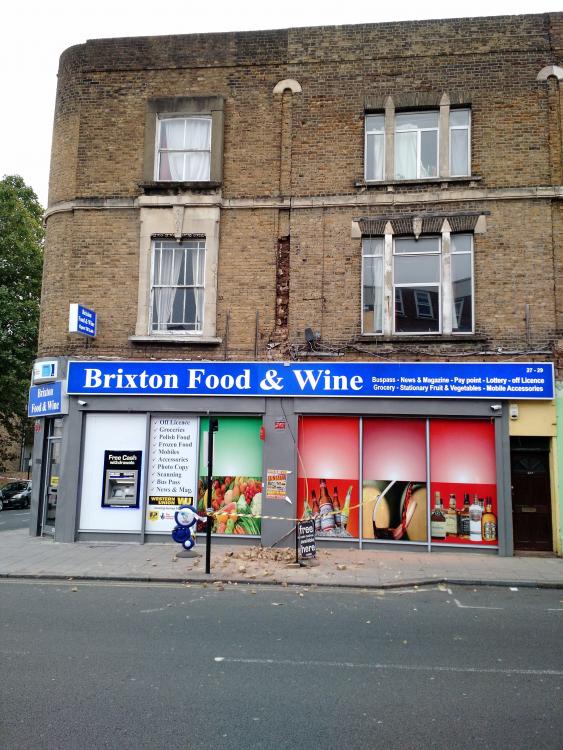
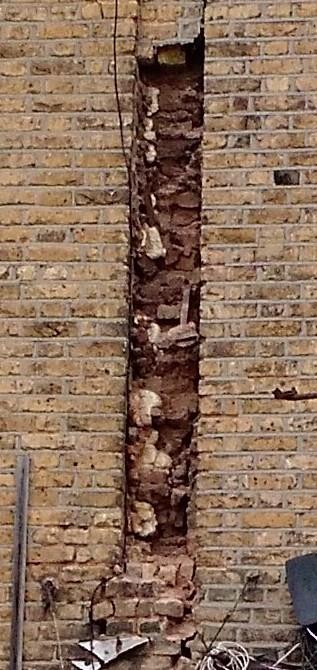
I once saw 'mini' spray foam blowing out a brick wall into the street below. Given this is on a major bus route I suspect the mortar on these Victorian buildings was pretty much dust.
-
I had a brief tour shortly after they started re-excavating, around 2000. A story cited was the sandstone cutting into Lime Street station was being dug at the same time, and at one point the labourers working on the cutting unexpectedly broke through into a dimly lit underground chamber filled with toiling diggers (the in-progress Williamson Tunnels) and fled believing they had uncovered Hell and its dammed minions.
-
Also worth considering that in the not too distant future there might be some large EV batteries in there periodically. Who knows what chemistry these might have in future, but no doubt there will be guidance / regulations on fire safety relating to EV parking. I suspect for now we'd have a 'no EV under there' rule until the world understands the risks better.
-
@scottishjohn Yes the plan is for 150mm of either phenolic or kingspan quadcore panels on the soffit, should give about 0.12U. I had wondered about something like a mist system, but needs more investigation. As per it may be a really good alarm system(s) might be more effective. I did once live in a flat where a mattress was set alight in an abandoned flat below, and the first I noticed was the floor under my sunday morning feet starting to heat up. This early warning won't be available with 200mm of concrete.
-
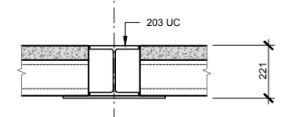
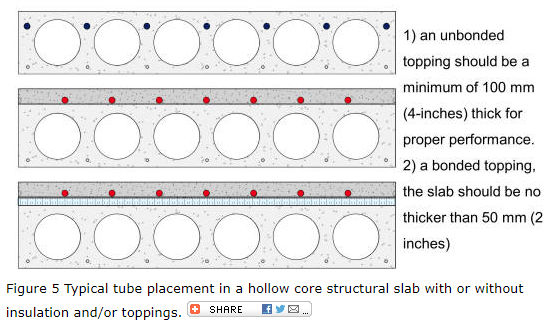
Thanks all of the comments. Thinking about it today, I think there's flaw that in our case means we can't use the structural topping to lay the UFH pipe. The planks are laid on the bottom flange of asymmetric steel beams in a 'slim floor' style, in order to save height. e.g. (based on shallow-floor designs such as https://www.steelconstruction.info/Floor_systems#Shallow_floors) Since the structural topping doesn't in our case go over the top of the steel beams, the UFH pipes can't go through the beams (without complexity). However, if anyone is ever interested in UFH pipes in hollowcore topping, it does appear that it is (or at least was) tacitly supported by US and Canadian building codes: http://www.healthyheating.com/Concrete-codes-radiant-heating/Concrete-codes-radiant-heating.htm#.XZpJr0ZKhhF The middle one was what i was thinking of. @scottishjohn The ICF floor style is neat and something I would have looked into, but in our case this floor is over an agricultural-use ground floor, which could have vehicles, workshops, storage, etc in and I am very concerned about the effects of a fire down there on the house above. Any EPS in the floor soffit I would expect to last hardly any time before melting. In the EKONECT and quad-deck examples it looks like the EPS in the floor doesn't provide any structural aspect, as that's all handled by the cast/pre-cast concrete, i.e. the EPS melting might not affect overall floor integrity. I suspect had I looked into these in more detail 8 months ago, we might have made a different choice, but we are on course with the hollowcore now.
-
Our design has a first floor of hollowcore planks (about 150mm thick) with a structural concrete topping (minimum thickness 50mm I think), and we are looking to add UFH. Naively, it seems to me simplest, thinnest, lightest, and perhaps cheapest to have the UFH pipe laid in this structural topping and then make the topping the required thickness above the pipes (60mm?). As opposed to having; hollowcore, 50mm structural topping, then a separate (60mm?) screed with UFH over the top of that. As I understand it, a structural topping over hollowcore is partly to create a smooth level surface, but also sometimes to create a composite floor with the precast planks, which is stronger. My concern is that having UFH pipes in this topping would somehow adversely affect this structural aspect. I know there is general acceptance (on this forum at least) of UFH in structural ground slabs, such as in MBC builds, but what about as part of hollowcore floors? This is one for the SE, but would be keen to hear people's views.
-
Idealcombi futura, aluminium window with PUR thermal break. Available inwards or outwards opening. Alu clad uPVC can get higher performance than timber (with the right version) if top performance is what you are after. E.g. the foam-filled energyline 91 P from gaulhofer (via ecowin)
- 1 reply
-
- 1
-
-
For ultra-dense, there's structural thermal breaks like: Farrat https://www.farrat.com/structural-thermal-break-connections Armatherm https://www.armatherm.com/thermal-break-materials/ Which presumably you could just use a few blocks of and fill the spaces between with standard non-dense insulation. I assume expensive though.
-
Here's a list of prices compiled from BH public posting https://docs.google.com/spreadsheets/d/10mPQ-4HnTuUbiKmQVn3fPPoVkxDMPgRFNvaji4R8USg/edit?usp=sharing Apologies anyone if I've made a mistake on your prices or missed you out. I wasn't hugely systematic. I'm surprised not to see any Green Building Store ones. As @craig says, a simple m2 hides a lot of detail that affects price e.g. ratio of fixed vs opening windows, doors, cills, coated glass, non-rectangular, airtightness level of the model, etc. I suspect the mysterious discount factor also distorts things. @lizzie I'd previously had you at £390/m2 - was that just for alu UPVC and you went for alu timber at £566/m2 in the end? From https://forum.buildhub.org.uk/topic/1820-alu-clad-timber-or-pvc/?do=findComment&comment=26286
-
If longevity is what you are after, there's also foam glass aggregate / gravel e.g. geocell, technpor, glapor, etc. Made from recycled glass. It needs to be much much thicker than foam to achieve same U values, but I'd imagine it would then stay inert and drainable for a very long time. @Snowbeetle used it on their barn floor and it seemed eminently self-buildable and very appealing.
-
@worldwidewebs "I think the total floor area of the barn is something like 600m2, although the current plans show some of this to be demolished to fit in with the Class Q limit" AKAIK there is nothing in Class Q that would necessarily require the unconverted portion to be demolished, though of course you might want to in order to gain some other kind of improvement like more windows. Our conversion under class Q is mixed use residential and agricultural, and while the planners initially questioned this, a single letter convinced them it was ok. The unconverted portion would still have to remain in agricultural use though. Your implication is that this barn is part of an existing farm with other buildings and so I assume the unconverted portion could remain 'with them' as part of a working unit. Would need to check this all with someone though. Personally I'd want to remain as much built structure as possible, as once it comes down, less likely planners would allow you to put something back up.
-
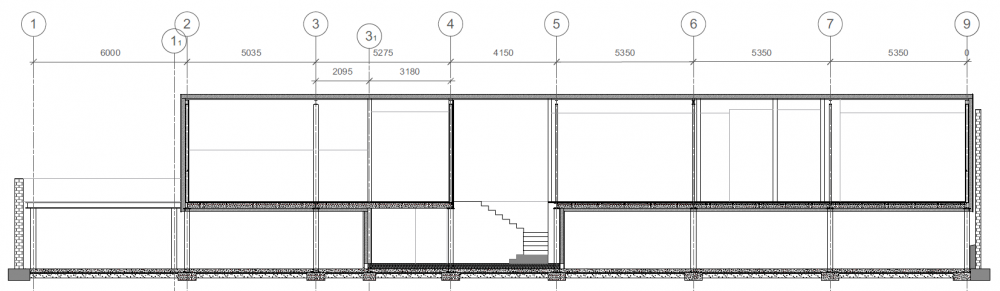
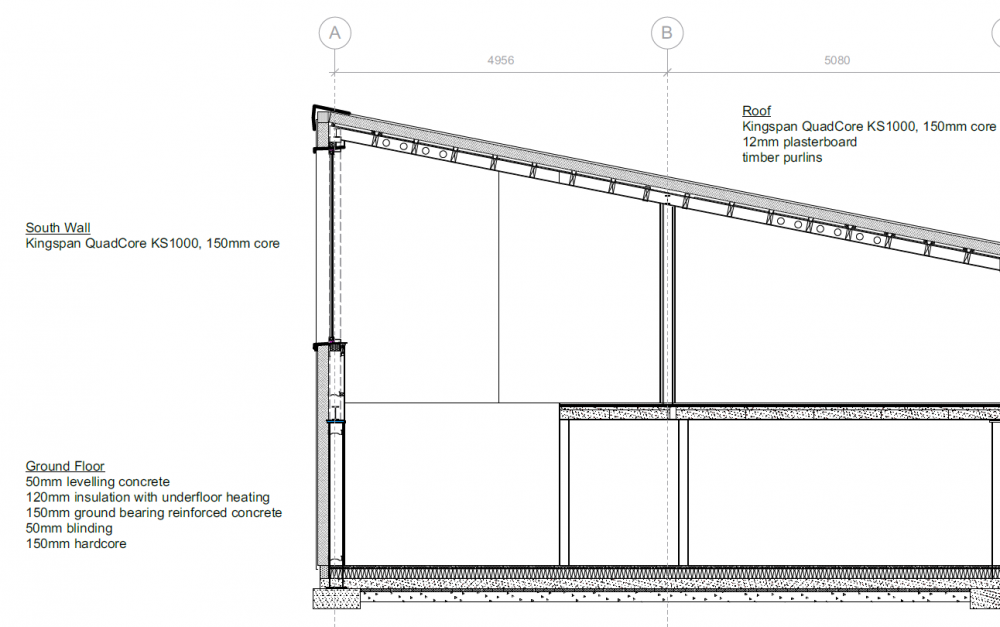
After much consideration, the build method we'll be using for the conversion is 'big shed'. In that we'll be: - Adding a new steel frame internal to the existing walls - Which supports a new precast concrete plank first floor - Then wrapping the roof, new walls, and potentially the underside of the new first floor in Kingspan KS1000rw insulated panels - 150mm quadcore. Bearing in mind the house is mainly single storey up in the air - The panels fixed onto timber purlins for the roof, and off metal inline purlins for the walls - Internally, the external wall panels & purlins hidden by PB/fermacell board covering the 'cavity', also board between the ceiling timber purlins to cover the underside of the roof panels Why this? Naively, it seems like a simple & relatively cheap way to achieve a high-insulation (0.12U), thermal bridge free, airtight shell. Though the idea came about from trying to think of the thinnest roof possible without use of exotics like areogel (which for a 360m2 roof was out of the question) since we are very height constrained on the north side. Decrement delay issue noted. @scottishjohn We also wanted a highly fire resistant first floor (hence the concrete) with large spans, due to the ground floor space underneath being agricultural use. This leads to a steel frame, which the kingspan panels go with. Frame & panels can then be constructed as a single package. In terms of precedent, we have heard of a couple of similar residential examples, and I expect more will appear due to Class Q permitted development, and obviously there are lots of offices & workshops that use this approach, often as part of bigger sheds. Various issues to work through, but making progress. For example we've found the north-south steel roof beams are thick enough to have 100mm holes cut to allow radial MVHR ducting, which gets it out of the way.
-
Thanks all, very helpful.



