
Simon R
-
Posts
262 -
Joined
-
Last visited
-
Days Won
6
Everything posted by Simon R
-
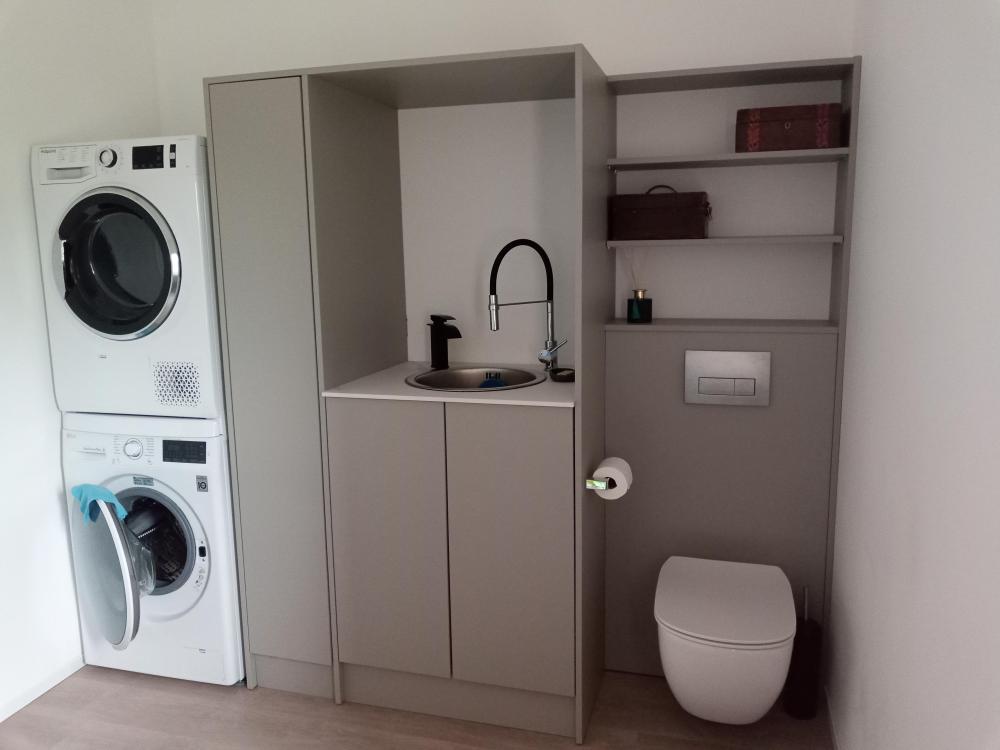
I've sprayed a little, but as an easy but slightly more costly option there are outfits like WoodByPost that sell edged sheeting that mean you can make your own stuff. Here's our utility room, all our own sizes and a fraction of the cost of bespoke.
-
We've managed to get some real nicely made furniture from ebay/facebook. Keeping an eye open for specific high quality manufactures such a BoConcept, Heals and Ozzio. Probably the best buy of the whole self build was a BoConcept bed and two side cabinets, they are as good as new and much better quality than you'll find in the retail park show rooms.
-

ICF and Foundation design
Simon R replied to Renegade105's topic in Insulated Concrete Formwork (ICF)
Our ICF build is on clay and we looked at piled but ended up with and insulated raft. We had to get soil testing done but the structural engineer was happy with an mot base for the raft. A raft also has better thermal performance and is a good match for ICF. -
You'll have a job making it draught free. Faced with a similar problem we sealed the garage from the rest of the house which is fine if you have no internal doors from the garage. Caulking round the ceiling plaster boarding and air seal tape did an acceptable job, with airtightness down to 0.6 ACH for the house.
-
Windows are certainly a big bit of the budget,like you we went to multiple suppliers and ended up with Velfac who offer a six year guarantee if installed by an approved installer. Our alu clad windows which are three years old and show no signs of ageing. We did find the prices varied crazily and lots of sales people driving round in very nice cars. Take a look at the thread
-
Absolutely, I didn't mention stick on hooks as they are so readily available and I thought most people would know about them. The GripIt fasteners are bigger stuff like the air-con internal units.
-
120mm of re-enforced concrete, it used to be my shed base🤣. I grouted with the mapei flexible wall and floor grout. I've also sealed it all. I borrowed a water fed track saw to cut the 600mm slabs down to 520mm.
-
Ominous, batteries do have a reputation for being difficult to put out as demonstrated buy the Felicity Ace incident! combined with the car it's 59kWh of combustible batteries. The majority of cells are Shenzen, the GivEnergy stuff is all on the MCS tested and compliant list, fingers cross all will be fine. As it's a new build we also have linked smoke and heat sensors.
-
Hi Dreadnaught, I got it wrong, It's wood by post https://www.woodbypost.co.uk/ email enquiries@woodbypost.co.uk . They keep a pretty good range of sheets and cutting accuracy millimetre perfect.
-
That goes for most of us on the forum, a real fount of knowledge. I don't think he looks at the forum, I contacted him through email as we had dealings earlier in out build and I knew he has an in depth knowledge of all things electrical.
-
It’s been over a year since we got our completion certification and we’re still mopping up tasks in the garden and generally cleaning up. It occurred to us that some aspects of the discovery process of the build may be off use to others on BuildHub. It’s too hot in here: Thermal modelling limitations. Our thermal modelling done as part of the design stage SAP suggested we had minimal thermal gain problems. However we suspected that thermal gain from our east facing windows would be a problem and indeed it has been. The first action we took was to put on a solar film on the outside of our east facing windows. After some research we opted for Johnson PD75 which claims to reduce thermal gain by 40%. It cost £1,170 so seemed like a good place to start. Well, it may have helped but by mid May it was clear it was not enough and we would need something more. We looked at air conditioning units and decided we would retrofit some. We hadn’t planned on this and the thought of messing up the clean lines of the build and the pristine plaster work did not appeal. Purely by chance it turned out that the false wall in our bathroom built at the request of my wife and much muttering from me (who needs somewhere to put a wine glass while your in the bath) was a saviour. It meant we had a service void from ground floor to second floor in which to route pipes to the internal units. We contacted Mr Harris and he kindly lent us the pump gear required for installation testing, so far so good. We identified the units with the best energy efficiency only to discover you are not allowed to purchase them without having confirmation the installation will be done by a certified F-gas installer. We wanted to do the main parts of the installation ourselves and just have the F-gas engineer do final test and connection. Sounds reasonable but we had a lot of difficulty finding anyone. Mr Harris came to the rescue again and recommended Artech Air who were unbelievably helpful. We ended up with two Midea Blanc units, a 2.5 kW for our bedroom and a 3.5kW for the open plan living area. Result – bliss, and a very reasonable bill for £1,800. In the long term they will add to the comfort of the house all year round. On a slightly different subject MVHR summer bypass. It sounds perfectly reasonable, don’t heat the incoming air form the outgoing air in once a set temperature threshold is reached. The incredible heat of the last month has made us completely rethink it’s use. If the air inside the house is colder than the outside air, then cool the incoming air ie you don’t want to bypass the heat exchange. Also when it very hot between 9:00 and say 20:00 don’t run the MVHV, there is plenty of air in the house and we certainly never felt stuffy. We set the MVHR scheduler to do this for us. Similarly in winter it goes off at 22:00 and back on at 07:00. PV We didn’t put any PV on when we built, the house should need such small inputs it simply didn’t make sense in carbon or cost terms, or so we thought. Two things changed our minds, the air conditioning and we bought an EV. Doing anything more than 4kW is a pain as it involves more certification and silly cost items like Southern Electricities £300 fee for observing testing on equipment that was already certified on the MCS database. Again we had not planned this in so it was a retrofit...grrrr. Very annoying as we were pretty smug about having thought through the whole build. Fortunately our standing seam roof made it as easy as it could be to fit panels and hide all the wires. With the panels added we are still in surplus on the air conditioning units, not cooling for free as we had to pay for the panels and inverter, but no additional utility cost. Bye the way this was done before some nameless psychopath started a war and energy prices rocketed. The house now sits at a very comfortable 23c while not drawing any energy from the grid. We even have enough surplus to charge the EV between 10:00 and 15:00 on sunny days at a very slow 6A. We also opted to put in battery storage which we ordered in February and has only just arrived, it should have been 8.2kWh but in the delay they manufacturer introduced a 9.5kWh version for not a lot of extra money. We’re not up and running with the battery as the manufacturers decided to change the inverter battery connection cables with the new model and there are no cables shipped with the battery. I must confess I found it very hard to see the funny side of this. House wiring We did this ourselves and got it tested and certified, but made no provision for an EV charger, inverter and PV. Fortunately we did put ‘Routabout’ access points into our floor intended to allow access should anything go wrong. We also have loose lay flooring which has made the four times the utility room floor has been up no drama. Providing access to fix and change is something definitely something that should be done early not as an afterthought, when we put the traps in we had no idea how useful they would be. Fixings and fastening Our build is ICF and while it’s great in may ways it does present some interesting challenges when it comes to mounting anything on the walls. The ICF system we used came from JUB and has a very tough vertical nylon strip every 150mm about 30mm from the internal surface. With a course thread screw you can hang things like TV’s but not heavy stuff cupboards. For heavy items it’s a case of drilling into the ICF concrete core 75mm internals and 170mm externally from the ICF surface. This makes for a significant cantilever, internally this is fine you just use big fastenings. Externally the problem is two fold, 1700mm cantilever and you don’t want any thermal bridging, this makes using big fastening as real no no. We ended up using four fastening types: Internally we used cheap and easy to use concrete frame fasteners for heavy stuff. For lighter stuff on plasterboard we used GripIt fastenings which do the job remarkably well. The largest size claims to be able to hold 70kg, but I wouldn’t trust it with anything like that. Externally we use Fischer ‘Thermofix’, expensive and not available in this country. Fischer say they don’t sell enough here to make it worth there while. It seemed lost on them that we were buying from Germany along with every other UK user of the fastening. For light external fixing we used pasta twirls supplied by JUB. Useless for anything heavier than a letter box. DIY cabinets We found we couldn’t always source ready made furniture that was the size we needed. Some friends run a bespoke kitchen business and pointed us a site “wood online” who make up panels to your specification complete with edging. Using a ‘Pocket hole’ jig and these panels allows you to create you own furniture simply and quickly at a fraction of the bespoke cost. We also found some very neat panel clips for panels that need to be removed for access. Garden We finally got round to sorting out the garden. It’s small, just 11m by 5m and like a lot of self builds it had been used as a storage area (dumping ground) during the build. As we’re getting on a bit we wanted to make it low maintenance and low water. Raised beds and a patio area seemed to fit the bill. As the house is a contemporary build and we wanted to the garden to complement the house which is white and two shades of grey. For the patio we have used 600 x 600 porcelain tiles for ease of handling and laying. Getting a patio right is not the easiest of jobs and I was not looking forward to. With the patio base prepared, materials were order, tiles on Tuesday followed three days later by 5000kg of limestone chippings. Of course it just happened to be one of the hottest weeks on record…returned the rapid set tile cement and bought standard set. This still went off at a frightening rate. Trying to get a large are flat and true is not as easy as it sounds even when you’ve done all the preparation. With the first slab set to the correct run-off the other tiles were laid using it as reference. Despite our best efforts to get it right, the first tile was just off and as a result by the tile the 8th tile in the row was reached we were using a significant amount of tile cement, about 10mm deep. The four 20kg bags of cement that should have done the whole job disappeared quickly and another 7 bags were required to complete the job. The hoop and wedge helped keep everything flush and the result is perfectly acceptable. Lesson learnt, do buy the expensive laser measuring and levelling gear at the start of the build, it’ll pay for itself many times over by the time you finish. I’ll know for the next build, however my wife may well threaten divorce if I mention the idea….
- 8 comments
-
- 12
-

-
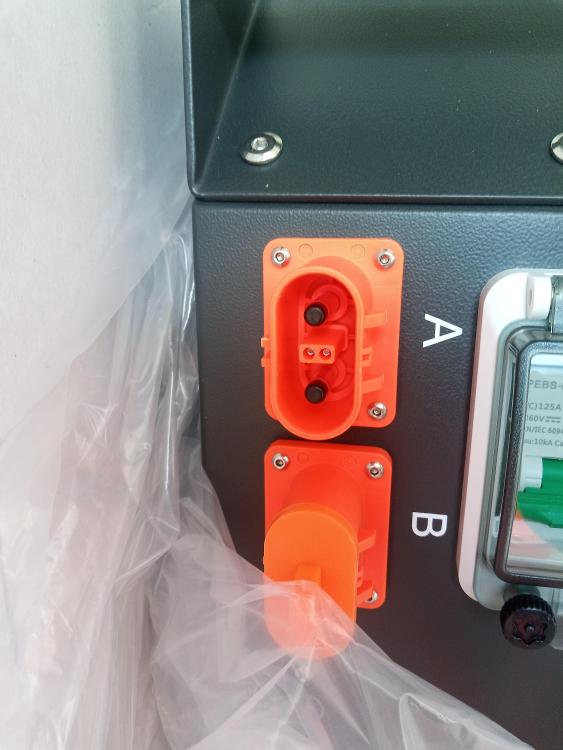
Mystery solved thanks to Mr Harris: That's a high voltage 150A interlock connector, mostly used in EVs. Renhotec make them and the part number you want is HVIL150-2P-AO-C35 for the free socket (I think). The fixed plug you have is part number HVIL150-2S-AO-M6 (I think). The fixed plug web page is here: https://www.renhotecev.com/product/hvil-high-voltage-interlock-connector-2pin-6mm-150a-socket-plastic-w-busbar-m6-thread-hole and the free socket web page is here: https://www.renhotecev.com/product/hvil-high-voltage-interlock-connector-2pin-6mm-150a-straight-plug-plastic-shell
-
I hope one of you may be able to help me identify this plug type. Our battery storage arrived yesterday and it came without a lead and so far I have failed to find a supplier with one in stock. If I can identify the plug type I can make one UP as I have crimpers etc. The socket is 38mm x17 mm with two DC 6mm pins and two small signal cable pins. Any idea what the plug type is? so I can get one from CEF or RS
-
Rainwater Harvesting...
Simon R replied to Mulberry View's topic in General Self Build & DIY Discussion
We had those concerns too. Interestingly when we walked in NZ RWH was the norm for remote buildings, and filtered was what we drank! It does require maintenance. We have 'scotchbright' pads in all the drains to filter out the big bits. The water that comes through pipe is clean and orderless. The washing machine loves the soft water as do all the house plants. It's very important to have a decent tank and keep out all light. We were somewhat panicked by Mr Harris's comment on RWH, but three years on we're glad we have it. -
Rainwater Harvesting...
Simon R replied to Mulberry View's topic in General Self Build & DIY Discussion
Well, we only got into RWH because of the 19K+ quote to connect to the surface water drain. Roof size 150m2, our tank is 4,600ltr from which we flush our toilets and run the washing machine. It's just the two of us and we've not run out of water yet. However we are just getting our garden done and I suspect that may change the equation. As insurance all our RWH take-offs all have a mains water option, none off which have been used. The system we opted for was the Kingspan Klargester, nice tank but very poor implementation of the controls. The pump failed and so has the tank depth sensor. No support from Kingspan and a call out cost of £300, which is more than the new pump cost. If we were to do it again I would get a tank, depth gage and pressure activated pump like the Divertron 1200x (get one with a float intake). A case of keep it simple. -
Maximum demand greater than 100amp single phase ukpn
Simon R replied to Newbuildnewbie's topic in Electrics - Other
Maybe if you ran everything at once, but in the real world it's not a problem. We have a 100A supply and a 32A EV charger + Induction hob 20A + 16A cooker +++++ but in practice we never get anywhere close to 100A. -
We were in the same position and found that Utilita offer a prepay plan that has no standing charge.
-
Timber Portal Frame Goin Up
Simon R commented on Patrick's blog entry in Timber Portal Frame - but stick built
Great to see the pace picking up. Working out floor levels is something we too could have spent more time on, just so many other things competing for attention at the early stages of a build. Hope the blown cellulose works well. -
Passivhaus window suppliers to UK - recommendations
Simon R replied to markharro's topic in Windows & Glazing
No reason for it to arise alarm bells. We found that windows are like kitchens people charge what they think the market can bear. After going to multiple companies we settled on two and it was in the six months haggling that reduced the bill. Norsken the other company we shortlisted got very close to Velfac's price, we went with Velfac as they give a six year warrantee if their windows are installed by one of their approved installers. We used Wescott Construction, not cheap but very much worth it. They were the most professional builder of the whole project. -
Passivhaus window suppliers to UK - recommendations
Simon R replied to markharro's topic in Windows & Glazing
All the Velfac windows came drrectly from Velfac. The roof lights were a separate order not part of the 15K. -
Passivhaus window suppliers to UK - recommendations
Simon R replied to markharro's topic in Windows & Glazing
Yes, they are good quality. We looked at a whole raft of window suppliers and ended up with Velfac. The quality is certainly comparable to Internorm and Rationel, for our build they came in at 20% less money. Having said that it was a very painful pricing process, started out at 25k and reduced to 15k. We also have roof lights from RoofMaker that we are very happy with. -
Real world passive house heating demand figures?
Simon R replied to Smallholder's topic in Boffin's Corner
Just thought I would throw in my pennies worth. We're not passive, but designed from the start to minimise inputs. Our calculated structure value came in a 68W per degree. In practice this means we need about 2.5kW for maintain a 20 degree difference. The input is so small we don't have an ASHP and rely on a small gas boiler to heat two towel rails and provide hot water on demand. What is easy to get wrong is solar gain. All our SAP calculations looked good but we soon found out that our east facing glazing was causing overheating and we have had to add solar film to the windows. We're not alone in this it has caught out several builders on the forum including Mr Harris. More importantly by designing to minimise input you get a very comfortable living environment, and tiny bills. Our gas used this week works out at about 75p a day, and we have had a couple of frosts. We are now looking at adding a small 2.5kW air-con system to provide summer cooling which hopefully we'll run from PV. We used a very good service from 'SAP Box' that cost just £120 for design stage calculation, money well spent. -
I had intended to remove the units fan on the grounds the that the flow rate from the MVHR should provide more than adequate cooling. It was proving hard to get the information on fan flow rates for the unit to verify my assumption though. Going the aircon unit is so much simpler, found an entry from Mr Harris with some very useful stuff
-
It does sound odd, but given the our MVHR installation it's easy for me to install the ashp in the MVHR exhaust to scavenge a little more energy. That way all the mods are in the same area and pipe runs are kept to an absolute minimum. Our mvhr has frost protection and so would protect the AG unit. However as has been pointed out by @Iceverge , the simplicity of going the inverter heat pump route rather than modifying the mvhr ducting and putting in water pipes makes a lot of sense. The only down side of this approach is that the heating/cooling is in a single area and will have to dissipate through the house rather than being distributed to all rooms by the mvhr.
-
Ah, I think you're absolutely right. Why complicate life when there is an even simpler solution. Just got to love the build hub for a second opinion! Many thanks