Bitpipe
-
Posts
4118 -
Joined
-
Last visited
-
Days Won
53
Everything posted by Bitpipe
-
Thickness is not specified, but overall u value as it depends on the characteristics of the various materials used in the build up. Passive standard is u = 0.10 to 0.15 W/(m²K). To calculate u, add up R for each layer and then 1/R = u. https://www.uvalue-calculator.co.uk/calculator/
-
5 years in our TF and not had any issues at all. Maybe some frame designs are more susceptible than others?
-
We were lucky that our architect was on the same page as us but some of the early concepts were quite off the wall and we were not afraid to say so. They were also dead against a basement (through lack of experience) we persisted. They were excellent at navigating planning politics, one refusal and a second success. They knew nothing (2015) of low energy build methods, which TBH we did not have in the initial brief, and were used to traditional build methods - i.e. get a quote from a main contractor, detailed drawings etc. When we brought a turnkey timber frame firm to them, who provided full drawings etc, they wanted to replicate much of that work so we parted company and we took it from there. Friends got to selecting a contractor before getting cold feet and realising they were not happy with the design but had been too driven forward by architect to hit the stop button. They went back to drawing board, lost a year of time but ended up with something they loved. Your statement about how 'you might miss your timeline' is an alarm bell. This is likely the biggest thing you'll ever do so accept that it may not unfold to a precise timeline.
-
Another basement built here, passive standard with timber frame on top. Looks impressive - what energy performance standard are your aiming for? Quite a bit of glazing so beware of overheating risk - have you done any modelling to determine heating /cooling requirements? Agree with Jack - ground source is expensive so interested in why you chose that. One of the founder members here @Jeremy Harris did a borehole and had a lot of challenges with but eventually succeeded. He's not an active poster anymore but there are lots of posts here relating to it.
-
 Well the one way to address that is to change the standards and then the skills will follow. Sad fact is most volume house builders have made their profit when planning is granted and everything from there on in is a cost to be reduced. Usually only 1:10 builds is inspected by BC (I got this figure direct from a BC themselves) so if that one barely passes then god knows what state the others are in. SAP has helped to a degree but we've all seen new builds with 'bolt on green' like solar thermal that the householders likely do not understand either. As a nation, we're not very environmentally literate - we like nature and the countryside and tut at litter and fly tipping but won't learn how to reduce energy consumption at home unless it's really hitting us in the pocket.
 -
If the average person is not that bright then 50% of the population is dimmer than that. I think the comments above say it all really. If your house is well insulated and reasonably airtight then MVHR makes sense as you get good ventilation 24/7 and in an energy efficient manner (not loosing warm air you paid to heat). Yes you can open windows as much as you like, no MVHR will not noticeably heat or cool your house.. Will a buyer pay more for it? Almost certainly not but then you can say the same for most of the building fabric that contributes to its performance. 5+ years in a near passive house with MVHR and perpetually open doors for teenagers and dog. Overheating will make those houses uncomfortable to live in though - you need to mitigate that before considering anything else.
-
Cat6 for data, terminated to sockets (not plugs) in the rooms and to a patch panel where they congregate - often where the BT master socket comes in as that’s where you’ll likely have your DAL router. You can then buy a cheap Ethernet hub and use it to share the data connection from your DSL router to each socket as required (you use little patch cables which are quite cheap). Every static device (smart TVs, consoles etc) that have an internet connection should be on a wired cable to free up your WiFi for genuinely mobile devices (phones etc) but you can use WiFi if you want. Challenge you may have is the DSL router is also your WiFi hub so that may not be the ideal place for it, however you can buy WiFi repeaters and plug those into convenient data plugs to cover other areas of the house. For telephone extension then standard telephone cable, not sure if data cable can be repurposed - but maybe if you use the same twisted pair. Be wary of having the DSL modem too remote from the master socket as that can impede the data rate if the internal wiring is not good or introduces interference. TV / satellite signal is coax - usually you have a powered multiplex somewhere to share the antenna signal to all the sockets, not sure if you can do same with satellite.
-
Slimline water harvesting unit inside wall cavity?
Bitpipe replied to ashthekid's topic in Rainwater, Guttering & SuDS
Modern dual flush systems are pretty efficient. I used the Gerbrit in wall system with wall hanging WCs and it works and looks great. I looked into RWH deeply and there is a lot of cost if you want to go beyond watering the garden. You need a mains fed tank to compensate when there is insufficient rain water, a separate plumbing system for your loos plus health concerns about bacteria and virus in bird droppings washing into your system from the roof and being aerosolised when you flush. Legionnaires is also a concern for any standing water source. It's a nice creative idea but one that I think will get over complicated very quickly and you probably have better things to worry about and spend your money on! -
Slimline water harvesting unit inside wall cavity?
Bitpipe replied to ashthekid's topic in Rainwater, Guttering & SuDS
What happens if someone drills a hole in either wall and punctures it? What do you do in a dry spell ? RWH is of marginal benefit domestically given you need a lot of contingency to meet WRAS. You’re better off using efficient appliances and reduce your consumption that way. -
50mm is a decent overhang to minimise stains from drips on render.
-
On a related note, was walking the (new) dog a few days ago and was watching two red kites duelling in the sky. Cue something plummet to the ground and my lab pup snatch it up and run off with it and evade my best attempts to retrieve. As she got closer, I saw it was a disembowelled mouse and I eventually persuaded her to drop it and have a nice doggy treat instead. Felt bad for the kites loosing their lunch like that...
-
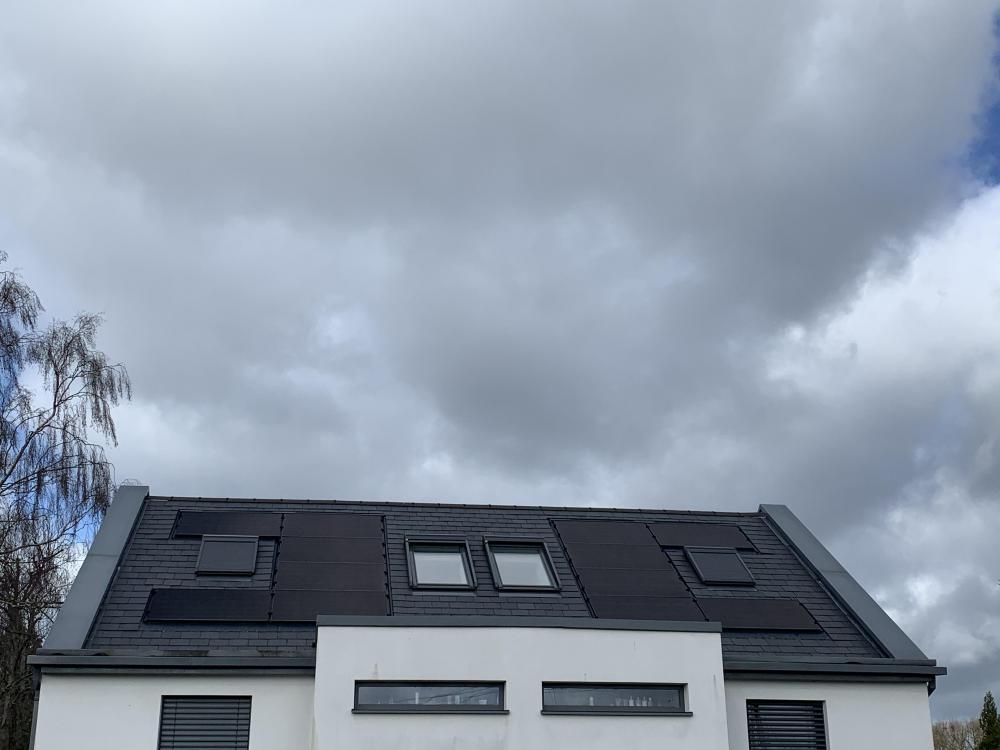
Photo of our in roof install - not quite as tidy as the one above.
-
You can but the batteries are currently quite expensive. We have a PV solar diverter - when it detects that power is about to leave the house it switches it to run two immersion heaters in our UVC so free* hot water. *free once the cost of the diverter is paid for but it was not that expensive and tells us it has saved 3000 KWh since installation in August 2016 so its paid for itself at least twice over so far. We also both work from home so as well as laptop power etc - dishwasher & laundry all occur in daytime. Not hard on most modern machines to schedule the run time either. We were lucky enough to get on the FIT before it was reduced so that gives us £1.50 benefit a day, that said we needed a MCS approved install to quality.
-
We have a few 13A style sockets on the 5a lighting circuit that are in wardrobes and that's how the kids LEDs and also Ikea wardrobe lights work.
-
Depends on the driver - we have plain white LEDs in otherwise hard to light places - e.g. bathrooms with bulkheads, loft rooms etc. For some rooms the driver is dimmable so just the wall switch needs to be changed to a dimmer, others have non dimmable drivers so those would need replaced and the switch. I've put cheap RGB LEDs (from Amazon) strips in the kids bedrooms and they have a driver (that has the IR / BT / audio interface) that's driven by a mains transformer so you could never dim them from the power side, only via the app or remote.
-
Hello, from two Lake District Passive House wannabees
Bitpipe replied to LakeDistrictEugene's topic in Introduce Yourself
Knowledge no, time yes. Well, I was living onsite in a caravan and worked from home so was always 'around' but was not hanging on everyones shoulder. Was really a case of explaining the ground rules to new trades, but TBH the spark and plumber already knew the rules and had worked with the frame before. Yep, only regret really is not putting in ducting to allow for a future split aircon. I honestly would never advertise my house as passive (or any kind of 'eco' label, even low energy) nor would many estate agent recommended it. I guarantee you would repel far more buyers that you would ever attract. The number of people who would actually understand what it meant and ask to see certification, I expect you could count on one hand. if / when I ever come to sell, I hope havinga house in a good location of a contemporary style (that will appeal to some but not all), lots of space and finished to a high standard will be attractive to buyers - the low energy bills and general living comfort will be of interest but that's it. I think the majority of self builders ensure they can oversee construction to some degree - this does not mean 'over the shoulder' monitoring of trades but a clear expectation of what is required and selecting trades who share that understanding and are competent to execute it. Even the best PM, taking a 10% cut of the build budget, will be on site at most a few times a week. So the key to success lies in selecting contractors and trades who have a proven history in building low energy houses - there's a good reason many here have used turnkey timber frame providers as it de-risks the most critical stage of the construction. -
Getting hold of Bt
Bitpipe replied to Russell griffiths's topic in General Self Build & DIY Discussion
Only thing that annoyed me was the cable emerged just shy of the shoe at the bottom but rather than feed it round and up the steel conduit, affording some protection, it was tacked to the back of the pole so much easier to interfere with -
Device to Monitor Electricity Use
Bitpipe replied to canalsiderenovation's topic in Electrics - Other
Looks interesting. My meter is in a kiosk remote from house, however I have a solar PV diverter (to drive supply to hot water generation when otherwise exporting) and it has a similar clamp on sensor on n house wiring so I suppose I could put it adjacent to that? -
Getting hold of Bt
Bitpipe replied to Russell griffiths's topic in General Self Build & DIY Discussion
Openreach will always do the connection, the service provider just makes the request on their system. Looks like you have a decent local OR crew - they do tend to be pretty useful but the back-office system is impenetrable. -
Getting hold of Bt
Bitpipe replied to Russell griffiths's topic in General Self Build & DIY Discussion
It helps to understand what goes on behind the scenes (obviously simplified). You request a new line from BT and enter into a contract with them. They contract OpenReach for a new connection - by design you, the consumer, cannot engage with OR directly - only BT and other telco providers. BT does provisioning on their side and awaits OR. OR schedule their works. OR complete their works (assuming this lines up with the BT provisioning bit) Your BT contract is live and you get billed. Looks like you're stuck at step 4. I would just call BT sales to cancel the contract - do not get passed off to any other department. Then go back to step 1, maybe with another provider like PlusNet (who are a BT sub brand but semi autonomous) and see if that is more successful. --- Our tale is thus - we did not want a drop wire from pole so ducted on our side and then requested a new line from BT. OR arrived to survey and we explained what we wanted - they produced a quote which was double what we could get it done for privately and agreed that if suitable cable were laid to the foot of their pole, they'd happily use that. We cancelled BT order, got the duct laid to pole with suitable cable purchased and pulled through and then re-ordered the line (OR advised waiting 30 days for quote to disappear from the system). OR turned up and happily used our cable to make the pole connection and then installed master socket on other side. -
Hello, from two Lake District Passive House wannabees
Bitpipe replied to LakeDistrictEugene's topic in Introduce Yourself
Agree @Jack, we did the PHPP modelling to ensure that the whole performance was within passive standards and to quantify the space heating requirements plus overheating risk - as a result we specified external window blinds on the east and south aspects which massively reduced that risk. We then designed a built a passive standard basement (not that hard, lots of external insulation and inherently airtight concrete), entrusted the above ground fabric build to MBC (who contractually guarantee the airtightness) and used a passive certified window supplier and installer, same for front door. The follow on electric and plumbing trades were sensitive to the fabric and low energy requirement having worked on MBC before. Aside from that, the rest of the construction was standard. We did not use a passive certified MVHR. As I was the PM, I was effectively the supervisor but given that the majority of the detail was taken care of, it was mostly stopping anyone drilling a hole through a wall etc. Were we to have used traditional methods of construction and a main contractor, some amount of passive PM would have been required but would have increased the cost significantly. Our 'proof' is the completion of the fabric to design, the airtightness test, which came in at below the required 0.6 ACH. The low temp heating works as designed and is rarely used, energy bills are low (£1.15 electric (after FIT) and £1.20 gas daily for a close to 400m2 house). Occasional overheating from evening summer sun in the west but we did not build the bris soleil as specified. SAP is A rated. What you have described above is clearly not a credible passive build. -
Why spend all that money on a cheap shed and toilet from B&Q . Just remove the inspection cover, knock the bottom out of an old chair and place over the drain. Bit of tarp for privacy, job done.
-
I went with an electric mat in each bathroom and it works just fine - a 150W system is adequate, sits on 6mm insulated backer board, covered in latex with porcelain tiles above. Total build up is 25mm. We also have wet towel rads. We have wet low temp UFH on ground floor on spreader plates (our GF is suspended timber over basement which itself has no heating) and there is only rockwool under the plates, installed when basement ceiling was being boarded. Even at 35o the heat easily penetrates 18mm OSB, 21mm of ply and the 8mm of resin floor.
-
VAT reclaim on Excavator?
Bitpipe replied to gc100's topic in Self Build VAT, Community Infrastructure Levy (CIL), S106 & Tax
Nope, unless you're planning to make them a permanent part of the fabric of your house Same goes for any kind of tool or equipment, purchase or hire, and any consumables not directly contributing to the finish of the house. So paint is ok, paint brush and white spirit not ok. -
Yep but you either take a small insurance package to cover dents & scratches, get them fixed ahead of return or just take the knock when you hand it in. Still cheaper than funding with a loan.