

Ed Davies
-
Posts
1674 -
Joined
-
Last visited
-
Days Won
1
Everything posted by Ed Davies
-

Wylex Combined AFDD/RCD/MCB
Ed Davies replied to Onoff's topic in Regulations, Training & Qualifications
Do they work (as AFDDs)? John Ward found a worrying lack of operation for another brand in this video: https://youtu.be/kVpXQa6EW3k Starts on the AFDD bit about 15 minutes in. -
Previous discussion of MK.
-
Doesn't extraction stop while flushing is actually happening? Water going down the pipe (from cistern to pan) instead of air going up it. The exact opposite of:
-
Was the panel manifold below the level of the water surface in the hot tub? Seems unlikely. If not a thermosyphon won't work.
-
Previous discussion.
-
Just come across this video with some nice demonstrations of the effect of shading parts of a panel when there are two connected in series or parallel. If shading is likely to be a problem (as in @ProDave's case it definitely is) then this confirms that parallel is the right answer. https://www.youtube.com/watch?v=1qD3mN8VotQ Their results are very much in line with what I'd expect.
-
Something with house numbers/names that people don't think about is that fire and ambulance services need to be able to read them easily, probably at night in foul weather. They may not be going to you house but knowing quickly to look elsewhere could save some valuable time for somebody else. Putting the number in paving might not be helpful if it's dark and wet or, worse, has snowed.
-
No, that's not what a positive correlation means. There's clearly a positive correlation on a minute-by-minute basis: if it's sunny now it's more likely than not to be sunny a minute later and vice-versa. It could change dramatically in that minute but for most minutes it doesn't; even in England the weather's not that random. Still, it's equally likely to be a tiny bit more sunny or a tiny bit less sunny; just because it's equally likely to be a bit less sunny doesn't mean there isn't a positive correlation. 12 hours or 6 months out there will be a negative correlation in the sense that if all you know is that it's sunny somewhere (you don't know where or at what time of day) and somebody asked you to bet on whether it'll be more sunny or less sunny in 12 hour's time or 6 month's time you'd be better off betting it'll be less sunny. OK, if it's just past dawn on a long summer day then it'll be more likely to be sunnier in 12 hour's time but taking the solar radiation time series overall there will be a negative correlation at 12-hour intervals.
-
That sounds about right. 1 tog = 0.1 m²K/W which is equivalent to a U-value of 10 W/m²·K which, in turn, is about the conductance from a floor to the surroundings above it. So 1 tog of carpet halves the heat flow upwards or doubles the temperature difference needed for a given heat flow. 2.5 tog would multiply the temperature difference by 3.5 which seems like about the point when a simple control strategy of keeping the slab at a constant temperature would break down.
-
That's a pleasant surprise. But then they're probably the same Chinese modules inside anyway.
-
Sunamp UniQ HW+i experience? Charge via ASHP?
Ed Davies replied to oranjeboom's topic in Energy Storage
But the return temperature out of the Sunamp will be something in the 50's °C which will be too high to cycle back into the ASHP usefully. Both because that's intrinsically how Sunamps work and also because of the flow rate reasons @ProDave points out. I think the only plausible scheme like this is to have a buffer tank which the ASHP heats to something like 30 to 40 °C and use that to preheat the DHW flowing into the Sunamp so that the Sunamp only has to heat the water through the last 10 or 20 °C. @JSHarris has a scheme like this but doesn't use it a lot. If you're going to have a buffer tank for your UFH anyway for flow/cycling reasons then using that to preheat the DHW might make sense. I have similar thoughts about a pre-heat buffer tank heated by solar thermal followed by a Sunamp heated by PV. That'd allow the solar thermal to operate at lowish temperature where it works more efficiently and the PV to do the just the last bit of heating of the DHW up to the use temperature where you want to use the least electricity for the purpose possible. -
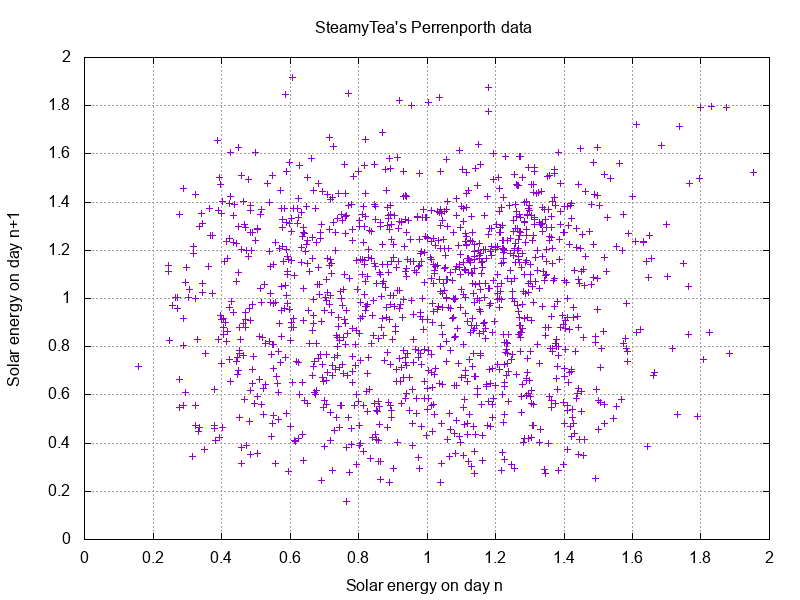
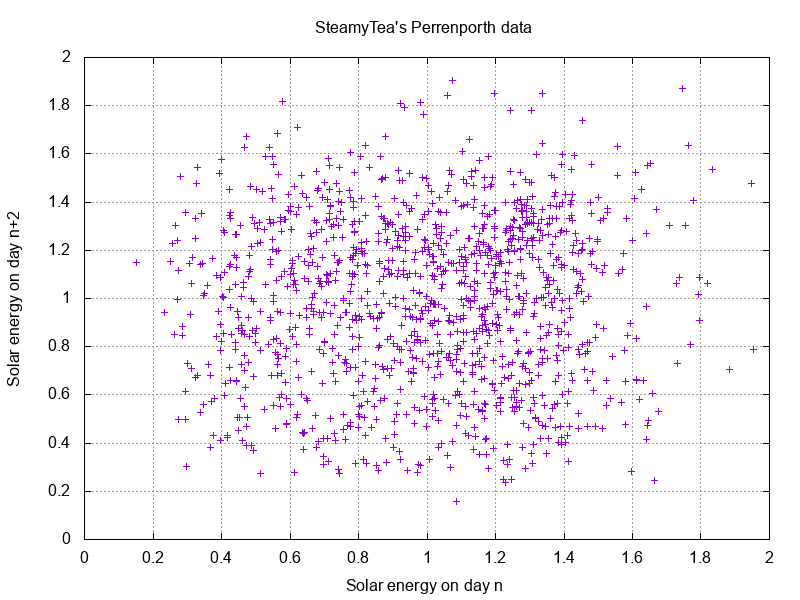
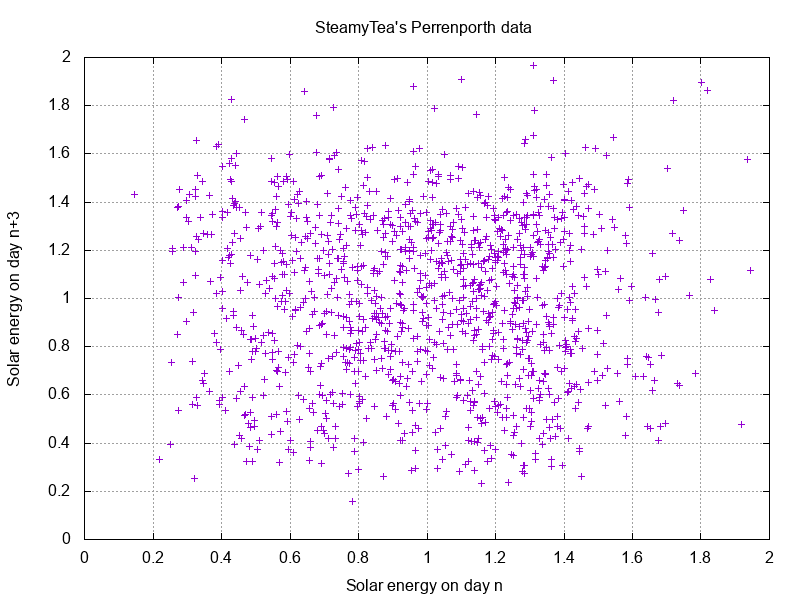
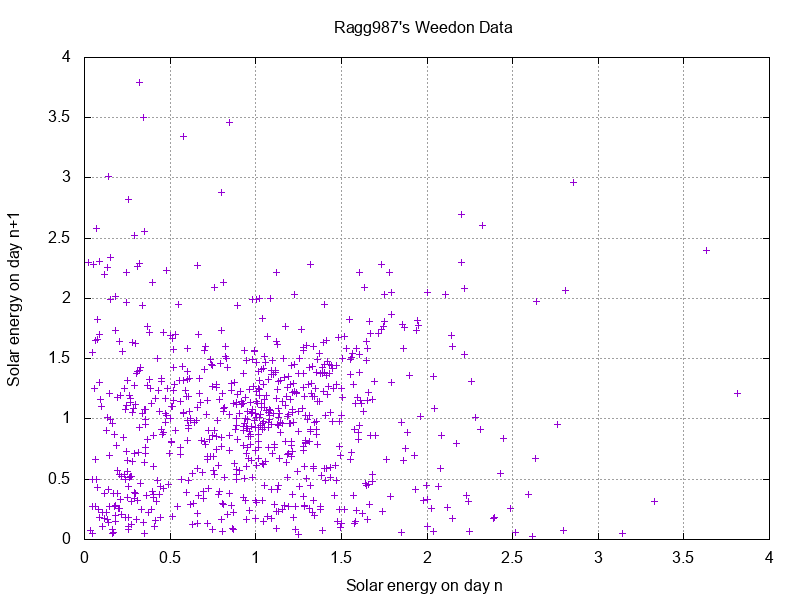
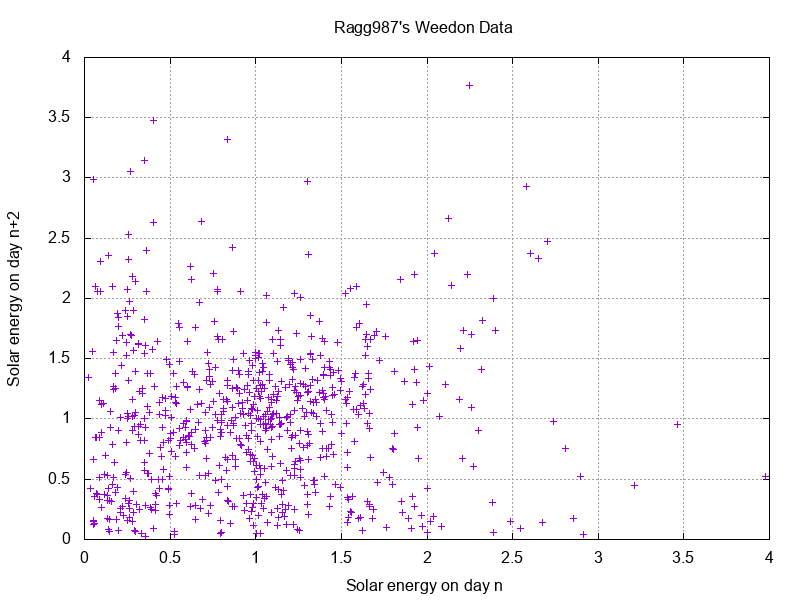
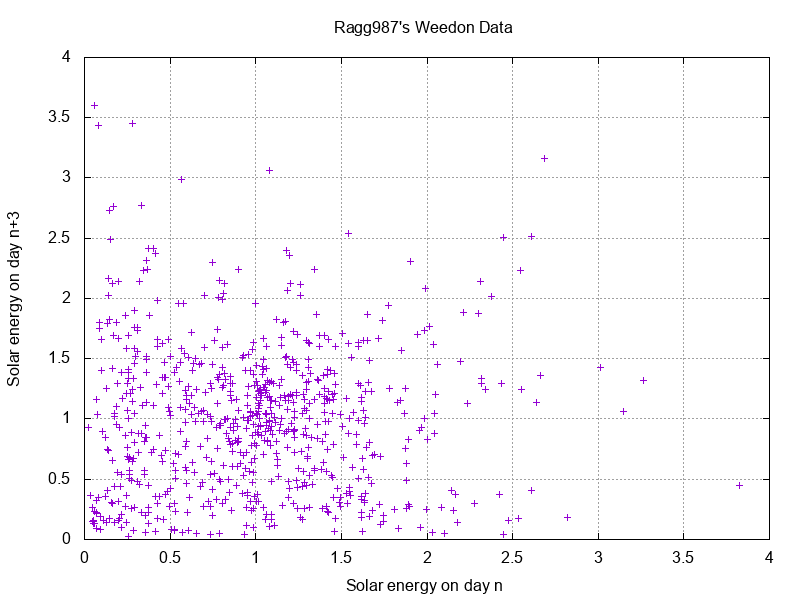
I'm no data analyst, either, and a bit scared of statistics, one of those areas where a little knowledge can be a dangerous thing so I just plot graphs and if something's not obvious from those I leave it to others. Yes, it's a Python program. Standard Python3 (no non-standard libraries needed) but it does need the gnuplot program installed. That'll be easily available in the Linux repositories and simple enough to install on a Mac or Windows I imagine. The program reads the .csv files, either the one from Steamy's .zip file or the appropriate tab exported (via Save As in LibreOffice) from Ragg987's spreadsheet. It takes a --steamy or --ragg command-line switch to choose which data source to use. Try --help for how to produce PNG (or SVG) output instead of just displaying gnuplot windows. To get round partial correlation for the time of year I normalised the solar energy amounts by dividing by the average for days from ten days before the first day to ten days after the second day in each pair. If there were fewer than 15 days of data available in that period the pair was ignored. So the point at (1, 1) represents an average day for the time of year followed by another such average day. To be honest, I'm a bit disappointed as it all seems a bit inconclusive. There's not much obvious pattern in the results. Maybe Ragg987's data shows that an unusually bright day is not likely to be followed by another such day but there are few enough of those that it's not really conclusive. Still, a negative result is still a result. Mildly interesting: Steamy's data doesn't much go below 0.2 times the average whereas Ragg987's is close to zero quite often. I'd assume that's because the inverter doesn't bother to turn on until there's sufficient solar radiation to at least cover its own power consumption plus enough for a small about of actual generation whereas a solar energy monitor would sum all the light in the day, however low level. solar-correlation.py.txt
-
I've started some code to look at @SteamyTea's data. Will do more on that and similar for @ragg987's later.
-
Engineering toolbox gives thermal conductivities of likely [¹] woods ranging from 0.12 to 0.17 W/m·K. This page says 0.22 W/m·K along the grain and 0.14 W/m·K across the grain for pine. Skip reading this article gives mostly higher conductivities for engineered bamboos. Taking the worst-case (i.e., lowest) plausible value of 0.12 W/m·K and assuming a thickness of 12mm that would give a thermal conductance of 0.12/0.012 = 10 W/m²·K. That's about the same as the conductance from the surface of the floor to the air (by both conduction/convection and radiation) so the effect of a wooden floor would be to no more than double the temperature difference needed between the top of the substrate (screed, concrete, whatever) and the room. Since in a well-insulated house that's only a degree or two anyway and any other flooring will have some thermal resistance of its own the effect of the amount of extra insulation provided by the wood would be tiny. As @Bitpipe points out, if you're likely to walk around in bare feet much then the reduced conductivity of the wood allowing the floor to feel comfortable at a lower temperature might be a more significant effect. [¹] Balsa's probably an unlikely wood for floors.
-
Yes please. The size, orientation and slope of your PV would be interesting background, too. BTW, the reason I only did June/July/August was that if you do a whole year there's an obvious correlation added because January tends to be darker than July. On the other hand, glancing at my data that doesn't actually seem to be the case (the brightest days are in March) probably as a result of the sensor being indoors and very dependent on the sun angle. So real outside information would be helpful to look at.
-
10. Indeed, hard to image a case where more would be needed. https://www.quinetic.co.uk/products/rf-receiver/
-
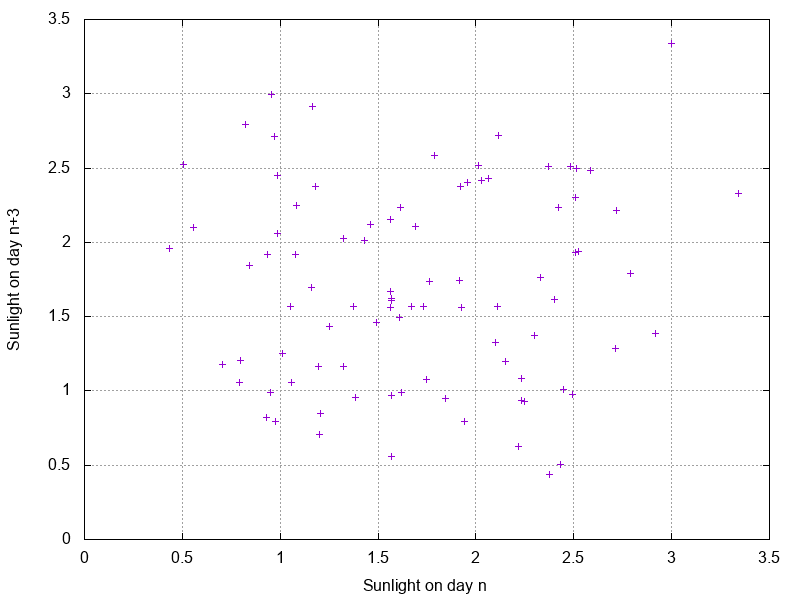
Just done some scatter plots of sunlight for days against the sunlight 1, 2, and 3 days later for June, July and August this year. Sunlight is in “Mfot·s” (a joke unit described in this blog post). It needs a bit more statistics but just looking at the plots it doesn't feel like there's much correlation one way or the other at any of the day differences. Be amusing if somebody with daily PV production data could do something like this.


-
It'll be interesting to see your statistics when you've 12 months of data, as a counter argument to the “what about when the sun isn't shining and the wind isn't blowing” brigade, if nothing else.
-
This is a key thing when thinking about PV into electric or heat batteries: what's the distribution of sunlight over short runs of days. E.g., if two consecutive days are dull, what's the probability that the third day will be dull also. My impression, not backed up by any statistics, is that consecutive days tend to be correlated (if it's dull one day it's likely to be dull the next) but over about 3 or 4 days it tends to be anti-corrolated: if it's dull today it's more likely to be bright the day after next, and vice-versa of course. So if you're wanting to use PV to cover a lot of your energy use (for DHW, say) then it's worth having about three days of storage.
-
Laid the sash flat on the floor (on some EPS to protect the hinges) and fiddled with the latch mechanism for a few seconds and it clicked together perfectly. I think the “headlock bar” was in the intermediate position (vent open but latch latched) when it worked. Sash is now installed, covers put on the outside but too windy to put its bib on today. I don't know why it didn't go before but suspect it might have been to do with it resting on floor unevenly. Thanks for the advice folks, very helpful to know that the latch shouldn't necessarily have been fully latched and also that it's not all just me.
-
@andyscotland, thanks for the piccies.
-
Not for a turbine operating in duct. If the Betz limit applied pumped storage systems wouldn't be able to achieve 80% round-trip efficiency. https://energymag.net/round-trip-efficiency/
-
@andyscotland, thanks for that but the image links need you to be logged into Gmail, presumably as you. I'll email Velux. I'll admit those instructions confuse me. If the “headlock bar” and “console clip” are what I think they are then they seem to be saying to engage this latch with the window unlocked rather than locked as you normally do.
-
Don't suppose you still have those instructions and picture? Any chance you could forward them if you happen to? (Off to put the sash in today. Will see how I get on once it's in.)
-
Yes, once the sash is out the frame is pretty floppy so, even with the sash in, it could be out of alignment slightly if it's not resting on the floor evenly or something. Bit odd though as the frame is not directly involved in the connection between the vent bar and the latch mechanism. I've split the frame and sash now and put the frame in the roof so I'll put the sash in and make sure it's all square before I try again. If that doesn't work I'll call or email Velux.
