


MikeSharp01
-
Posts
5693 -
Joined
-
Last visited
-
Days Won
16
Everything posted by MikeSharp01
-

All is not well in the PW SE multi verse
MikeSharp01 replied to Pocster's topic in Photovoltaics (PV)
That works. -
All is not well in the PW SE multi verse
MikeSharp01 replied to Pocster's topic in Photovoltaics (PV)
Have you shared that somewhere I must have missed it. -
Thanks Joe, that's very helpful, I was wondering how I was gong to make the dampers work for each of the outlets (inlets depending).
-
I found a pic of @joe90's system here:
-
I am just working up the design for my distribution and silencing system - do you have any more details of yours you can share - I think there was a post on e-build about it but that is long gone now.
-
All is not well in the PW SE multi verse
MikeSharp01 replied to Pocster's topic in Photovoltaics (PV)
Firstly can I admire and respect your wish to give this setup a try. It feels relatively obvious that unless they were designed to, or can by use of their settings be made to, work symbiotically that they will work parasitically - everything tends to chaos. Both the PW & SE assumes that they are "the only battery in the village" and behaves accordingly. Which does what to which probably comes down to the sensitivity of the respective front end - IE what they think they see happening on the wires and a fractional difference in interpretation will be enough to upset the applecart. As I see it you will need some pretty tricky control electronics, perhaps a sort of rules based MQTT broker like device (function of not form of) to get these two talking to one another and their respective PV arrays nicely - have a word with @Radian cos he seems to be the master of this sort of stuff! -
All is not well in the PW SE multi verse
MikeSharp01 replied to Pocster's topic in Photovoltaics (PV)
Not sure it sounds like that! -
+1 to that.
-
It is a risk, we haven't yet, probably won't but it does get tetchy - just yesterday we verged on shouting at each other about the shape of a roof light reveal. I wholly missed the fact that although she has been in the house many, many times and looked at the roof light she didn't clock how the reveal would have to be done because of the way it was positioned - it just cannot flair in all directions because it is set up between two 300mm deep beams. Same thing a few minutes later when she realised how big the flat portion of the vaulted ceilings would be. The structure in which it must fit has been there for a year or more but she does not see the implications of that and I just didn't spot she didn't get it even though we chose to flat it out much earlier in the build to give us some service space at the top of the house. This naturally works both ways so don't think I know exactly what is going on all the time - I get caught out too. So although we have worked hard on communication over the build we still have our moments. "What you want a light there? - I wish you had told me that 3 years ago and we could have built a different house. SO COMMUNICATE, COMMUNICATE, COMMUNICATE....
-
Probably more if you go the full architect route but if you have vision and are ready for hard, often relentless, work you will make it to the end. You will have A. The satisfaction of having done it. B. Much better equipped in all kinds of situations you will find yourself in the future - because you understand the challenges of constructing a home, you have grown in confidence with a wide range of skills and, C. There will be this artefact on the street that will be testament to your work for generations yet to come who will, if you build it to be light on the planet, thank you for it.
-
No it won't, but in conjunction with other things it can help with cooling.
-
Well I never thought I was that clever but maybe I am by comparison to some - oh that's how IQ works, now I get it 😂.
-
Then they clearly have no understanding of number.
-
Which ASHP are set up to cool
MikeSharp01 replied to Triassic's topic in Air Source Heat Pumps (ASHP)
I suppose there is a chance that you have hit the sweet spot? I wonder how the ASHP is cycling do you have any details of that? Sorry if I don't recall your upstairs temperature management systems but you, and others, talk about it getting a bit warm upstairs over the past heatwave. So I have been looking at cooling for upstairs in our build but I do wonder if some sort of stirring system to pick up air from just above the slab or push warm air down to the slab (EG simple convection) might be a way forward. -
Leaf blower it into a shed or some such then scoop it up from there?
-
Some might say worst thing that happened, others might say the best thing that happened - but mostly nobody noticed which in itself was a shame but generally the way of things. ‘THE PAST IS A FOREIGN COUNTRY: THEY DO THINGS DIFFERENTLY there.’ L. P. Hartley. Which I guess is why building control is very different today. We are actually all over the place - and like @SteamyTea we sometimes move about a bit, none the less you are very welcome to THE forum for people like us.
-
Confounding an EPC Surveyor (Historic Interest)
MikeSharp01 replied to memnoch's topic in General Self Build & DIY Discussion
Just show them the patent - ? -
So he wrote it up and started a fad.
-
12.5 billion years ago in a universe not far from here......
-
It's on but only a dribble, this is going to bite us all in the bum, another good reason not to expose your bum by pushing your head into the sand.
-
Sorry just did that and I found a whole slew of senior politicians already there - no room for me.
-
Yep - that's a worry - think I will find some sand and stick my head in it.
-
Now I must finish my trustee report - sometimes life interferes and not capacatively.
-
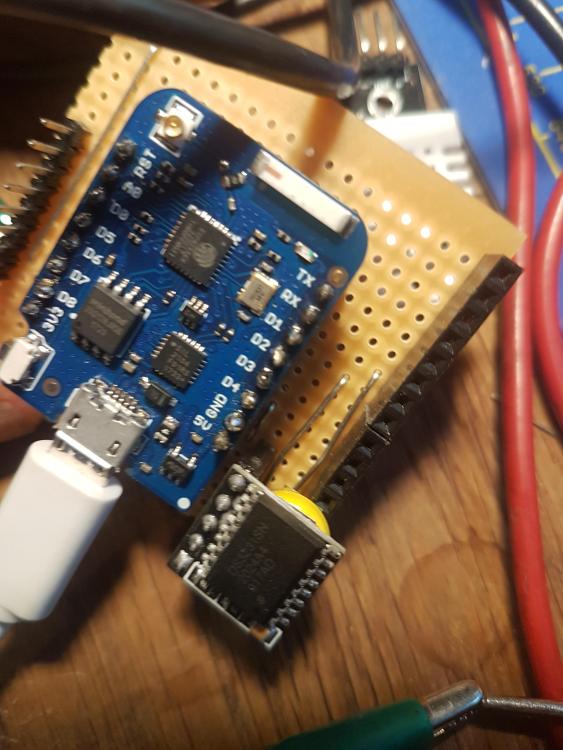
Bugger me, just looked at the tracks above the board taking SDA and SCL from the RTC to the WEMOS lovely and parallel - so thought nice capacitor there, so bent them apart - see pic, works like a dream - dry joint or interference?
-
Yes, thanks for the heads up on the boot pins - had the GPIO15 with a pullup for the pulses. That has cured the boot from reset switch but the rtc is still error 4 - bus arbitration fault. (Nothing else on the SDA / SCL pins I can see.)



