Sparrowhawk
-
Posts
607 -
Joined
-
Last visited
Everything posted by Sparrowhawk
-
When the Pi 4 prices increased I got a second hand one of these https://www.lenovo.com/gb/en/p/desktops/thinkcentre/m-series-tiny/m900-tiny/11tc1mtm900 off the bay for less than the price of a Pi. It's been superb and unless I needed a Pi for an IoT device I don't see any reason to go back.
-
When using 25-50mm of acoustic insulation in a 100mm+ wide wall, how do you place it for best results? Staple it midway with air either side? Pushed up against one of the plasterboards?
-

New member - stuck for what to do next to warm the house
Sparrowhawk replied to Sparrowhawk's topic in Introduce Yourself
Penetrations. I've set a new record this week. Not counting joist ends (I can poke a twig into the cavity round most of them) there's 7 penetrations into the cavity in 1.2m. And 5 penetrations through the ceiling to the room below, which houses the boiler and fusebox. Rewring TBD later. Plan is to fill the gaps or coat the entire damn section of brickwork with something - mortar? plaster? - and then use Blowerproof to seal round the joists. I'm not taping this lot. Happy weekend everyone!


-
Blowerproof sell a Non Shrink Gap Filling Mortar to use on bigger cracks before painting with Blowerproof liquid sealant. What can I get from a local builders merchant that will do the same job?
-
Seconding this. When thinking about remodelling we got big sheets of cardboard, put them up where the walls would be and painted them. We've kept one up to see how much of a pain the doorway position is. I envy people who can see 2D plans or 3D renders and visualise themselves in it. I need to inhabit the space.
-
More foundation fun - straw bale garden room on clay
Sparrowhawk replied to Nick Thomas's topic in Foundations
@Gus Potter are you sure you mean @jayc89 and not @Nick Thomas? -
Looking for help installing my network
Sparrowhawk replied to Triassic's topic in Networks, AV, Security & Automation
I've got a patch panel on the marketplace if you want one -
@NCXo82ike Did you install ducting in the chimney stack in the end? I've been thinking about this for our house so your experiences would be good to hear.
-
Radiator Placement and Eskimo Radiators
Sparrowhawk replied to PNAmble's topic in Central Heating (Radiators)
They are beautiful radiators. If money was no object I'd fill my house with them. I'd like some 3rd party verification of the correction factors though. -
New member - stuck for what to do next to warm the house
Sparrowhawk replied to Sparrowhawk's topic in Introduce Yourself
I know. Thought it was only one room we needed to get rewired for cavity wall insulation but no... How does a "normal" house get its cables from the fuse board downstairs to upstairs? A wide chase above the fuse board, through the ceiling, then fan out under the floor? -
New member - stuck for what to do next to warm the house
Sparrowhawk replied to Sparrowhawk's topic in Introduce Yourself
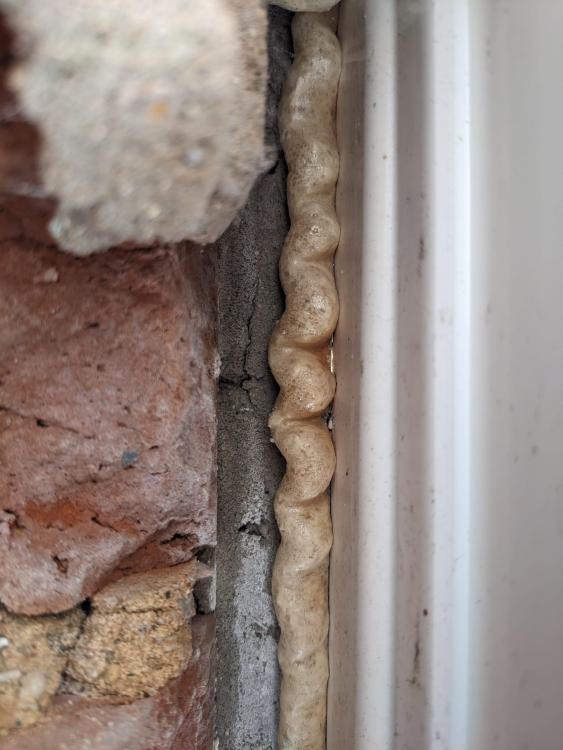
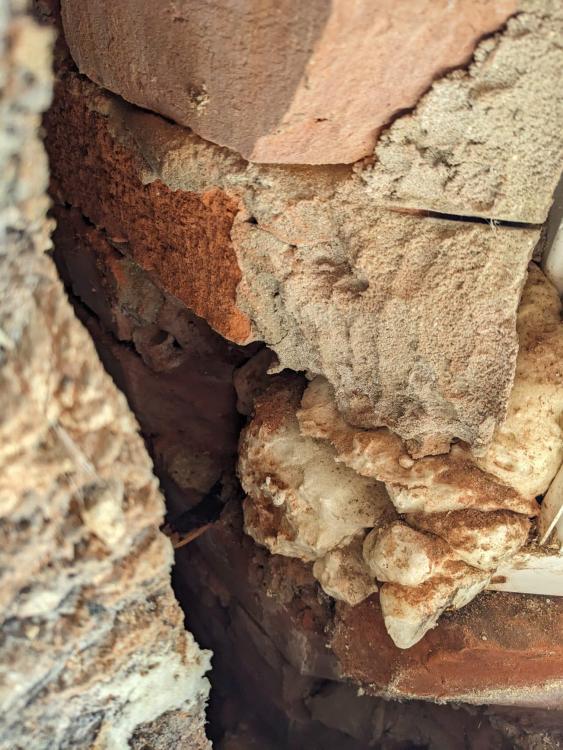
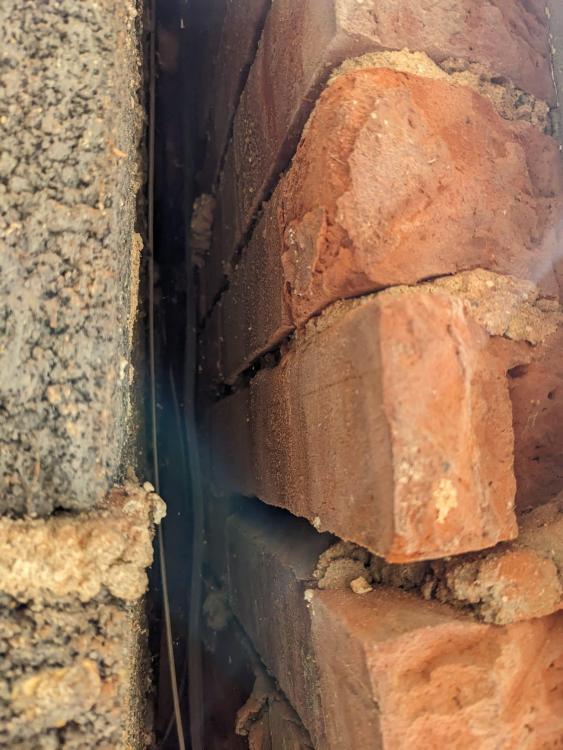
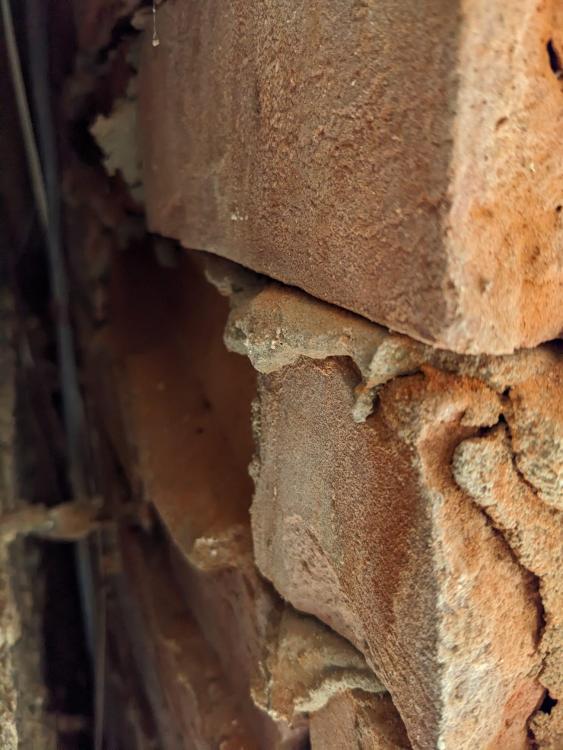
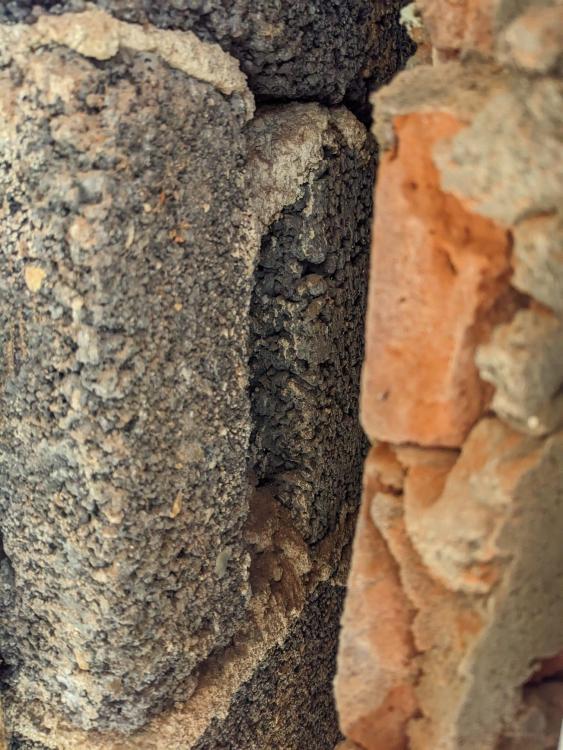
I took off a wooden cavity closer by the bay this morning. Turns out it's not just the bricks in the bay that are soft it's the whole wall. Think the render is holding the wall up! A generous gap was left between the UPVC frame and brickwork, plugged with mortar(?). Look out for the daylight below! Lucky to have foam here, it's missing for most of the rest. The mortar-filled gap is over 2cm wide at this point. The out of focus bit is where the face of a brick has disappeared. To get a nice straight edge to the window opening they didn't cut cinder blocks to fit. Oh no, they took small ones, lined up the edge and left a couple of inch gap to the next block... covering it with plaster in the room. Despite the strong breeze blowing through and out of the cavity, it smells a bit - damp I think. I've temporarily stuffed HelloFresh insulation in the cavity. My plan had been to shove 100mm PIR in as a cavity closer but the brickwork is too uneven for a 100mm sheet to fit. Will rockwool do the job as well? And between the window and brickwork where there's the mortar and a little old foam: best to fill this entirely with foam, or does it need something more solid like chunks of PIR too?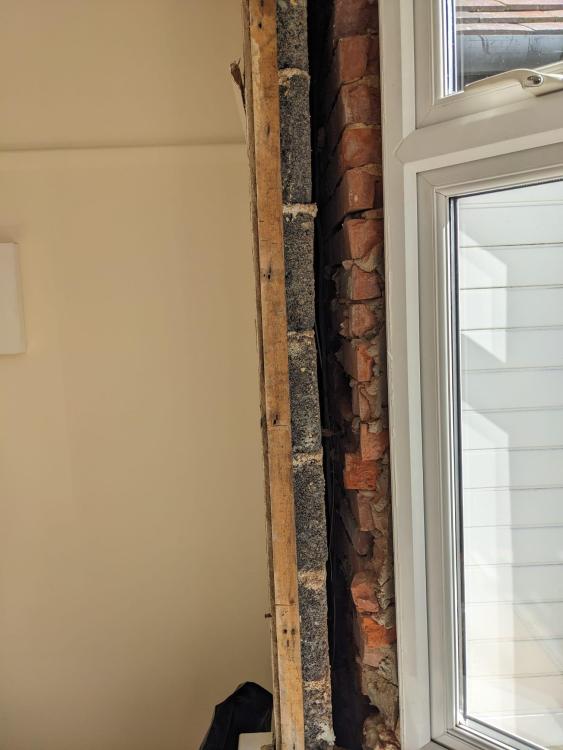

-
New member - stuck for what to do next to warm the house
Sparrowhawk replied to Sparrowhawk's topic in Introduce Yourself
Now it's cooling outside I am hoping internal RH comes down. It's remaining stubbornly high. Since all rooms are within 10% of each other I'm assuming there's not a leak in one room adding moisture to inside as I'd expect one room to be worse than the rest. -
New member - stuck for what to do next to warm the house
Sparrowhawk replied to Sparrowhawk's topic in Introduce Yourself
It was. The dew point would be about 12.5C with those internal conditions. Condensation was in the corners of the windows (more at the bottom) & across the bottom - thermal bridging via the aluminium spacers? -
New member - stuck for what to do next to warm the house
Sparrowhawk replied to Sparrowhawk's topic in Introduce Yourself
First morning with internal condensation on the 2g windows. 8.8C minimum outside with 95% RH, internal temperatures remained above 18C and a RH of around 70%. A window supplier came round to quote. Harder to get rid of than the JW's and vague when pushed on details. -
Well sure, but the feel of 6l/min coming out of a shower head at 3-4 bar is going to be different to the feel at 1-1.5 bar. I'm having a job putting "drench" and "6l/min" together in the same sentence so keen to hear more as I'd like to cut our water usage.
-
Which shower are you using, and at what input pressure?
-
How to make area behind skirting board airtight
Sparrowhawk replied to garo99's topic in Heat Insulation
This is a better search term: https://www.google.com/search?q=plasterboard+thermal+bypass Mark Siddall's guide for The Passivehaus Trust on thermal bypass risks is very much worth a read: https://www.passivhaustrust.org.uk/UserFiles/File/Technical Papers/Thermal bypass risks v1.0 222909.pdf -
How to make area behind skirting board airtight
Sparrowhawk replied to garo99's topic in Heat Insulation
That's the stuff and it doesn't expand a lot - it's well controllable. However the blue is strong - you can wipe the foam off if it goes too far but in my experience the blue colour stays forever. For this reason only I've switched to the Illbruck FM330 that everyone else mentions, despite the price/having to buy online. -
I have a collection of blunt wood saws so will give this a go without grinding and hope for the best. My studs are 20-30cm apart (every one different) so plenty of cutting to do.
-
Ah but if it appeals to the right people... my (young) other half on seeing the purple colour with a happy octopus on it: "Oh that's cute!". So that's one barrier gone to getting them installed.
-
When the temperature outside is roughly the same as inside, the relative humidity RH which is what these meter measure is going to be similar to outside. Today the outside humidity where I live is below 65% here; on a damper day or early morning when the dew is evaporating it's 75%+. We're keeping inside at a lower humidity by not opening the windows. Keep an eye on them this winter. When it's near freezing outside, that's when you expect the humidity to be in the 30-50% range indoors.
-
You missed the first sentence of my first post John "posting after digging online for figures to use in a friend's thermal model." but fine let's move on 🤷
-
Except. Sometimes the figure being quoted is the @50Pa already converted, i.e. divided by 20 as @IanR says, to ACH at atmospheric pressure. When the figure is "0.35ACH" it's hard to tell if that's a good build, or a standard build "7ACH @ 50Pa". In this case it was the latter.
-
Rant posting after digging online for figures to use in a friend's thermal model. When someone quotes their air changes as "1.5ACH" do they mean "at 50Pa" or "at normal atmospheric pressure"? The web is awash with figures from people who don't specify. Some are helpful and use "ACH @ 50Pa" or "ACH (50)" and similar. Others use "ACH (nat). I made the assumption because no pressure was quoted then it was normal atmospheric pressure... but from the range of figures I found it could be either. Is there an accepted meaning for "ACH" on its own?
-
Bay window brickwork - cause for concern?
Sparrowhawk replied to Sparrowhawk's topic in Brick & Block
So the consensus is messy, but make airtight and carry on, no need to get a builder in?