


Sparrowhawk
-
Posts
607 -
Joined
-
Last visited
Everything posted by Sparrowhawk
-

Sorting drainage between patio and house
Sparrowhawk replied to Sparrowhawk's topic in Landscaping, Decking & Patios
In one place it looks like roots have come through, against the house wall. Do I pressure wash this, push the small roots back through and then pack the hole with mortar? Or does it need more than this to sort?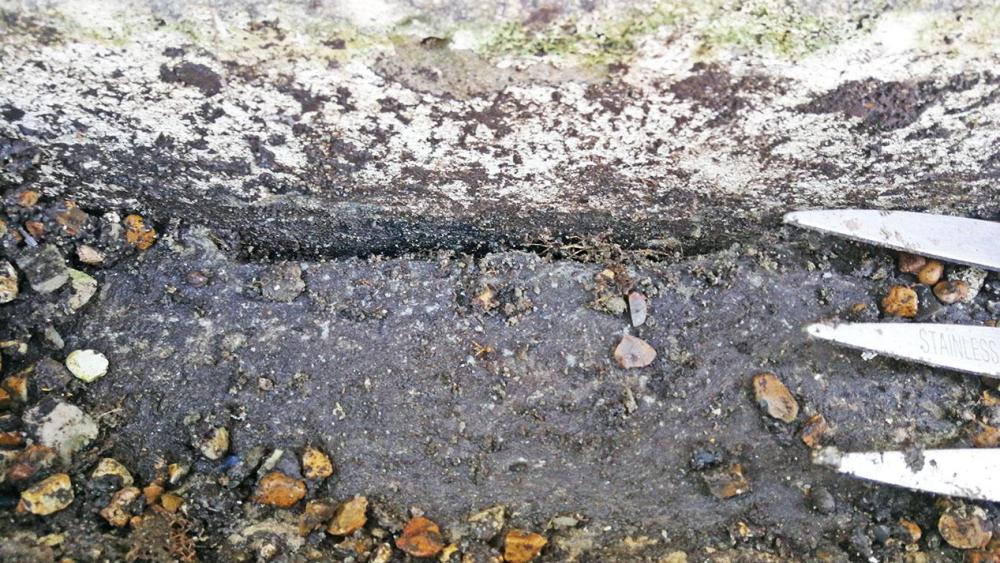
-
Have we got a good (definitive?) thread on Buildhub re 'mass', as I was going in circles over this picking glassfibre insulation. E.g. for loft insulation will 40kg/m2 make a difference over 11kg/m2, which will be better than 8kg/m2? Don't want to derail this thread so if there isn't one to point to, let's start a new thread on the subject.
-
Sorting drainage between patio and house
Sparrowhawk posted a topic in Landscaping, Decking & Patios
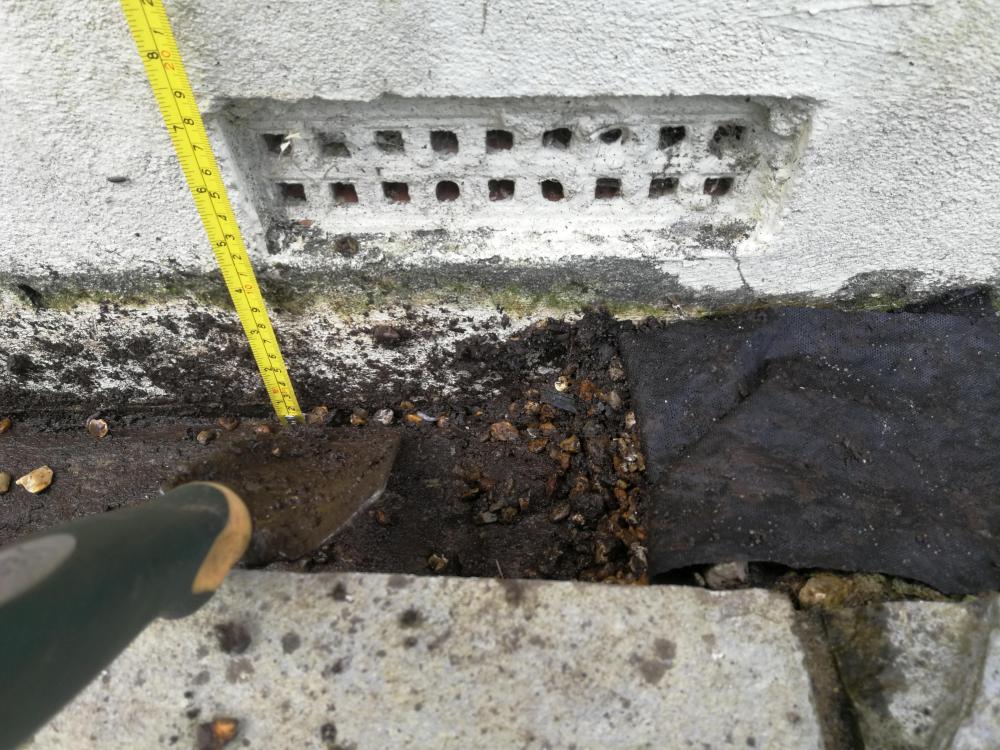
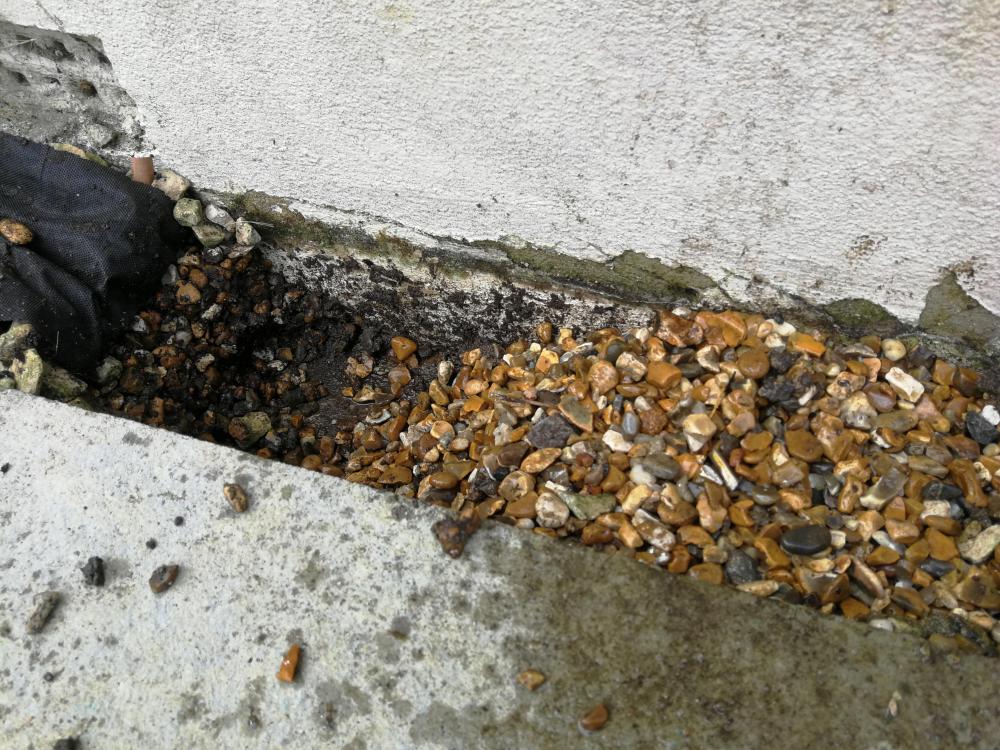
The patio laid to sell the house is level or slopes gently towards the house, and between the house and the patio is a 10cm x 10cm shingle filled drain, that at one end is connected to a soakaway. The wall is getting more stained and the paint coming off the render, and in heavy rain I've seen water reach the airbrick. Water sits on top of whatever this membrane is and drains slowly, usually off the edge by the house. I dug a section out today and the shingle was pretty full of earth and earthworms. I washed this shingle and put it back in without the membrane on top. I'm guessing I need to clean all the shingle in this way so it will let the water drain quickly. Is there anything else I should be doing? Do I need to put strips of membrane back down? And what about the render? I understand it's unusual to have render across the DPC.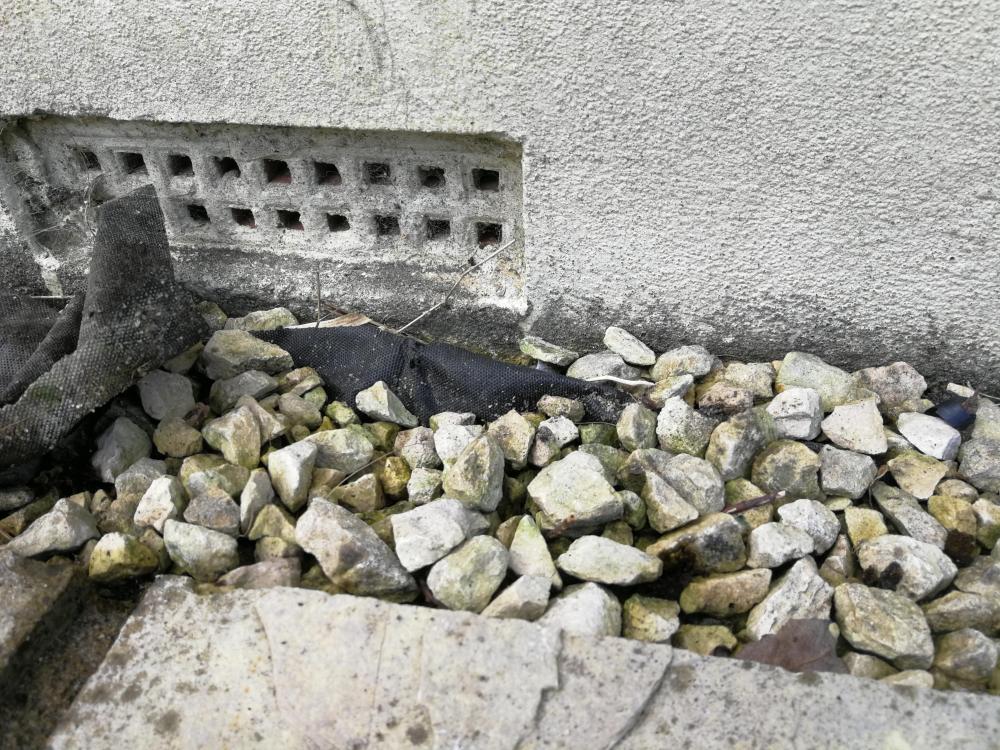
-
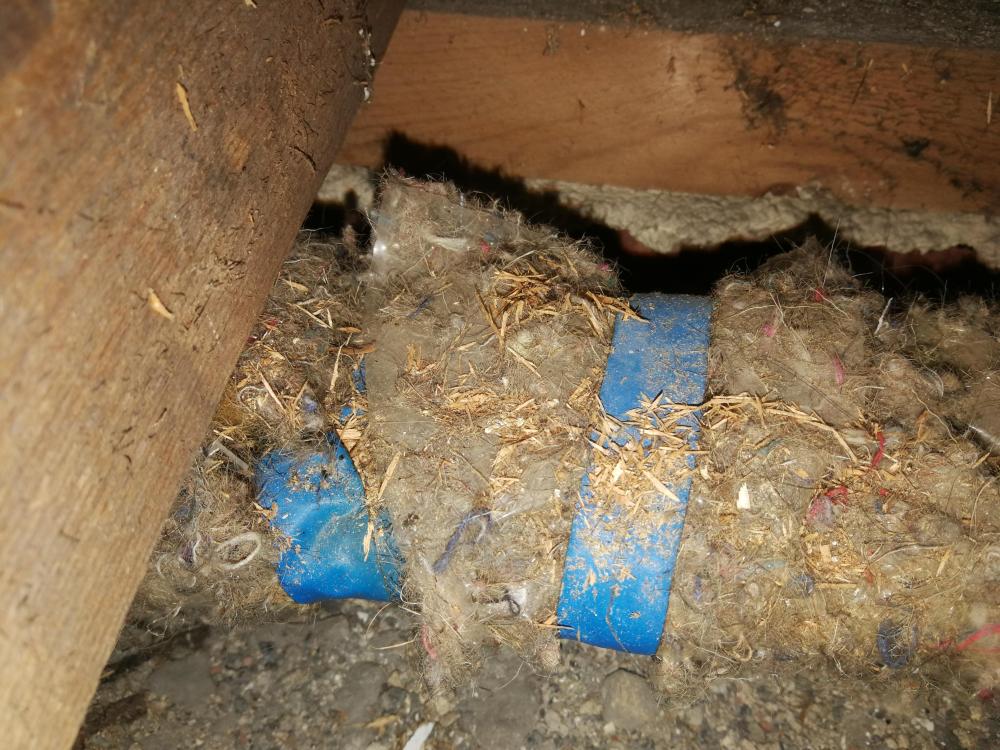
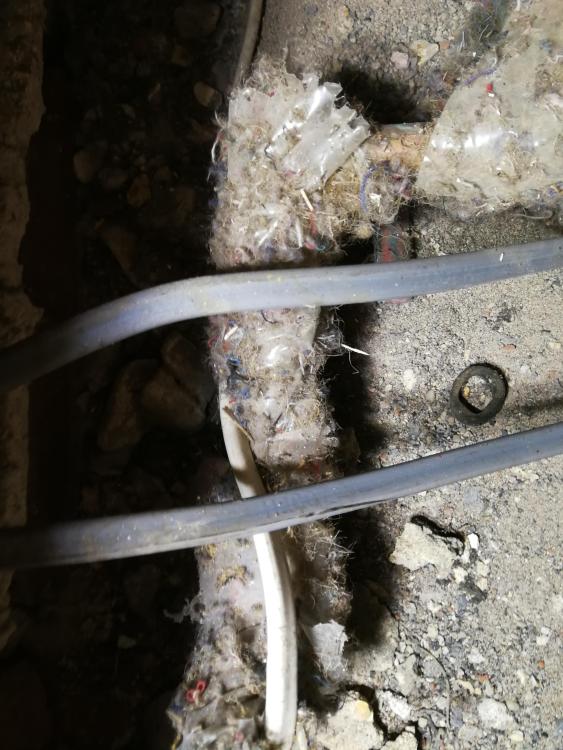
I've lifted my suspended floor to insulate and the heating pipes are wrapped in something that looks like felt or cotton waste with a plastic layer in it. I'm guessing this doesn't do much for insulation in the vented floor void, but is it worth replacing, and if so with what?
-
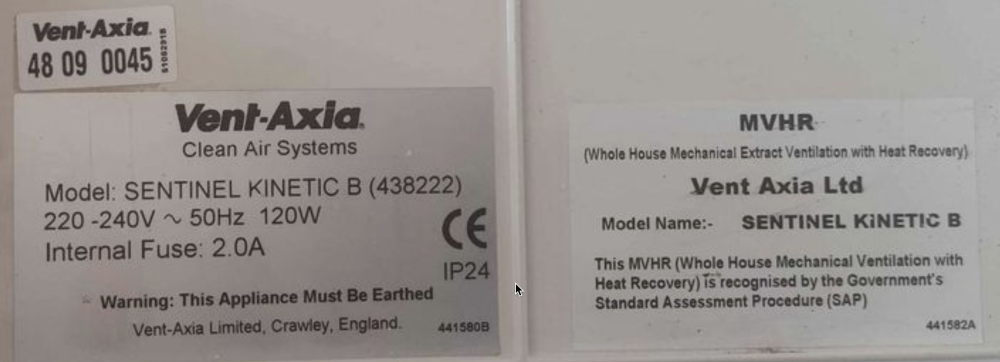
That's my guess too. If true it makes the unit less good value, as after 14 years' operation the fans must be getting knackered.
-
I've found a second hand Vent Axia Sentinel Kinetic B going cheap. Do any of the codes give a clue to its age?
-
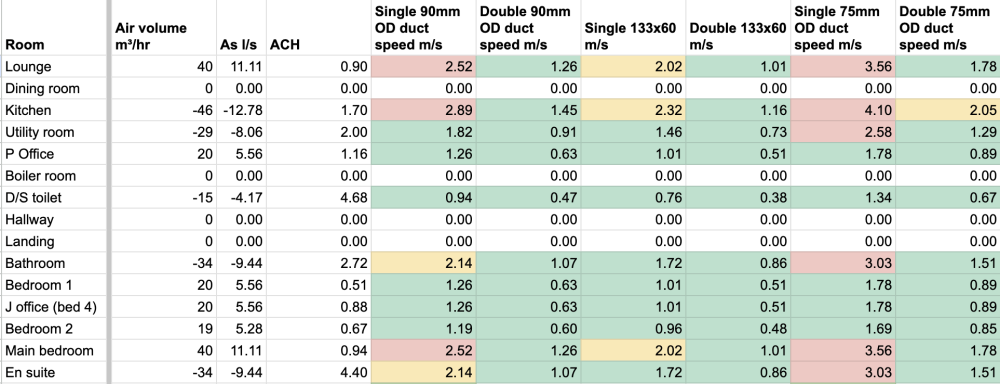
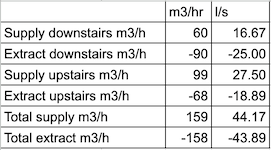
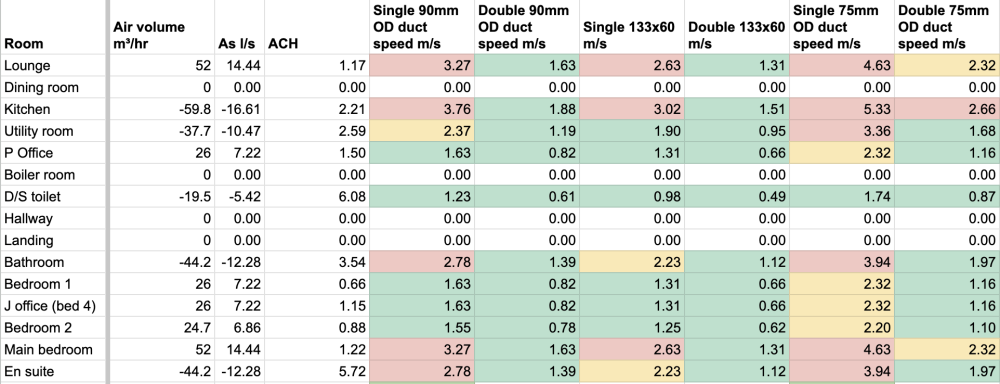
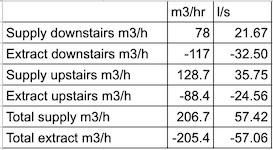
Latest update: I've redone the floor area reducing it for the skeilings, excluding areas under 1m in height and taking 50% of the floor area for areas 1m-2m high. 50% seems to be the done thing, but makes that part have an effective ceiling height of 3m instead of the 2.5m elsewhere 🤷🏻♂️ That gives a floor area of 142m² (previously 162m²) ADF for a 4 bed (Table 1.3) = 133.2m³/h ADF on floor area (1.24a): 154m³/h ADF boost extract rates (Table 1.2): 156m³/h And 0.33ACH of the volume is 120.6m³/h So designing for a minimum ventilation rate of 154m³/h: This gives distribution of (downstairs = lounge/P office, upstairs = bedrooms) For 2 of us in the house I expect to need to turn this down (based on forum members' experiences), but I think we should still have 40m³/h into our bedroom which will need it rebalancing. We will see. Nevertheless, I thought I'd best calculate a boost mode. I arbitrarily chose 1.3x (the Passivhaus figure is 1.42x). This results in: with distribution as Should I keep boost mode under 2.5m/s? If I should, Boost mode means doubling more duct runs. This leads to unit size. Blauberg talk about a 40/70 rule, where "The trickle rate is no more than 40% of the MVHR units full speed. The boost rate is no more that 70% of the MVHR units full speed.". Is this a common rule of thumb? 159m³/h is 40% of 397.5m³/h. 207m³/h is 70% of 295m³/h. I'd been thinking to use a Zehnder Q350 (rated by PHI for 270m³/h) or Brink Flair 325 (rated by PHI for 251m³/h). Given my floor area's only 142m² getting a result that says "increase unit size" sends me looking for a mistake. Looking at the initial quotes I got based on 155m2 floor area, BPC specced an "Up to 425m³/h" unit (will be less once F7/G4 filters are added), GBS a Zehnder Q350, HS&L a Zehnder Q350, and CVC a Brink Flair 400 (rated by PHI for 313m³/h). So a bit of a spread.
-
Full house renovation with MVHR
Sparrowhawk replied to Pappa's topic in Mechanical Ventilation with Heat Recovery (MVHR)
Hi @Pappa and welcome. First question, are you planning, designing and installing the system yourself? Do you want to pay someone to plan and design the system and then you installed it yourself? Or are you looking for everything to be taken care of for you? This forum is full of tips and advice. It's interesting to see how much people's practices have evolved over the last five years if you dig back into the older archives in the forum. People's ideas of what ducting should be like and machines they use have changed a lot. One big decision to make is how much you want to spend. A lot of people use cheaper MVHR units like the Ventaxia Kinetic Sentinel. While others use passivhaus quality machines like those from Zender or Brink. I'm in the middle of doing calculations for my retrofit (see https://forum.buildhub.org.uk/topic/38091-critique-my-mvhr-plans-round-2/ and other threads). For me getting the ducts from ground floor to first floor is taking most of the brainwork. I'm leaning towards using one of the more expensive passive house quality machines. But honestly just having the ventilation will probably make the most difference rather than the machine used. -
I've seen it quoted on MVHR supplier sites and here, but where does it come from and why? Is it draughts, or air moving faster than this is audible (in any diameter pipe)?
-
Airtightness approach for suspended floor PIR insulation?
Sparrowhawk replied to Sparrowhawk's topic in Heat Insulation
Which side of Glidevale VP400 lets moisture out - the printed side? Or it doesn't matter which way up it's installed? -
Cost comparisons - Aluminimum Clad Windows
Sparrowhawk replied to DavidG's topic in Windows & Glazing
Where would you say NorDan and Norskken sit? I ask as their windows looked similar to me but their quotes are quite different. -
Lifting first floorboard without damaging others
Sparrowhawk replied to Sparrowhawk's topic in Wood & Laminate Flooring
Heed this man. I've finally bought one of these (the Faithfull one off Amazon) and it's a gosend for L cleat floorboard nails which are rusted and stuck in the joists. -
Airtightness approach for suspended floor PIR insulation?
Sparrowhawk replied to Sparrowhawk's topic in Heat Insulation
Cheapest breathable membrane I can find to go over the joists and hold the mineral wool in place is https://www.fixdirect.co.uk/product/breathable-membrane-100gsm/ at £35.50 for 50m. Will that do the job or at 100gsm tear too easily? They also do 140gsm which is still a hell of a lot cheaper than Pro Clima Solitex Plus (170gsm). -
Airtightness approach for suspended floor PIR insulation?
Sparrowhawk replied to Sparrowhawk's topic in Heat Insulation
The buildup I had in mind was 2&4 from the first post : VCL (polythene sheet, stapled down) on top to stop any moisture getting into the space, and as a second airtightness layer. Glass mineral wool between joists Vapour permeable airtight layer (or VCL TBC) draped over joists and fixed in place to support the fibreglass, prevent wind washing and add airtightness Void So the timbers should be fine, it's whether to make the glass mineral wool able to breathe. While your earlier calculations used 0.32 glass mineral wool the stuff easily available here is 0.44 Knauf loft roll. It means the calculated U-value of the floor is 0.29, but is cheap. Good to know there's a way to plaster over it, thanks. -
Parent's chalet bungalow - insulation plan.
Sparrowhawk replied to TheTeaBoy's topic in Heat Insulation
Yes there is, but 70mm -> 100mm has less impact than 40 -> 70 would have. If 70mm is significantly cheaper use it, else 100mm. Do the soffits have ventilation in them? And is there any ventilation in the loft to let out air that rises? If not, getting that circulation of air from bottom to top is your first task. I think you have a massive struggle on your hands with no destruction or redecoration possible. How long do you expect your parents to stay living here? As an alternative is to get an Air to Air heat pump fitted to provide heating and cooling (aircon) winter and summer to give them more comfort. -
AFAICT this has to be attached direct to Ubbink manifolds (or distribution boxes as they call it) rather than between some 90mm duct and 75mm duct? Will be v pleased if I'm wrong. This was the kind of thing I've been looking for, but as 90 -> 75: https://www.paulheatrecovery.co.uk/product/zehnder-flat-51-straight-converted-to-90mm/ Genius John 😁 That reduces the upstairs supply manifold from 8 port to 6 port.
-
I've been unable to find 90 -> 75mm reducers in any MVHR semi-rigid ducting range. Got a link? Ditto for Y-pieces, which would be handy to ventilate a large cupboard off the room's duct.
-
I'm looking for distribution box manifolds that I can attach both 90mm and 75mm semi-rigid ducting to. The only ones I've found are Ubbink's which seem to be 75mm with an external converter for 90mm dia ducting. Zehnder's and all those on the BPC site like Quiet-Vent seem to be all 75mm or all 90mm. Any options I've missed?
-
Parent's chalet bungalow - insulation plan.
Sparrowhawk replied to TheTeaBoy's topic in Heat Insulation
Welcome! First your visuals are amazing. I think you rendered them in Twinmotion but how did you draw the building? It's hard to see in the photo but it's either turned black from mold in it or a build up of dirt. The lack of airflow isn't good, so you may want to sacrifice here and later when you can redecorate consider some internal wall insulation over this particular part. Remember that building regs expect a 50mm gap between the roof felt and the insulation, with free flowing air in here. I did knee walls last autumn and had significantly underestimated the impact it would have in winter. I used 100mm supasoft insulation as we use these for storage so brush against them. We shall see about summer overheating soon, and whether it's better or worse now. Others will have the knowledge to make suggestions, but you're spot on re rigid foam boards. For snug fit installation you can put strips of Gapotape down either side of the boards, but it costs an absolute bomb. With the badly fitted ones here I taped them to the joists with aluminium tape, so the insulation value isn't great but they are airtight. Thermal mass is a running joke on this forum but if budgets allow you may want to reach for denser insulation like wood fibre, which slows the progress of heat into the building in summer (see https://www.steico.com/fileadmin/user_upload/English_Media/Content/PDF_Not_PIM_EN/Brochures/STEICO_heat_protection_EN_i.pdf). -
Airtightness approach for suspended floor PIR insulation?
Sparrowhawk replied to Sparrowhawk's topic in Heat Insulation
OK with no feedback on a breather membrane at the bottom I'll take it that's a silly idea and use polythene sheet above and below. Where this laps up the wall and is taped, you can't plaster onto polythene right? So it needs to be a small lap and plaster onto the Tescon Vana tape - or the wall replastered first and then this has to be done after? -
Hi @JohnBishop, for temperature and humidity I've tried Sonoff, Aqara and Tuya. Avoid Sonoff, the one I had was more out of calibration than the others and dropped off the network more despite being closest to the dongle. My Aqara ones are excellent (this model) and give the finest resolution data. However they are more expensive than... Tuya, which is what most of my sensors now are because they were less than £3.50 each. Beware there are two models on AliExpress, IH-K009 and ZG-227Z. IH-K009 are slightly more expensive and have performed better, but I have no idea what the difference between them is. Zigbee range is surprisingly short (well it was a surprise to me) if you have more than plasterboard and timber walls in your house. I've ended up with a second Sonoff dongle in repeater mode 8m from the other to keep sensors in all rooms connected to the network. For plugs, I went with these WiFi ones preflashed with Tasmota (Esphome wasn't an option at the time). I currently have a temperature sensor and a WiFi plug automatically controlling my heated propagator.
-
Airtightness approach for suspended floor PIR insulation?
Sparrowhawk replied to Sparrowhawk's topic in Heat Insulation
Should the membrane between the joists and under the fibreglass be vapour permeable, in case the insulation ever gets damp (dripping pipe or whatever)? If so, what's the cheapest one I can get? The layers I'm thinking are: VCL (polythene sheet, stapled down) on top to stop any moisture getting into the space, and as a second airtightness layer. Fibreglass between joists Vapour permeable airtight layer (TBC, draped over joists and fixed in place) to support the fibreglass, prevent wind washing and add airtightness Void -
And where did you find installers that know and care about such things?
-
Airtightness approach for suspended floor PIR insulation?
Sparrowhawk replied to Sparrowhawk's topic in Heat Insulation
I like this idea. Is Marmox strong enough to replace chipboard in the floor build up, or needs that on top of it? Longer term the floor level will be raised in this room by ~20mm; it's a half/half mix of old suspended wood floor and (we think) beam and block. Which is probably uninsulated. I thought lifting the floorboards would show me a cross section of the beam and block but they whacked 2 joists across the join so going to have to try harder to determine its make-up and if there's any insulation in it. -
Airtightness approach for suspended floor PIR insulation?
Sparrowhawk replied to Sparrowhawk's topic in Heat Insulation
My wife agrees I was explaining last night how I was trying to prove it'd meet building regs for BC and got that look. "You're not planning to put in an application to insulate the floor, are you?", followed by "stop being a stickler for the rules and get it done". Well that's me told.



