Iceverge
-
Posts
4381 -
Joined
-
Last visited
-
Days Won
31
Everything posted by Iceverge
-
Is this the stuff they were suggesting? https://www.coreprosystems.co.uk/thermal-lightweight-aggregate https://www.alphaquarryproducts.com/thermal-bead-screed From what I'm reading you would need a normal screed over it for UFH and you would require twice the thickness of EPS as it's thermal conductivity is about 0.067W/mK rather than graphite EPS at 0.033W/mk. What is your current situation. Do you have a concrete subfloor? I'm a little baffled by this sentence?
-

How effective are integral blinds? (hermetically sealed)
Iceverge replied to puntloos's topic in Heat Insulation
@Russell griffiths They're ace. Obviously not for me as I'm not allowed to have nice things? -
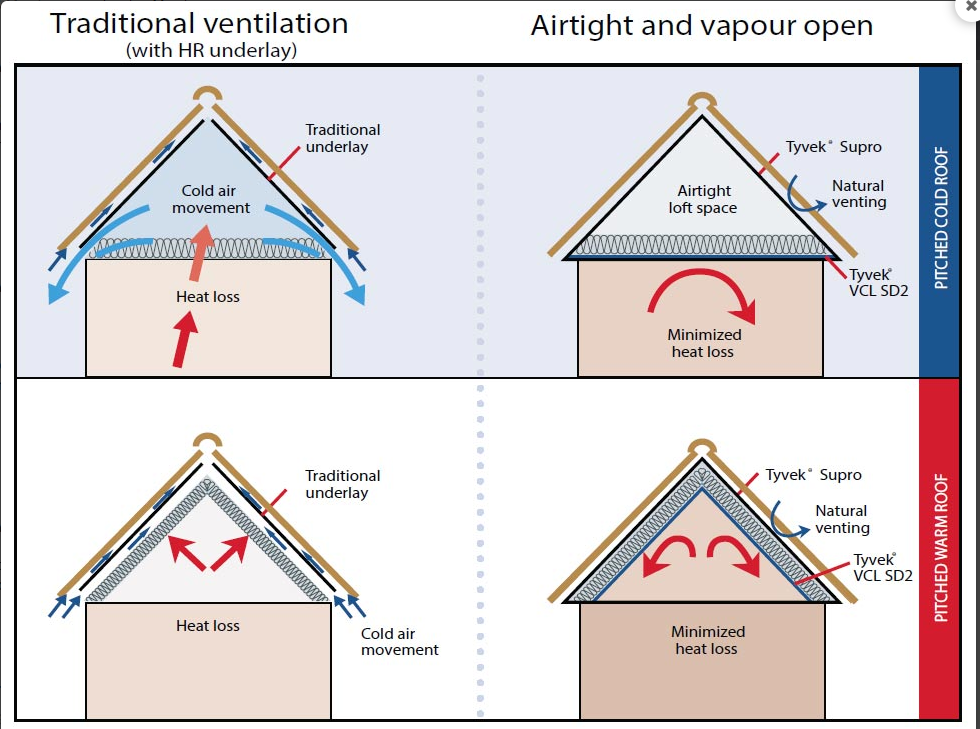
You're better off keeping the wind out of your cold loft. Breathable membrane taped at all joints. Batten and counterbatten and ventilate above the membrane. Attached are diagrams from proclima and tyvek and a greenbuildingstore video that from 3:30 discusses Thermal Bypass. Pro Clima
-
Not enough glue in 22mm Egger Chipboard installation?
Iceverge replied to Adsibob's topic in Floor Structures
A little bit of a long video but Robin makes a nice job of this. https://youtu.be/YB78HiD3mlI -
Thumbs up for cavity with diligence and oversight. Otherwise timber frame. MBC is the most sorted package I've seen in this regard. Not the cheapest mind you. About €35k more for our house.
-
You should insist on it. If you have counter battens everywhere you can omit ventilation through your cold roof section, breathable membrane dependant of course, and ventilate above. This will make your cold roof perform properly as the wind won't be blowing through the insulation and there'll be a saving on soffit vents etc. Venting an attic below the membrane is poor practice thermally and a hangover from days of yore . I like battening and counterbattening in a practical sense in that the batten running parallel to the rafters pinches the membrane fully making it much less likely to tear. The counter battens then make a nice ladder to climb the roof within sticking your boot through the membrane.
-
To protect from the worst of the summer overheating a good rule of thumb is to extend the overhang by 1 ( units unimportant) for every 2 it is above the bottom of the window. For instance if the overhang is 2m above the bottom of the windows you should overhang by 1m. It seems like a lot but a nice overhang is excellent all year round. You can stand outside the patio door with a cuppa in the drizzle. See out into the garden in the rain as it won't be drizzling down the windows. Kick off your dirty boots in the dry without messing up the house. Still enjoy the winter as the sun's rays will be much lower.
-
MVHR Location Dilemma
Iceverge replied to Ryan Bazeley's topic in Mechanical Ventilation with Heat Recovery (MVHR)
+ 1 to the comments above. I would keep the unit itself away from the bedrooms. They do make noise. If you have to have it there I would consider hanging it with steel wires so it's suspended. Very good for decoupling. -
I cut down some 50mm GRP grating from ebay, then added some insulation in the holes. It supports our sliders and doors across the cavity. It was cheap and worked fine. I did some calculations and reckoned it had a thermal conductivity of about 0.065 W/mK with the added insulation.
-
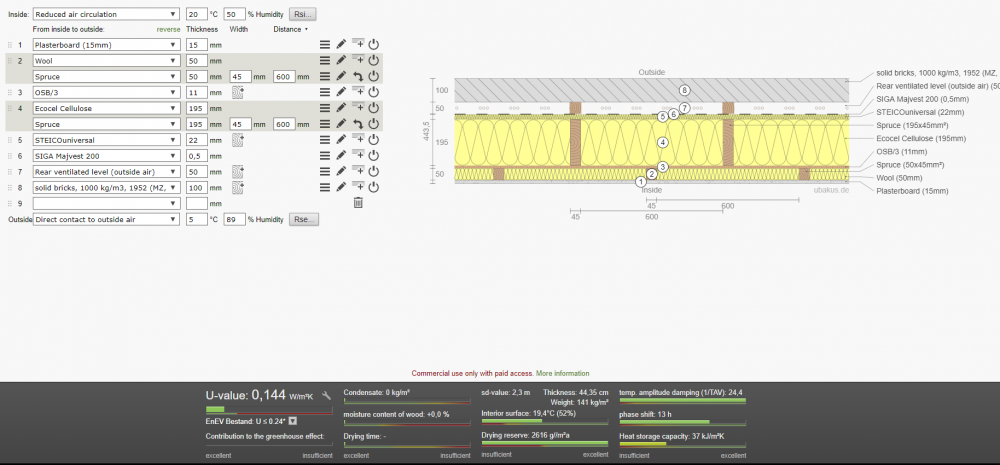
It sounds like you've a very good handle on things. Cavity wall is no doubt the cheapest method and probably the thinnest wall assuming you've excluded the possibility of brick slips. However it's very workmanship dependant. For instance I spent ages with a long stick cleaning mortar off the cavity ties after the bricklayer was gone and then using a home made thin brush and scoop cleaning the bottom of the cavity also. Probably 3 days of work and very skinned knuckles. I was paranoid about the airtightness and put about 200 man hours into it. You couldn't pay someone to spend ages chasing every tiny pinhole leak. If i was to do it all again I'd build timber frame. In your situation how about the below. Plenty timber framers this side of the water doing it. Don't know about the UK. You could even stick-build on site. Robust taped OSB layer for airtightness. Fully breathable. excellent decrement delay. Woodfiber layer deals well with thermal bridging. Not the cheapest option but far more likely to perform as well in reality as it does on paper.
-
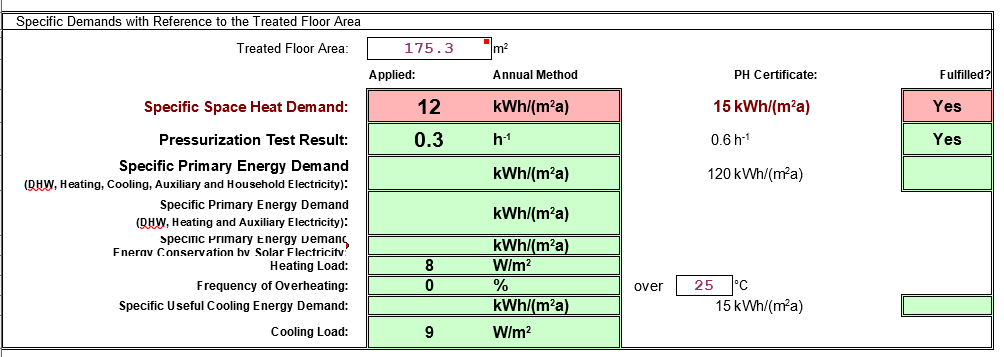
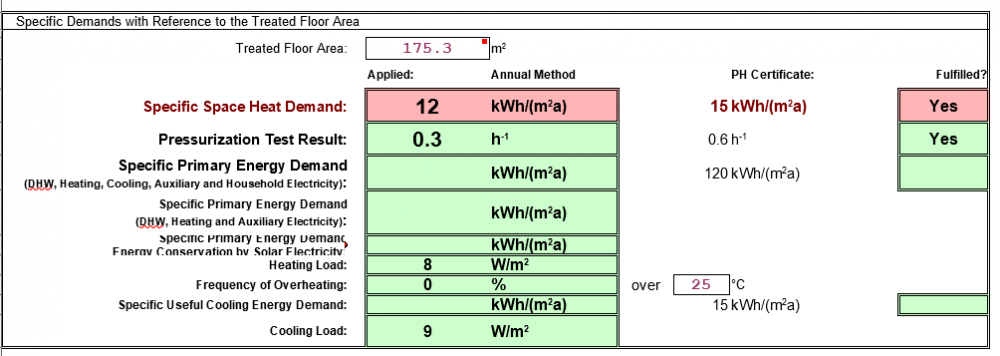
I agree, many people live in houses hundreds of years old. Payback is oft too taken for only the period of first owner occupation. There is a practical limit somewhere. Our ground floor walls are over 600mm thick, I think someone would have had me committed if i wanted even more insulation! As we don't have any central heating I didn't want to take too many chances with missing our performance targets. I allowed for 1 ACH in PHPP and still meet the ability of a post heater in the MVHR to supply heat to the house. As it ended up I think our heating demand should be something like this. This winter will tell how it really performs.
-
What I did was decide on a projected cost of heating ( direct electric in my case, €0.10) and then look for a break even period with the insulation, in our case 25 years. I chose 25 years as it seemed to tie in pretty well with achieving passivhaus targets. Much less would suggest just building to Bregs. To take an example I began by plugging the backstop building regs floor U Value of 0.21W/m2K ( in Ireland) into PHPP. This equated to 150mm EPS at a cost of €1250 euro. To increase to the next step up in insulation was 200mm EPS at a price €415. It reduced our annual heat demand by 175kWh or €17.50 or in other words itwould pay itself back in 23.7 years. ( I didn't take into account the increased cost of credit as the money was likely to be spent elsewhere anyway if the builder didn't get it!) Clearly increasing the insulation in our case to the next step 250mm wouldn't pay back in less than 25 years. I repeated the process for the walls and roof. This allowed me to arrive at a ratio of where money was best spent with regard to insulation in terms of thickness. We ended up at 200mm Graphite EPS in the floor 250mm EPS bonded bead in the walls and 400mm blown cellulose in the roof. Had we dropped to 200mm cavity wall insulation we would have needed 300mm floor insulation and 600mm attic insulation. It would have cost about €2800 more in insulation. Having 2 imperfect airtight layers is a recipe for disappointment. IMO success can only be had by employing very good professionals or else building in a fashion that allows your airtight layer to be remedied before being hidden in the structure of the building. I like the idea of an airtightness layer away from the following trades but if it can't be tested and fixed you're goosed!
-
If it's underneath groundfloor joists I assume it's ventilated. Insulation is pointless if you need to keep an airflow going to stop your joists rotting out. Even insulating between the joists you need to be careful not to block any airpaths through here. I'd put an inspection hatch in the plasterboard or the floor above. Insulate the floor and forget about it like @ProDave says. Potentially you could just use it to store things you wouldn't mind being a bit damp, spare tiles, pots of paint, wedding presents, small children........
-
Your build sounds similar to @joe90 I think he used wet plaster internally. I'd avoid using aerated concrete if I could. They only reduce your U value by 0.05 W/m2K, they're twice the price and difficult to fix to and prone to cracking. I'm sure @tonyshouse can elaborate more. You could get the same benefit from making your cavity 5mm wider. Also what cavity ties are you using? Basalt are the best but very expensive. We just used SS ones and widened the cavity to 250mm. This gave us some breathing space if we didn't hit airtightness targets and were able to cut down on attic insulation later on when we did. ( This was the theory at least, I still put 400mm cellulose up there out of stubbornness!) We used dense concrete blocks throughout, wet plaster internally and skim. 0.31 ACH50 so if done properly there's no issue with that method. It would need to be a paint on one as any membrane would require sealing around every cavity tie. The airtight layer is also in the wrong place to allow for any test before completion using a DIY fan or otherwise. This is the only reason we were able to get such a tight house. If you have non passivhaus builders they can't and won't reach a good airtightness result. It's very expensive. Good for junctions though. Why is this? The only alternative solution I thought of when doing ours was to inject closed cell foam into the cavity. It was almost 5 times dearer than bonded EPS bead though.
-
What products do you think will be banned/worth avoiding using?
Iceverge replied to CalvinHobbes's topic in Ireland
Portland cement concrete. Too much CO2. Steel and concrete and petrochemicals to be displaced by organic materials, timber woodfiber, hemp etc . Buildings have excellent potential as long term carbon stores. Light polluting and noise polluting electrical devices. Every bloody appliance in our new house insists on beeping once it's finished and some even keep going until you've attended them. I'm looking at you zanussi dryer grrrrrr The quantity of 24/7 LEDs on smoke alarms, washing machines, TVs stereos, dishwashers, ovens, fridges form a mini consultation worthy of a skychart. Wet trades will gradually diminish as the skill base dries up (pun not intended!). It's generally heavy dirty work and hard on bodies. It's also difficult to dismantle for recycling. -
Ideas for a large corner window
Iceverge replied to Blynchy's topic in New House & Self Build Design
Not being an engineer, this seems difficult to solve within a reasonable budget. A 4.3m cantilever rigid enough over a frameless glass corner looks beyond the reach of ICF. A giant glutam or very beefy steel frame might work. Have you asked a SE? In reality you will probably end up with a steel prop in the corner. Beware if you install bifolds your kitchen living it will be very difficult to heat. They’re too drafty and you’re already on the back foot with the outside surface area vs floor area and the quantity of glazing. Your western elevation has many many windows. Have you had any look at overheating? Good luck -
Nice idea but unfortunately The heat pump would move far too much air far too quickly through your poly-carbonate box to allow for any noticeable gain in intake temperature. A 10kw heat pump can move up 5000m3 air per hour through the heat exchanger. Thats about equilivant to an average houses volume every 4 minutes. Now if you had an industrial glass house handy it might work. However in that case you'd be better off putting the house inside!
-
Welcome @Mr BlobbyYou could provision for a split air to air unit for cooling as an alternative to blinds. It's relatively cheap to and it sounds like you'll have an excess of solar also. Just a 16A spur and maybe a covered duct in the wall. Overheating is very much influenced by how you live in the house, how much you open windows, how breezy your location is etc. Hard to model this in PHPP.
-
Increasing insulation is always cost effective but it depends over what time period. If you plan on moving house in the first 10 years its likely to never return your investment improving from BRegs. From playing with PHPP the floor was the slowest for me to return the investment. Passivhaus standard doesn't specify any construction details rather that the psi value at every junction be Or That the (total internal surface area heat loss+thermal bridges) is less than the (total external surface area heat loss) Our house isn't certified so maybe someone with more knowledge could help more. Internal insulation backed plasterboard is a common detail in Ireland on our new builds over the entire wall area. However is expensive, wasteful of materials, and very difficult to get a satisfactory airtightness result.
-
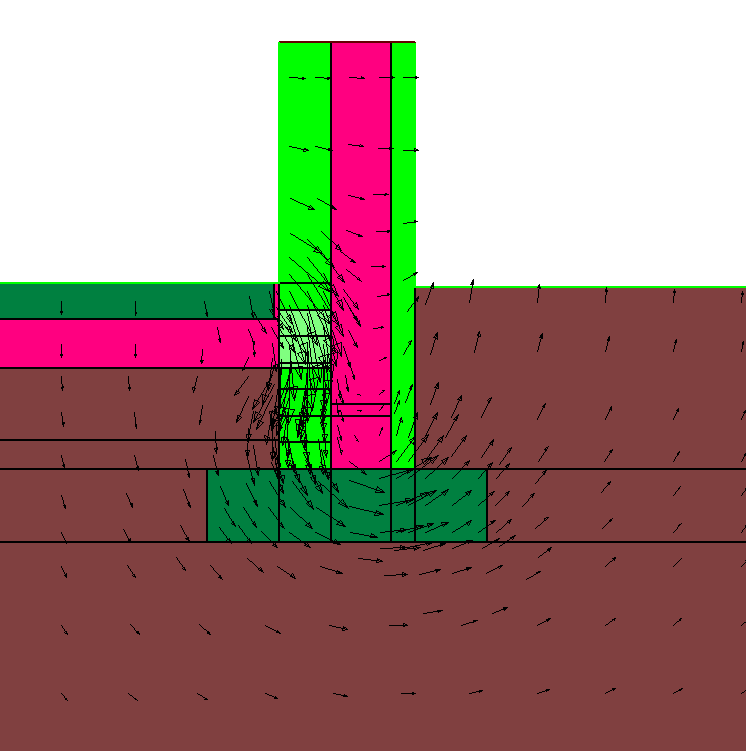
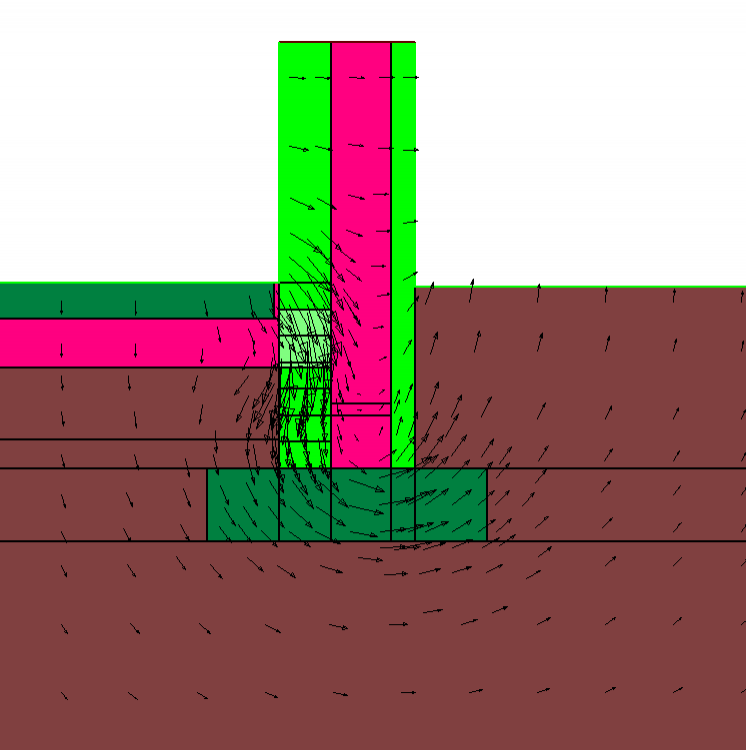
Our foundation detail. Note our insulation in the cavity extends a good distance below the floor level and this design mitigates the worst of the bridging on it's own. In a narrower cavity omitting the thermal blocks is likely to be more significant. You could add a thin layer of EPS below ground level outside the wall if you're concerned, or even top up your roof insulation to compensate. However the difference to the total heating load of the house is still likely to be in very low single digit percentages. It'll be completely negligible compared to airtightness and your choice of windows etc. On a non passive house you'll never notice.
-
I calculated this when I did ours and I came to the conclusion it was worth it. About 0.04(W/mK) improvement in the thermal bridge. For example on a 0 deg day with 50m perimeter it would be delta t 20deg* 50m *0.04 about or 40w on our heating load. However our heating load is only about 1400w so it was a 3% improvement. Ours is constructed to passive standard. If we had built to the building regs it would still be 40w but only about 0.07% improvement or 7 parts per 1000 improvement. Practically nothing. We used a PIR upstand. No issues. We wet plastered inside (20mm) and have a 20mm skirting board so any more than a 40mm perimeter strip would have been an issue for carpets or exposed concrete. Tiles or timber no issue.
-
7 ballast 5 sand 1 cement
-
Sounds like you have a handle on it. PM me for a cheaper alternative to intello and their tapes etc if you like. poujoulat flue?
-
You can't without knowing the starting conditions and the heating load of your house. Ideally you want a large mass heated just above the temp of the room for long slow release. High temp difference= fast heat transfer (think old fashioned radiators) Low temp difference= slow heat transfer. However you're stuck with the slab you have it sounds like. You can improve its heat storage capacity by using an anhydritec screed (about 25%) or installing UFH pipes in your concrete walls too like on the continent. There after you'll need to minimise you heating load. The "good-airtightness" sounds like a bit of an afterthought. What are your targets? Also the stove will loose energy hand over fist whilst it's not in use. Do you need it? In practice at this stage I'd plumb to allow a heat pump and bin the stove. Probably not much of a cost difference and will ensure a warm house.
-
Can you post your calculations please. I reckon 150mm of EPS will be a u value of 0.21. Regs in Ireland require 0.16 for UFH. 200mm EPS, or 150mm PIR. If you upgraded to kooltherm you could get away with 110mm. And 65mm screed. I think reading the above height limitations you're stuck with this .