Iceverge
-
Posts
4487 -
Joined
-
Last visited
-
Days Won
32
Everything posted by Iceverge
-
Is this a demolish and rebuild scenario? There is too many moisture barriers. One "barrier" ( think plastic sheet) max in any buildup. Everything needs to be breathable ( think goretex jacket). Otherwise the wall will not be able to dry and stay damp and rot. No moisture barriers normally on internal walls typically. The ply Vs OSB has its protractors/detractors arguements. Good quality OSB for me every time. I like Smartyply. One factor I would be cautious of is using lightweight insulations like glasswool and foam considering you have no masonry externally leaf. It would be similar to a caravan in the summer regards overheating due to poor decrement delay/phase shift. This is the the time it takes for the initially daily blast of external summer heat to soak though the wall/roof. Two buildings will perform drastically differently in summer even if they have the same U values. The caravan and stone outhouse are the dramatic examples. The stone building remains comfortable but the caravan overheats in summer although in winter they take the same amount of energy to keep warm. Have a play with Ubakus.com. it's great for this.
-
Installed MEV in my parents house in the upstair landing. Just extracting from one location. No measurements taken but it has reduced dampness and mould in the whole house . The house is very leaky. I figured it was the same as PIV in reverse but at least it wasn't dumping a single column it cold air on everyone and was giving the moist air a controlled path to outside rather then being pushed through the building fabric. So long as room doors get opened semi regularly I think it isn't too much of an issue not ducting every room.
-
@Nick Laslett Exactly the same. 13m sweeping bends of 10mm. 5-6l/m Vs 8l/m for 15mm. About 1l/m loss of this was throttling by the Flexi tails/tap. Hot water in 8-9 seconds. 2 seconds of this are emptying out the water held in the tap.
-
I cut a sheet of 18mm OSB to the sash size of one of our windows and fitted a pair of radiator fans from a Lexus is200. Then used a length of cable to connect it to the car battery with crocodile clips. Back of the hand for big leaks. A candle rammed in a length of stiff electrical conduit for the small leaks. I tried Joss sticks and a bee smoker too early on but they were various combinations of smelly and suffocating!
-
https://www.donedeal.ie/tools-for-sale/mitsubishi-air-to-water-heat-pumps-puhz-w50vha-bs/31698623
-
You're lightly looking at less than 1m2 of a gain in floor area for a whole lot of trouble. Something like stacking the dryer on top of the dishwasher or bolting a TV to the wall and removing the TV table would gain as much floor space for almost no cost.
-
There's some new Mitsubishi ASHPs on donedeal at the moment for €1700. If you DIY install you're looking at less than a 2 year payback. Plumbers in Ireland are taking the proverbial with their prices. It was €7-10k extra for an ASHP for us plus fitting. I couldn't stomach the gouging. If you're any way handy the Hep2O plumbing system is childsplay. Even on our passive house payback would be less than 3 years. Not the 25+ it would have taken had we paid the plumbers.
-
Looks fine. It has "good UV resistance" like the SP510. couldn't find any UV data about @Radian suggestion of everflex 195. The workability of sealants varies massively. Maybe buy one of each to see what is easiest to apply and report back.
-
White window, - white sealant, no problem. just mask off the area as you would if over painting a window. This is silicone free and designed for the job. This is a good video for the same technique. I would wipe with an alcohol wipe or similar solvent first and use @Nickfromwales baby wipes instead of paper wipes.

-
Reduced risk there. It wouldn't fit in the air fryer.....
-
 Any chance of a quick sketch? A thousand words and all that.....
 -
I think the SE has made as tidy a job as possible without simplifying the roof design. It won't be cheap but probably the most economical effort given the design. There's too many roof surfaces to make sips or even trusses cost effective. I count 18 separate planes. With a few pen strokes you could easily get down to 10. I think I had redrawn this sometime in Feb to a more buildable design. I'll have a poke on my laptop if you like when I get home .
-
Caravan leisure battery lifestyle. No light switch left unflicked!
-
Also welcome welcome 😄
-
Listen very carefully, I shall say this only once. BULLDOZE YOUR EXISTING BUILDING AND BUILD AN UNCOMPROMISED REPLACEMENT PASSIVEHOUSE.
-
Welcome welcome. You sound fairly adept. Nothing in building is as complex as mechanicing a car however the project's scale and the breath of ways to skin the cat are daunting. If you are planning on doing the work yourself I'd start small. Literally build a model of your idea. Even a crude one will take absolutely ages and you'll realise how poorly planned out it was to begin with. It seems trivial but it really replicates an actual house build. Very different from modelling on a company or drawing one.
-
On a slightly more sadistic note keeping energy prices as high as could be stomached without public unrest would certainly reduce usage. People would find a way to cope, no think tanks or fancy policy needed. Large uninsulated houses would become unsellable apart from plot value. To continue the flogging, power rationing would change behaviour. Allocate a certain daily or hourly amount of MWh to each segment of the electricity grid based on historical usage. Then unashamedly turn off the power when the limit was reached. Gradually reduce the limit over time or adapt it to daily wind/solar output. You could give a single 2 second power cut at 75% of the limit. A 5 second one at 90% and a 10 second one at 97%. Chop the power completely at 100% and make everyone go to bed. Within a few days people would have altered their behaviour. A slightly more nuanced version might have a smartphone app with an alert but I prefer the drama and suspense of the first method. On the supply side I think isolationism/energy independence isn't a solution. Pulling up the drawbridge leaves a country in a vulnerable position, especially with so much dependence on variable wind and solar. Opening more doors to buy and sell power is far more secure. Interconnectors, pipelines, oil and gas terminals. Gas and oil storage. Even Coal stockpiles would give far more options to keep the lights on rather than going "off grid" as a country and hoping the weather worked out ok and everyone discovered a shale well in the backyard. It is filthy though.
-
It could.
-
Ball park guess looking at your house you'll use 6000 MWh of heating per year plus 4500kWh of DHW. Realistically solar@4kWp might give 3000kWh towards DHW mostly. 7500kWh left to make up. Electricity will probably be about 20c per unit so €1500. An ASHP at €4k to reduce your bill to €500 looks like a 4 year payback if you can self install. In fact forgoing the solar and paying for an ASHP makes more sense financially at least. Even with airtight+ super insulated houses cheap Willis only heating really depends on a good form facto( a 2-3 story box). Few + small windows (the window + window/wall junctions are poor thermally) and a small floor area.
-
Allow anyone to knock and rebuild a house without planning provided it would fit into the same "box". No planning limits on solar panels. No planning limits on external insulation/triple glazing/external blinds. No Aircon without solar PV. V5 style deed of transfer and government house "MOT" to allow peeps to sell their old icebox house simply. Encapsulate entire uninsulated streets in a giant polytunnel.
-
I'd use 300mm EPS rather than PIR. It's cheaper and would save you some hardcore. Typically 150mm doesn't need reinforcement. 100mm concrete with reinforcing fibers is usual for mass house builders around here with no screed. Just some SLC if needed for vinyl flooring afterwards.
-
Welcome to the forum. Masonry build here. TF with pumped cellulose would be my preference time over again. MBC is the best detailed system I know of, not the cheapest though. Looking at Scandi-Hus they use Actis Hybrid and 100mm floor insulation. Probably the best Vs the worst TF specs I've seen. PS. If you stick up some plans you'll get a world of knowledge and experience if you want it. I wish we had.
- 17 replies
-
- 1
-

-
- scandia-hus
- mbc
- (and 1 more)
-
Building a Block Workshop - ADVICE NEEDED!
Iceverge replied to stunotch's topic in General Self Build & DIY Discussion
A sturdy metal rake is the top tool for concrete, forget shovelling. Wellies and gloves too, it's nasty on one's skin. I wouldn't worry about having it a bit wetter for what you're doing, it's not a skyscraper, the slight reduction in strength will be more than compensated by having it a bit more workable. Tamping it down with the rake will work fine to remove air at the scale you're at if you want to avoid a poker. However a couple of pieces of rebar are cheap and will make it infinitely stronger. Keep them about 50mm from the bottom of the trench, supported on chunks of brick/rubble. If you have it I'd be tempted to use lengths of rebar instead of timber pegs. You can just leave them in the concrete when you're done. The string will just get in the way I reckon. Here is my technique for one man concrete. Mates and concrete goes the same way everytime I've seen it. All first timers start really enthusiastic until about 10 minutes in. Then they start leaning on tools and grumbling about the heavyness of the work. Self scheduled breaks start appearing, totally unaware of the time limited nature of the job. The couple of seasoned concrete workers meanwhile be pushing on, steely eyed and sweating. Have a power washer setup if you have one. If not a couple of large tubs and stiff brushes. The job isn't finished until everything is cleaned down. Best of luck!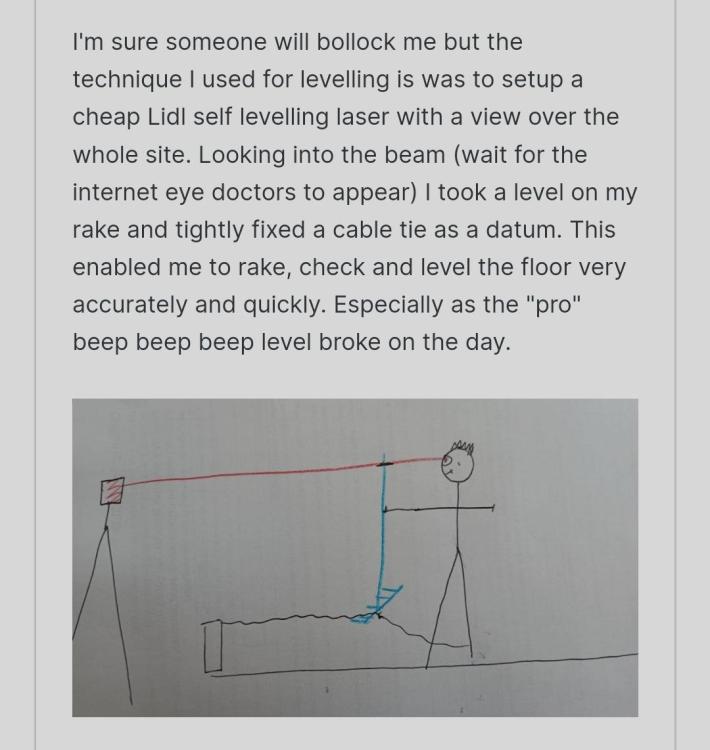
-
Partially threaded screws won't split the wood like fully threaded ones. Ask me how I know........
-
Twin Wall flashing for steep pitch...
Iceverge replied to Mulberry View's topic in Stoves, Fires & Fireplaces
I used a lead flashing for my parents house when I did this from "Just Lead" in Kent. The flashing was fine but DPD did loose the first one and by the time they returned it to sender it was mangled so I didn't get a refund. There's a few degrees of play in the lead slate so the 45deg one should be fine. This is the only pic I could find. We used a 220mm slate tile for a 150mm twinwall flue.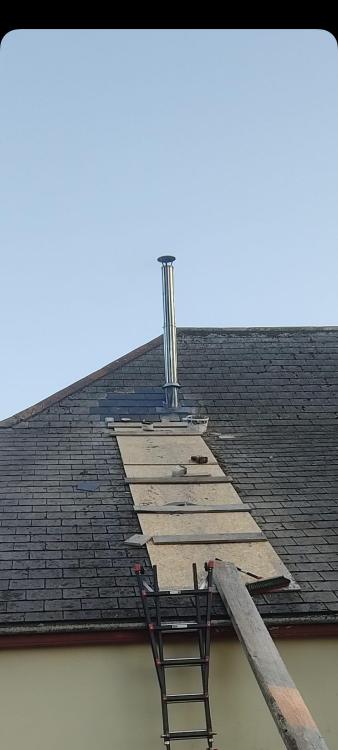
- 1 reply
-
- 1
-