Iceverge
-
Posts
4487 -
Joined
-
Last visited
-
Days Won
32
Everything posted by Iceverge
-

Your thoughts on this design?
Iceverge replied to Alan Ambrose's topic in New House & Self Build Design
Oak post and beam framing is expensive but it's lovely too. Money no object I think an oak framed structure, wrapped in a hempcrete exterior wall or a lightweight timber frame with straw infill or similar would be tops. I'm not a big fan of SIPs in this case that most companies use. Often they're self supporting andreduces the oak to just decoration which seems disingenuous. Similarly this building type can wear thick walls easily so no need for the thinness of sips. Something about the mass produced nature of sheets of OSB and polystyrene mixed with oak mortars and tennon joints etc just jars a bit. -
Vaulted roof insulation condensation risk?
Iceverge replied to LinearPancakes's topic in Heat Insulation
These are the limiting values for England I found in part L. Have I missed something?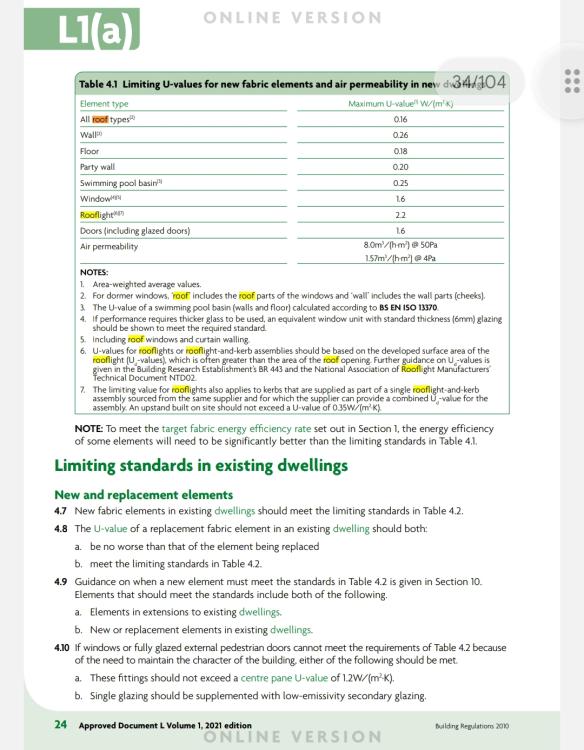
-
Vaulted roof insulation condensation risk?
Iceverge replied to LinearPancakes's topic in Heat Insulation
With the PIR there and a roof that breaths outwards there's much point in the variable permeability of Intello. It would come into its own if you had an impermeable layer outboard and the wall needed to dry inboard. Here's an example. https://passivehouseplus.ie/magazine/new-build/longford-self-build-goes-certified-passive-on-a-budget -
Groan... pity you didn't post earlier. An airtight membrane underneath the rafters and ventilation above the breather membrane with pumped insulation in between would have been simple in comparison. None the less we are where we are and a good solution can still be had I'm sure. Apply the breather membrane to the lower portion of the roof (over the PIR) and batten for tiles. Put one or two flat timbers longitudinally along the top of the rafter ties to hold up the insulation. On a dry day with roll out 350mm of rockwool over the top of the battens. Put some of these over the rafters to maintain ventilation . Working both sides concurrently apply membrane to the rafter bays as you go to protect the insulation from rain. You can roll it out one rafter at a time. Finally push up the remaining 100mm (or whatever is needed to fill the rafters) from below. Apply a vapour barrier /Airtightness layer below the 45mm pir and rockwool. Then 20mm batten to provide a service cavity and finally plasterboard.

-
MVHR Inlet - Outlet vent Placement
Iceverge replied to Parzival's topic in Mechanical Ventilation with Heat Recovery (MVHR)
Could you go out through the roof and avoid both issues? -
Self-build Garden Room (Garden Office) with PV Solar
Iceverge replied to Hermes's topic in Introduce Yourself
That's perfectly fine! Since when can't grown-ups have fun. -
You may find yourself trying to organise it from a camp bed in the cinema room, simpler now with a few strokes of a pen.
-
Been there, done the sums. Passive House with just electric rad heating and 300L direct UVC on immersion here. 100% of DHW on cheap night rate (14c/kWh) and about 40% of space heating on day rate (48c/kWh) For space heating a single A2A unit in central area for the bulk of space heating/cooling with electric resistive in the bathrooms to boost them is cheapest over a lifetime. UFH with a Willis heater using the slab as a storage heater for cheap night rate electricity isn't much more expensive like @TerryE. ASHP on UFH has very low running costs but is offset by the cost of installing first day and care is needed to get good COPs. Direct electric is expensive even with our modest heat demand of about 3MWh/annum. Planning on an a2a soon. ASHP not really worth it for DHW as the COP really drops off above 40deg and you need to have tremendous amounts of storage to heat only on night rate. PV with divert is the cheapest here I reckon. With 2 adults and 2 small kids we use 10kWh per day. A 300l cylinder at 70deg suffices easily for the full day as it stores about 14kWh. If you went for a 500l or left space for a 300l X 2 you would be well covered.
-
It depends..... If you are confident to oversee the passivhaus aspects of the build yourself then I wouldn't bother. If you are going to be more hands off it is probably the only standard I would put faith in. Building control, SAP and other surveys can be woefully inadequate as one of the ongoing threads here sadly found out. It will add cost though. Re the lift. I would put a dedicated bedroom with ensuite downstairs instead. It gives privacy from the main occupants for guests staying over. Unfortunately the inability to use the stairs can occur rather suddenly ( like when I fell off my push bike) and always in times when you have health struggles, long or short term. The hassle of fitting a lift or new ensuite is not something you need to be thinking about when in ill health. I listened to a heartbreaking documentary when a woman who had MS was having builders in while dealing with an awful illness. Do it day one if you can afford it.
-
Sounds like a warm loft. Tricky with a trussed roof. Is there an option there for an cut roof. Alternatively a hybrid/warm roof with taped OSB sarking above the trusses forming your airtight layer and more insulation above it.
-
I think upstairs washing machines are good so long as you have somewhere to dry clothes up there too and can isolate noise. Given that it is a house for staying in can you provision for a lift. It would be a shame to have to limit the use of the house in old age because you can't use the stairs. Either that or a downstairs bedroom. Something with a big house is the physical distance between rooms. Going to the kitchen from the bedroom for a glass of milk or from the car to the kitchen with groceries is a trek in huge houses. We really noticed the difference between our 60m2 rental cottage and the 185m2 new build. Given it's a big building with a good form factor I would definitely put it through PHPP as with some care with glazing and airtightness you'll be at passivhaus levels or better. It'll really highlight any overheating issues too. Thinking about the tree, it'll need some water and sunlight I'd have thought. Have you looked at that?
-
It's a really vast building. I make the first floor alone about 200m2. Packaged well you could get the house done at 250m2. Have you looked at a budget for this yet? We had 3 set of planning permission. One because of land registration issues but the last change to scale the design to something affordable. It would have been much easier to start with the dosh and make the house fit first time. I think the stairs needs reworking. Maybe circle it around the tree. That would be lush! Mentioned already but office is a bit pokey and given you have such access to scenery, a desk with a view would be nice. There's 3 bathrooms in close proximity to each other in the SE corner. You could move the door of the master bedroom and use the shower room as the ensuite and make the dressing room larger. The laundry room will have a washing machine backing onto a bedroom wall. This might be a noise nuisance. I'd sandwich it between the bathroom and the shower room. Thinking about natural lighting I read on another forum that natural light in the Northern hemisphere penetrates about 4m from the South and 3m from the North. I drew our house with this in mind and it seems to work well. What drawing program are you using? Does it offer the option to draw in mm and metres? It's a mind boggling experience to begin with but will be worth it long term as you'll be au fait with the nomenclature of construction (Unless you're in the States). Keep at it, it's an interesting project.
-
Low energy retrofit - Architect cost
Iceverge replied to anonymous's topic in Surveyors & Architects
Passive house planning programme. Software to design a passive house. -
Your thoughts on this design?
Iceverge replied to Alan Ambrose's topic in New House & Self Build Design
Good stuff. It's a fun part of the project this stage. You're right, there is a lot of glazing. You've touched on the overheating, SW might be your issue here. Keep an eye on energy use too. The best window once installed is 4 times worse (1.0W/m²K)than an average wall. (0.25) I would have a look at this before planning application as it's trickier to change later. Similarly the oak post. It's a beautiful end result but quite specialised and not cheap. You may be better consulting a dedicated company for consultation at this stage to make sure you are not planning something that cannot be built or cannot be afforded . 2 nice projects here. https://passivehouseplus.co.uk/magazine/new-build/kildare-passive-house-uses-unique-oak-frame-construction https://passivehouseplus.co.uk/magazine/new-build/heart-of-oak -
Low energy retrofit - Architect cost
Iceverge replied to anonymous's topic in Surveyors & Architects
I would get them to define what they mean by passivhaus ethos? Architects often specialise in asthetics, functionality, planning approval and the useability of a building. Not so much in the fabric quite often. If you are not too concerned with altering the house layout I would get a passivhaus consultant to do a PHPP of the building as is and also a suggested upgrade plan. Like Dave says enerphit is the natural target. -
Not officially recommended. However if you have a calipers and can verify that they are the correct diameter and the inserts fit then I would go right ahead. More professional advice will be along shortly....
-
MVHR insulated ductwork throughout??
Iceverge replied to matt-me's topic in Mechanical Ventilation with Heat Recovery (MVHR)
There's not really any benefit to the insulation in this situation. Time might be better spent ensuring that the joint between the sips is airtight and insulated or making sure the inlet and exhaust ducts from the MVHR units are insulated. -
300mm of EPS @0.038 will be about the same as about 180mm of PIR but about £2444 cheaper than 2x90mm Celotex boards from the same supplier.

-
Pro Blocks: House insurance is cheaper. Easier to fix washing lines, satellite dishes to etc. Can use sand/cement render with coloured sand which is/was 40% the price or acrylic/silicon when I checked. Plenty of sand and cement here since 1950 and going strong. Blocks are cheap. 68c+Vat is the cheapest I can find in Cork at the moment. Thick walls for asthetics. Person dependant that one. Easy to find experienced workers and materials. More soundproofing from outside. Better for fire from an outside boiler/carfire. It's a well known method. Very robust Vs ball games etc Cons Blocks Mica in the NE?? (Is it still a thing?) Takes slightly more time than boards. Needs foundation. Mortar bridging the cavity. Sand and cement can be done badly. Messy. Window thermal detailing needs care. Pro Boards. Much thinner wall. ~110mm less than blocks. More internal space. Fast. No lintels needed. Less mess. Less chance of mortar bridging the cavity. Can be done by carpenters but ensure they follow MIs to the letter. @Bitpipe had some issues I think. No painting. Con boards. Silicone/acrylic can go wrong too. Look at @ProDaves blog. Expensive materials and render. May be a special order item = not easy to pick some up from a local hardware shop if you run short. Some renders get mouldy/fungus/algee covered.
-
Insulated Concrete Slab Garden Office - Questions
Iceverge replied to Ticky's topic in Garages & Workshops
The norm is to keep any sole plate at least 150mm above the ground to prevent any splashback damage. The OSB will be a structural component of the building too and longterm fairs even worse than timber when exposed to wet. I wouldn't have them that close to the ground. For the roof you could do a 100mm insulated panel at 5⁰ slope. Even with a 150mm floor that would give you 2m head height at the low side. To drop the floor any further I would have a very robust perimeter drain and a blockwork cavity outside the timber. -
MVHR insulated ductwork throughout??
Iceverge replied to matt-me's topic in Mechanical Ventilation with Heat Recovery (MVHR)
From how I read it you have a SIP roof as the below pic shows? COLD LOFT WARM LOFT This means you have have a "WARM LOFT"?? In this case all the ducting will be inside the "thermal envelope" and even if you have no radiators up there and will be fine without insulation.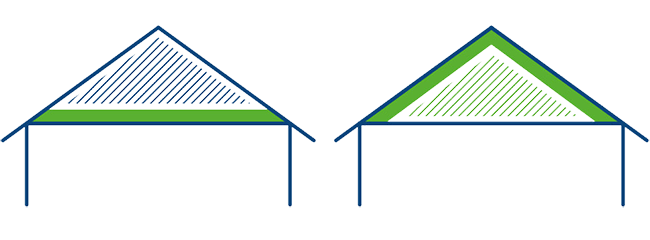
-
I was hazarding that the R/C would be inherently waterproof, keeping any fill dry and less lightly to expand/contract? I'm thinking farm prices maybe. I don't know for non agri projects. Ideally yes. Mind you it might only take 1mm of settlement to crack a tile at a threshold. That's a miniscule shrinkage over 900mm. Our builder put rebar from the floor slab into the walls at the thresholds of doors because he had had callbacks from sinking floors and cracking tiles.
-
If flooding is really a significantly risk I would be drawn towards shuttering and pouring a reinforced concrete perimeter wall. Especially if it's a simple shape. Much stronger than blockwork and no more expensive. Hollow core planks on top and a void underneath may be cheaper too depending on how much it costs to import hardcore. There is a risk of differential settlement of such a large mass of compacted stone if not done really well.
-
Cool house. I like the tree. Can you get some morning sunlight into the kitchen? The lounge is very much an evening room but will get the best morning light. I'd bin the step into the cinema room so you can use it as an accessible bedroom should the eventuality arrise.
-
DPC under stud wall on insulated slab foundation?
Iceverge replied to BotusBuild's topic in Timber Frame
I also wouldn't worry about it. In fact I'm against it. Putting in impermeable membranes "just because" is a bad plan. When building my garage, TF on blockwork, I put one DPC under one sole plate. It was saturated as the moisture was trapped in the gap between the timber and the DPC. Mostly from rain during construction mind you .On the rest I didn't bother and they got wet but dried super fast in comparison. You're not trapping water in there permanently. I didn't bother either for the few stud walls in the house we have and absolutely nothing went wrong. Timber never got wet.