Iceverge
-
Posts
4487 -
Joined
-
Last visited
-
Days Won
32
Everything posted by Iceverge
-
Welcome welcome. Any chance of a plan sketch of what you'd like. Maybe some photos too of the similar styles that take your fancy.
-

Insulated Concrete Slab Garden Office - Questions
Iceverge replied to Ticky's topic in Garages & Workshops
This might be easier to build. Note the 50mm insulation outside the concrete, the 50x100mm wall plate supporting 150mm studs to give a much better junction thermally. Something like EPS 100 should be fine for a garden room. I've thickened the slab 50mm at the edge for some strength but it's educated guesswork really. Some reinforcing mesh would make it much stronger too.
-
Stolen quote from a different thread. Doing the sums: Based on an installed cost of €6000 for an ASHP and UFH and €2000 for a WILLIS and UFH Our space heating of 2500kWh/annum (COP of 4 for the ASHP) DHW of 3200kWh ( COP of 2.5 for the ASHP) Day rate of 48c/kWH and Night rate of 14c/kWh then the total 7 year cost of €7831 for the ASHP and €7,666 for the Willis. Assuming zero maintenance for both. With double the space heating (5000kWh) the sums are €2k in the ASHP favour. Except for the cooling I don't think there's a case for ASHP in low heat demand houses. Maybe the transition from ASHP to Willis is a good marker for how passive is passive enough. Even with our current system of direct electric rads the 7 year cost is €8603. Swap out for a good A2A @ €2000 installed cost and the cost drops to €6,374. Any recommendations, for what brands? We have a fused spur in the bathroom + ensuite crying out for exploitation.
-
Your thoughts on this design?
Iceverge replied to Alan Ambrose's topic in New House & Self Build Design
I would say an experienced a oak timber framer would be worth a consultation before committing to a design. One of the projects I linked had £6000/m2 cost and that's pre 2020's inflation. Oak etc get proportionally much more expensive as it gets thicker and longer. It could easily save you a 5 figure sum to have some pre planning advice from someone in the know. -
A big HELLO and a questions about insulation
Iceverge replied to Otter's topic in Introduce Yourself
With that in mind I would propose the following. FLOOR: 50mm PIR to the floor ( or as much as possible) 2 x 11mm layers of OSB staggered, glued and screwed) WALLS: 75mm Cavity wall mineral wool slabs to external walls between 50mm X 50mm battens at 600 centres stood off the wall by 25mm spacers. Variable diffusion membrane to the inside like Siga Majrex 200 or Intello Plus. Taped very diligently to all penetrations, roof and floor and returned at least 300mm to all internal walls. It's important this has ZERO holes. All wires etc should be in the service cavity or taped completely airtight. 20mm service cavity with battens ( or resilient bars) at 90 deg to wall battens for service cavity. 12.5mm plasterboard CEILING: 75mm mineral wool batts placed across the rafters between battens to maintains 75mm ventilation above. 20mm service cavity as above. 2 x layers of 12.5mm plasterboard for noise. Obviously the suggested insulation values are only notional and more is always better. For ventilation a small MVHR unit like this would do the trick. As it's gym you probably wouldn't need any heating.



-
A big HELLO and a questions about insulation
Iceverge replied to Otter's topic in Introduce Yourself
From a structural and safety point of view you always need to consider the effects of moisture on a building. Firstly external moisture. This is easier to visualise. 1. Make sure the roof isn't leaking, valleys chimneys etc. 2. Make sure that gutters are all working and taking water away from the building. 3. Make sure no water is pooling by the external walls, correct sloping/french drains can solve this. 4. Make sure that the water table isn't trying to push water up through the floor, again a french drain is a great and cheap way to solve this. Secondly internal generated moisture. Tougher to see as it's largely water vapour from breathing/cooking/showering drying clothes etc. It stays as suspended tiny moisture droplets in the air and forms into water droplets when it gets cold. Much like steam from a kettle condensing on a single glazed window. This is a real problem in almost all houses as it is hard to see and it's poorly understood. The consequences , mould, rot, damp and smells are widely known however. The air can suspend a certain amount of water vapour particles per m3 depending on temperature. At 4 deg it can hold 6.4g of water vapour per m3 of air. This is the maximum and is called 100% relative humidity (RH). You will see this as fog outside. However if you bring that m3 of air inside the house and heat it up to 20 deg it can hold much more moisture, 17.3g/m3. Given that it only has the 6.4g, that means it is nowhere near it's capacity to hold water. It's absolute humidity ( 6.4/m3) is the same but its RH has dropped to 37%. This is why weirdly if you open the windows and doors briefly on a foggy day, let in 100%RH air, close the doors, allow the air to heat up it'll really aid the drying of the house as it can take on much more moisture. A similar thought experiment can be done in reverse. Take your kitchen RH 70% and 20deg. That is 12.2g/m3 in absolute humidity. Unfortunately you have a poorly insulated window where the surface temperature is 12deg. The air that touches this gets cooled and it's RH climbs to 100% at 14deg. This is called the dew point as it is where dew begins to form. As the temperature of the air beside the window continues to drop the water vapour has nowhere to go and condenses out of the air making droplets on the window making an area for mould and damp. Not a massive problem if the window is in a breezy area of the house where it can dry when the RH drops again but a real issue where air movement is limited like behind furniture etc. The solutions for this are four fold. First ensure you have proper ventilation. It needs to be forced and continuous. Trickle vents and hole in the wall vents do nothing in still weather and too much in windy weather. This will take the internal air and replace it with external air that can help keep the house dry more. This was the a job of the fireplace in ye olde houses and mechanical ventilation in new ones. Secondly, build your house in such a way that no internal surface gets cold enough to collect condensation. This is typically a surface temperature of 16 deg for most houses. It can be easily achieved in a solid walled building by just running the heating a lot. A better way is to add a continuous layer of insulation. Thirdly, you need to do your utmost to prevent any moist internal air from getting into the structure of the house via cracks, holes and incomplete construction. Thirdly, keep the damp air out of the structure of the house where it could condense. This is done with a good airtightness layer. Fourthly you need to ensure that any moisture that gets into your structure can dry out as quickly and painlessly as possible again. Vapour open construction is best. I hope that wasn't too much theory. TLDR Deal with bulk water from outside, it's easy to see and solve. Then deal with damp caused from inside via 1. Ventilation. 2. Continuous insulation 3. Airtightness 4. Vapour open construction. -
A big HELLO and a questions about insulation
Iceverge replied to Otter's topic in Introduce Yourself
Hi @Otter and welcome. The first mm of insulation is the most important. Can you afford to loose any head height from the floor? If you could loose as little as 50mm you could put down: 25mm PIR. 11mm OSB floating on top. 11mm OSB offset from the first. It wouldn't be the last word in heat loss of course but it would make the room much more comfortable and much better than nothing. For the walls. There's many takes on internal insulation. Badly done it can be a recipe for disaster with condensation and mold behind the insulation and frost damage on the existing structure as the insulation will keep the wall cold. If you go down this route you must ensure that the wall doesn't take on excessive external moisture from wind driven rain leaky gutters etc and also that moist air cannot get to the wall in the first place. Most of all though it must be able to dry out again if it does get wet. -
Thermal bridge of vertical metalwork
Iceverge replied to MattMiller's topic in House Extensions & Conservatories
I suppose there is situation where you could just put the Siga majrex /Intello plus etc membrane inside your current ceiling, ensure the RH in the house is low, let the roof slowly dry to the inside then pump something moisture resistant and permeable like EPS beads behind the membrane. I think it theoretically should work, again if you again have a totally sealed membrane, but I very much doubt anyone is going to offer you a warranty. I know funds are tight but is there any possibility of borrowing the money to do the job properly now? Even with interest payments it'll be cheaper than doing the job twice. I can't imagine a bank not being receptive to fixing a leaking roof as it's sheltering their money as much as yours if you're mortgaged. -
Thermal bridge of vertical metalwork
Iceverge replied to MattMiller's topic in House Extensions & Conservatories
With insulation in between the rafters the dew point will be much nearer the inside of the house in cold weather, the roof timbers will get damp and especially when they are almost completely surrounded by impermeable PIR they will stay wet. The DPM is really a mute point in the case above as the moisture comes from the house. How to build a moisture-safe flat roof | SIGA Have a scan of their hybird/compact roof here. It may give you options. I wouldn't do it without ensuring the workmanship was very good. The internal variable membrane needs to be done really well.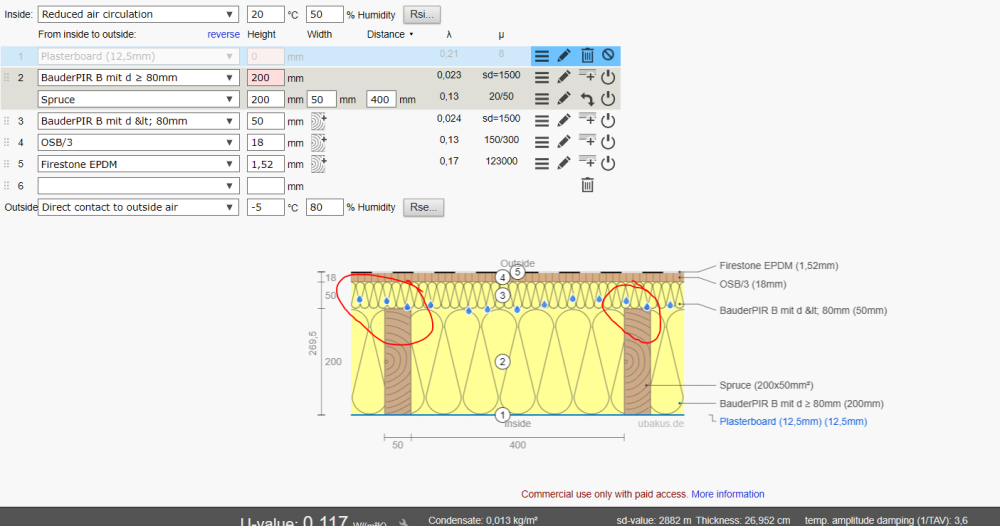
-
Thermal bridge of vertical metalwork
Iceverge replied to MattMiller's topic in House Extensions & Conservatories
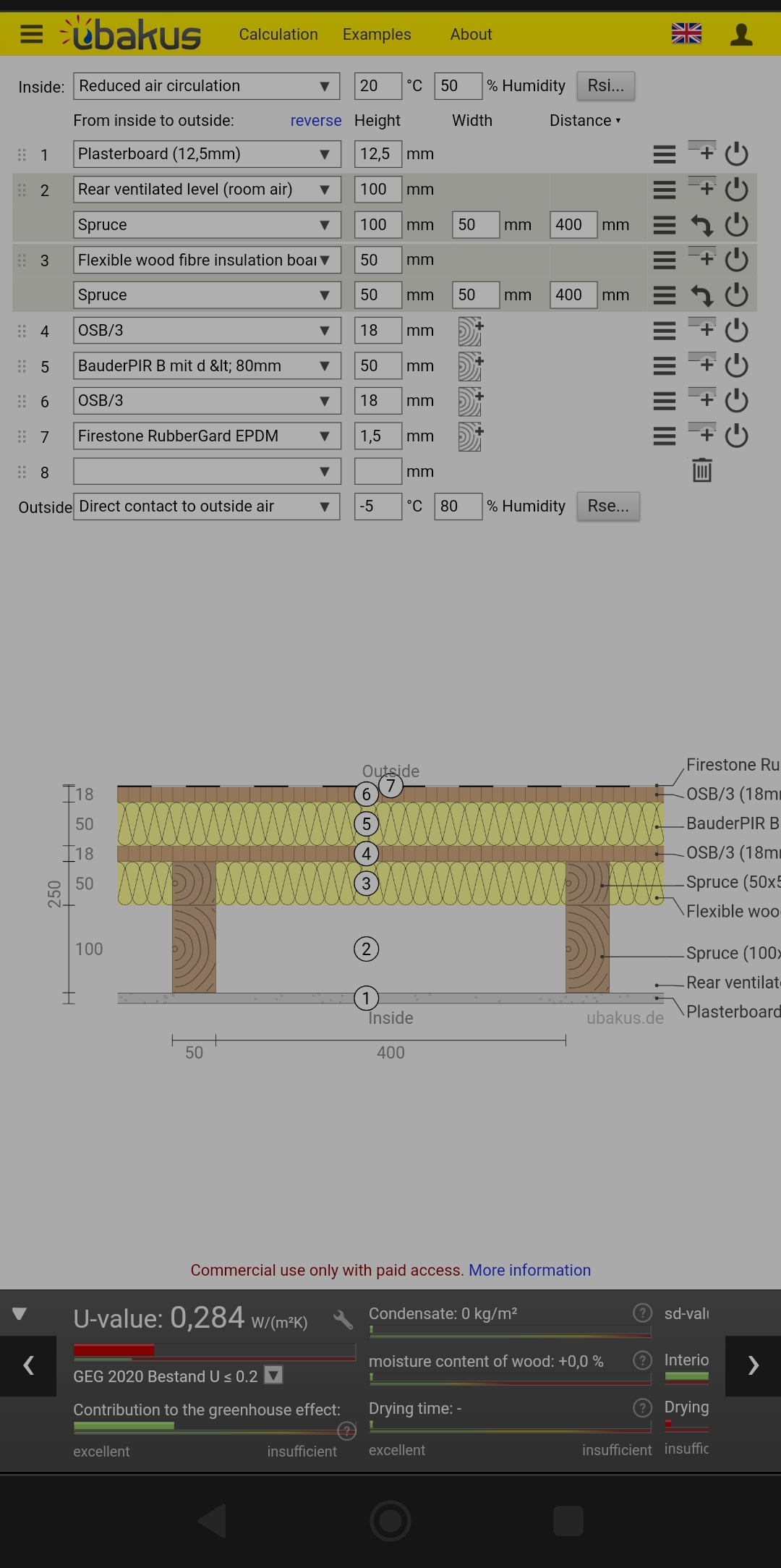
How about that if you can make it out. With a warm roof and such a thin layer for insulation you'll be at poor U value. That's why I think a metal panel might be better.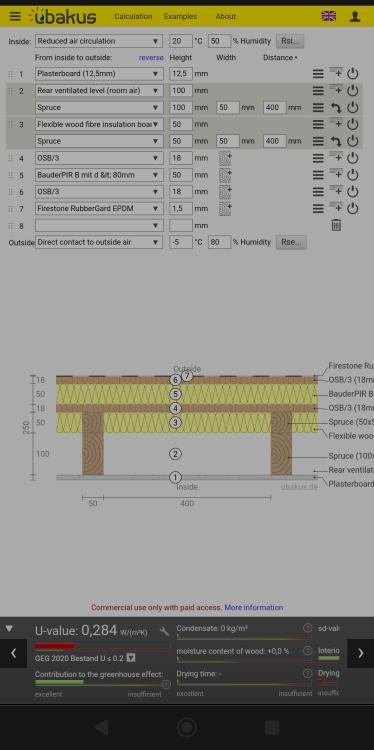
-
Thermal bridge of vertical metalwork
Iceverge replied to MattMiller's topic in House Extensions & Conservatories
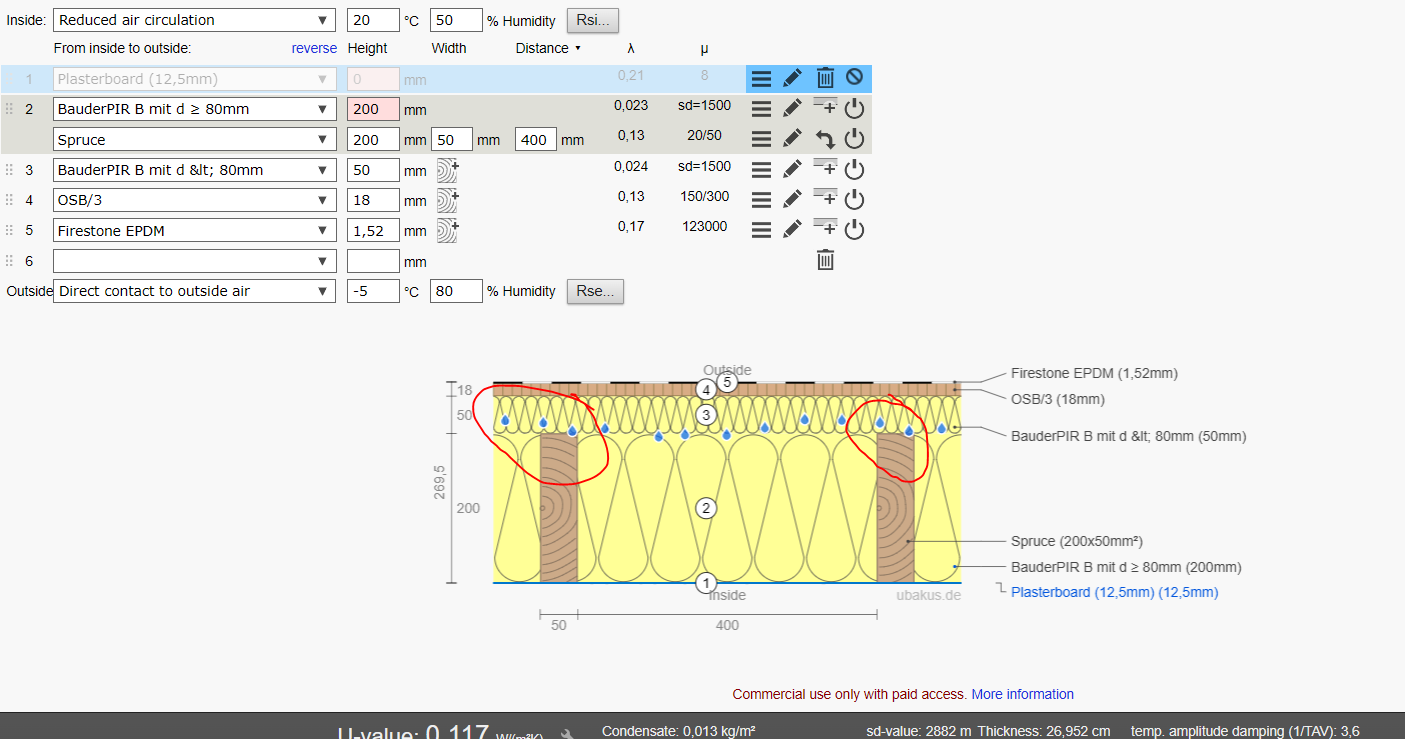
Mineral wool batts pushed up against the OSB. https://www.ubakus.de/en/r-value-calculator/index.php?is the one I play with. Have a look at that calculator, you may need to create an account but it's free and it'll give you a good feel for it. In principle if you had a 100% solid vapour barrier you could have all the insulation below the roof structure. The issue here however is that the roof will never be warm enough to dry if any vapour gets in there. That's why there's so many issues with hybrid and cold roof designs and people are much more comfortable with a fully warm roof. -
Concrete floor slab insulation above or below
Iceverge replied to karl293's topic in Floor Structures
Why not this but omit the screed and powerfloat the concrete? -
Why not a hall feed system?
Iceverge replied to Petrochemicals's topic in Mechanical Ventilation with Heat Recovery (MVHR)
https://forum.buildhub.org.uk/topic/23724-diy-mvhr-acoustic-silencer/#comment-366744 -
It's been a while but I seem to remember much more dilute that that. Safer to start weak 90:10 maybe and up the dosage from there. If it's just green algee a brush and a garden hose will shift it. Otherwise a cheap karcher or similar will get the job done.
-
Thermal bridge of vertical metalwork
Iceverge replied to MattMiller's topic in House Extensions & Conservatories
The safest method is the pure warm roof, with all the insulation above the Rafters. A hybrid option can be done with between and over. Roughly 50mm of PIR at 0.022w/m2K over the top and 50mm of batt insulation below the OSB would be ok. Play with Ubakus.com for ideas. Any more and you'll risk pushing the dew point too far outboard. This will mean that water vapour will condense in the roof and you're back in the same place. Making it a cold roof with insulation only below/between the rafters would work but I would want a bulletproof vapour membrane below the insulation and some really clear ventilation above it. This may eat too much into your head height. As a curved ball could you opt for pre insulated metal sheeting as it's not a long term solution. https://www.steelroofsheets.co.uk/products/kingspan-ks1000lp-lo-pitch-roof-panel/ 80mm panel foam jointed and max 80mm rockwool batt insulation below should be about a U value of 0.2W/m2K and small labour costs. -
Cheap(ish), fancy(ish) toilets - Toto, Vitra, Grohe
Iceverge replied to puntloos's topic in Bathrooms, Ensuites & Wetrooms
Buy an extra thermostatic shower bar mixer and plumb it in to the wall. A poo on every other non shataff equipped lol will be like a dirty protest in comparison. -
Insulated Concrete Slab Garden Office - Questions
Iceverge replied to Ticky's topic in Garages & Workshops
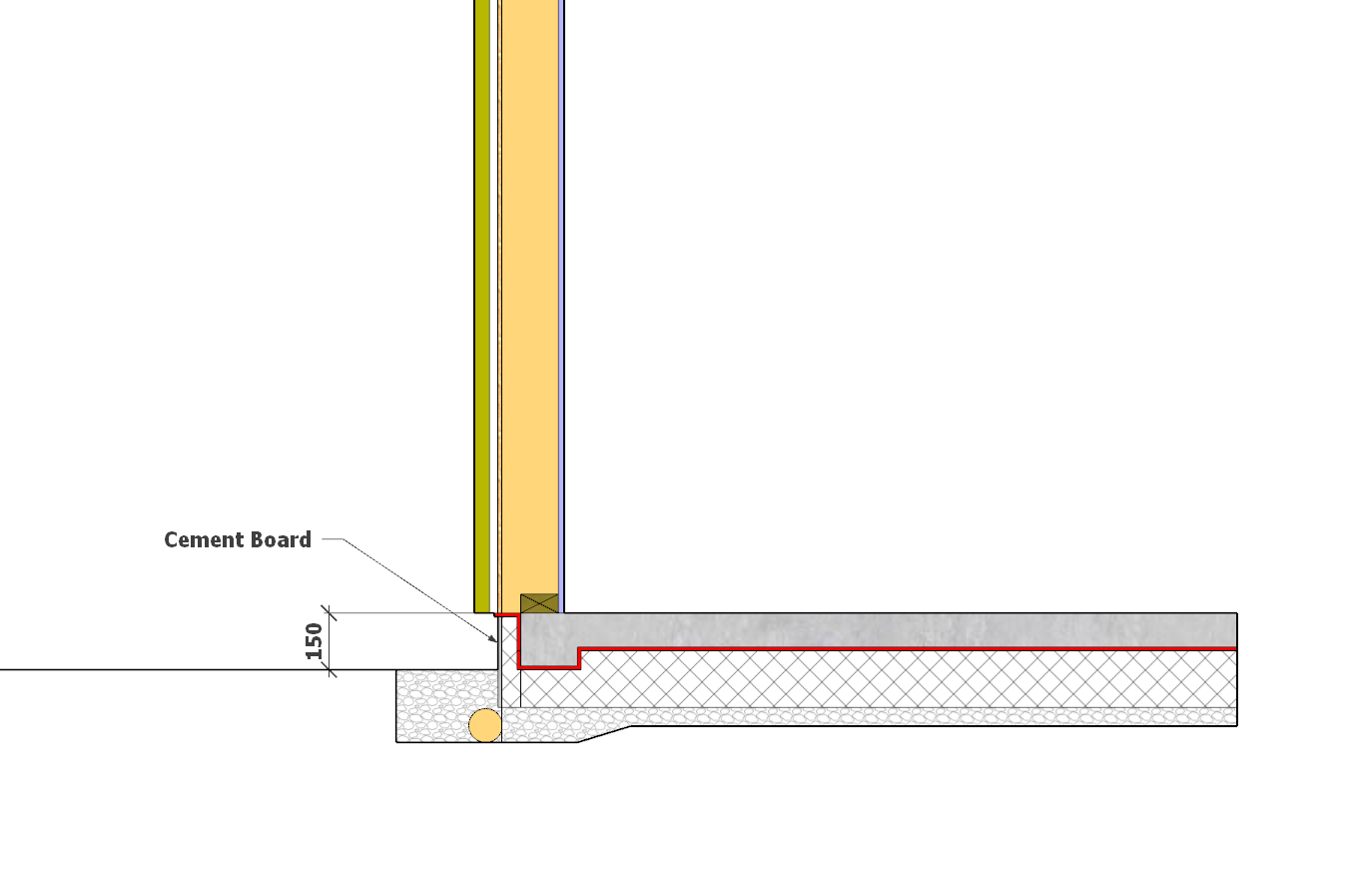
Something like this is what I'd look at if going below a floor level of 150mm. The door would still need to be above the DPM termination in my mind so you'd be stepping up to step down. I would tank the floor to the walls with a waterproofing kit and put in a drainage sump for when the floor floods too.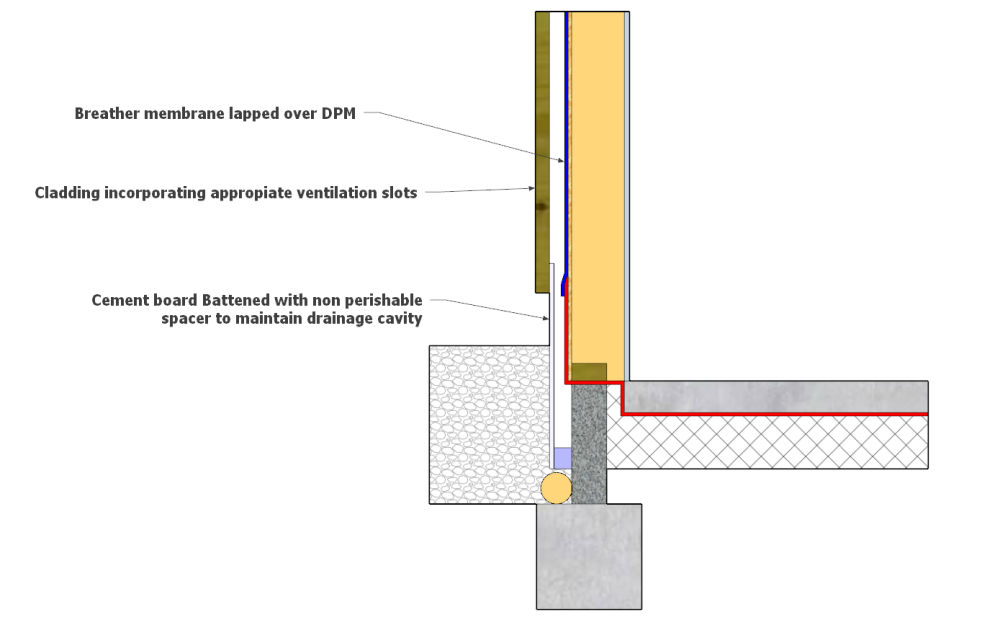
-
Insulated Concrete Slab Garden Office - Questions
Iceverge replied to Ticky's topic in Garages & Workshops
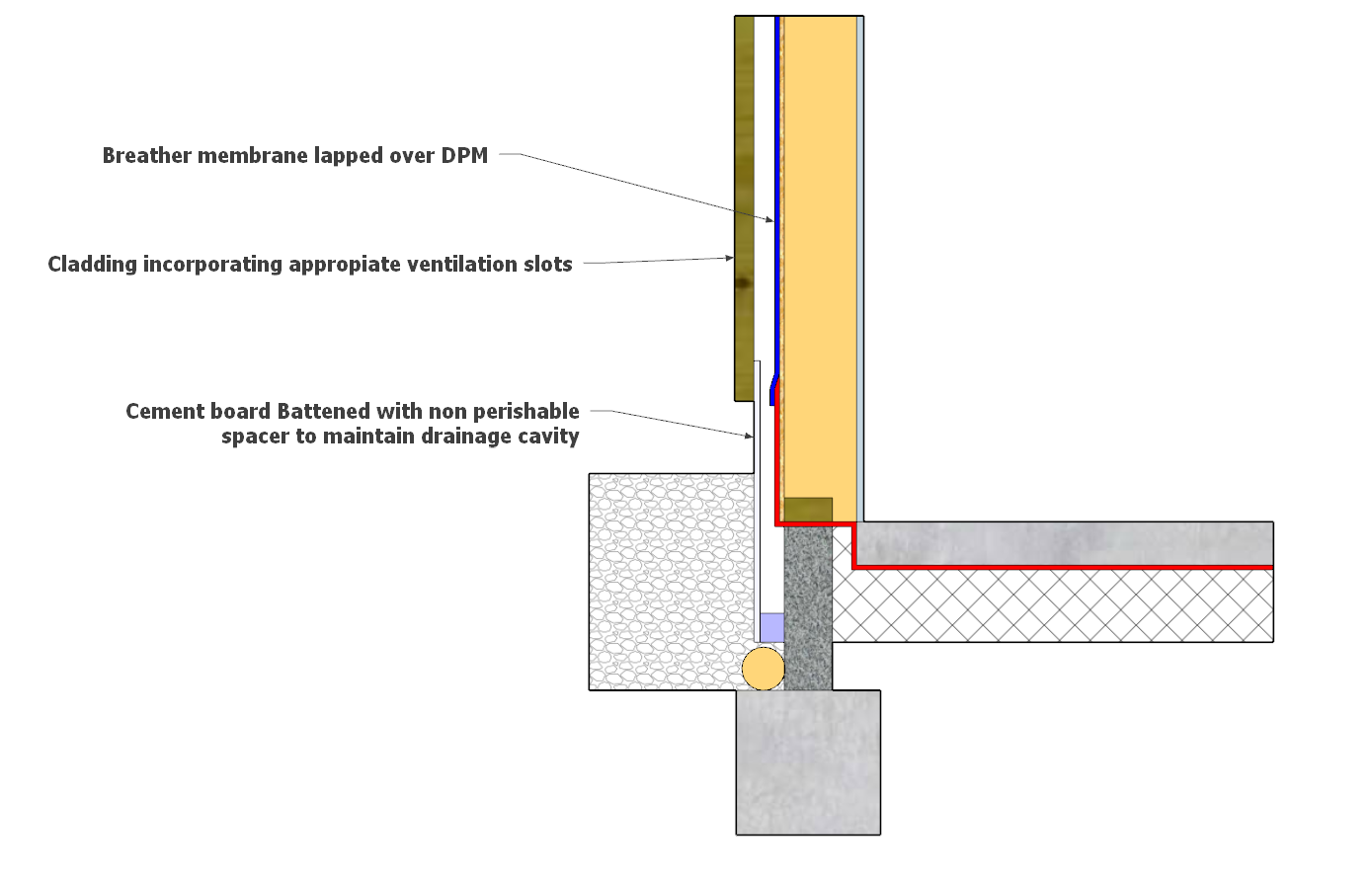
Here's a quick sketch of a robust detail. Note the 65mm upstand which joins the insulation between 150mm studs to mitigate the thermal bridge. I would consider tanking/rendering the outside of the foundation blocks to stop rain water getting into them as over time the freeze thaw action may crack them.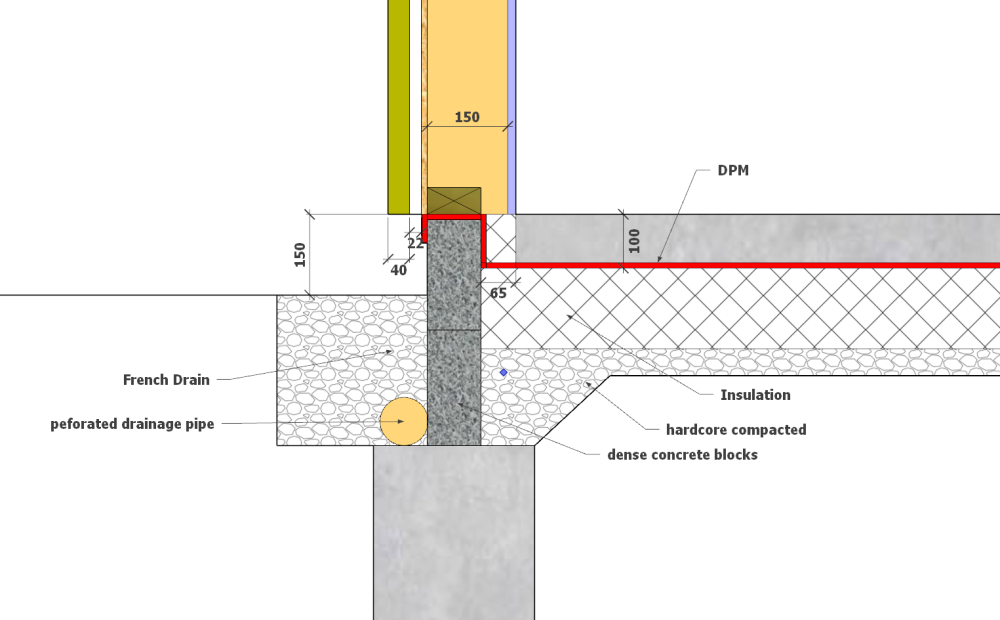
-
Insulated Concrete Slab Garden Office - Questions
Iceverge replied to Ticky's topic in Garages & Workshops
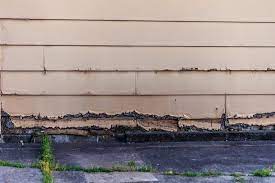
Here's the reason that any timber products are kept well out of the rain splash zone. 150mm is recommended as a minimum. It can even be a problem for single skin masonry too. The splashed water can find its way to the inside via mortar joints etc. The problem is made worse by having a surface that will allow water to pool or bounce easily. Gravel is a good way to stop this. Make it deeper and put some drainage pipe there and you have a French drain that will prevent the local water table ever rising up and pushing up water inside the floor, even if the DPM fails. ( Assuming the French drain can always flow to a lower plain)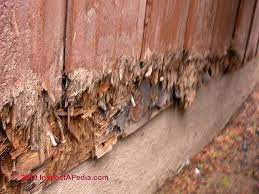
-
Insulated Concrete Slab Garden Office - Questions
Iceverge replied to Ticky's topic in Garages & Workshops
Some thermal simulations of what you've drawn. Think of keeping heat in like keeping sheep in a field. The will get out eventually but you have to try to make their progress as slow as possible. Higher R value materials like Mineral wool and polystyrene are like denser bushes in the fence that will really slow the sheep ( heat!). You need less thickness to slow them to an appropriate level. Lower R value materials like concrete and steel are like really non dense bushes that the sheep can move through easily. When you have a low R value material like brick/concrete connecting the inside and outside it's a thermal bridge. It's so significant that it renders all the other insulation almost ineffective. For my analogy it's equivalent to letting the gate of the field open, the sheep are going to run straight out there and the thickness of bushes ( insulation ) elsewhere is irrelevant. Demonstrated by the Flux vector ( arrow) diagram lowest above.


-
+1. Spray or brush on a dilute solution. Be careful with your skin and eyes obviously. Doing it in slightly damp/misty weather seems to help it soak in I find. Quite often just a rince with a bucket and brush once the chemicals have worked will do the trick but a pressure washer will make it a simple job.
-
Insulated Concrete Slab Garden Office - Questions
Iceverge replied to Ticky's topic in Garages & Workshops
Will do a model in an hour or so if I can for you .... -
Why not a hall feed system?
Iceverge replied to Petrochemicals's topic in Mechanical Ventilation with Heat Recovery (MVHR)
Like this one? Had one, it wasn't great. Some for sure but not all. The best analogy I can think of is squirting cordial into a glass with a straw and sucking out beside it. Almost all of it will still be diluted in the water, very little pure cordial will be left. -
Consider how best to jamb the PIR upstands in place. You can put them in place first and then wedge them with the floor boards or stick them later with some expanding foam . I think I prefer the former. I would go for more than 25mm if I could. It's just a bit fragile at that depth. Wouldn't bother with the blue foam TBH. Just more PIR.
-
Why not a hall feed system?
Iceverge replied to Petrochemicals's topic in Mechanical Ventilation with Heat Recovery (MVHR)
I reckon if you ran an MVHR unit without any ducting in a central room in a compact house and left all the doors open then you'd have acceptable air quality. Otherwise just make sure you have a good unit, large enough ducting and an appropriate silencer. You can DIY one if needed.