


Jeremy Harris
-
Posts
26430 -
Joined
-
Last visited
-
Days Won
360
Everything posted by Jeremy Harris
-
Sadly not. One of the major issues we had with the Sunamp was that it wouldn't accept a charge until it was significantly discharged, and there is no easy way to find out the actual state of charge (temperature doesn't tell you anything very useful as it's a phase change storage system), The new controller has fixed the charge acceptance threshold problem, but there is still no easy way to determine the remaining state of charge. To be fair to Sunamp, trying to do this would be complex and error prone, anyway. I think the only way to attempt it would be to measure input charge (easy for an electrically charged unit, not so easy for one charged by hot water) and also measure discharge energy. To do the latter would mean measuring the temperature and flow rate of the outgoing hot water, together with a factor to allow for heat loss (a fixed factor dependent on time since last charge would probably work OK) and then subtract that from the last know fully charged state. The fickle nature of UK weather, plus the variability in the house demand (some days are a lot higher, when the washing machine, dishwasher etc are run) would make any attempt to predict PV generation relative to consumption challenging. Given that I think we will only end up paying about £60 a year for hot water, if it ends up costing us £10 more a year just because we're not squeezing the last bit out of our available PV generation I'm not going to lose any sleep over it.
-

Flooring over UFH decisions, advice please
Jeremy Harris replied to Grian's topic in Underfloor Heating
There isn't much difference between different hard floor coverings, the major issue that determines efficiency (how much it costs to run) is the amount of insulation underneath the floor. All UFH systems lose more heat to the ground than other heating systems, typically around 10% for a reasonably well insulated floor, but if the insulation under the floor isn't that good then the losses can be quite high. We have a mix of bamboo flooring (very like engineered timber) and travertine, and there's no noticeable difference between the two areas. Carpets and rugs do tend to slow down the heat transfer a bit, though. In terms of care, we find the travertine easy enough to look after. I sealed it with the special sealant after it was laid, and before it was grouted, then again after it was grouted, and since then have just swept it and washed it with a normal (non-acidic) floor cleaner. -
value for money house design
Jeremy Harris replied to Amateur bob's topic in New House & Self Build Design
Which raises the old question about the spelling of the name of the little furry creatures (there's no P in hamster, unless it pees on you when you pick it up). -
Which one? We have at least three architects here that I know of, including one who's been around since the early days of Ebuild (before I joined in 2008 for sure).
-
Thanks, I remember that now, it's what gave me the confidence to just order them from TLC and risk it, IIRC. It is a very neat solution, especially if you like switches to look neat. Two way switching with normal switches always offends my eye, as inevitably you end up with one of the switches in the "wrong" position (i.e. American style, up for on).
-
Neighbour has objected to our plans
Jeremy Harris replied to Robert Clark's topic in Planning Permission
I've just dealt with an application that has created a lot of objections. Having spent half the afternoon reading them, most are just a rant, without any valid supporting evidence. The daft thing is that there are some key points that would be valid things to object about, if only the objectors had the wit to use them. In that case I doubt they will be a problem. Sit tight for the time being and see what pans out. I know it's a bit stressful; I well remember checking the planning website several times a day during the consultation period for our application, just hoping that we wouldn't get enough objections to trigger it being called in. -
FWIW, I have two sets of lights on two way switching, using the standard Quinetic stuff. Each receiver can be programmed to work from several switches very easily (can't remember how many, but more than most would ever need). In our kitchen I have two sets of lights, each with a single receiver, and two sets of double gang Quinetic dimming switches[1]. The receivers are programmed so that the left hand switch of either of the two switches operates one set of lights, the right hand switches control the other set of lights. Two way switching works seamlessly, we can use either switch to switch lights on or off. 1 The reason for choosing the dimmer switch, but not the dimmer receiver, was to make two way switching work seamlessly, and to allow the switches to always look the same whether on or off, as they lose their position memory if the power goes off (when power comes back on after a power outage the receivers stay switched off until a switch is operated). A feature that Quinetic don't advertise is that the retractive/momentary dimmer switches work perfectly well with the non-dimming receivers.
-
Sorry to have raised another potential issue... It looks like the pitch of your roof is shallower than the 45° of ours, and that may well reduce the problem. I actually went up a ladder in torrential rain to try and see what was causing our gutters to overflow, and it was only when I did this that I could see that the gutters weren't overflowing because of the volume of water, it was just the way the water was shooting off the solar panels as a flat sheet of solid water, mostly missing the gutter altogether. The giveaway initially was when I noticed that the gutters at the back of the house never overflowed, despite there only being one downpipe. The front has two downpipes (because the gable sticks out in the middle) so the gutters should have been able to better handle heavy rain, but with so much of the front roof covered with solar panels it seems that the water just flows off a lot faster.
-
@Temp will be shown on Ebuild under two user names, so you'll find posts by him on Ebuild prior to 2008 with his original username. The @Temp one was because something glitched in the forum software, IIRC, and the admin gave him a "temporary" username. That ended up being permanent, and he then chose to keep the same username when we created Buildhub. I think one or two others had different usernames on Ebuild. @jack, for example, was NotNickClegg, I think. I was boring and just used my initials and surname there, much as I'd did on other forums at that time. Sounds a bit too formal now, so forums that I've joined in the past couple of years or so I've switched to using my first name.
-
Ye Gods! I don't think I've got any emails going back that far . I only remember joining around Spring 2008 because we'd been on holiday and seen an earth sheltered house (which is what my first post on Ebuild was about, IIRC).
-
Neighbour has objected to our plans
Jeremy Harris replied to Robert Clark's topic in Planning Permission
I often think that some (most) people who object to planning applications don't do themselves any favours by raising issues that aren't planning considerations. Reading lots of them, I often get the impression that most feel the need to raise as many points as possible, even if 99% of them are just going to be ignored by the planning officer. If someone wants to make an effective objection they would be far more likely to have their objection looked at seriously if they took the time to see what aspects of planning policy and guidance an application might contravene, and focus wholly on those points, quoting the relevant documents to reinforce their case. -
One thing I've found is that water runs really quickly off our in-roof PV panels. The combination of a 45° pitch and the slippery glass means that in heavy rain water overshoots our gutters. It tends to just carry on flowing at the roof angle for some distance, so hits the outside edge of the gutter, or flow over it. This only happens in torrential rain, but it has created patches of staining on our cladding. I'm planning on fitting wider, deeper, gutters and moving them up a little bit, so that there's a better chance of them intercepting heavy rain.
-
When I said the weather can be fickle I wasn't joking. The Sunamp was fully charged as of about half an hour ago, we're back to normal (generated about 7.5 kWh so far today) and there's just about enough export for me to think about plugging my car in for a top up. Bit of a contrast to yesterday.
-
MVHR Flat Roof Vent Needed
Jeremy Harris replied to Diablo's topic in Mechanical Ventilation with Heat Recovery (MVHR)
Not that I would or would not concur, just that I had similar problems getting enough separation with our Genvex system to make it comply with their MIs, and as our building inspector had never seen a house with MVHR, he used the MIs as the document that had to be complied with. I also had to fit 90 degree bends and some tight duct work to get this to fit! -
Neighbour has objected to our plans
Jeremy Harris replied to Robert Clark's topic in Planning Permission
Yes, planning officers are adept at just ignoring anything that isn't a valid planning consideration. Parish councillors get to be pretty good at it too, except we have to often go face to face with parishioners who think they have the right to control what their neighbours do. Most are fairly unreasonable expectations, in my experience, not that I can ever tell them that... Might be an idea to clarify your agreement to having obscured glass in the windows overlooking the adjacent house, if you're OK with that. Probably worth checking the thread here where someone had a problem with getting low U value obscured glass 3G windows first, though. We have one obscured glass 3G window and it's the same U value as the others, but at least one manufacturer has said that they cannot offer a Ug of better than 1.2 W/m².K (I think) if the centre pane is obscured. -
Neighbour has objected to our plans
Jeremy Harris replied to Robert Clark's topic in Planning Permission
Should be fine, then. Also worth checking to see if there is a distance between facing windows specified in your local planning policy and guidance. I know ours is 20m, as it came up during our consultation (a neighbour was concerned about overlooking their garden, but overlooking a garden isn't usually a planning consideration) -
Neighbour has objected to our plans
Jeremy Harris replied to Robert Clark's topic in Planning Permission
Unless the neighbour objection is supported by planning policy and guidance it will almost certainly just be ignored. The only real issue with neighbour objections is that there maybe an automatic trigger level after a certain number have been received that then gets the application called in to the planning committee. Here I think that level is eight objections during the consultation period. FWIW, we started off with 14 objections to the previous application when we submitted ours, and all were read out at the PC planning stage. Made not a jot of difference, and our application was approved. As a councillor I get to read loads of objections to planning applications, and have yet to see any application where a neighbour objection has had any effect. Edited to add: Not seen the link when I started writing the above - the overlooking could be an issue - depends on the exact layout and perhaps what the local policy is on the distance between facing windows (here it's 20m, IIRC, less than that needs something like obscured glazing). Reading the objection, the only valid point is the privacy one. The possible nuisance from the garage is almost certainly not a significant planning issue, and anyway, pretty much all cars have to be low emissions now. -
MVHR Flat Roof Vent Needed
Jeremy Harris replied to Diablo's topic in Mechanical Ventilation with Heat Recovery (MVHR)
My concern was only that the MIs for the MVHR normally over ride any guidance in building regs, so technically a Genvex MVHR installed with the intake and exhaust only 2.2m apart on a roof would be non-compliant. Whether it makes any appreciable practical difference in performance is doubtful. I'd have thought a couple of metres apart should just about be OK, as long as the intake isn't downwind from the exhaust. -
I'll make sure to do an annual review next January, when I have 12 months worth of data. Just to illustrate how fickle the weather can be, we are now generating around 1.9 kW, with a total for the day so far of 2 kWh, so it looks like today's going to be a bit better than yesterday.
-
MVHR Flat Roof Vent Needed
Jeremy Harris replied to Diablo's topic in Mechanical Ventilation with Heat Recovery (MVHR)
Are those roof terminals >3m apart? The MIs for our MVHR gave specified minimum separation distances for intake and exhaust ducts, both for roof mounting and for through wall mounting: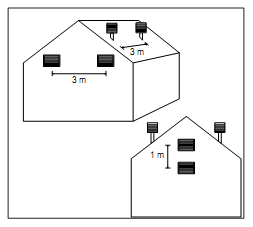
-
The old Ebuild forum was a very busy place when I joined in 2008, probably around double the number of members we have here at that time. It was well-established as pretty much the dominant self-build and renovation forum back then. I'd guess that there were a lot more members involved in renovation work than complete self-builds, though, and a fair number involved in work on older buildings, some of which needed specialist techniques to repair/restore. Things changed pretty dramatically over the years, though. After the hiatus caused by the software update that took the forum offline for a time, the emphasis gradually shifted more towards self-build, and more towards building low energy houses, I think. It certainly seemed like that from my perspective. This forum started off as a close replica of the final iteration of Ebuild, with many of the old Ebuild members, so sort of carried on in much the same way. The main difference is that BuildHub is non-commercial, and doesn't allow advertising, because the views of the founders is that advice is likely to be less biased if there are no commercial interests at stake.
-
All induction hobs use pulse width modulation to control the heat output, so all will pulse on and off. However, it does seem that some do this with a finer degree of control than others, also the heat capacity of the pan that's being used makes a significant difference. Since we switched to using Le Creuset pans we've found that the heat is a fair bit more controllable, and it's now very easy to just simmer.
-
I agree. We have just under 2 days worth of DHW storage, but also top up the Sunamp overnight, at the E7 rate, if it needs it. The cost of doing that is pretty modest, the worst case of topping it up overnight when there's been no excess PV generation (very rarely happens) would cost around 50p. I'd guess that most of the paid for top ups cost maybe half to two thirds that. If I had to guess, based on the ~9 months worth of data I've got on the split between free hot water and paid for hot water, I'd say that our annual bill for hot water will be around £60 or so. I can live with that, TBH, especially as we get paid around £1000 a year for the FiT and exported electricity.
-
Accepted, but we were discussing architects, who I'd guess probably have a different take on life than an average seasonal farm labourer. I was also on the AECB forum and GBF. The AECB forum had the potential to be pretty useful, but seemed to die for some reason. It's a shame, as I met a couple of local AECB members who were really helpful through it. The GBF was fine until posts started getting heavily edited to change their meaning. I received a torrent of pretty offensive emails from an extreme animal rights supporter, who I very strongly believe was very closely connected to the site owner. It seems that private messages there were being read, and in one or two of them I'd foolishly revealed the place where I had worked. I then had posts edited to make out that I had views that were the opposite to those I'd expressed, started getting really offensive emails to the email address I'd used to join that forum (which, like the one I use here, isn't my everyday email address), and then finally got banned for highlighting that posts were being heavily edited to change their meaning.
-
Right of Way, Area of common parts
Jeremy Harris replied to success1980's topic in Party Wall & Property Legal Issues
It looks like the right of way applies just to the access to your garage, which makes things a lot simpler. It's hard to see what the common parts provides, in terms of a benefit to anyone other than yourself. Perhaps it's just left over from the land having either had some real purpose in the past, or just a consequence of the way the titles have been split up, perhaps. Maybe the original intention was to allow for all the users of the garages (I'm assuming that there is more than one in that row) to have access for turning etc within that area, when it extended down in front of all of them?

