Jeremy Harris
-
Posts
26430 -
Joined
-
Last visited
-
Days Won
360
Everything posted by Jeremy Harris
-

It's embarrassing.
Jeremy Harris replied to ToughButterCup's topic in General Self Build & DIY Discussion
By coincidence his self-build was styled on a farmhouse, but he lives out at North Newbald, in relative peace and calm compared to Hull. -
It's embarrassing.
Jeremy Harris replied to ToughButterCup's topic in General Self Build & DIY Discussion
A friend of mine lives in East Yorkshire, was born there, lived there all his life, built a house there and has a business there. Even he won't go into Hull after dark! -
It's embarrassing.
Jeremy Harris replied to ToughButterCup's topic in General Self Build & DIY Discussion
I bet you were even more delighted that you didn't have to go to Hull to pick it up............................ -
You're right, and the real problem is that few architects are fully aware of how an MVHR unit is constructed, or even how it works, other than at a basic level. How many architects are also heating and ventilation engineers? Probably very few, I suspect. Some of the simpler MVHR units really are so simple internally that there's no reason they couldn't last for decades, and all MVHR systems, even ours with it's built in air-to-air heat pump, are less complex, and have fewer moving parts, than something like a boiler. What's the life of a modern boiler, I wonder? Our old gas boiler was still working perfectly well when we replaced it, yet it was about 30 years old. We only replaced it in order to fit a more efficient combi, and that combi is now around 7 or 8 years old and probably still has 10 years or more of life left.
-
Modelling the "Chunk" Heating of a Passive Slab
Jeremy Harris replied to TerryE's topic in Boffin's Corner
I have about 10 day's worth of data now, but we haven't had any cold weather, if anything it's been pretty mild, so I think it's best if I keep the loggers going for at least another week or so, just to try and get as wide a range of outside temperature variations as I can. Looking at the temperature displays on the loggers, the floor surface rarely seems to be more than 0.5 deg C above the room temperature, and the room temperature seems to be fairly steady, between about 20.5 and 21 deg C. I've not noticed the heat pump running for the past week, but it's possible that it may have come on earlier in the morning, before I get over here, for a short time. I'll know for sure in a week or so, as the log will have the heat pump flow temperature, which will show when it's run and for how long. If we get a spell of cold weather in the nest few days then I'll stop the loggers in a week or so and post the data here. -
Maintenance on ours is a 6 monthly filter check/clean/replace, with a reminder on the control unit display when this is due, plus an annual clean out of the filter boxes with a vacuum cleaner, really just the fresh air in side to remove the build up of dead flies etc that get sucked in but stopped by the filter. Every two years there is an advisory to inspect the heat exchanger and if it's dirty give it a wash. The fan motors are usually brushless, so the only likely failure is the bearings, but they are so lightly loaded most of the time that I would be surprised if they only lasted 10 years; they are probably good for 20 years plus I think. The electronic controls, in particular the motor drives, are probably the shortest life component, and they may well need replacing at around the 10 year mark, just because their capacitors will be right at their end of life around then. This might well mean replacing the whole control board, but I've had a look at ours and reckon that it should be easy enough to just remove it, do a precautionary replacement of the commutation capacitors on the motor drives and replace it. with luck that should extend it's life for a long time. I strongly suspect that MVHR prices will decrease as they become more popular, so even replacing the whole unit isn't likely to be too big a deal. As it has to be easy to get at, to comply with building regs, and as the ducts should last decades, it's not a big job to just replace the unit.
-
Perfect boiler temperature re ufh?
Jeremy Harris replied to DH202020's topic in Boilers & Hot Water Tanks
At our old house I spent a fair bit of time faffing about measuring flow and return temperatures and the flue gas temp at the terminal, to try and determine if there was a "sweet spot" in terms of efficiency. It turned out that if the return temperature was above 55 deg C the boiler flue gas temp was sky high, and it was definitely not condensing. As the return temp dropped there was a big jump in efficiency at around 50 deg C, and a corresponding big drop in flue gas temperature. From then on, reducing the return (not flow, but they are clearly related) temperature further gave a fairly linear improvement in efficiency, until I reached the point where there wasn't enough heat output to keep the house warm. Our boiler was over-sized, because I didn't size it, the installers did, and they refused point-blank to take account of the added insulation I'd fitted (350mm in the loft, plus ~50mm bonded graphite bead EPS in the walls) or the fairly decent (for the time) 28mm DG. It means that all the radiators are too big now, and the boiler has too high a capacity, but the one advantage is that I can run at a 48 deg C flow and about 43 to 44 deg C return with the boiler in fully condensing mode. It makes a worthwhile difference; probably knocks about 10 to 15% off the gas bill. As Nick says, for low temperature UFH you need something for the boiler (or heat pump) to work into, so that the boiler (or heat pump) can run efficiently and without going into short-cycle protection mode. A buffer is pretty much essential with a boiler, I think, as otherwise it's going to try and modulate down as low as it can, still chuck out too much heat and then it'll turn off and wait of the short-cycle delay before firing up again and doing the same. This won't be efficient, as it takes a few minutes of running for a boiler to stabilise and start running efficiently, so the greater the number of times it fires in a day the worse the efficiency. Ideally you want it to fire and stay on for a fair time, then turn off and stay off for a long time, whilst the heating draws stored heat from the buffer. @TerryE is going for a system of using the slab as a buffer, which should work with the low flow temperature from a heat pump, but won't really work with the higher flow temp from a boiler, I think. -
Yes, Anthony, I guessed you were just over the road from the photo. It's amazing how all those thousands of trees he's planted have established into such a mature woodland over the past 20-odd years. His treatment plants are all pump-aerated ones that I'm pretty sure discharge to the lake, and don't seem to cause any harm because there are a lot of fish doing pretty well over there. He also heats at least some of the cabins with water-source heat pumps, drawing heat from the lake.
-
Just to clarify this, MBC are splitting the work between Hilliard with Kore and Buildlite (now run by a chap from Cork, apparently). The foundation system's the same, it's just that they needed more capacity and Hilliard was working flat out on designs and sign-offs, and Buildlite can provide the same standard of service and performance, with their own engineer doing the design and sign-off, so it gives them additional capacity.
-
I know that area well, and have stayed in a cabin nearby, right on a lakeside. That had a pumped air treatment plant discharging into the lake. I know the owner reasonably well and can ask what problems he had sorting out the treatment plants he has discharging into the same lake, if you like (he has 7 or 8 cabins around the same lake).
-
ebay mvhr
Jeremy Harris replied to Alexphd1's topic in Mechanical Ventilation with Heat Recovery (MVHR)
The spec looks reasonable from the data here: http://www.dealec.co.uk/acatalog/pdf/xpelair/xpxcell350v.pdf, and the price looks to be around 1/4 of the normal retail price, so I'd say it looks good to me, if the size is right for what you're building. I think the price may be low as these are old stock, perhaps, as this is a 2010/2011 product, as far as I can tell. No reason for it to be any the worse for that, though. -
Well done! I'm still in the "clearing 17 years worth of junk out of the old house" stage", plus in the midst of a shoulder problem that's going to mean another round of surgery soon, I suspect....................
-
Good news! I had a feeling that doing this would make a big difference. If you're fitting MVHR then it's unlikely that you'll need to ventilate at more than 0.5 ACH in practice, so the losses could be even lower.
-
Your old system probably stopped working around 10 to 15 years ago, in reality. This is the reason that treatment plants are now preferred over septic tanks. What happens with a septic tank is that it relies on the leach field to do 90% of the treatment, the tank itself is just an anaerobic settling chamber and does very little to remove any pathogens (in fact, being anaerobic it is always a significant source of potentially nasty pathogens, hence the same "septic tank"). The treatment in a conventional septic tank mainly happens in the aerated soil around the leach field drains, where aerobic bacteria in the surrounding soil feed on the high biological oxygen demand effluent and render it safe. What happens after a few years is that the biofilms develop around the field drains and seal off the surrounding soil from air, so the soil around the field drains then also becomes anaerobic and septic. This isn't usually visible unless you dig up an old leach field, where the black and pretty foul soil around the drains will be apparent. In effect, a septic tank ends up dumping raw effluent out of the drains after a few years, and presents a potential health and environmental risk. The snag is this can't be seen, as far as the user is concerned it's all working as it always has. Treatment plants work differently. They are all aerobic, so they don't allow the release of anything with a high biological oxygen demand (BOD). This means that their effluent is pretty harmless and can be discharged into a watercourse, large soakaway or whatever, with very little risk of harm.
-
The key thing is that this threshold support has to be integral with the slab, so that there is no chance at all of differential movement. The cut-out in the upstand method is very simple and ensures that the slab and door threshold are contiguous. There's very little room to secure any other material to the slab, so that it would never move, as we're talking about a strip 100mm x 100mm x the door width, that would need to be secured to the slab somehow. Remember the DPM is under this, so there really isn't a simpler way to detail this that I can think of.
-
My understanding is that they are the UK suppliers of the passive slab components, as distinct from the Irish component supplier, Kore Ireland. My guess is that MBC switched to a UK, rather than Irish, supplier when they moved to Gloucester. Here's their website - looks identical to the passive slab we have: http://www.build-liteuk.co.uk/products/future-found/
-
You're right, but then every company I approached was the same, even one fairly local to me that seemingly offered a "turn key" package (at a very high price!). When I met with them (twice) it was clear that their idea of "turn key" was that they would supply a completed frame, they didn't even offer to provide a foundation package. I was originally going to use a project manager, in fact I retained and paid one for a short time for the first plot we were going to buy, and it was clear from talking to him that very few UK companies offered a full "turn key" self build, but that some companies outside the UK, like Huf, did. I learned quite a bit from that project manager, as he was happy to talk through the process and some of the potential "gotcha's" for self-builders. I'd have happily used him had our purchase of the plot not fallen through. By the time we'd found our plot I felt I'd picked up enough information to manage things, but for someone not familiar with what each trade or supplier is likely to do, or more importantly not do, then it could well be a bit of a shock to discover just how much coordination and project management you have to do as a self builder.
-
Our BioPure is only around 1m above the water table. The only problem with installing any treatment plant like this is pumping the water out of the hole so it's dry enough to put some concrete in as an anchor ring, to stop the tank floating up when empty. I think there have been mixed experiences with the BioRock, enough to put me off a couple of years or so ago when we bought a plant, even though it had the advantage of not needing power. Having said that, I've heard that they have changed/replaced the media and this has, I believe, resolved some of the issues some had. There is also a fix for the slight odour problem others have had with the BioRock, and I think they now suggest some remedies for any odour from the air vent pipe in their installation instructions. I know someone (not on here, AFAIK) fixed the vent odour problem by placing the vent in to the centre of a hollow planter. Apparently the plants and soil in the planter absorb the smell.
-
Bath Surround / Boxing In, and concealed pipework
Jeremy Harris replied to Onoff's topic in Bathrooms, Ensuites & Wetrooms
B&Q sell "electrical tape" that is especially designed to turn into a sticky mess within 6 months................ The odd thing is that Screwfix (who are B&Q in disguise) sell pretty reasonable electrical tape that doesn't seem to go soft and goey. -
Trying to ascertain if this is a load bearing wall
Jeremy Harris replied to Tennentslager's topic in Brick & Block
In the top drawing, do the first floor joists run perpendicular to the walls, or parallel to them? If they are perpendicular, then there's a good chance the wall is load-bearing, if parallel then it's less likely, but still possible, depending on the structure inside the ceiling/first floor space. Edited to add: Sorry, just re-read the post, and seen they are perpendicular, so that wall is almost certainly load bearing.............. -
Bath Surround / Boxing In, and concealed pipework
Jeremy Harris replied to Onoff's topic in Bathrooms, Ensuites & Wetrooms
No, as PVC tape contains plasticisers (same as in cable) to make it soft, the result would be a soft adhesive, plus the risk that the plasticisers may well stop a good bond from forming. -
All I had was the agreed drawings as per contract, which were the drawings I'd sent them but with some slightly changed dimensions to fit the 400mm centres better and a fair bit more detail on the dimensions of the walls, etc. I asked for, and received, copies of these in AutoCad .dwg format so I could use them as the basis for the modified drawings I drew up for building control. What else was it you were after?
-
Bath Surround / Boxing In, and concealed pipework
Jeremy Harris replied to Onoff's topic in Bathrooms, Ensuites & Wetrooms
The solvent is the same for PVC of all flavours, and the cleaning agent is MEK (methyl ethyl ketone). Cheaper to buy MEK in litre or 5 litre cans than buy the branded cleaner. EDITED TO ADD: You can thicken up standard solvent cement by adding ground up PVC to it. Takes a bit of time to dissolve but works OK. -
My take on this was the same as with the ground works guys; I drew up plans and double checked all the dimensions before going out to tender, then double checked things on the ground to make sure everything was in the right place. I remember clearly checking the position of the soil pipe and ducts with the ground works guy, we measured and re-measured about three times, and in the end he just went and got the Total Station out to be absolutely sure they had put the stuff in the right places. With the MBC guys it was different, as they came with plans laminated in plastic and were clearly pretty good at getting the slab laid out very accurately, so after one check at the corner I left them to it. I think it's important to remember that you, or your project manager or architect, has responsibility for taking the lead on this, so you need to be the one checking and providing the accurate plans and drawings, and providing oversight if needed.
-
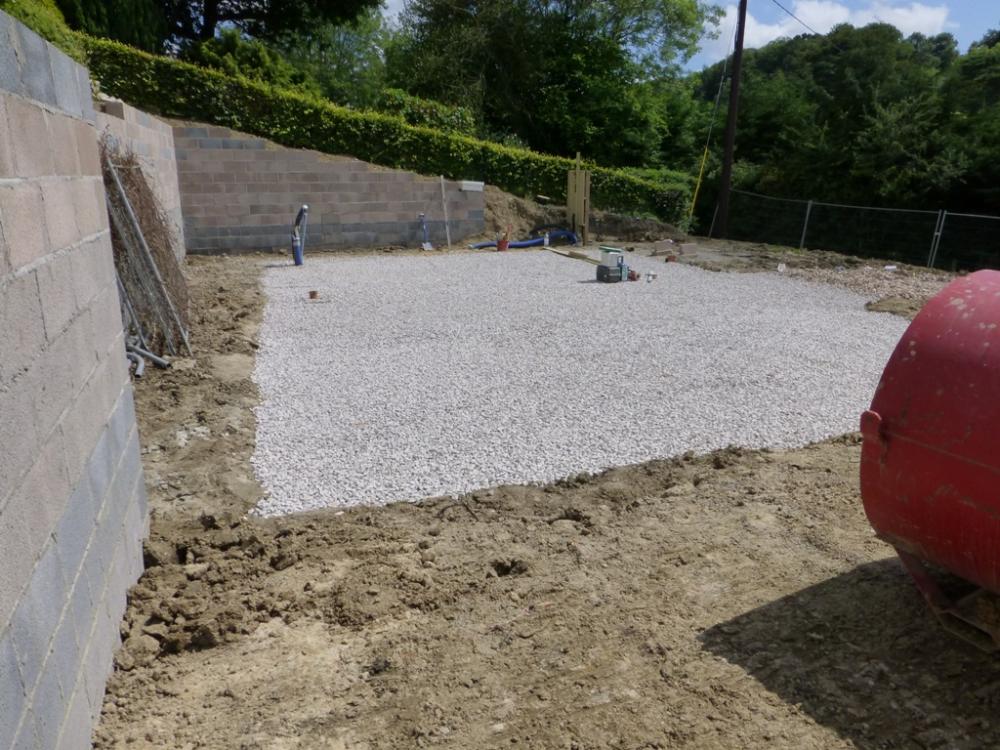
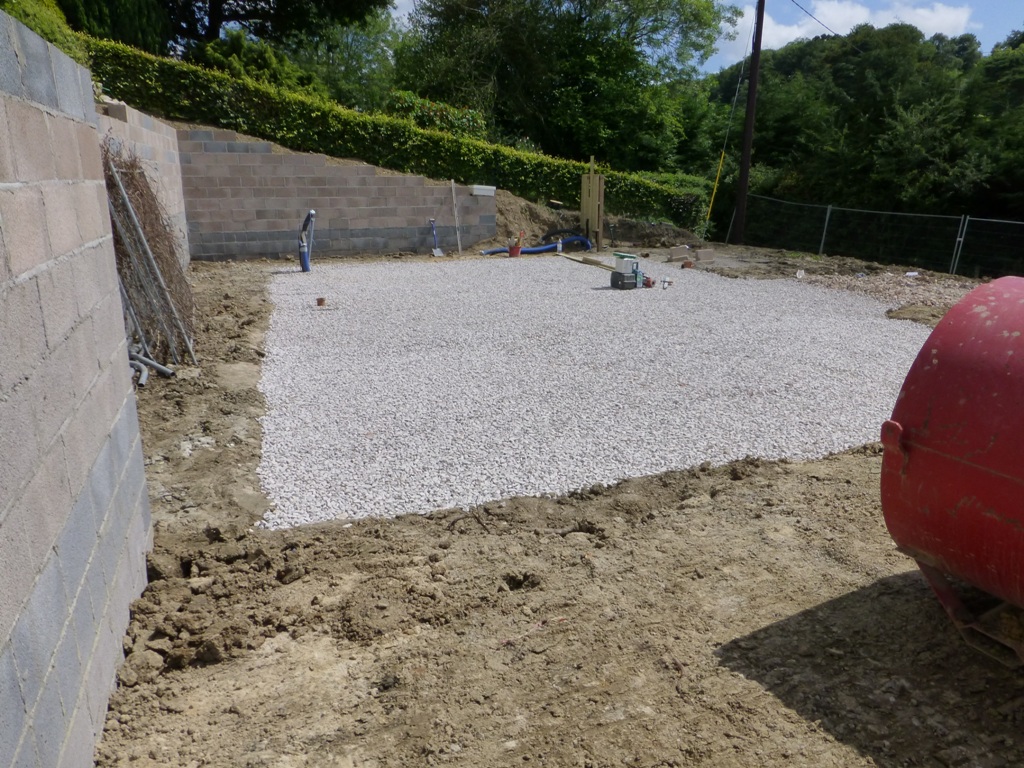
All I did was lay the base stone in compacted layers, to their spec, with around 300mm all around as an additional French drain. I had a soil pipe coming up and some ducts for the water pipe, phone line and power cable, all in exactly the right place according to my plans. They had those positions and they laid and levelled the 50mm grit layer and placed the outer ring of EPS, with the upstands, so that the North East corner was in the correct position relative to my datum point near that corner, and with the North wall parallel with the retaining wall we'd already built, and the correct distance away from it (again, as per my plans). The didn't lay any drainage pipes for us, as we'd already put them all in well under the sub-base and had them pressure tested for BC before MBC arrived on site. That, together with the compacted sub-base of type 3, was all done by our ground works guy. The did leave the UFH tails poking up out of the slab on a temporary timber frame and also put the 25mm conduit I'd made up to take power from the wall to the kitchen island in the place I'd marked out on the plans. This is what our site looked like not long before the MBC guys arrived; you can just make out the ducts and soil pipe poking up at the centre left in the distance (the other stuff is the ground works guys radio and tool box). The type 3 is 150mm deep, whacked down in layers: