Jeremy Harris
-
Posts
26430 -
Joined
-
Last visited
-
Days Won
360
Everything posted by Jeremy Harris
-
We used Pear Stairs and found their service very good indeed, and they were a fair bit cheaper than any other oak staircase company who quoted. The stairs were supplied assembled, except for the newels, hand rail and glass balustrade panels and fitted perfectly first go (much to the surprise of the two joiners who fitted it).
-

What accidents have you had while DIY'ing?!!
Jeremy Harris replied to mike2016's topic in General Self Build & DIY Discussion
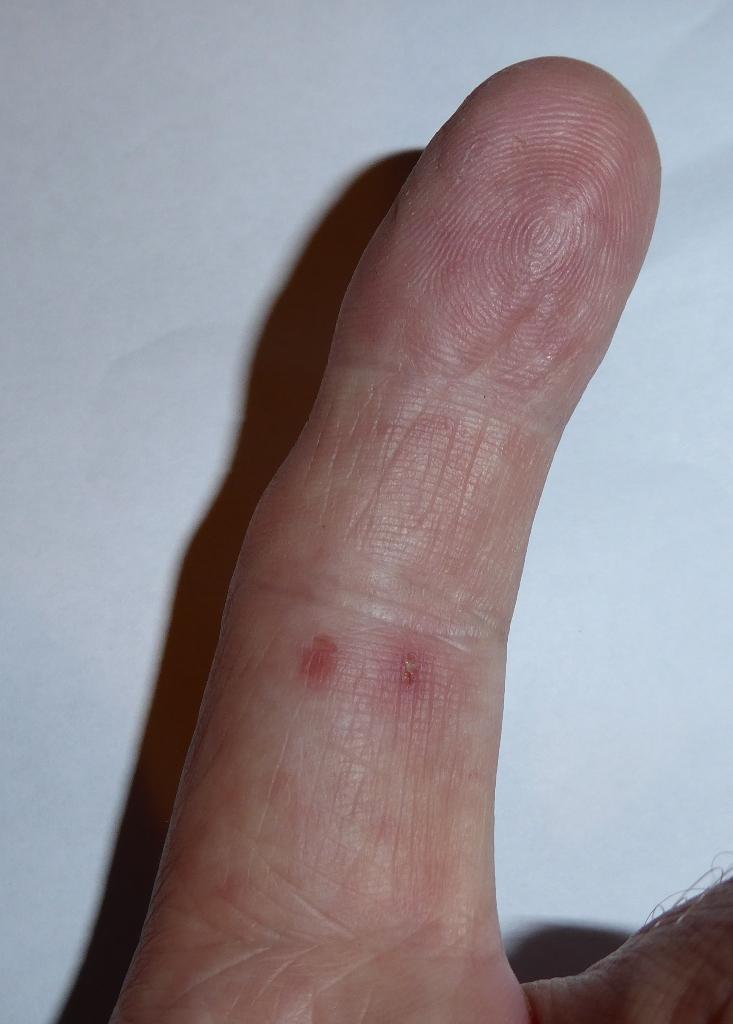
As @Ferdinand says, one with at least two sharp teeth! The general consensus was that it was probably an adder, as grass snakes don't usually bite. The inflammation that followed also tended towards that view, in that the adder is our only venomous snake, and the inflammation seemed to proceed very quickly. That photo was taken within a few minutes of the bite, and the puncture marks are already showing early signs of inflammation. Within a couple of hours the finger was the size of a small banana, and pretty painful. -
Green Wall of Herbs
Jeremy Harris replied to Ferdinand's topic in General Self Build & DIY Discussion
There are probably already good designs for doing just that on some of the alternative hydroponic growing sites. . . -
What accidents have you had while DIY'ing?!!
Jeremy Harris replied to mike2016's topic in General Self Build & DIY Discussion
I think one of the most painful things I suffered during our build was getting bitten by a snake when shifting stuff in the overgrown area that is now our garden. I took this 'photo a few minutes after it had bitten me (through a glove) and before the finger started to swell up : The nurse who treated it later that day thought that it was probably the fact that I was wearing gloves that saved the bite being worse. It was still as painful as hell for a day or so, though. No gory 'photos of the finger when it was swollen, I'm afraid.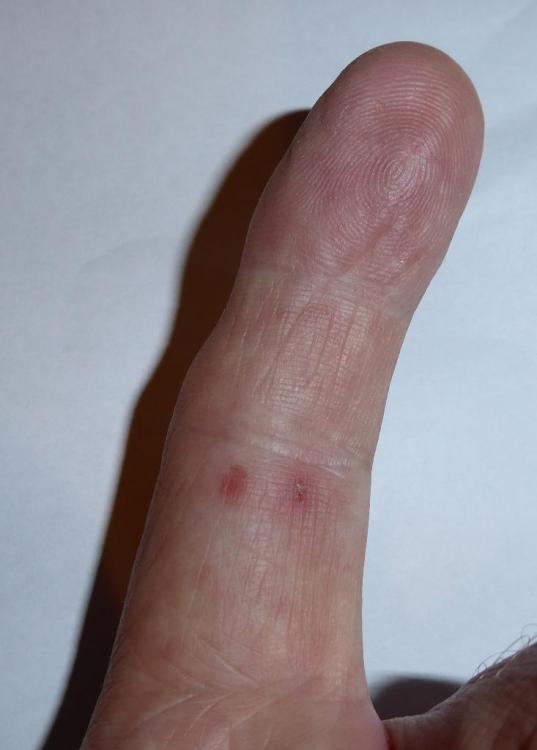
-
ASHP questions about install and costs of 'bits'
Jeremy Harris replied to Roz's topic in Air Source Heat Pumps (ASHP)
I'm not convinced that Agile makes sense when it comes to trying to run a heating system, TBH. The heating needs of a house tend to follow the heat loss rate vs inside/outside temperature differential, with a phase lag that is largely determined by the house thermal time constant. We find that heating overnight on E7 works well, but our heating wouldn't work at all well on Octopus Go (just not enough time to get heat into the slab) and I'm pretty sure it wouldn't work at all well with Agile, either, based on some simplistic modelling I did a while ago, looking at the Agile data provided via this web site: https://www.energy-stats.uk/ One thing I found was that, rather unsurprisingly, periods of very cold weather tended to be at times when Agile wasn't offering a very good rate. For a house that doesn't need a great deal of heating, this can mean that whenever heating is needed the rate is higher than, for example, E7. This page from that site has the last 18 months of Agile prices: https://www.energy-stats.uk/octopus-agile-south-western-england/ and shows pretty clearly that a fair bit of the time when it's been cold, the Agile tariff has been higher than the 8.148p/kWh we currently pay for E7. -
ASHP questions about install and costs of 'bits'
Jeremy Harris replied to Roz's topic in Air Source Heat Pumps (ASHP)
Some of the costs quoted for things like installation and commissioning are a bit ludicrous. As @ProDave says, those prices indicate that there's several times more work than there really is. I bought a 7 kW Glowworm ASHP (really a Carrier unit with a Glowworm badge) that was supplied complete with the controller and delivery for £1,700. I built a concrete base for it in about an hour, and actually installing it, connecting it to the heating system and wiring it took me a bit over half a day. I'd never installed one before, but it wasn't at all difficult, the hardest bit was probably deciphering the instructions. The heating and hot water system stuff is pretty much the same as any other system, the only difference being the one that @ProDave has already pointed out, that the unit will switch between heating either hot water or heating, but not both at the same time. This doesn't really add any more complication though. -
How far are current Building Regs from Zero Energy House?
Jeremy Harris replied to Ferdinand's topic in Boffin's Corner
Precisely why I put inverted commas around the word "sequester", to make it clear that nothing was really being sequestered directly at all. The fact remains that for every kWh of zero carbon energy exported to the grid there is the potential to reduce emissions from generation by that amount. Whether that happens in practice, or not, depends very much on the particular state of power generation at that instant. -
How far are current Building Regs from Zero Energy House?
Jeremy Harris replied to Ferdinand's topic in Boffin's Corner
The data's been plotted with Grafana running on a Raspberry Pi, and there are axis labels if you look closely. The legend's at the bottom, and the left Y axis is speed, power and SoC, the X axis is time and the right Y axis is range remaining in miles. -
Help with Salus auto-balancing actuators
Jeremy Harris replied to europa's topic in Underfloor Heating
We have the same type of manifold thermometers and they are hopelessly inaccurate. I tried to find more accurate ones that would fit the ports in the manifold but failed miserably. My first solution was to buy some of these cheap digital thermometers and poke their sensors into the holes in the manifold: https://www.ebay.co.uk/itm/Mini-Digital-Fridge-Freezers-Coolers-Chillers-Aquarium-Thermometer-Probe-Sensor/333389376769?hash=item4d9f8e2d01%3Am%3AmCniJn-0tAsdFCUJGopbXZg&LH_BIN=1 but I found that these stick on LCD temperature indicating strips were easier to fit, although they are harder to read: https://www.ebay.co.uk/itm/Stick-On-Digital-Thermometer-Adhesive-Aquarium-Fish-Tank-Glass-Water-Window-LCD/182082101146?hash=item2a64f05f9a%3Ag%3AJ8oAAOSwuolboq37&LH_BIN=1 -
How far are current Building Regs from Zero Energy House?
Jeremy Harris replied to Ferdinand's topic in Boffin's Corner
We effectively "sequester" about 0.9 tonnes of CO2 per year, by generating zero carbon power that's exported to the grid, and used by the house in place of power supplied by the grid. That's about 0.245 tonnes of carbon per year. I've not worked out the impact of my car yet; need to get a feel for the proportion of energy it uses that will come from self-generated, zero carbon, energy. Car energy use is interesting, especially at this time of the year when the weather's a bit cool. This is the data from my ~10 mile trip to the supermarket yesterday: This data wasn't taken from the car directly, it was retrieved from Tesla's server, and is just a tiny bit of the telemetry between the car and Tesla that is running all the time the car is online. For the power fanatics, the peak power used on that trip was 134 kW (~179hp), the minimum power was ~ -41 kW (~ -55hp) and the average power for the trip was 6.75 kW (~ 9hp).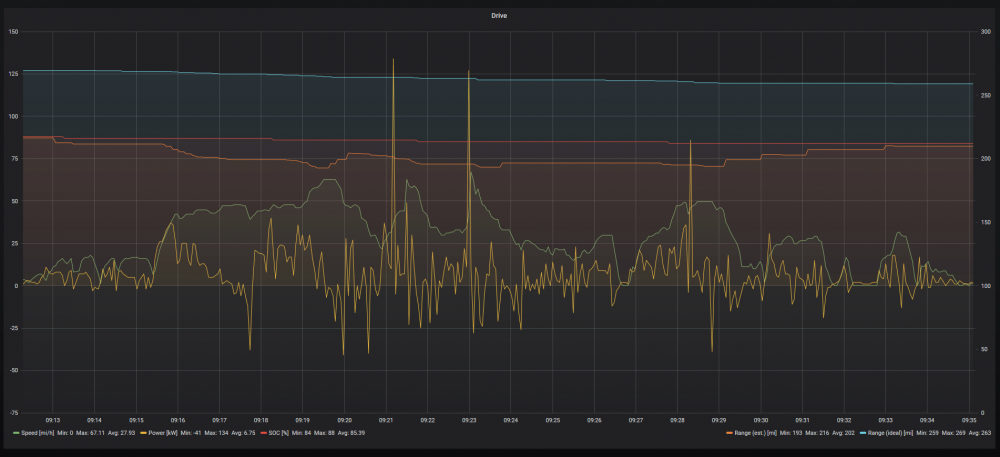
-
How far are current Building Regs from Zero Energy House?
Jeremy Harris replied to Ferdinand's topic in Boffin's Corner
Cellulose is about 44% carbon by weight, so for a wall blown with cellulose at a typical density of around 56kg/m³ , built to the same sort of spec as ours, then each m² of wall (ignoring the timber for now) has around 17kg of carbon. Our roof has a bit more (again ignoring the timber), about 22kg/m². Our total wall area is about 347m² and the roof area is around 128m², so that gives a total amount of carbon just from the cellulose insulation of ~8,715kg. The timber frame will be ~50% carbon and at a guess is roughly around another 5 tonnes of carbon. So the total amount of sequestered carbon is probably somewhere around 13 to 14 tonnes. -
Powerline WiFi options?
Jeremy Harris replied to Jeremy Harris's topic in Networks, AV, Security & Automation
The spare router I set up as an AP yesterday is working like this. It works OK, but is a bit bulky, and being old it draws a fair bit of power and runs a bit warm, plus it's only a 54 Mbps unit, it's that old. At the moment it's connected to the kitchen TV Ethernet cable, which is OK as the switch in the thing has four ports. I set this up so that DHCP was disabled in the one being used as an AP, with both the main router and the one being used as an AP having the same SSID, security credentials etc, and with both set to the same fixed 2.4 GHz channel (11 in my case, as it seems free from any other traffic). I set the router used as an AP to a fixed IP right near the top of the subnet, and then limited DHCP in the main router to not allocate IPs that high. This works seamlessly, with devices just switching from one AP to another without any noticeable break. I think the best solution might be for me to look at getting one or two decent APs that include a small switch, maybe 2 to 4 ports, and see if I can use them where we already have wired Ethernet. I'll need APs with built in Ethernet switches so that we can continue to have the wired devices connected (a couple of TVs that work a lot better with a wired connection). With hind sight I should have run at least a couple of runs of Ethernet cable to each place I thought we might need it, rather than just a single run. I already have a 16 port switch in my study, which is where all the network stuff terminates. It is staggering just how many connected devices we've accumulated, though. Just in my study I have four PCs, a Raspberry Pi monitoring data from my car with TeslaMate (and running PiHole to bin adverts), an Odroid HC1 running a couple of Tb of network storage and a network printer, all on Ethernet connections. Then there are two TVs and my wife's iMac, also on Ethernet connections, plus at least six WiFi devices, a couple of internet radios, my wife's iPad, my Android tablet, my laptop and my car. At any one time it seems we usually have between 10 and 12 devices active on the LAN, whenever I do a scan. -
Data and power cables should be separated in a trench by at least 100mm, according to the info that SSEN and Openreach sent me. The data cable is best put in a duct, I think.
-
Powerline WiFi options?
Jeremy Harris replied to Jeremy Harris's topic in Networks, AV, Security & Automation
I've got net stumbler installed on a laptop, which does much the same, shows the signal strength around the house. That's confirmed that the signal is pretty dire at either end of the house, and non-existent outside. -
Powerline WiFi options?
Jeremy Harris replied to Jeremy Harris's topic in Networks, AV, Security & Automation
I bodged up an old router as an additional access port today connected to a spare Ethernet port on the living room, but it's a bit clunky. I managed to set it up so it's bridged to the main router, with its DHCP turned off, so it's transparent; IP's are allocated and served from the main router and the same SSID and login works for both. It's a solution of sorts, and it fixed the problem I had getting a reliable connection to the car for a software update today, but it's a bit clunky. The BT solution is one of the ones I've been looking at, nice to know that it works well. I'll check out the Devolo stuff, too. @ProDave, I've no idea why we have such a problem getting decent WiFi. I've tried two different routers, and spent a fair bit of time setting them up in what should be the best location, on top of a cupboard pretty much in the dead centre of the house, at about head height. For whatever reason, the signal isn't great at the ends of the house, and there's no signal at all outside the front door where my car is parked, yet that's only about 10m away, with just a stud wall and the front glazing in the way. I know the outer skin of the house attenuates radio a lot, as although we can just about get an FM signal outside, we can't get anything inside the house at all (hence the internet radios). -
Although I put a fair amount of network cabling in the house, we still have a few WiFi widgets, including my car and a couple of portable internet radios. Sadly, it seems that our house is very good at attenuating WiFi, so we have a bit of a problem. I've upgraded the router and placed it high up in the centre of the house, but we still have a problem. My thoughts are to use something like a powerline adapter connected via Ethernet to the router, and then fit maybe a couple of plug in WiFi repeaters around the house, to give the coverage we need. I looked at using just WiFi repeaters, but it looks like the latency of some of them is an issue. The mesh systems look OK, but for some reason some other Tesla owners seem to have connection problems with them. Has anyone got any recommendations for a reasonably affordable powerline to WiFi solution?
-
Correct installation of Willis Heaters
Jeremy Harris replied to Jeremy Harris's topic in Other Heating Systems
There's a finite limit set by the water flow rate, the ∆T between flow and return and the heat capacity of water. For a total flow rate of 12l/m and a ∆T between flow and return of 4°C, the maximum power that you can deliver to the floor is about 3,345 W. Our UFH runs at a total flow rate of about 9l/m and a ∆T between flow and return of 4°C, so the maximum heat we can deliver to the floor is less, about 2,508 W. We could increase the heat delivery rate by trying to increase the ∆T between flow and return, but that gets harder to do as the slab warms up, or if the slab is close to the desired temperature. -
Not a lot, if my experience in Manama, Bahrain, years ago is any indication. Being young and foolish I had too much to drink at the sailing club and on the walk back to my apartment I must have just crashed out. I came to in a doorway being looked after by two local guys, who helped me to my feet and saw me home. I was pretty amazed to discover the next morning that my wallet was intact, and still had around 50 dinars in it (at the time worth a bit more than £50 IIRC). Theft seemed to be pretty much unheard of there, and generally it seemed a pretty safe place, as long as you accepted that, being non-Arab, you would always carry the blame for any incident.
-
Correct installation of Willis Heaters
Jeremy Harris replied to Jeremy Harris's topic in Other Heating Systems
Good point. I'm pretty sure that @TerryE is only using a single Willis heater. It depends on the heated floor area, but if you had, say, 100m² of heated floor and ran it at a maximum output of about 25 W/m² (which is a fair bit higher than we run our UFH) then you only need 2.5 kW. -
Yes, this is pretty much our set up. We have 25 PV panels built in to the roof, with a peak output of 6.25 kW. We divert excess generation from them to heat our hot water, which needs ~6 kWh/day. We find that the PV supplies around 59% of our annual hot water requirement, so we only pay for about 41% of it. Our ASHP is only used to heat and cool our ground floor, but we could use it to heat hot water if we had a hot water tank (we use a Sunamp).
-
Help with Salus auto-balancing actuators
Jeremy Harris replied to europa's topic in Underfloor Heating
I have Salus autobalancing actuators and haven't had any issues with them. The only thing I can think of that may cause a problem might be if the actuators aren't screwed down tightly enough when they are first powered up. On first power up they go through a calibration routine, that sets the throw of the actuator, I believe. Having said that, I've removed and replaced them when fiddling around with the system and still not had any issues with them. Overall I'm impressed with both their performance and with their speed. They turn on a lot faster than the older wax type actuators, and they seem to hold the set temperature differential pretty well. -
Correct installation of Willis Heaters
Jeremy Harris replied to Jeremy Harris's topic in Other Heating Systems
Just looked at a spare immersion stat I've got here (no idea why, we don't have an immersion heater). Rather surprisingly it looks as if the lowest temperature setting goes right down to 10°C. If the ones on the Willis heaters are similar, then it should be easy to set the flow temperature just using the stat. -
Correct installation of Willis Heaters
Jeremy Harris replied to Jeremy Harris's topic in Other Heating Systems
Shouldn't be a problem. If the thermostat on the Willis is set to run at the desired flow temperature for the UFH then I'm pretty sure it will just turn on and off as required to try and maintain that temperature. Not sure there's any need for a mixing valve, either, as I would guess that just using the thermostat for control should work OK. -
Correct installation of Willis Heaters
Jeremy Harris replied to Jeremy Harris's topic in Other Heating Systems
The person here who's been using a Willis heater to run UFH for a fair time now is @TerryE, and he may be able to give some details of his system. I have a feeling that all that's needed is to turn the Willis thermostat right down, but that probably depends on how low it will go. I'm pretty sure most can be set down to around 30°C, maybe lower. -
The main problem is that many heat pumps will modulate their input power over quite a wide range, plus the compressor and fan are often not running at the same speed, or even at the same time. For example, our ~7 kW output heat pump draws between about 400 W to over 2,000 W, and that input power fluctuates a fair bit. On average it seems to sit at around 600 W or so, which is around 2,000 to 2,400 W output.