Jeremy Harris
-
Posts
26430 -
Joined
-
Last visited
-
Days Won
360
Everything posted by Jeremy Harris
-
As a tip, you can unscrew the black part from the brass part to clean the valve if it needs it, without needing to drain the system down. There will be a small amount of leakage as you unscrew the black part - the faster you unscrew it the less there will be. If you wrap an old towel around the thing it will soak up the small amount that dribbles out.
-
That looks like a 3/8" BSP one to me, one of the ones that has a shut off valve so you can unscrew the top part for servicing without draining the system down.
-

Residential Mortgage Secured on plot
Jeremy Harris replied to Adamantium's topic in Self Build Mortgages
I think you will find this to be near-impossible to arrange, as the mortgage market deliberately sets higher interest rates for self-build mortgages, and is unlikely to want to lend on a building plot at normal rates. Worth talking to a good broker, though, as sometimes brokers can arrange deals that aren't normally available when going direct to the lender. A specialist lender might be prepared to lend on the value of the plot only, but I suspect you may struggle a bit to get an interest rate that's any better than that for a self-build mortgage, plus you may well end up paying the exorbitant up-front fees that the self-build mortgage brokers seem to charge. -
Ian, I know this may sound tough, but frankly, why don't you terminate your contract with him now? What are you going to do if he turns up before Friday, as I believe he's promised, keep him on? It sounds to me, as it does to others here, that you've made the decision, and are now worrying about it, and, perhaps, about the way you can terminate this contract with as little unpleasantness as possible, and also, perhaps, that you want the builder to fail to show, as promised, as that gives you another reason to end things. In my view, the sooner you finish things with the builder the better. Draw up a list of the conditions for terminating the contract, together with the things you need from him (like an itemised invoice, that clearly states that it is in full and final settlement of the work done to date), and go and see the chap. If it were me, then I would probably choose not to terminate the contract on the grounds of anything the builder has or hasn't done. I would tell a bit of a white lie, and say that you need to crack on and get the build finished, and want to make a greater personal contribution to what will be your new home. After all, that's not very far from the truth, is it?
-
The biggest problem I found was finding reliable and competent tradespeople. You really only need to find one, as the good people will have a network of other trades they know to be good, and they won't risk their own reputation by recommending someone that's not up it. If you're very lucky, you may find someone who is a very good "jack of all trades". We chanced upon one, when we started doing the landscaping. He came by recommendation from one of the guys we had working inside the house, and turned out to be one of those people who work hard, can turn their hand to a wide range of jobs, always turn up on time and set themselves high quality standards, just because he's proud of his work. The big downside is that people like this are in demand, and have a pretty full order book.
-
I've used lots of XPS making composite stuff, and would say that it can absorb moisture, as it has a sort of "grain" from where it's been extruded. EPS has been used underground for a great deal longer than XPS, so there is more experience of it's ability to work OK when buried and under load. IIRC, they started using EPS in basement insulation in Germany over 30 years ago, and I have a feeling it's been used for raft support for railway lines across boggy ground for about as long. XPS may be just as good, but given that EPS is cheaper and better proven in this application, may well explain why it is more popular. Unless you really have to have the specific properties that XPS has, then I'd say stick with EPS.
-
Continental plumbing
Jeremy Harris replied to Tennentslager's topic in Bathrooms, Ensuites & Wetrooms
When I was living on my own I didn't have a proper washing machine, just a portable one, that could be sat on the draining board and fixed to a tap. That was fine for pretty much everything except bedding, which got washed in the bath. I reckon a lot of people could live with a small machine like this OK. Looking at the number of small loads that go into our machine I reckon something this size would probably meet around 80% of our needs. I wonder how much less energy is uses, being so small? -
That's a very good point. We've mentioned here, or on the old forum, that the building industry is a bit resistant to change, and builders are far more comfortable doing stuff the way they've always done it. Add in that doing building work for a self-builder may well make any builder feel under a bit more pressure, because they have someone looking over their shoulder and setting higher standards than they may be used to, and it may well be that the builder would be rather throwing up an extension for someone who doesn't have a clue as to what's good or just so-so than finishing this build, using a system he's not used before.
- 59 replies
-
- 1
-

-
- project management
- decision making
- (and 4 more)
-
Ian, You have gained a great deal of experience. You know how to build your house to the standard you want; that's clear from the way you've been picking up errors made by your builder. You can project manage the rest of the build, and hire sub-contractors directly; that will be less stressful than trying to carry on with your present main contractor. You have backup, in the form of lot of people on this forum who will respond to your questions quickly and openly. As a brigadier I used to work with used to say and who had a big brass plaque behind his desk with these initials on it, JFDI
- 59 replies
-
- 3
-
-
- project management
- decision making
- (and 4 more)
-
Condensation Drains - Connecting to waste
Jeremy Harris replied to Barney12's topic in General Plumbing
I can confirm that a 15mm inlet, 22mm outlet, plastic tundish will fit 21.5mm plastic overflow pipe OK, as it's what I've done. -
They are a problem, in that plugs do overheat if they are run for long periods on maximum power. A 3kW 230VAC rated heater will draw 13.6A at 240VAC, for example, above both the plug and the fuse continuous rating. 240VAC is probably closer to the average supply voltage in the UK than the nominal 230VAC that it's supposed to be, because of the way we've bodged the tolerances in order to comply with a harmonised supply voltage. We didn't ever change anything when the UK system switched from 240VAC to 230VAC, we just made the tolerance asymmetric, so it's 230VAC +10%, -6%, whereas much of Europe is 230VAC +6%, -10%. That means our 230VAC nominal supply can be as high as 253VAC, or as low as 216VAC, but tends to still be around 240VAC much of the time, as it used to before harmonisation................ These heaters often have a thermostatic control, and rely on that reducing the duty cycle in operation so that the plug doesn't overheat. Frankly I don't think that's sensible, but it is allowable under the way they are tested. If anyone doubts that a 3kW load will overheat a good quality BS1363 plug, fitted with a decent BS1362 fuse, then poke a thermal camera at one that's been loaded for a time and see what it looks like. As a final point, there are a lot of fake BS1363 plugs, and BS1362 fuses around on the market. There are various exposés of these around on the web, illustrating some of the shortcomings of the many fakes. The favourite trick with fake fuses is not to fill them with sand, so they become a fire hazard - something that's hard to tell from a quick look at a fake.
-
Condensation Drains - Connecting to waste
Jeremy Harris replied to Barney12's topic in General Plumbing
Is the heat battery a Sunamp PV? If so, then it's not a condensate drain, but a pressure relief valve overflow, and needs to connect to a visible outlet. I connected ours to a tundish, then fed the outlet of the tundish down to a waste pipe, that runs across and connects to the MVHR condensate drains (there are two on ours). The drain from the water softener also connects to this. This waste then runs vertically down inside the ground floor airing cupboard in the utility room below, where there is a standard U bend trap on the near horizontal section that runs across behind the units to the soil stack. The trap is kept topped up by the regular drain from the water softener, which stops it drying out in spring and autumn, when there may well be no condensate from the MVHR to keep the trap topped up. You may need to fit a dry trap, like this HEPvO: http://hepvo.com/ -
Yes, I can confirm that the heat loss from our old 210 litre combination thermal store was far too high for us, so high that it cracked the oak door between the services room and the adjacent bedroom. The services room would easily get to over 40 deg C on a warm day, with almost all of that heat coming from the thermal store, even after I'd added an extra layer of insulation, by bonding on a 50mm layer of PIR foam all around the thermal store.
-
I see the problem! I didn't realise the concrete had already been poured, but you are where you are, so do now need to drill and bond rebar ties in. I guess a lesson may have been learned for future pours...............
-
@PeterW, to be honest, I had no idea about this potential problem until I bought the Plug-in Prius. I was puzzled by the fact that the charge point lead that came with the car only charged at a maximum of 2.2kW. A bit of digging around revealed that the charge current was deliberately limited when using the 13A lead, to prevent overheating the BS1363 plug, and a bit more digging discovered that the 13A rating for the plug is the maximum intermittent load rating, not the maximum continuous load rating.
-
Don't do this, as a BS1363 plug and outlet is only normally rated for a maximum continuous load of around 10A. 13A is the intermittent maximum load rating, and a 3kW heating element that is rated at the nominal standard UK mains voltage of 230 VAC will draw just over 13 A at 230 VAC, and over 14.3 A at the maximum UK supply voltage of 253 VAC.
-
Any reason not to cast in the connecting rebar? It seems to be a lot of work to go around drilling and resin bonding rebar in after a pour. Our retaining wall is made from doubled up 215 hollow blocks, with rebar and concrete infill, so similar to Durisol in terms of the basic principle. The rebar was just left poking out after each pour.
-
I've been asked to try and help someone out who lives in a nine storey building, that has been clad in a similar way to Grenfell Tower. The residents have had some advice and have now fitted a linked alarm system, and changed the "action in the event of fire instructions" from stay put with the doors closed, to evacuate, with an evacuation plan. They are now looking for a Chartered Fire Engineer who is prepared to evaluate the fire risk from their cladding system and come up with the best way to make their building comply with both the building regulations and the requirements of the local fire officer. Just to avoid this thread getting derailed, the cladding and insulation was applied before the last change to the building regs, was probably compliant at the time it was fitted (over ten years ago), and the building is privately owned and occupied. The legal situation with regard to the cladding and compliance with Part B is still an ongoing issue, I believe, but the residents primary concern is to find someone who can act for them in coming up with a plan to help them make their building safe. The chap I'm trying to help is chairman of the residents management organisation, and also a resident. The building was built new in 2004/5 (so just out of the NHBC warranty period) and currently they have been advised by building control and the fire and rescue service that their initial mitigation action makes the building safe enough to live in for now. The cladding is the same as that on Grenfell Tower, but was fitted when the building was constructed. A personal recommendation for a suitable Chartered Fire Engineer would be preferred over just choosing one at random.
-
Scottish Power - Under-grounding of electricity wires
Jeremy Harris commented on Lucy Murray's blog entry in Lucy Murray
No, sounds pretty reasonable. They charged us around £3,500 to move a pole, run a new underground cable around our site, and across the road to supply a neighbour's house, with us doing all the excavation and laying the ducting for them. -
I only used the Duct 56 because I had loads of it (still have, I think there are around ten lengths on a rack on my workshop wall). We needed Duct 56 for the relocation of a phone cable that used to run overhead, across the site, and which was put underground when we took down the electricity pole it was mounted on. Because the pole was an SSE one, we didn't have to pay anything to relocate the phone cables - some bizarre rule about only needing to pay for relocation if the pole is owned by OpenReach. Anyway, we ended up with loads of spare underground cable and Duct 56, so it was easier to just use that to bring the phone cable into the house underground, too. I can't see why a bit of 25mm duct shouldn't do the job OK, as I don't think that OpenReach are fussy about what happens for the run into your house, they only seem to insist on using Duct 56 in some areas, too, as I seem to remember Dave saying that they still use armoured cable, buried direct, in Scotland.
-
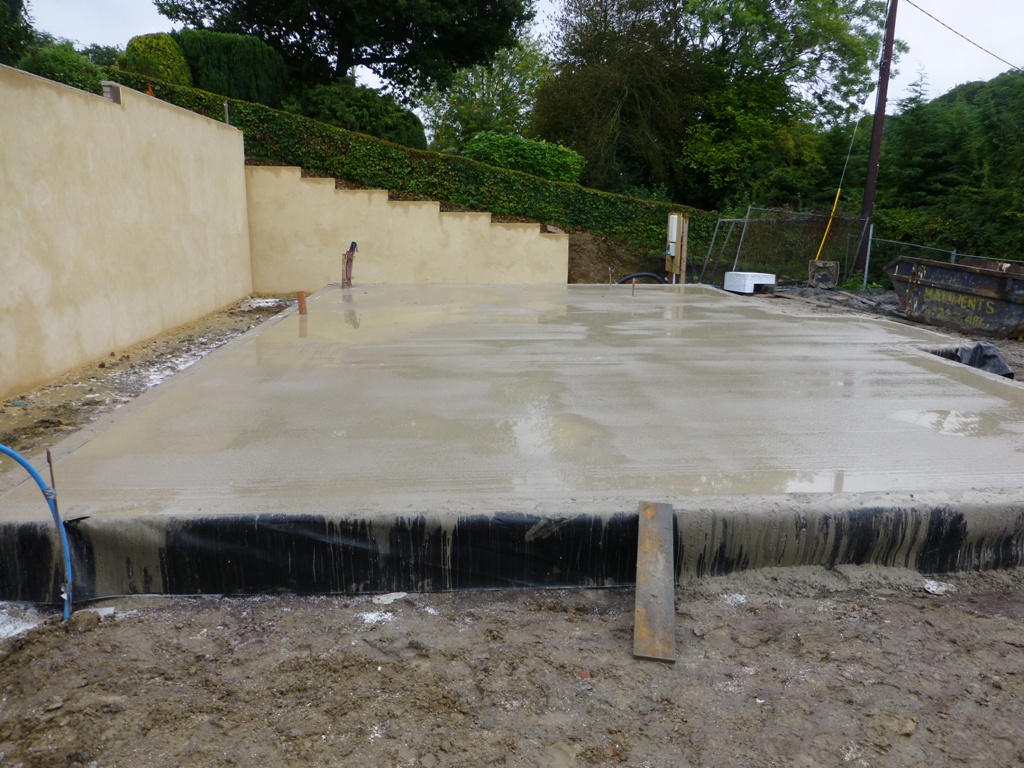
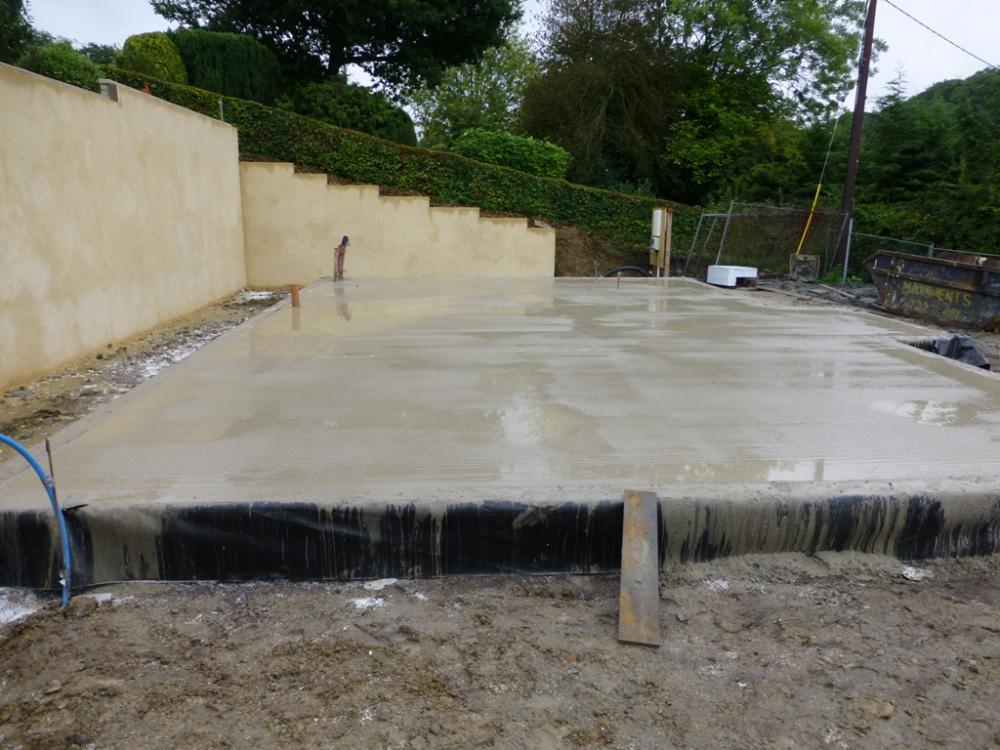
My very helpful local OpenReach engineer supplied a load of free Duct56, hockey stick bends, cast iron boxes etc. This was just cast into the slab alongside all the other stuff, you can just see all the ducts coming up at the far corner of the slab:
-
Yes, I ran the ducting in there, as it seemed an out of the way place to stick all the odds and ends that I didn't want on show in the main part of the house. On that bit of wall there is the power for the ASHP, the ASHP command unit and the thermostat receivers for the wireless thermostats. Underneath the work surface that's below that photo is the UFH manifolds and controls, with a space for dirty boots and shoes in front of it (this is right by the back door).
-
I'm pretty sure they were Adastra IW5s. I can't find the place I bought them from, but a quick look around shows that there are lots of places selling them, like here: http://tech4homes.co.uk/adastra-iw5-in-wall-ceiling-speaker
-
This is what I did, @PeterW: The modem wasn't fussy about power, and runs on 12VDC nominally, so I have just run 12V directly down the unused pairs in the cable to provide power. This works fine, I just wish I'd had a white power plug and a bit of white two core cable for the power lead that I tapped into the home made link cable The VDSL cable is also home made, just so I could keep it short. All this stuff is tucked away on the utility room wall, so pretty much out of sight.
-
Bonding Fibreglass to PVC Pipe
Jeremy Harris replied to Barney12's topic in General Self Build & DIY Discussion
FWIW, the pipe cleaner for solvent weld pressure pipe is usually MEK, which is very similar in effect to acetone, but slightly less harmful. Buying MEK or acetone is a lot cheaper than buying the small cans of pipe cleaner. For example, you can buy 5 litres of acetone for about £20 delivered, or 5 litres of MEK for around £22 delivered, yet about 1/2 litre of "proper" pipe cleaner will set you back around £8 to £10. If you want to be really cheapskate, then you can easily make up large quantities of solvent cement yourself. A mix of around 60% Tetrahydrofuran and 40% MEK, plus some offcuts of PVC pipe cut into small bits and dissolved into the mix (to give it gap filling properties) works every bit as well as the stuff you pay an arm and a leg for in small bottles.