Jeremy Harris
-
Posts
26430 -
Joined
-
Last visited
-
Days Won
360
Everything posted by Jeremy Harris
-
There seems to be a general public illusion that insurers pay out vast sums to claimants for personal injury claims, but in my experience they very rarely do. In around 20 years of doing insurance claim and the very occasional bit of criminal work, I can only recall one case where an insurer did find the pilot they had insured wholly liable and just paid up pretty quickly. In that case even the pilot's instructor and other members of his club gave evidence that he was known to be reckless, and when I went to the accident scene it was blindingly obvious that he'd been an idiot to have even contemplated taking off from there (the crash was a stall shortly after takeoff from a short bit of grass, whilst trying to climb over some trees, with a tailwind and the aircraft practically at maximum take off weight). In that case I don't know the full sum the insurers paid out, but it was certainly at least 6 months loss of earnings from the fairly seriously injured passenger, plus, I suspect, something for the stress and trauma. It didn't go to court, and never even went as far as instructing solicitors, let alone barristers, as the evidence against the pilot was just overwhelming. Even then I doubt that the payout exceeded around £50k in total; certainly not the hundreds of thousands that people assume gets paid out.
-
Welcome. What's the spec of the slab? In particular, if using a construction method that is going to put point loads on to areas of the slab around the periphery, like a steel portal frame, are you confident that the slab will take those point loads? Block walls would spread the load more evenly around the edge of the slab, but it'd still be useful to know the slab specification, just to be sure that the edges are OK for the load that's going to be imposed.
-
The bottom line with H&S is that the person doing the work has to be content that their way of working is OK. The law uses the "reasonable" test here, and that is not clearly defined, but if it ended up in court it would be the classic case of "was an action deemed reasonable in the view of the man on the Clapham omnibus?". This test of reasonableness has been around for a very long time, and is used very regularly in and out of court. Accidents do happen where no one can reasonably be expected to take all, or part of, the blame. A court would, in all probability, say that a daily safety inspection by someone competent would be "reasonable" - it would be unreasonable, for example, to expect hourly scaffold checks. There is an onus on every individual to check the area in which they are going to be working to make sure it's safe, specifically to pick up on the fact that no one would reasonably expect any supervisor or inspector to do very frequent checks, unless there was a reasonable expectation that safety conditions were likely to quickly change. It's a subject that comes up time and time again in the sort of part time consultancy work I do. The classic, and very common, case is when a passenger in a small aircraft suffers an injury in an accident and the pilot is sued. Inevitably the pilot's insurer will seek to obtain as much evidence as possible about both the cause of the accident and the actions the pilot and passenger took before it. For example, I dealt with one case where the accident was caused by unforeseeable bad weather. I was able to show that several other aircraft in the area had been caught out by the same unusual conditions that day, and the pilots of those aircraft gave statements that they had done their usual met checks (as had the pilot of the aircraft that was involved in the accident). Both my view, and that of the AAIB, was that the cause of the accident was the unforecast weather conditions that prevailed very locally at the time. The AAIB cannot, and will not, attribute, or even hint at, blame, so their evidence isn't often used; normally their report would be submitted as supporting written evidence. My report to the insurer was that, my opinion, having looked in detail at the accident cause, visited the site, interviewed several witnesses (including the pilot, passenger and other pilots at the same club on that day) was that the pilot had acted reasonably, and done everything he could have reasonably been expected to do in order to have avoided the accident, under the circumstances that prevailed at the time. The eventual agreement was that the pilot was not considered to be liable, but it never went to court (such cases very rarely ever do) and so I strongly suspect that the insurer made a modest settlement payment to the passenger. Given they had paid me a few thousand for an opinion, I doubt they would have quibbled over doing something similar with the claimant, if only to avoid the high costs of going to court.
-

Shower(s) and hot water supply
Jeremy Harris replied to Pocster's topic in Bathrooms, Ensuites & Wetrooms
Bear in mind that even the biggest single phase electric shower will only deliver a bit less than 5 litres per minute of water at around 38 deg C to a shower head, if that. -
I think it depends a lot on your water quality and a host of other things, like the type of shampoo or soap used When we had sealant exposed around the shower/bath it was a very regular job to clean off the pink fungal (?) growth on the stuff, then gradually it would get black growth that could initially be cleaned off with a bit of diluted bleach, then it would get so bad, after around three years or so, that I'd have to rip the sealant out and replace it. The type of sealant used seemed to make little difference, with the ones advertised as being resistant to fungal growth being little different to the others. In the end I just fitted PVC trims so there is virtually no sealant on view at all, and that seems to have made keeping that area clean a lot easier. We still get a bit of the pink stuff, but never seem to get the much harder to remove black stuff.
-
Kingspan heating (or lack of) issue
Jeremy Harris replied to Lynford's topic in Air Source Heat Pumps (ASHP)
Normally B goes to the coil in the cylinder, so it does look as if the valve may be the wrong way around. One of the experts like @Nickfromwales will be along shortly to confirm or deny this, I'm sure! -
It fits with another point I've made elsewhere in the past, that's unrelated to H&S related issues. If you are going to project manage your own self-build you really do have to be on site very regularly, even if it's just for a half hour walk around and chat to whoever is working. Failing to do this is almost a near-certain way of ending up with problems, often not out of incompetence, but just from people "doing what they always do" rather than specifically what you want done. It's also a way of reminding people, perhaps gently, of the sort of fit and finish you're hoping for, as a way of helping to ensure things are done well. Tradespeople aren't mind readers, and although you may have the overall plan of what's going where later, they won't, so could very easily put things in the wrong, or an inconvenient, place just by accident.
-
Portaloo Massacre: no unreasonable offer refused
Jeremy Harris replied to ToughButterCup's topic in Project & Site Management
The woods were full of people who had got there early and were camping. There was a cornfield next to the arena, and many used that instead of the official arrangements. I remember the field well, as on the afternoon that Quintessance were playing, I wandered off there for a pee, and came across a girl called Poppy. I would guess we were both "under the influence of pharmaceutical products", as I remember her wandering over to me, smiling, and suggesting that we explore "horizontal metaphysics". It was probably the second most amazing thing about the festival, with Barclay James Harvest, complete with a full classical orchestra on stage, playing at sunset being the most absolutely amazing experience. I still have their album I bought as soon as I got back from Weeley. I never saw Poppy again, and have no recollection of us talking at all. We just wandered off, smiling at each other, afterwards, in search of the next amazing experience. -
Yes there are. I don't think I'll ever forget my meeting with this bloke. It was in his site office on the caravan site, and the bloke was a bit like a gangster. Smiled the whole time, but was clearly a ruthless character. He didn't even know that he had the power to say no to these extensions, and force their demolition if he really wanted to push it, until he received the letter from the vendors solicitor when our solicitor uncovered the covenant and lack of evidence that it had been complied with. I'm certain the vendor had asked the farmer for permission at the time, but just didn't get it in writing or have it lodged with the deeds. The bloke called Pratt just saw it as way to make easy money from an old lady, or so he thought.
-
Shower(s) and hot water supply
Jeremy Harris replied to Pocster's topic in Bathrooms, Ensuites & Wetrooms
I measured the shower at our old house, an ordinary mains fed one with hot water from a combi boiler, It hasn't got a massive flow rate, but was a bit over 10 litres per minute, so 100 litres for a 10 minute shower. A big rainfall type shower could easily be double that, I think. Not all that flow will be hot water, depending on the incoming hot and cold water temperature to the mixer, but I used to run our hot water at 50 deg C from the combi, the shower would run at around 38 deg C and the incoming cold water was between 6 and 8 deg C, so perhaps 70 to 80% of the total flow rate would have been hot water at a guess. -
Not much use now, but I included a clause saying that although we had provided scaffolding, it was erected and certified by MJ Scaffolding and all liability for them using it rested with that company. If they spotted an unsafe or changed part of the scaffolding then they should stop working on it and inform me, so that I could call the scaff company out. Only one company bothered to do this, and then only after a near-miss accident, and that was the solar panel installers. Everyone else who used the scaffolding just unbolted and moved bits, untied ladders and moved them, shifted boards around, you name it, and it was up to me to walk around each day to see what had been buggered up and then call the scaff company back.
-
Ours had one too, but it doesn't stop every trade on site just deciding to alter the scaff willy nilly. I had to keep calling the scaff company out to rectify unauthorised alterations made by others, and just accepted the £50 or so charge I got each time. It didn't matter how many times I told people not to touch the scaff, they still did. I even threatened one company (the fencing company) with action to recover the cost of getting the scaff reassembled properly, as I had motion camera images of them unbolting stuff and moving boards, but they were such a PITA about it that I just chose not to continue with trying to recover such a relatively small amount, but told them they would never get any more work from us and I'd tell everyone who asked not to deal with them.
-
A self-builder will usually be a domestic client, so only needs to be concerned with site insurance, not personal liability insurance (which you probably wouldn't be able to get unless you were a tradesperson anyway). I did the much the same as @HerbJ and just asked for copies of each contractors liability insurance. There were a few exceptions for low-risk minor works (like the chap I had in last Monday to clear some ground, lay some topsoil and help plant some trees), but in every case I did check that somewhere on their paperwork they stated that they were insured. I also made it clear to every one on site during the build stage that my site insurance did not cover them for anything, and that I had no plant or tool insurance and would not be held liable for any losses if they left kit or tools on site overnight. I didn't have any problems, but as others have noted, virtually no one wore any PPE on site, and some chose to leave tools on site, despite me warning them that it was their risk.
-
The potential problems you have to look forward to isn't the relationship between you and the vendor, it's the relationship between successors in title, as the covenant will automatically pass to them if either of you ever sell. I can give an example from personal experience: In 1997 we purchased a house in West Sussex that had been built in 1959, by the husband of the widow that was selling it. They had bought the land from a farmer, not long after they got married, who eventually sold the surrounding land and then it was sold again to a company that built a caravan park on a part of it, and let the fields behind our house to another farmer. The vendor had built two extensions at the rear as their family grew, both with planning permission and building regs approval, so there was no issue there, but there was a covenant in the 1959 deeds that was worded exactly as your is - anything built on the land had to have the prior approval of the vendor or their successors in title. The vendor assured us that they had spoken to the farmer who'd sold them the land and he had given them permission to build the extensions during the 1960's and early 1970's, but there was nothing in writing with the deeds or any of the approvals. My solicitor wasn't happy, so got the vendors solicitor to write to the successor in title, the company that owned the caravan site and fields, and they demanded £5,000 plus legal fees to retrospectively grant permission for the extensions. Bear in mind that this company didn't even own the adjacent land at the time the extensions were built. This very nearly scuppered the deal, as the lady selling didn't have the money to pay the company that was effectively blackmailing her and our solicitor said it wasn't our problem, but the vendors, and advised we should just walk away from the purchase. I went to see the landowner (a chap called Mr Pratt..........) to try and negotiate with him, on the vendors behalf (she was an elderly lady, recently widowed, and was getting really upset by all this) and he told me that because I was creating a problem for him, he was now going to double the charge to £10,000. I spoke to our solicitor and he said we could get the vendor to take out a one-off insurance against any action being taken, but I was bloody annoyed at the greed of Mr Pratt. I wrote him a letter, on the vendor's behalf (signed by her), sent by registered mail, formally requesting retrospective permission for the erection of the two extensions, and telling him that unless we heard from him or his legal advisor within 10 working days his retrospective consent would be assumed and recorded with the deeds. He didn't reply, and ten days later the letter, and proof of receipt from the post office was included in our deeds, together with a letter from the vendors solicitor to the adjacent land owner telling him that he had granted retrospective approval by failing to respond. Our solicitor added a note that the 1959 covenant in the deeds was now deemed to be null and void, on the basis that no enforcement action had been taken. All told it added over a month to the purchase and a lot of stress for us (we were living in Scotland at the time and travelling down at weekends) and even more stress for the vendor, who had no idea that the old covenant could have caused so much trouble.
-
Why not just make clause 4 the same as PD rights? They are designed specifically to allow unobtrusive development and additions, that shouldn't interfere with any neighbours, yet still allow sensible structures like sheds and single storey extensions (within tight limits) to be built. I'd suggest changing that clause for to read: "in accordance with the provisions contained within the Town and Country Planning Act (General Permitted Development) Order 1995, as amended at the time of any additional development" although strictly speaking the whole clause is redundant anyway, because of the restriction that will always apply under PD. The order is here: http://www.legislation.gov.uk/uksi/1995/418/contents/made and there is guidance on it here: https://www.planningportal.co.uk/info/200187/your_responsibilities/37/planning_permission/2
-
Portaloo Massacre: no unreasonable offer refused
Jeremy Harris replied to ToughButterCup's topic in Project & Site Management
Just found some old photos of the "facilities" at the festival mentioned above. They don't show the scaffolding over the deep trench, though, just the delicately screened entrances: You can just make out some of the vertical scaff poles, the "seat" was a horizontal scaff pole that you perched over, holding on to the nearest vertical pole like grim death. I can't recall there being any hand washing facilities or even bog paper. Looking back on it now it seems pretty grim, but I can't remember being bothered by it at the time, Then again I can't remember a lot about that festival, like most I was pretty put of it much of the time. -
Not sure what @ProDave used, but we used ABB Multipanel, and found it to be excellent. I fitted it around 8 years ago to our old bathroom and it still looks like new. It has a ply core, watertight click together joints and it's only failing is the very poor bottom sealing trim, which is frankly so bad that I'd never use it, but use one of the other methods pictured on other posts here.
-
Valleys and Soaker - Lead or GRP
Jeremy Harris replied to Tin Soldier's topic in Roofing, Tiling & Slating
FWIW, the two lengths of GRP valley that I have going spare, if anyone wants them, are exactly the same in @Tin Soldier's first link, but they wouldn't be my first choice for a slate roof, as I think the raised upstand tends to hide the valley a bit better, and doesn't leave the edges of the cut slates on show. -
Portaloo Massacre: no unreasonable offer refused
Jeremy Harris replied to ToughButterCup's topic in Project & Site Management
Back in 1971 I went to a festival at Weeley, near Clacton, where the facilities were just a long deep trench, with scaffold arranged over it. One perched on a horizontal scaffold pole and held tightly to the vertical poles, trying desperately not to fall backwards into the trench. I found this website a while ago: http://www.ukrockfestivals.com/weeley-festival.html , and after a lot of careful looking though the photos found one that has me in it, not that it's easy to recognise me, as I had the obligatory shoulder length hair and no beard back then. -
Valleys and Soaker - Lead or GRP
Jeremy Harris replied to Tin Soldier's topic in Roofing, Tiling & Slating
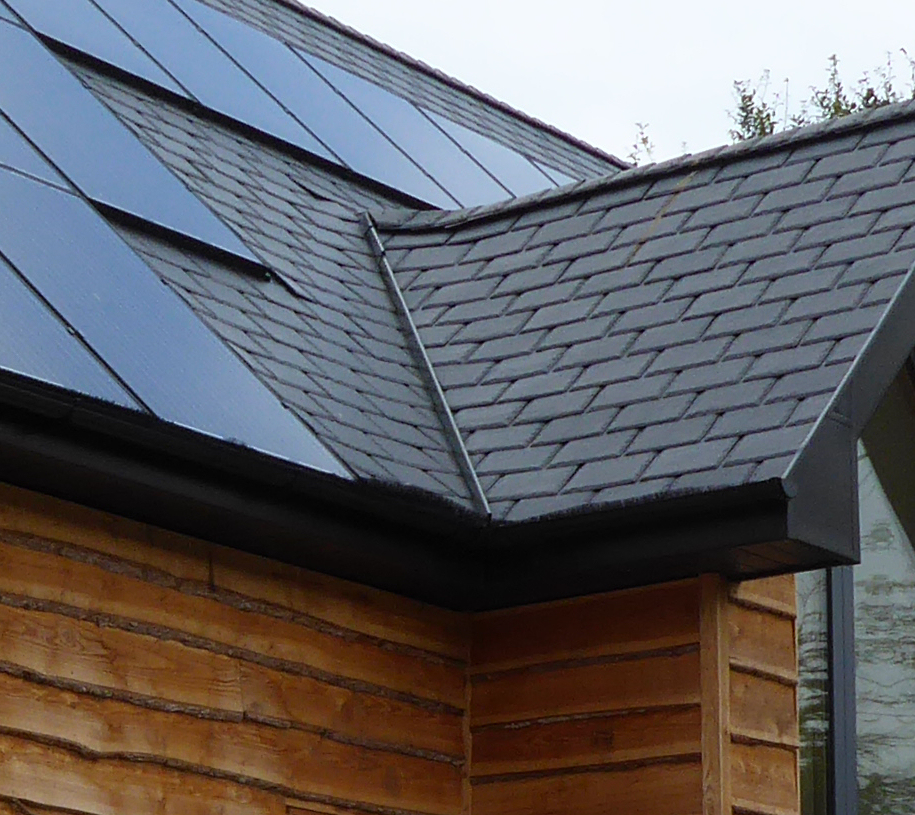
We used pre-formed GRP valleys. If using slate, I found that the type with the upstand in the centre look much neater, as the cut edges can be abutted to the upstand, making the valley less obtrusive looking. I still have two grey GRP normal valley sections (i.e. not the ones with the centre upstand) left over, as we had the wrong type supplied, so if anyone wants them they can have them if they collect them. This is what ours look like with the upstand bit in the centre: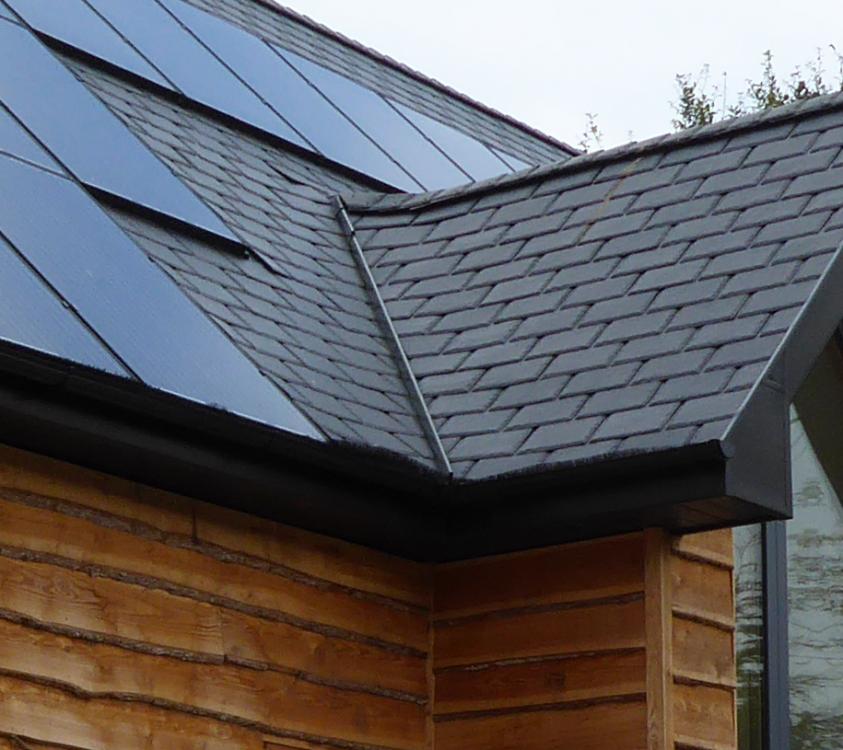
-
I should have spotted this earlier. I found that Jasun Envirocare will supply custom made filters for any MVHR at a much lower price than the manufacturer charges. In our case I bought five sets of filters (10 filters in total, 5 G4 and 5 F7) custom made to fit our Genvex Premium 1L for a bit less than the price of 1 set of filters from the UK Genvex agent. As far as I can see the filters look absolutely identical apart from the labels, and even have the same colour filter material, same number of pleats and identical looking card frames. I suspect that someone, somewhere, is making loads of money on high priced filters.
-
BT/Openreach - a private monopoly in action
Jeremy Harris replied to a topic in Networks, AV, Security & Automation
This last exchange about speed, plus a chit through the post today telling me that they have just doubled my upload speed (which seems true, I've just run another test and can now almost get 2 Mb/s upload, but only 3.9 Mb/s download) has spurred me to complain (again) about our really poor fibre broadband performance. Last time I complained nothing happened and the state of the copper loop from BT was blamed. Given that there will be an obligation in a couple of years to give me at least 10 Mb/s download (bearing in mind that I'm paying for an "up to 38 Mb/s" service), it will be interesting to see how they respond this time. Last time I complained nothing happened, so I don't hold out a lot of hope, especially as I'm with Plusnet, who are owned by BT................. -
BT/Openreach - a private monopoly in action
Jeremy Harris replied to a topic in Networks, AV, Security & Automation
If the price was reasonable, I'd be prepared to pay a one-off charge for FTTP, especially as, geographically, I'm only around 400m from a fibre enabled cabinet with loads of spare (unfilled) slots in it. It's just a matter of running the fibre along a row of poles and through our conduit, really. Our problem with the copper loop is that it runs in the opposite direction to the cabinet for a few hundred metres, then doubles back. It doesn't need to, there are now a row of poles directly along the lane from the cabinet to our house, it's just the hodge-podge way the system developed as the village expanded. BT, or it's predecessor GPT Telephones, ran the main trunk cable up the wrong one of the two lanes that fork out of the village and village development stopped on the lane they selected and switched to run along the other lane instead. If they just re-routed the main trunk cable up the "right" lane we'd probably get three to four times the speed we get now, even on FTTC. -
BT/Openreach - a private monopoly in action
Jeremy Harris replied to a topic in Networks, AV, Security & Automation
By contrast, I have a ~1.5km long copper pair connected via FTTC and VDSL 2 and struggle to get better than 4 to 5 Mb/s. -
BT/Openreach - a private monopoly in action
Jeremy Harris replied to a topic in Networks, AV, Security & Automation
I'm pretty sure I've never heard anyone praise BT Openreach here, or on Ebuild. Their management is the main problem I found; once I found the mobile number for the chap that looked after our local area he was great, and bent over backwards to help, but even he was thwarted several times by his own managers. An example, the local chap had managed to get all the duct, cable, hockey sticks, cast iron boxes, etc delivered to our site, as I'd agreed that we would run all the cables for them, as we already had trenches open where they needed to go. He suggested we leave long lengths of cable coiled up at the poles at either end of our site, ready to be connected, which we did. When we couldn't get the connection team out to take down an overhead cable that was in the way and connect the new cable we had laid, the local chap's solution was simple, He told us to "accidentally" snag the overhead cable with a digger first thing the next morning, then call his number. We did this and a connection team arrived within half an hour. They took one look at the coils of wire waiting to be connected, and the broken wire, muttered that this was "another (name of local chap) job" and made the connections within half an hour, including the run up to our house external junction box. Apparently this was the only way to get the connection team to do anything on time, as they are required to fix broken lines ASAP, so this job goes to the top of the list. From what I could gather it was a fairly common tactic used to get jobs to the top of the priority list. All told, I first contacted BT Openreach in January, got a chap out on site within a week or so to look at the work involved, agreed we needed the work done in June and finally got it done some time in August. The DNO were slightly better, we paid them in full in April, agreed a date for the work in June and they also eventually got around to doing the work in August.