Jeremy Harris
-
Posts
26430 -
Joined
-
Last visited
-
Days Won
360
Everything posted by Jeremy Harris
-
The only exception to that might be for a design where the insulation forms an intrinsic part of the airtightness, such as when pressure blown cellulose or a thick layer of a spray foam like Icynene is used. Both these types of insulation are highly resistant to "wind wash", so contribute a fair bit to the airtightness of the structure.
-
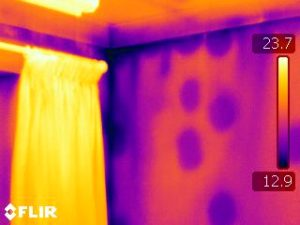
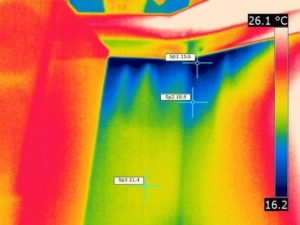
It's near-impossible to stop cold air getting behind dot and dab plasterboard without sealing the blockwork, as several tests have shown. The main problem is that blockwork is inherently porous, especially at the corners of mortar joints, so air will flow through and around any slight gap behind the plasterboard, bypassing any insulation that may be in the cavity. Doesn't really matter how you do the dot and dab, this will always be a potential problem, although using continuous beads on all edges and around all openings makes a slight improvement. Parging the blockwork before applying the dot and dab plasterboard is probably the cheapest and quickest fix, as that should seal up any porosity at source. Easy to test to see whether cold air is getting behind the plasterboard, just point a thermal camera at it on a day when there's a cold wind blowing. If it looks like this then you may as well not have bothered putting insulation in the walls:
-
The lid problem can be fixed by cutting the second layer of neoprene out so that it gives a bit of clearance around the pipes. This then allows it to compress more easily and allows the top layer to sit a bit better. Mine doesn't bulge like that at all now, having done this. Arguably the middle layer of neoprene should be supplied with cut outs a bit wider than the 4 pipes where they run out to the side, but I guess they don't do that because they don't know which side the customer will run the pipes. An instruction in the manual to make a series of generous slots in this section of the foam would be useful.
-
Yes they do, it's normal. Not great, but I did look closely at the cause and called Sunamp about it, and it's not a problem. The cause is just a lack of rigidity in the large single PCM cell, and in the design of the case. They have redesigned the lid to try and overcome the distortion in that, but the flat sides of the case do still bow out a bit. Doesn't do any harm, AFAICS, but I'd like to see the case, or perhaps better, the cell casing, made a bit stiffer to prevent this. Personally I'm not losing any sleep over it.
-

PIR security light wiring
Jeremy Harris replied to oldkettle's topic in Networks, AV, Security & Automation
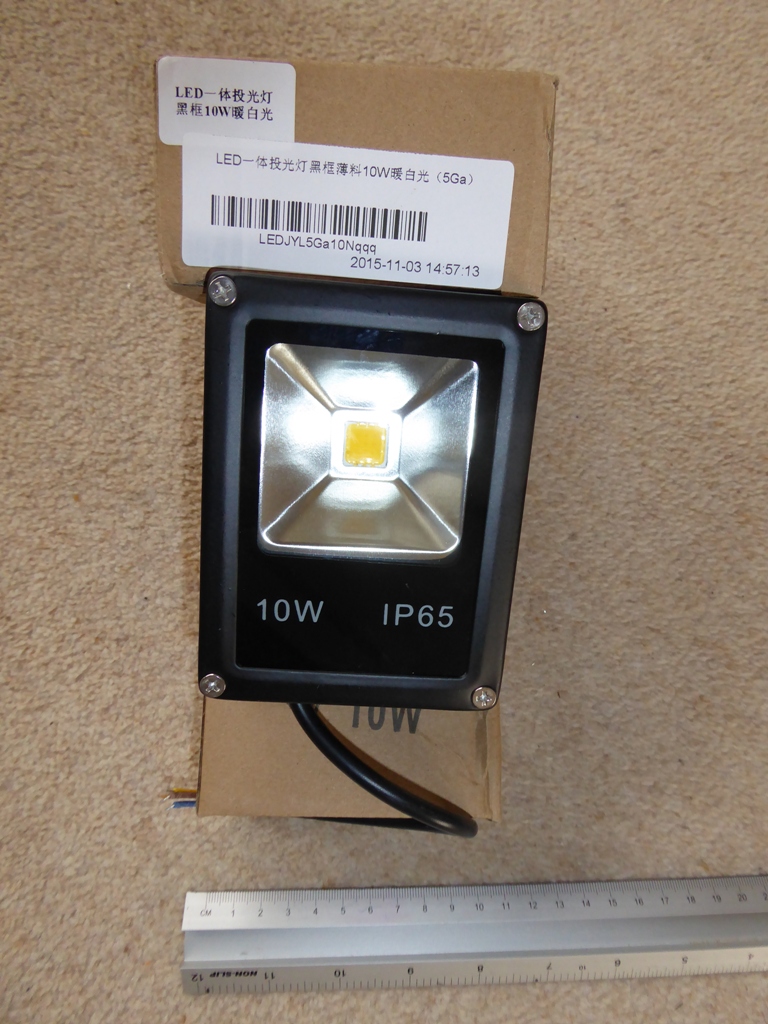
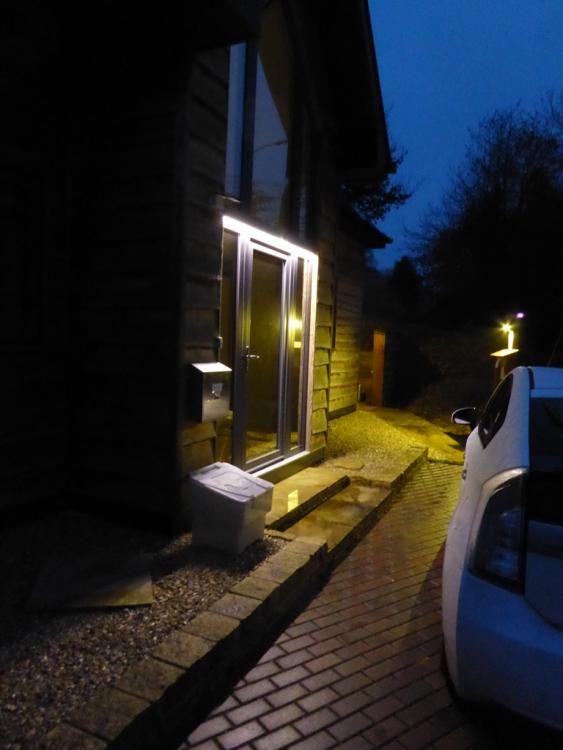
They look very similar, and are almost certainly the same construction as the ones I have. Using an outdoor junction box is fine, if that's easier, but I'd try and keep the short cable they come with out of the sun, as it's probably PVC, and may harden and degrade when exposed. These lights are all (AFAIK) made in China, and can be very good value (look on eBay for cheaper ones that may well be absolutely identical). The issues I've found have been missing earth connections on all the ones I've bought (from two different suppliers, one in the UK, one in China), and screws on the front (M4 x 12mm on the front) , and on the bracket (M6 x 12 on the bracket, IIRC) that corrode very quickly. Apart from those issues (easy and cheap to fix, just connect the internal earth and replace the screws with stainless), the lights are very reliable and give a nice, warm, light that's not too bright (ideal for us as we are within a "Dark Skies" area). This is what a pair of these PIR switched 10W floodlights look like at the side of our house: and this is one mounted on the post that has my car charge point on it (ignore the LED strip light above the front door, although that's also PIR switched):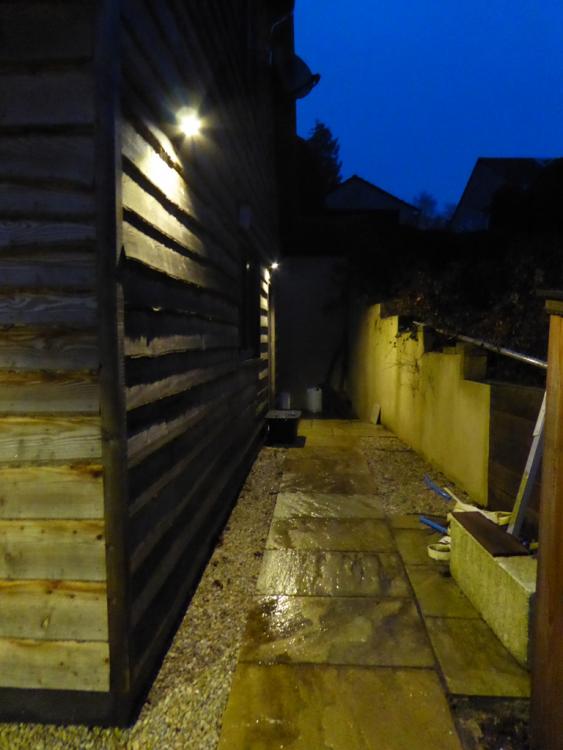
-
PIR security light wiring
Jeremy Harris replied to oldkettle's topic in Networks, AV, Security & Automation
Are the lights similar to these: If so, then fitting a new cable isn't hard, but does need the ability to make a wire-to-wire insulated joint inside the unit, using crimp in-line connectors or soldering with heat shrink sleeving. Happy to talk through how to fit a new cable to similar lights to these. I bought a reel of cable from Screwfix to make new cables for all the ones I have: https://www.screwfix.com/p/time-rubber-pond-flexible-cable-3183p-3-core-0-75mm-x-25m-black/61627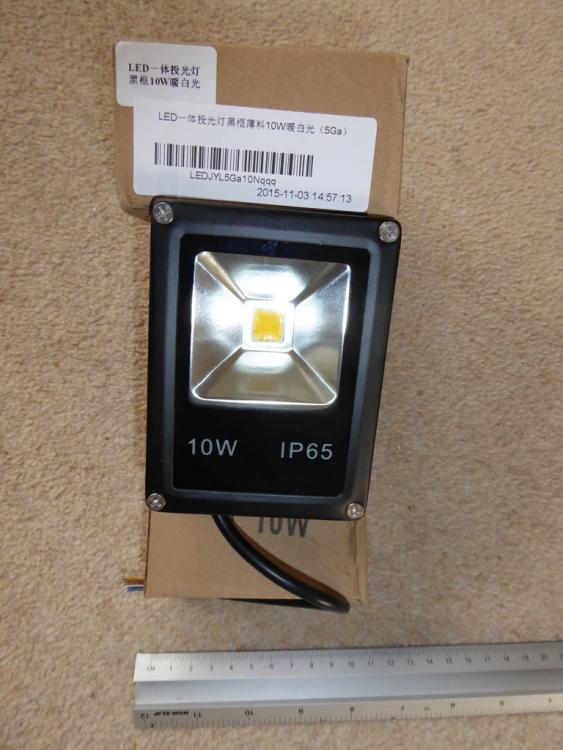
-
PIR security light wiring
Jeremy Harris replied to oldkettle's topic in Networks, AV, Security & Automation
IMHO it's better to try and fit a new, longer, cable to the light. I have a few LED outdoor lights, and they all came with short cables (and no earth connection...) and I replaced the cables on all of them. Not hard to do. I used 3183P 3 core rubber "pond" cable, as it's pretty durable when used outside and fitted the cable gland on the light fittings. -
All mine are T568B too, as for some reason this seems to be more common (at least here) than T568A. No idea why. Anyway, there is still a crossover with T568A, it just switches to being the orange and orange/white that get split, so just as awkward to fit into the connector.
-
The snag is they don't go into the connector in pairs, the green and green/white pair have to be split either side of the blue and blue/white pair, which is what creates much of the problem in trying to hold the eight wires flat and in the right orientation to slide into the connector, IMHO.
-
Does Antifreeze make your heating quieter?
Jeremy Harris replied to ProDave's topic in Underfloor Heating
Might it also be that the glycol is lubricating the pump a bit better than water? -
Looks very similar, but mine is ancient, at least 20 years old. The neat thing is that it holds all the wires tightly in the right order and alignment to slide them into the connector. I've found that it's pretty foolproof, as it's easier to feed the wires into the tool than it is to try and hold them between your fingers whilst pushing them home. Not sure about that one, looks like it may only work with their connectors.
-
There's a definite knack to getting all the wires dead straight, in the right order, and of exactly equal length before you push them into the connector. I have a tool that I acquired years ago from a telephone engineer, that has a pair of narrow flat jaws with grooves in, that grips the eight wires tightly at exactly the right pitch to slide into the connector. It makes fitting connectors a lot easier, as once you've sorted all the wires into order and got them in the tool, you can just trim them dead square, then push them home. There's another potential gotcha with the connectors, too. Some have IDC terminals that seem designed for the multicore flexible Ethernet cable, others have narrower IDC terminals that work better on solid core cable. I've yet to find an easy way to tell the two apart, other than the fact the the ones designed for multicore cable don't work reliably on solid core cable.
-
We used to do much the same, practically camp out in the barns, at night, keeping dead quiet and waiting for the rats to pop up. The great thing about having young weaners in the pens was that there were heat lamps running, so the barn was warm and we could see to shoot the rats. My cousin's gran used to keep chickens on their farm, and his party trick was to stick a sheet of wrinkly tin on the ground by the chicken pen and leave it for a few weeks so that the rats felt safe nesting under it. He'd then get his dad's 12 bore, don a pair of steelies and kick the sheet of wrinkly tin in the air whilst letting the rats underneath have both barrels. We had to dissect a frog and a rat in biology, which was OK, but the really fun dissection was when I bought in a pigs head from home. Had to borrow a hacksaw from the metalwork shop to cut its skull open to get the brain out...
-
Not as sporting as a 410 or an air rifle, though. Years ago, on my Mother's previous farm (an intensive pig farm), we had some old rubblestone barns that had been converted to house concrete block pig pens. The block walls went around the base of the old rubblestone walls, to stop the pigs rooting out the lime mortar. The result was a small gap between the barn walls and the block pen walls, where rats loved to hide. We couldn't use poison, in case a poisoned rat came out and a pig ate it, so the only way to control them was to shoot them. The block walls were around 4ft high, so the secret was to sit dead still with a gun ready to swing left or right if a rat popped up on to the wall. I found the .22 Airsporter was a bit better than the 410, and didn't piss off the pigs as much. Still damned tricky trying to hit a rat running along the top of the wall. The bonus was if the rat fell into the pig pen after being shot, as pigs don't mess around when there's a bit of extra food chucked their way.
-
I've had the same with glyphosate. I used to be able to go in the local farm store and buy the concentrated stuff for a fraction of the price they charge for the diluted stuff sold as Round Up and the like, but now that's restricted and can only be sold to account holders. I can still buy 5 litre cans of Gallup 360 (now re-branded Gallup XL, I think) on eBay, though, and that's not supposed to be sold to the general public, it's professional use only.
-
You can get pre-insulated twin pipe for just this sort of job, where you need to run the flow and return from a boiler or heat pump some distance underground: https://www.polypipe.com/housing/pressure-systems/pre-insulated-pipes Laying this before your slab goes down would seem to be a reasonable option.
-
Why does the ASHP have to be a split? There's no real problem with running a (often cheaper) monoblock, with the flow and return pipes 15m long, using insulated pipe.
-
Help with kitchen renovation/ 1st house.
Jeremy Harris replied to zoothorn's topic in Bathrooms, Ensuites & Wetrooms
https://en.wikipedia.org/wiki/Merkin ? -
I have used fairly cheap plastic trays in the back of my last three cars. They were all from eBay, (like this one: https://www.ebay.co.uk/itm/TAILORED-PVC-BOOT-LINER-MAT-TRAY-Skoda-Superb-Estate-since-2015-lower-trunk/401571377397?hash=item5d7f84f0f5:g:FdoAAOSw6AVbVYv8:rk:29:pf:0 ) and are made from a super-tough, flexible, plastic, with a non-slip pattern that looks like tread plate.
- 77 replies
-
- 1
-

-
- estate car
- load capacity
- (and 2 more)
-
Build a stone pillar around it to match the wall that's to be clad?
-
Ecology and anger. Bedfellows.
Jeremy Harris replied to ToughButterCup's topic in Planning Permission
Our landscaping chap always refers to nails he finds around as "puncture seeds". Must have pulled hundreds off our plot with the aid of my home-made "magnet broom".- 12 replies
-
- 1
-
-
- ecology
- wyre borough
- (and 4 more)
-
I just bought a couple of plain manifolds with 15mm connections (not expensive, IIRC they were around £15 each at the most) and added in-line shut off valves on each leg, to isolate each room with a hot/cold water feed. Works pretty well, and I doubt it cost any more than plumbing the house any other way. It also made it easier to ensure that I have no pipe joints hidden in the ceiling or walls, as the run of pipe from the manifold in-line valve to the point where it pokes out of the wall to supply something is a continuous length of pipe, with no joints.
-
I have 4 non-branded Makita lithium packs and found they all work as well as the genuine ones. I've hammered two of these non-branded packs, too, as they are used pretty much exclusively in the lawn mower, which doesn't treat them gently.
-
Thanks, @billt, that's very useful, as the only reason I've asked for FTTP is because I saw the guys stringing the fibre through the village a month or so ago. Opposite direction from where I want it to go; it runs from the newly extended fibre cabinet back along the main street of the village to the Post Office, but at least it seems to indicate that the cabinet is enabled to provide an FTTP connection. I walked along the lane from the cabinet to our house today and I reckon it's about 230m of fibre slung on 5 poles in total. The distance could be shorter if they opt to sling the fibre along the power cable from the sub-station, which is something that they can do with fibre with no problem, as long as the DNO agree. I'm pretty sure distance has little or no effect on FTTP performance, though, so the only real saving would be in installation cost. Hopefully, running a pole-mounted fibre node in the direction of our house would result in more people our end of the village asking for FTTP, so I'm not sure how they go about amortising the "trunk fibre" cost.
-
I can see why the regs changed, though. The fire service campaigned for it, and BRE recommended the change to fire resistant metal cable fixings back in 2015: Fire-Performance-of-Cable-Installations-Aug-2015.pdf