Jeremy Harris
-
Posts
26430 -
Joined
-
Last visited
-
Days Won
360
Everything posted by Jeremy Harris
-

MVHR air flow rates
Jeremy Harris replied to lizzie's topic in Mechanical Ventilation with Heat Recovery (MVHR)
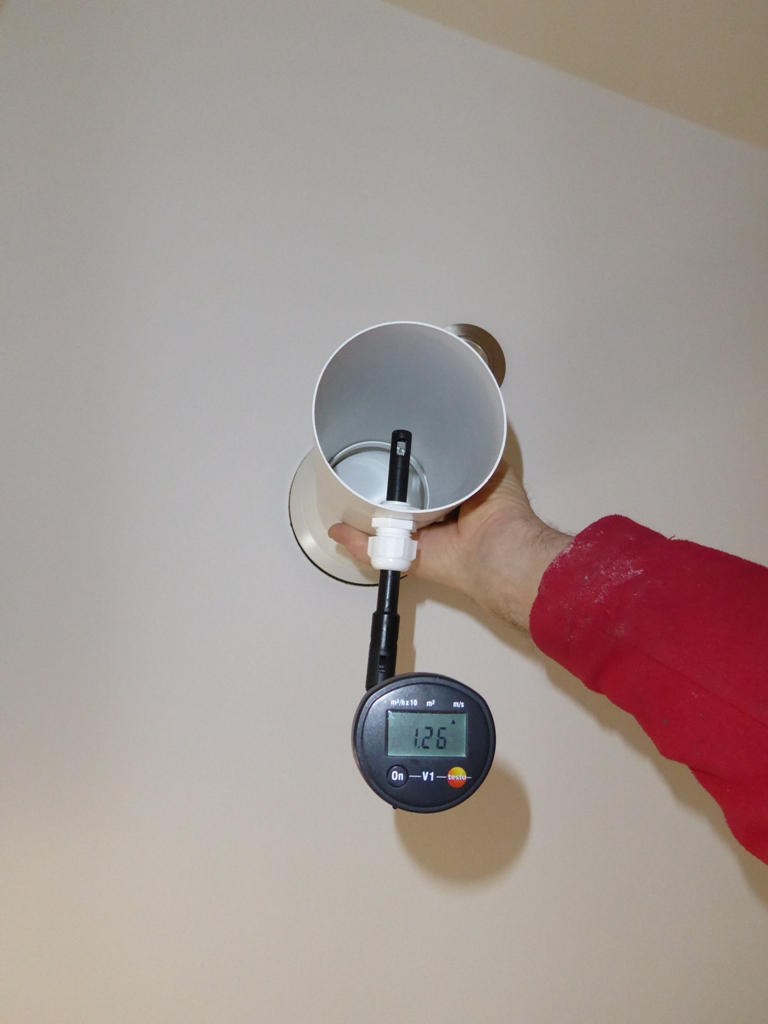
The air flow rates can't be measured by the MVHR, they need to be measured using an air flow meter at every room terminal. Sadly, I suspect that many, many MVHR systems may be installed and "commissioned" without bothering to set them up properly, let's hope yours is an exception, despite the room terminal readings not having been recorded. The process is to start by setting the MVHR to the background ventilation rate (the rate it runs at most of the time) and then go around every terminal using an air flow meter to measure the flow rate either in to, or out of, the terminal, and write the reading down. Here's a photo of me measuring one of our terminals that shows how it may be done (there are different types of air flow meter): Once a set of baseline readings for every terminal have been done, the first thing is to add up the rates from all the supply terminals, then add up all the rates from the extract terminals. The total air flow for all the supply terminals must equal (more or less) the total airflow from all of the extract terminals, this ensures that the system is balanced and operating at best efficiency. If the system isn't balanced then the terminals need to be carefully adjusted to get the system in balance, or restrictor rings have to be fitted if the system uses that type of flow balancing. Once balanced, the air flows need to all be measured again and the total background ventilation rate must equal or exceed the rate given in Part F, calculated from the house area. If all's well so far, the the next stage is to increase the MVHR fan speed to boost and check the extract flow rates to ensure that the minimum room extract rates for the kitchen, bathrooms, WCs, utility room etc can be met. Those rates are in table 5.2 in Part F IIRC. The chances are that the whole house background ventilation rate may already exceed the required extract rates, in which case there's no need to do this second set of tests. When everything is completed you should have a balanced system with the measured air flow rates at every terminal listed on the commissioning report. Adjusting the whole house ventilation rate up or, most probably, down, after commissioning shouldn't upset the balance, so you can adjust things for the best comfort level without needing to go around re-doing all these measurements. The measurement process is a bit tedious and time consuming, it took me the best part of a whole day to get our system balanced and set up properly.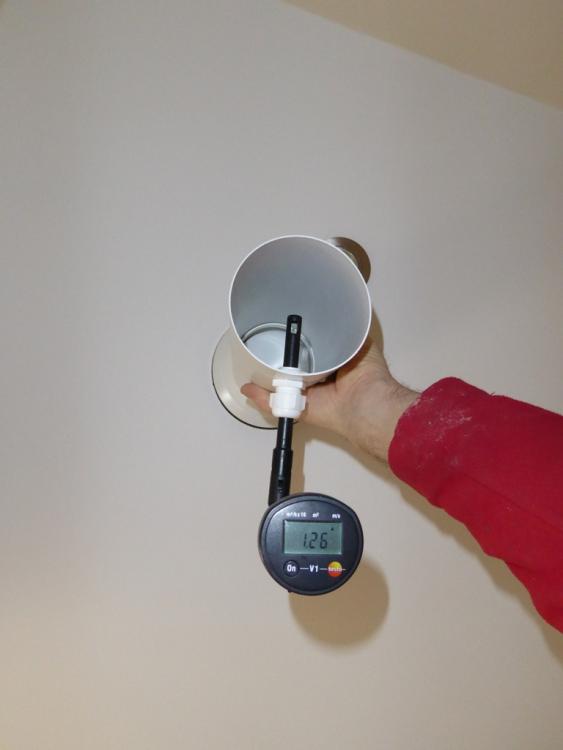
-
I agree with @TerryE here. Fitting our UFH pipes into the passive slab took less than half a day and cost a few hundred pounds. Even if I'd chosen to not connect them up I wouldn't have begrudged that cost. It was so quick, easy and affordable that it seemed daft not to just include the pipes in the slab. The big bonus for us was that when I found that our house overheats (solar gain though ~ 9.3m² of shaded, south-facing glazing, plus ~3.84m² of unshaded east-facing glazing) it turned out to be pretty easy to just cool the floor slab down by reversing the ASHP. I was very surprised at just how effective floor cooling like this is; it surpassed my expectations and is now an intrinsic part of the house temperature control system.
-
Have you modelled the passive house with PHPP to get the heating requirement? If so, then I'm surprised that you've ended up with a figure of 7 kW, as that sounds to be more like the sort of figure for a reasonably average house, rather than one built to passive house performance standards. If you haven't yet modelled it with PHPP, but want to do a "quick and dirty" estimate of heat loss, then I wrote a spreadsheet a few years ago that simplifies things a lot. It's nowhere near as refined as PHPP, but is a lot simpler, and people here who have used it have suggested that it gets within around +/- 10% of the real heat loss, which is usually good enough for sizing a heating system: Heat loss calculator - Master.xls
-
Get rid of those awful downlighters...
Jeremy Harris commented on Ferdinand's blog entry in God is in the Details
Easy to sort out, as I run ours of a single power supply. I did this for two reasons, the first was that I'd already got 12V running to the downlighter positions, the second was that I found there was a fair bit of radio interference from the small constant current power supply units; enough to make a portable radio unusable, but then we do live in an area where radio reception is pretty poor to start with. I ended up adding another 24 V power supply anyway, as we decided to increase the size of some of the units and they needed a higher voltage. The mod I did sounds crude and inefficient, but when I worked out the additional losses I found they were small enough to live with, in return for the simplicity of the approach. I made up connecting leads for each panel light that had a 2.1mm free socket on the end (so that the lights would plug straight in to the new wiring loom), and added a 68 Ohm, 1 Watt resistor, in series with the positive supply to each lamp. These resistors limited the current to each lamp to the rated 300mA, and only introduced a small efficiency loss, barely any greater than than of the rather crude constant current driver units that they are supplied with. By a happy coincidence, the same resistor value works for the 3 W, 0.3 A lamps and the 6 W 0.3 A lamps, although the latter need a 24 VDC supply and the former a 12 VDC supply. -
I'd missed that 7kW figure, too. Looks very high to me. Our house has roof and floor U values of fractionally under 0.1 W/m².K, walls at about 0.12 W/m².K and triple glazed windows that are around 0.7 W/m².K. Airtightness is about 0.43 ACH @ 50Pa. The floor area is 130m² and the worst case heating requirement, with no incidental heat gains at all, is only about 1.6 kW. In practice the house never seems to need more than a few hundreds watts of heating, and often needs no heating at all, even in winter.
-
Get rid of those awful downlighters...
Jeremy Harris commented on Ferdinand's blog entry in God is in the Details
We have flat panel LEDs in the kitchen/dining room and in the hall. They seem to have a very even spread of light, with none of the glare often associated with downlights. We originally fitted MR16 downlights in the kitchen/dining room, with 12V LED lamps, and still have a fair few of these around the house, in the bathrooms, WC utility room and my study. Replacing the downlights with panel lights was pretty easy, and didn't require any redecoration. I'll probably replace more of the downlights with panels at some future point, just to get better light quality. -
We have an air-to-air heating/cooling system built in to our MVHR (a Genvex Premium 1L). It has the capacity to heat and cool the house without any problems. Some like the feel of warm air heating, but we don't, so have never used it, instead we use UFH fitted into the ground floor passive slab. It's purely a personal preference thing, though, as at least one other member here heats their passive house using an active MVHR unit (a Genvex, different model to ours, but same working principle) and likes it.
-
how (not?) to erect scaffolding
Jeremy Harris replied to ProDave's topic in General Self Build & DIY Discussion
Ever seen them erecting bamboo scaff in the Far East? It always amazed me that the stuff ever stayed upright, let alone withstood the loads from people working on it. -
mvhr upgrade
Jeremy Harris replied to lizzie's topic in Mechanical Ventilation with Heat Recovery (MVHR)
The concern over vaporisation of bugs into the air from a humidifier is valid, but bugs from outside water vapour being introduced from an uncontrolled source has to be orders of magnitude greater than filling a humidifier from clean drinking water every day or so, doesn't it? If you are getting CO2 levels as low as 400ppm, then you're very definitely over-ventilating, by a pretty significant amount. A level of C02 of around 600ppm would be realistic for a well ventilated home, as it should not normally be as low as the open air outside, -
mvhr upgrade
Jeremy Harris replied to lizzie's topic in Mechanical Ventilation with Heat Recovery (MVHR)
No problem, PM me your address and I'll stick it in the post next week. It needs mains power (but has a battery back up for short power cuts) and can be moved from room to room easily enough. It measures temperature, CO2 and relative humidity and logs the displayed data (along with date and time) as a .csv file to a µSD card every 6 minutes. The files on the µSD card can be loaded into a spreadsheet programme (LibreOfice Calc, Excel etc) directly, and then used to produce any plots you like. -
mvhr upgrade
Jeremy Harris replied to lizzie's topic in Mechanical Ventilation with Heat Recovery (MVHR)
I made both of mine, one's built in to the house monitoring system and the other's a portable unit that logs data to a µSD card. I've loaned the portable one out to a few people - you are welcome to borrow it for while. I've not looked at commercial models at all, but the best type of sensor is fairly expensive, and uses non-dispersive IR. Because of the cost of the sensors I suspect that decent commercial units may be a bit pricey. I've just had a quick look around, and it would seem that a reasonable unit might start at around £70 or so: https://www.co2meter.com/collections/indoor-air-quality -
mvhr upgrade
Jeremy Harris replied to lizzie's topic in Mechanical Ventilation with Heat Recovery (MVHR)
I'd second what @jack has said above, and also suggest trying an ultrasonic humidifier. I built one a while ago and it really is a very effective way of increasing the humidity. The only thing to watch is to make sure that it gets fresh, clean water. Decent ones are around £30, so not that expensive as a way to see if one might improve the RH a bit and make things more comfortable. You might also want to consider getting a CO2 meter, as a way to see how "fresh" the air is really. I find that the CO2 concentration correlates very well with the "freshness" felt in the room air, and anything over around 1000ppm definitely seems to tally with stuffy feeling air. -
Interpretation of thermal images
Jeremy Harris replied to jayroc2k's topic in Energy Efficient & Sustainable Design Concepts
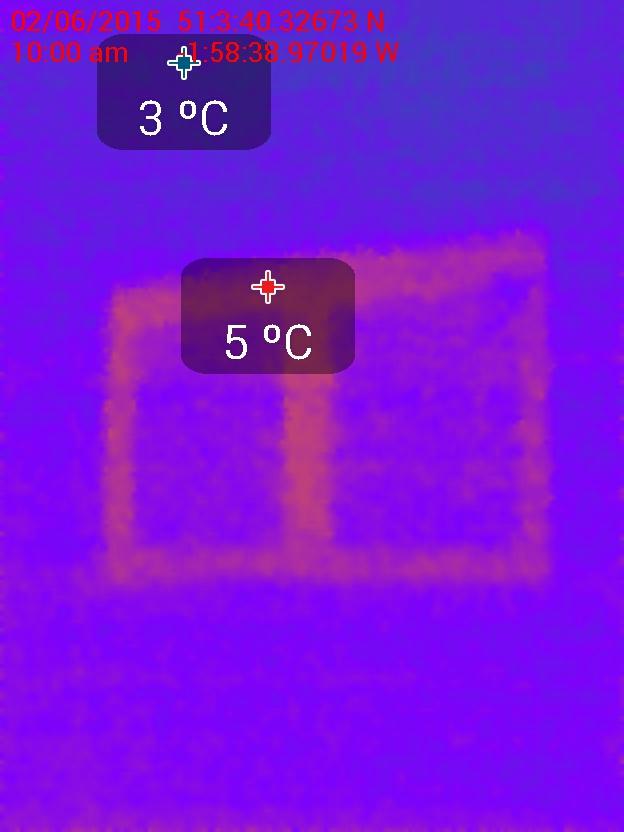
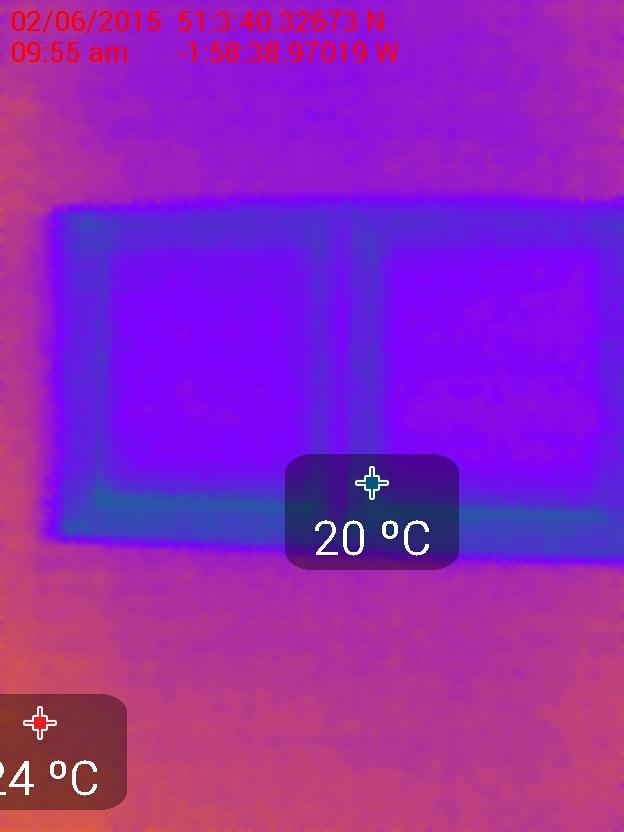
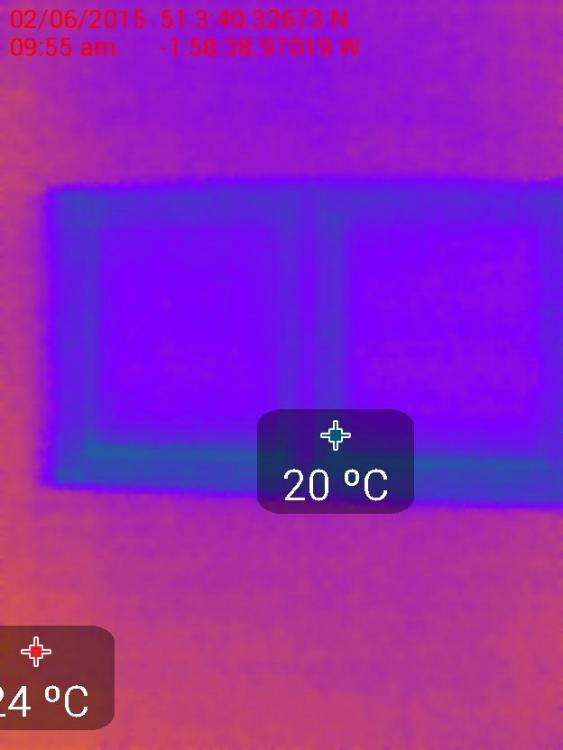
This is an image taken on a fairly cold morning of the outside of one of our living room windows, for comparison: I set markers over the highest and lowest temperature spots (useful, as it give a sense of the temperature range being displayed) but left the false colour settings to auto-adjust (this means you cannot compare the colour from one image with the colour from another, as they won't represent the same temperature). The above image shows that, as expected, the window frames have the lowest thermal resistance and that the glazing is reasonably good. However, a 2°C increase in the frame outside temperature versus the wall outside temperature isn't too bad. This image is the same window on the same day (5 minutes earlier) from the inside looking out: Again, I put markers on the highest and lowest temperatures in the image and allowed the false colour range to auto-adjust (so the colours in this image bear no correlation with the colours in the previous image) The same characteristic is present, in that the window frames are the components with the lowest thermal resistance, but again, a 4°C difference between the wall temperature inside and the coldest part of the window frame inside isn't too bad, and is probably as good as it's likely to be able to get.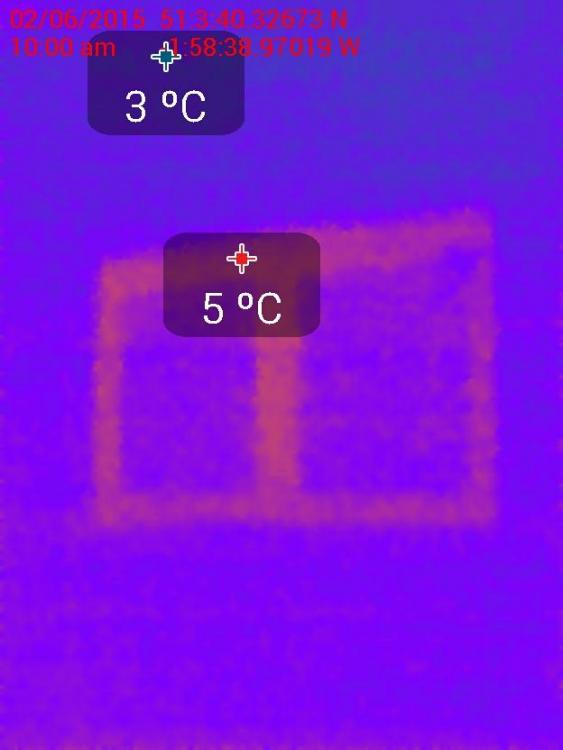
-
Interpretation of thermal images
Jeremy Harris replied to jayroc2k's topic in Energy Efficient & Sustainable Design Concepts
I have a Seek Thermal camera, and it needs using with care in order to get anything useful from it. The main thing to remember is to only try to do a thermal survey when there is a high temperature differential between outside and inside. A cold, clear, frosty night is ideal, as that will give a wide contrast range and allow heat leaks from inside to out to be far more easily identified. Finding air leaks with a thermal camera is really not at all easy unless they are pretty big. Most leaks will only show from the way the air movement has heated/cooled something adjacent to the leak. For finding leaks a blower is far easier to use and doesn't require specific weather conditions to work, either. Where a thermal camera really works well is when looking for areas of missing or no insulation, and spotting thermal bridges around doors, windows etc. it's also an invaluable tool for tracking down potential faults in an electrical installation - it's easy to spot early signs of impending trouble from poor connections, loose terminals etc from the heat generated when under load. -
I sourced it from an eBay seller in Turkey. I've had a very quick look and can't find them now, which is a pity. They were selling whole pallet loads of Crema honed and polished travertine at a good price, but they wouldn't split a pallet load, so I ended up buying around 200, 400mm x 600mm tiles more than I needed (sold them to a neighbour). IIRC the price was pretty good, around £16/m². I remember that we paid nearly as much for adhesive, grout and sealant as we did for the travertine.
-
NuLok and due diligence
Jeremy Harris replied to ToughButterCup's topic in Roofing, Tiling & Slating
Seems so, also seems, from the dates, as if there may have been a crossover when both entities may have been trading. -
NuLok and due diligence
Jeremy Harris replied to ToughButterCup's topic in Roofing, Tiling & Slating
Yes, here: Should have been brought to the attention of the mods at the time, perhaps, as it's damned close to being just a blatant product promotion, and so a breach of the forum Ts and Cs. -
NuLok and due diligence
Jeremy Harris replied to ToughButterCup's topic in Roofing, Tiling & Slating
Here's their filing history: https://beta.companieshouse.gov.uk/company/NI039864/filing-history Struck off 14th June 2016, apparently. Make of the rest of it what you will. -
NuLok and due diligence
Jeremy Harris replied to ToughButterCup's topic in Roofing, Tiling & Slating
AFAICS, they no longer exist as a UK company, only a company pretending to be in the UK but which has contact details for France and Australia only. The Irish company went bust some time ago, it seems. -
A retired roofer meets Nulok. Too delicious.
Jeremy Harris replied to ToughButterCup's topic in Roofing, Tiling & Slating
As of now, it looks as if this company barely have a UK presence. It seems their UK business is being run from France and Australia, the Irish business seems to have folded and I can't find any other current UK business other than the one that seems to be based in France. -
Here's my Bulb referral link: bulb.co.uk/refer/jeremyh2413 It's worth £50 credit to anyone that does use it (and I get £50 as well).
-
Naming property and council tax
Jeremy Harris replied to Jilly's topic in Party Wall & Property Legal Issues
There seems to a lot of inconsistency in the way addressing and council tax liability is handled, from one area to another. Here I managed to get on the address database (after a struggle) by paying a load of money to the council street naming team, then chasing up Royal Mail who initially put us on the database, then removed the address shortly later without telling us, so I had to get it put back on again Council tax was a nightmare. We had the building site broken into by a lady from the council one evening (she literally climbed over the fence, ignored all the warning signs and peered through the windows, wearing no PPE at all). She was caught on CCTV, and I only discovered who she was when we received a very stroppy letter from the council accusing me of trying to avoid paying council tax. I got a lot of useful advice from this forum's predecessor, called the council back and quoted the law to them, and asked them for the name of their employee as I wished to make a complaint to the HSE about her, for breach of site safety rules. At this point the council very swiftly backtracked, passed me up the chain to someone more senior, who tried to make out that it was a "mistake" (it wasn't, it's standard policy here, I later found out). The useful thing about this debacle was that I discovered that of the house doesn't have a potable water supply, then in law it cannot be classed as a rateable hereditament, and if it isn't a rateable hereditament than it cannot be classed as a habitable dwelling and cannot be put on the valuation list for council tax. Because the council had really angered me by their underhand actions, I chose to play hard ball, and delay connecting a tested, potable, water supply until we had virtually finished the build. I would have been quite happy to do this a year or so earlier, but the council's behaviour got my back up. I also removed the implied right of access to all council staff, their contractors, sub-contractors or agents, by sending them a recorded delivery letter giving notice of this and by fitting signs at the site entrance making it clear that entry by any council personnel would be by appointment only. To the credit of the council they never again tried to gain access to the site, it seems that they did actually take notice of the legal warning (surprised me a bit, given the way they's ignored health and safety legislation). -
energy... I stand to be corrected.
Jeremy Harris replied to Big Jimbo's topic in New House & Self Build Design
Good point, I've just been trying to dig out some numbers (not at all easy) and it looks as if concrete may absorb about 40% of the CO2 released during its production over the first couple of decades after being poured, with more being absorbed through life as the deeper layers carbonate. It's a non-linear process, with the shallower depths from surface (even when buried in aerobic conditions) absorbing CO2 fairly quickly, and then the process slowing down for the deeper regions (typically greater than ~100mm from a surface). It seems reasonable to assume that a floor slab may absorb around 25% of it's manufacturers CO2 in the first 10 years, which reduces the total that needs to be offset from our house (excluding the retaining wall) to around 3.7 tonnes, and over the same 10 years the house will have avoided having to produce 9 tonnes of CO2, so will definitely be carbon neutral before them. -
energy... I stand to be corrected.
Jeremy Harris replied to Big Jimbo's topic in New House & Self Build Design
Back on to concrete, then working from the assumption that the volumetric mix will be 1:3:3 (cement, sand, coarse aggregate), that gives a mix by weight of about 3.11:7.95:7.95. plus the mass of water that gets included in the cured mix (probably around 1/5th by mass) Working back to mass percentages, then I reckon that cement is around 14% of the total mix for a typical RC35 grade concrete, which matches the Wiki article reasonably well. For our total of around 155 tonne of concrete, and assuming that the concrete would be offset by the energy saving in the the house running cost, it looks like the crossover point would be around 24 years, Ignoring the big retaining wall, and only looking at the house and garage changes things a lot, and makes the "repayment time" around 5 1/2 years (so it's just about paid of the CO2 from pouring that concrete for the house and garage by the end of this year). -
energy... I stand to be corrected.
Jeremy Harris replied to Big Jimbo's topic in New House & Self Build Design
It's a good pint, as although we used locally grown (as in ~6 miles away) larch trees for our cladding, and had them milled at a place about halfway between us and the estate that grew the trees, the transport footprint was pretty dire as were the 1930 saws and machines in the sawmill. The logs were taken out piecemeal on a big trailer behind an old Landrover, towed to the mill cut to size then transported back to us on the same trailer, in maybe 10 loads. They may have only come a short distance, but being transported on pretty dirty forms of transport, several times, added a fair bit to the environmental impact.