


Jeremy Harris
-
Posts
26430 -
Joined
-
Last visited
-
Days Won
360
Everything posted by Jeremy Harris
-
Seems to primarily affect people who are already ill, or have compromised respiration, so are less able to fight the infection. Around 75% of the ~250 cases a year are people who had a known underlying susceptibility to a lung infection. Probably just chance that it was Legionnaires rather than one of the many other causes of pneumonia that caused their infection. Overall, pneumonia kills around 28,000 people a year in the UK, so it's over 100 times more prevalent than Legionnaires.
-
I've had the view that Legionnaires was a virtually mythical risk for UK hot water systems for years. There's never, ever, been a case reported of someone being infected with Legionnaires from a domestic hot water system, and yet someone has decided that everyone should waste energy by heating up their DHW periodically in order to kill off bugs that almost certainly aren't there in the first place. Legionnaires is primarily a problem with things like air conditioning, where the bugs can live and multiply in evaporative cooling systems and then get spread around and breathed in from fine water droplets that escape from the coolers. Hot tubs and spas are another likely source. Although there are guidelines for disinfection regimes for these, it seems they may not be easy things to keep clean and well-disinfected, perhaps due to the warm temperature they work at. Looking at the statistics, it seems that the incidence of Legionnaires is around 240 to 250 people per year in the UK, with 50% of those being smokers, and most of the remainder having some form of long-term health problem (from the latest statistics about 75% of those who contracted Legionnaires had an underlying chronic health condition). The peak months for the disease are between June and September, where the rate of infection is around four to five times greater than in winter. This points strongly towards air conditioning and things like hot tubs being the most probable cause.
-

British gas fit meter tails?
Jeremy Harris replied to dannyboy123's topic in Consumer Units, RCDs, MCBOs
Somehow I found a few new seals and wires in our meter box. Must have been dropped by the last meter fitter, whilst I was chatting to him about the need to change the wiring around in the meter box (the new E7 meter he fitted doesn't have a built-in isolator, unlike the one he took out). -
British gas fit meter tails?
Jeremy Harris replied to dannyboy123's topic in Consumer Units, RCDs, MCBOs
Seals are easily obtainable, but they are all impressed with the specific number/code that is supposed to identify the person who fitted it. Given that there are now tens of thousands of people, working for DNOs, their sub-contractors, suppliers, and their sub-contractors, who have sealing pliers I somehow doubt that it's really possible to identify anyone from a seal. I also doubt that anyone would ever bother to check, let alone try to find out who may have fitted a seal. -
Power consumption, summer?
Jeremy Harris replied to JamesJJJ's topic in Mechanical Ventilation with Heat Recovery (MVHR)
I mentioned earlier that I suspected some systems probably weren't properly commissioned. I honestly didn't expect that you'd find a horror show like this, though! -
You must, if it's a combined labour and materials job on a qualifying zero rated build. Only those selling materials only, with no labour, can charge VAT on materials for a qualifying build.
-
The obvious question to ask is one of safety. From your photos, @TerryE , it would seem that there was a fire risk from this part overheating. The following link is to a long list of domestic appliances recalled because of a fire risk: https://www.gov.uk/government/publications/household-appliances-recalled-due-to-fire-risk More recently, Whirlpool recalled 500,000 tumble dryers that posed a potential fire risk: https://www.independent.co.uk/news/business/news/whirlpool-tumble-dryer-recall-hotpoint-indesit-fire-risk-a9015036.html So why have Sunamp made a customer pay to replace a badly designed part that posed a potential fire risk?
-
I've converted these .pdfs to .dxfs and am part way through editing them. Still a bit to do, though.
-
Downpipes into surface water drainpipe - how?
Jeremy Harris replied to Weebles's topic in Rainwater, Guttering & SuDS
We have the same, but with 68mm PVC downpipes fitting into the rubber collars. I buried the rubber collars under a couple of inches of coarse decorative gravel that runs around the house, so it looks like the downpipes just go into the ground, but it's easy enough to get access to the collars if needed. -
British gas fit meter tails?
Jeremy Harris replied to dannyboy123's topic in Consumer Units, RCDs, MCBOs
Me neither! Mother's old farm originally had a cast iron three phase incomer, complete with molten pitch running down the wall from where the thing had got a bit warm at some time... -
British gas fit meter tails?
Jeremy Harris replied to dannyboy123's topic in Consumer Units, RCDs, MCBOs
It's done so regularly by electricians that I'm pretty sure that the DNOs really aren't at all bothered by it. The "standard" way to do it is to make sure everything in the house is powered off, remove the seal, carefully pull the fuse to isolate the supply (ideally wearing gloves and a face mask if it's an older type of fuse holder), do the work, make sure everything is still off, replace the fuse and test the installation. You then call the DNO and report that whilst doing a routine inspection you noted that the seal was missing from the fuse. The DNO will then probably send someone out to fit a new seal, although sometimes they can be really slow to do this. This process is so common it has a fairy tale name, "calling Amelie" (The Seal Fairy). I'd not recommend that anyone does this unless they understand the risks involved. Get it wrong, and pull the fuse under load, and there can be a fair old flash. Also, there are still some brittle fuse holders around that are prone to crack and can expose the terminals, making the thing unsafe after it's been disturbed. -
Our meter also shows the rEd message, as did our old meter. Seems to be normal and doesn't bother the meter reader, but then there is also the mandatory warning sticker in the meter cabinet that lets anyone know that there is a PV system installed.
-
Fancy making your own off grid gas supply?
Jeremy Harris replied to Robert Clark's topic in General Alternative Energy Issues
I've spoken to him some time ago, at the same time that I was having a bit of a run in with the person promoting the system (who's still misusing images of our house), and he's written off all that wasted money and concluded that the thing would never have worked. IIRC, the original idea and design wasn't by the chap that was proclaiming it as his, but was Australian, I think. Pity that the chap promoting the product here is one of those who get convinced by the merits of something without doing a fundamental check as to how much energy there was available in waste in the first place. IIRC, this thing (had it worked) would have needed masses more waste than would ever have been produced by a single house. -
List of articles for budget and/or specifying
Jeremy Harris replied to Robert Clark's topic in Project & Site Management
Here you go: Simplified costing spreadsheet - 050421014.xls -
List of articles for budget and/or specifying
Jeremy Harris replied to Robert Clark's topic in Project & Site Management
Thanks, @PeterW, I agree that the HBB defines most of the elements, but I share your reservations about the accuracy of the costings in it. -
List of articles for budget and/or specifying
Jeremy Harris replied to Robert Clark's topic in Project & Site Management
Absolutely. I only wrote it for my own use, and never considered it to be anything other than a general guide for anyone else. Is that link supposed to be to SPONS, @PeterW? It redirects back to this thread, I think. SPONS is certainly very useful for guide prices, IMHO. -
I have Nitro Pro PDF on this machine, which can edit pretty much any .pdf file (often including protected files) and save them back as .pdf files, that have no sign of being edited. Happy to edit your .pdf if you wish. Just attach it to a PM, saying what changes you'd like, and I can have a go. As an example of what Nitro Pro can do, here's a .pdf that had a watermark on it that prevented me from using it for my design SAP submission: Self-Build, Fovant-Self-Build-Predicted_EPC.pdf And this is the same file after I'd edited it in Nitro Pro to remove the watermark (took maybe 30s to do): House at Mill Orchard-The House At Mill Orchard-Predicted_EPC.pdf
-
"Turnkey" timber frame house
Jeremy Harris replied to Amateur bob's topic in New House & Self Build Design
I suspect that some "turnkey" self-build suppliers may well offer an attractive-looking initial offer price, then have a fairly long list of "extras" that push the price up. When we were researching build options initially we paid our first visit to the Swindon self-build centre (which is probably the best of all the self-build shows we visited - we've been back several times since). They have a Potton house built in the middle of the centre and whilst walking around that we overheard a couple discussing the prices. The essence of their conversation was that they had been drawn in by a low initial price, but then discovered that there were a lot of additional costs, not really for "extras", but for things that many might assume would be included in the turnkey price. I suspect the best turnkey packages may still be from the German or Scandinavian companies. They aren't cheap, but they do seem to be pretty comprehensive, and the build time tends to be pretty quick. -
Power consumption, summer?
Jeremy Harris replied to JamesJJJ's topic in Mechanical Ventilation with Heat Recovery (MVHR)
I doubt that there's much air flow noise from the ducts at around 7 to 8l/s. Flow noise generally starts to become noticeable at a flow velocity of around 2.5m/s, which equates to the following air flow rates for various internal duct diameters: 63mm (semirigid), 2.5m/s = 7.8l/s 100mm, 2.5m/s = 19.6l/s 125mm, 2.5m/s = 30.7l/s 150mm, 2.5m/s = 44.2l/s You may get flow noise around the terminals when they are closed right up, but they'd have to be pretty near closed for this to be a problem, plus the fans would have to be running at high speed. It's most probable that the noise is fan noise, I think. -
Just treat it as a hot water cylinder of equivalent capacity with the standing loss that is in the Sunamp data sheet. The energy efficiency rating of the Sunamp is a bit of a red herring, in my view, and it now seems they all have an ErP A rating. For example, a 9 kWh Sunamp has an equivalent water heat capacity of 212 litres and a standing loss of 0.738 kWh/24h, so those are the figures I'd put in to the SAP worksheet. The heat loss rates and equivalent water heat capacity figures are in this table:
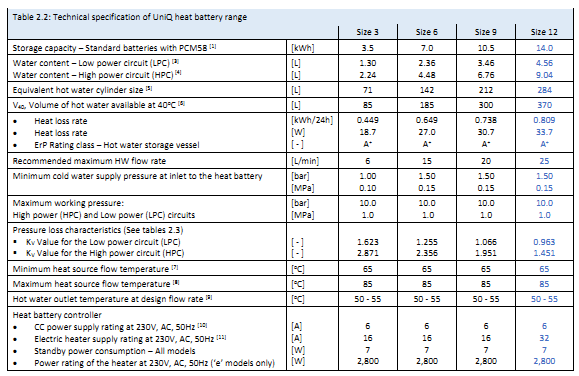
-
Anyone fitted a pre-charged aircon unit?
Jeremy Harris replied to Jeremy Harris's topic in Air Source Heat Pumps (ASHP)
I think it would be worth adding duct cooling upstairs, would probably work OK to keep the bedrooms cooler. My only reservation would be whether or not duct cooling would be powerful enough in really hot weather, as it will be limited by the relatively low air flow rate. A better way to build in cooling provision might be to use recirculating fan coil units fed from chilled water upstairs. These could heat or cool, and being separate from the MVHR would be a great deal more effective at pumping heat out. The only thing to watch for if fitting fan coil units is the need for a condensate drain, but that's no different to our split air con unit (a surprisingly large amount of water comes out of the drain). The only form of ventilation in the house is MVHR, but we do have a Genvex unit that has a built-in air-to-air heat pump, so that can cool or heat the fresh air supply. The heat pump is fairly small, about 1.5 kW output, and doesn't have enough capacity to cool the house in hot weather, although it does help a bit.. -
Heat loss and running cost
Jeremy Harris replied to Jeremy Harris's topic in Energy Efficient & Sustainable Design Concepts
I'd be inclined to look around at alternative glazing, as typically a 3G glazing unit will have a Ug of around 0.5 to 0.6 W/m².K, so unless you have small panes of glass and lots of frame area it's hard to see how you could end up with a Uw as high as 1.2 W/m².K for 3G. We have cheap 3G and the Uw works out at between 0.7 W/m².K for the large glazed areas down to 0.8 W/m².K for the smaller windows. Our main glazing sits under a 0.5m overhang, but that has zero effect on overheating, as the heat comes in when the sun is still low in the sky. We've ended up changing the ASHP around to cool the ground floor (via the UFH pipes), installed an air con unit upstairs and installed (expensive) solar reflective film to the glass to reduce the over heating. I regret not having known about Sage glass originally, as despite the cost, it seems a very good solution to over heating. Planning conditions meant we couldn't fit external shutters or blinds, which is a shame, as others here have found them to work well. If you have a read around here you will find that several members have encountered overheating problems from large areas of glazing. Very well worth considering the impact and trying to design in mitigation measure, IMHO, as it has been a PITA trying to change things in order to cool our house down in warm weather. It's not just a summer problem; this year our house overheated in April, such that I had to turn the cooling system on, from the low angle of the sun at that time of the year. -
Heat loss and running cost
Jeremy Harris replied to Jeremy Harris's topic in Energy Efficient & Sustainable Design Concepts
Yes, I installed a Toshiba split unit recently, just before the really hot spell (thank goodness!). There's some details here: -
Heat loss and running cost
Jeremy Harris replied to Jeremy Harris's topic in Energy Efficient & Sustainable Design Concepts
Welcome. 1.1 to 1.2 W/m².K seems a really poor figure for 3G, typically 3G will give a U value of around 0.7 to 0.8 W/m².K, perhaps slightly lower for large glazed areas. I would question the glazing supplier, as something doesn't seem right, as 1.1 to 1.2 W/m².K is about the same performance as a very good 2G glazing system, rather than 3G. The U value isn't the whole factor, either, as 3G allows two low e coated panes to be used, which just about halves the radiated heat loss, and subjectively makes the glazing feel warmer, by reflecting more IR back into the house. This is quite noticeable if stood or sat near glazing, where you can feel the reduced radiated loss on a cold day. Of more concern should be the potentially high solar gain from 12m² of South facing glass. I would very seriously look at ways to mitigate this. We have about 2/3rds that area of South facing glass and have had to install solar reflective film to try and cut down the overheating it creates, as well as add air conditioning. Others here have done much the same, and fitted external shutters, or installed Sage glass, as alternative ways to reduce solar gain. -
Cutting down a TPO tree by mistake - Enzo's homes
Jeremy Harris replied to Moonshine's topic in Planning Permission
Many magistrates courts now have a district judge rather than a bench sitting, the MoJ seems to have been quietly trying to get rid of benches over the years, as there was a view that having a group of lay people sitting in judgement was "less professional". Caused a stir within the magistrates association, and has resulted in some magistrates just chucking the (voluntary) job in. It's fair to say there has been a sort of running battle between the MA and the MoJ for some years. The maximum penalty for breach of a TPO is £20k I believe, so this wouldn't have gone to Crown Court. It was probably manipulated so that the case was heard by a DJ, rather than a bench, I suspect.

