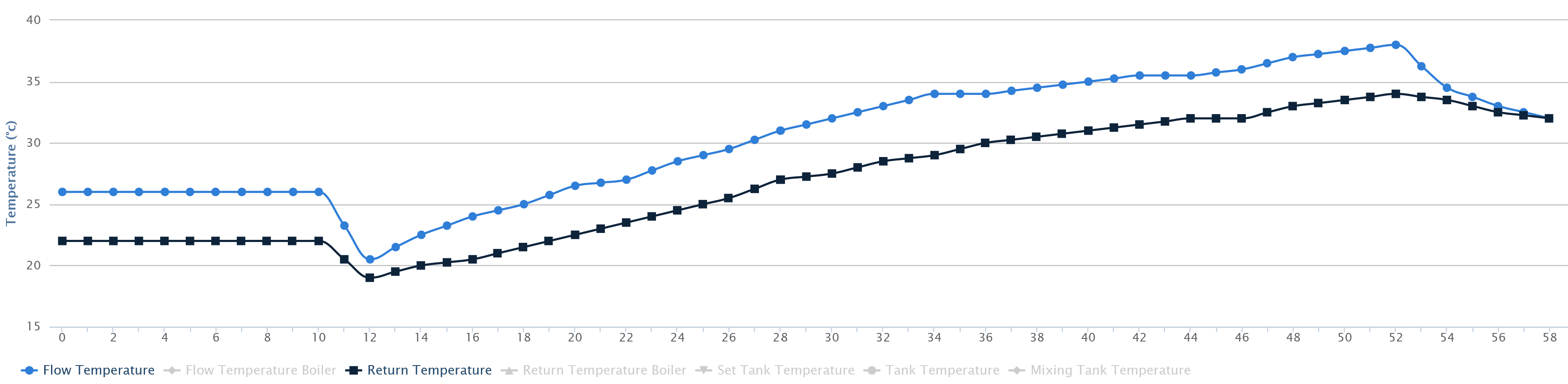
PhilT
-
Posts
502 -
Joined
-
Last visited
Everything posted by PhilT
-
As someone already pointed out earlier in this thread, a heat pump is an inductive load, for which CT clamps give the wrong power computation. You have to connect a dedicated power meter, or switch everything off except the heat pump and monitor the mains meter for as long as required.
-
Mini Store - Heat Geek / Newark Cylinders for ASHP
PhilT replied to Nick Laslett's topic in Air Source Heat Pumps (ASHP)
For low temp systems surely it must be possible to achieve a similar efficiency gain simply by allowing house heating and dhw flows to run simultaneously. So for my radiator setup the flow is typically 35 to 40. My dhw set temp is 40. My dhw tank would effectively be just another radiator. Timed dedicated dhw cycles could be added/configured to top up as necessary -
What refrigerant would you opt for if purchasing today?
PhilT replied to CalvinHobbes's topic in Air Source Heat Pumps (ASHP)
Where can you find the modulation ratio published for all the different makes and models? -
Try what you suggested, but only during the day 11am-3pm. You must have a few shower hungry people in your house. A tank full at 60degC would last me 3 days, but there are only two of us.
-
You have an enormous battery, isn't it easier to let the battery power the heat pump, then it doesn't matter if the sun and water heating are out of sync, the battery always buffers between the two, making best use of excess solar
-
What refrigerant would you opt for if purchasing today?
PhilT replied to CalvinHobbes's topic in Air Source Heat Pumps (ASHP)
Easy enough to find out there are dozens of articles and research projects comparing those two -
Change Two Pump+LLH to One Pump/No LLH
PhilT replied to PhilT's topic in Air Source Heat Pumps (ASHP)
fortunately just one zone for the whole house, well balanced with all rads open -
Change Two Pump+LLH to One Pump/No LLH
PhilT replied to PhilT's topic in Air Source Heat Pumps (ASHP)
After installation the 3 port valve leaked flow to the rads during DHW cycle, in the height of summer - not ideal. For reasons best known to them, the installers put in that 2 port valve, which had the desired effect of completely stopping the leaked flow to the rads. -
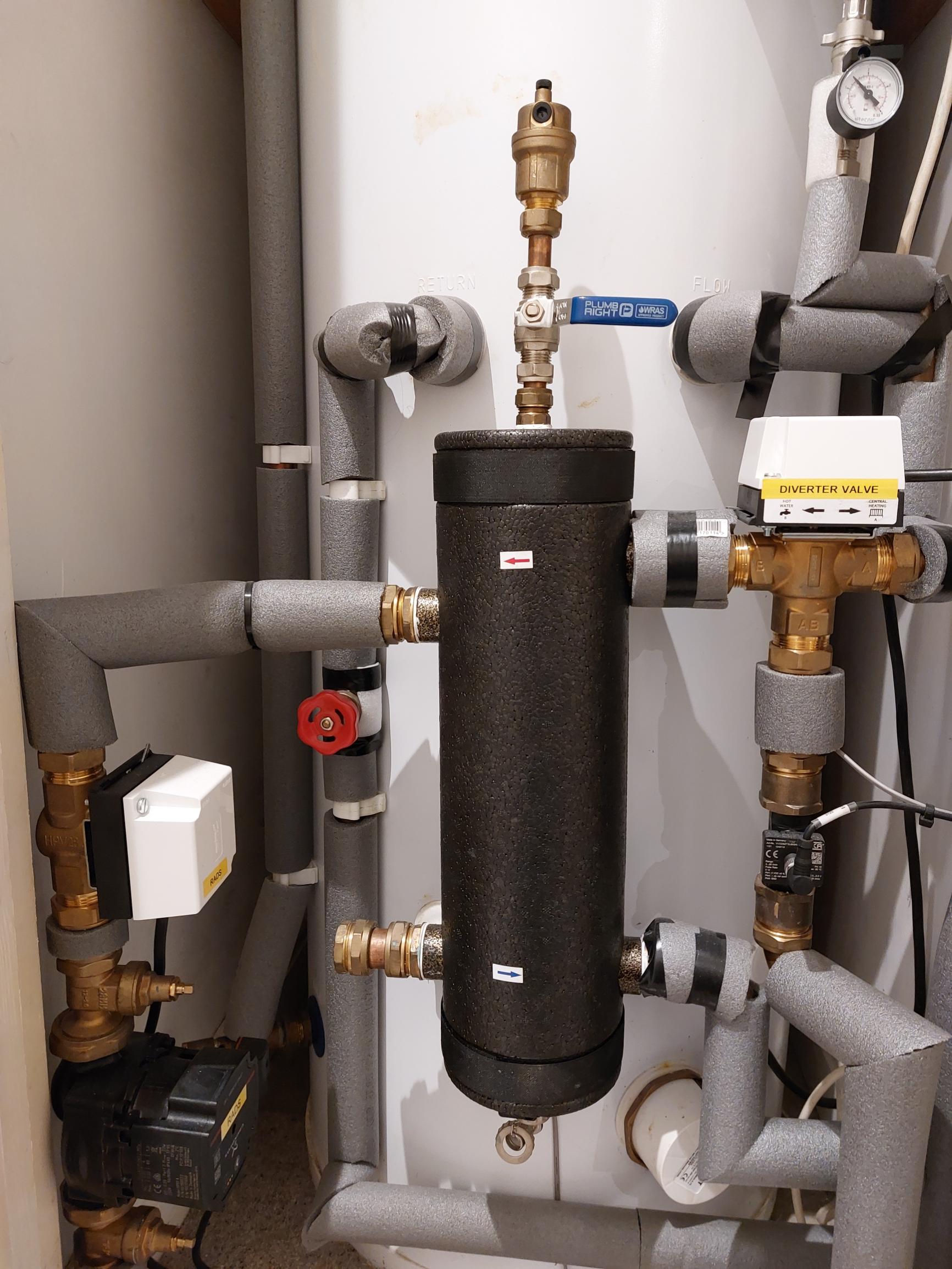
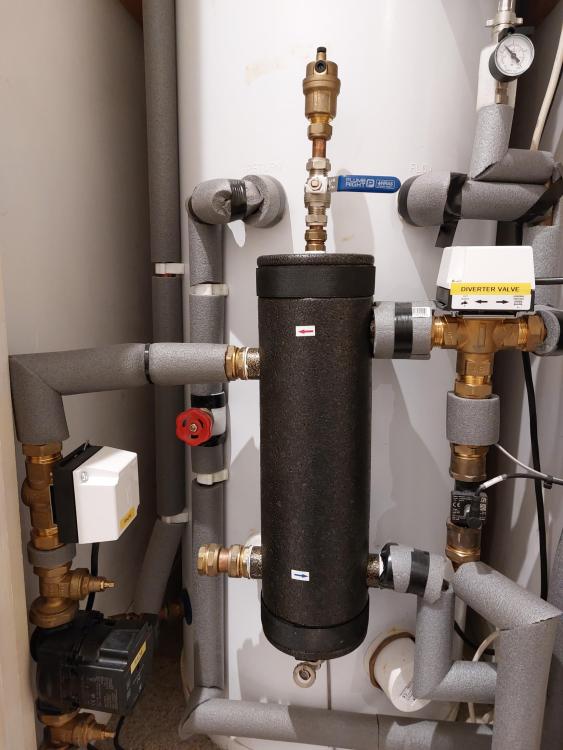
I've read a lot of good advice and observations about optimising efficiency by avoiding any kind of buffering/second pump setup. Currently my ASHP (which has no inbuilt pump) feeds a primary circuit, a 26 metres long loop of 22mm copper pipe, using a Grundfos UPS2 25-80 180, partially looping back through a small LLH. The secondary circuit tapped from the LLH is 8mm microbore feeding 16 oversized rads on two floors, area c. 130sqm, fed by a Grundfos UPS3 15-50/65 130. Interestingly the return from the rads/microbore does not loop back to the LLH but instead connects directly to the primary loop flowing back to the ASHP. Reading the specs I notice both of these are substantial pumps. Would the primary one be man enough on its own? Could the LLH and 2nd pump be taken out, connecting the "primary" circuit directly to the "secondary", and what would be the issues?
-
Maximum permitted flow temperatures?
PhilT replied to sharpener's topic in Air Source Heat Pumps (ASHP)
Well, whatever you believe on this subject, heat pumps don't need this kind of justification anyway, they easily stand up on their own merit. -
Programming a Mitsubishi heat pump (peak and off-peak rates)
PhilT replied to Garald's topic in Air Source Heat Pumps (ASHP)
At warmer ambient temps the ASHP cannot modulate low enough to achieve the equivalent WC curve flow temp without cycling, so in target temp (auto) mode it runs at no lower than the minimum continuous power level, allowing the flow temp to gradually increase to a pre-programmed level, then it pauses with the circulation pump still running. To extend run time even further the room stat allows a room temp overrun (hysteresis) of one degC. I spoke to Mitsubishi about this and they say it is absolutely fine and the way it is designed to operate to maximise efficiency.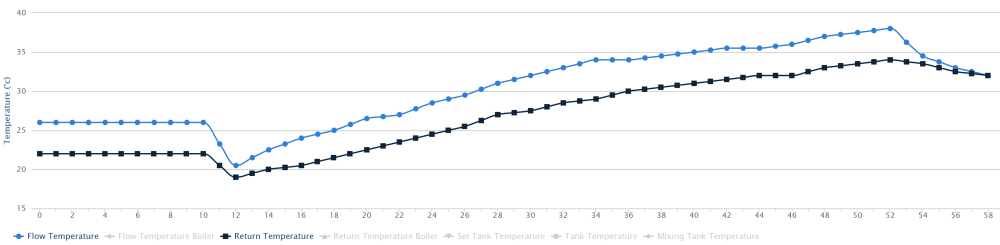
-
Heat pump cylinder without the heat pump...
PhilT replied to Antonb182's topic in Air Source Heat Pumps (ASHP)
you say "It'd save me buying a new immersion heater at £1500" - sounds like you are asking if you could use the heat pump only for heating hot water "without connecting up the heat pump" (to the rads/UFH?). Sorry if misunderstood. -
Sound power is neither room-dependent nor distance-dependent, being a property of a sound source equal to the total power emitted by that source in all directions. Sound pressure is a property of a point in space at a distance from the sound source. Example, a heat pump operates at a sound power of x watts, and at a distance of one metre a decibel meter records a sound pressure level of y dB
-
How to predict heat pump size from your EPC
PhilT replied to sharpener's topic in Air Source Heat Pumps (ASHP)
for those who have or had gas - kWh usage / 2900 seems to be a good sense check (can't remember what efficiency was assumed - 90% I think). Mine would have been 21000/2900 = 7kWh which is spot on based on my highest recorded peak usage on the coldest winter day/night so far. I have an 11.2kW heat pump but I'm still getting COP of 4.2 average for Oct-March so not a disaster by any means. -
An Ecodan plus FTC6 sounds way too much for a granny annex (I have those two items for my whole house) have you considered air to air mini split air con / heat pump? I had one installed in my annex for not a lot of money, but tapped hot water from the central system. I also live in the Aylesbury area
-
Combining radiators with UFH - some surprising conclusions
PhilT replied to sharpener's topic in Air Source Heat Pumps (ASHP)
Slightly off topic but 45 is too high for an optimal new rad system. My average this year so far is around 37 with 100% rads. Design temp was 40. -
just to put this into perspective and to inform choices, the reduction in heat transfer rate with, for example, a 20% mixture of hp-5c, is only around -2%
-
Like Chuck McGill in "Better Call Saul" I went mad trying to find the hidden electricity! I acquired an energy meter and tested all the "always on" appliances in my house, and the intermittent appliance usage, before I came to the inevitable conclusion that they add up to much more than expected. My non HP usage is around 6kWh per day with only 2 of us in the house. Yours looks to be around 5kWh per day so I don't think you have anything to be concerned about.
-
£2300 for an 8kW and a 300l tank sounds like a very good deal in this era of grant based pricing
-
My mistake, hp-5c specific heat capacity at 40degC = 4.09, water 4.18, so 20% mixture (4.09*20% + 4.18*80%) = 4.16 so only a 0.5% reduction in heat capacity.
-
Hardly at all, it turns out, thanks to this post. For example hp-5c at 20% reduces specific heat capacity by around 2%. Nothing to be concerned about
-
ASHP with underfloor heating project question
PhilT replied to Trojan's topic in Air Source Heat Pumps (ASHP)
Daikin make a 3kw R32 monobloc, the Altherma 3 -
It won't be able to adapt if you move the thermostat from room to room. I leave mine always in the living room in the same position, in a place where there is no possibility of it ever being in the sun.
-
Are you in target room temp (auto adaptive) mode? If so the flow temp will not follow the WC curve directly, it will "learn" from repeated runs the point at which flow temp maintains room temp, which may take a few days. At mild ambient temps, if your heat pump is oversized it will not allow short cycling, which may explain what you are seeing - that even at minimum continuous power level the flow temp increases from 25 to 40, then the heatpump switches off for a while. Mine is doing exactly this, in approx one hour cycles (it's been 16degC today)
-
That's surprising, you must have a very noisy heat pump. I can barely hear mine from 5m away never mind 20m and two fences