


PhilT
-
Posts
505 -
Joined
-
Last visited
Everything posted by PhilT
-
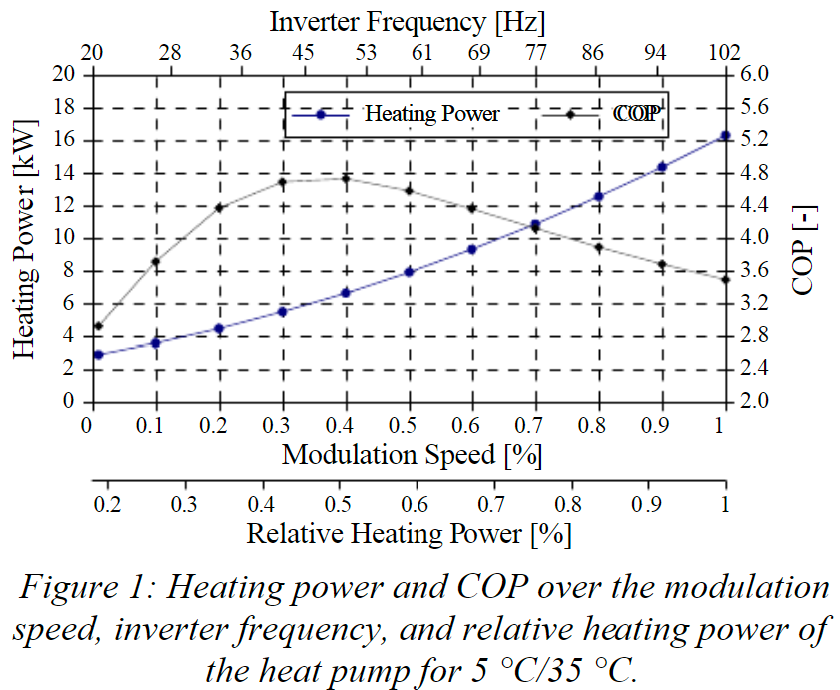
Which is not good. There is a significant variation in efficiency/COP throughout the modulation curve, for example this research chart shows peak efficiency at around 40% of the modulation range. JohnMo's heat pump is a 6'er I think, so in mild temps the modulation range could be as much as 3 - 8kW. His chart shows a constant 5kW output which would be around 40% of the modulation range - bang on the optimum according to this chart. Mine does exactly the same in Auto mode, but in straight WC mode it cycles on and off at minimum modulation level during mild outdoor temps, and the performance hit is very clear to see.
-
Is this normal behaviour - cycling ??
PhilT replied to mk1_man's topic in Air Source Heat Pumps (ASHP)
That previous post should have said Sensocomfort mode is set to "Incative", which is pure WC mode heating with no roomstat temp influence. "Active" means flow temp is influenced by room temp of any assigned roomstat. "Expanded" is the full monty, outside and room temp influenced flow temp using that wizzo Vaillant Sensocomfort roomstat controller, which suggests that it might work like the Ecodan "Auto" mode, which is highly desirable, as it does many important things over and above pure WC mode; suppresses start up power spikes, flattens out then, if necessary, reduces flow temp as room temp is approached, compensates for solar gain and defrost, and never allows compressor cycling, and works the heat pump at it's optimum efficiency level -
Is this normal behaviour - cycling ??
PhilT replied to mk1_man's topic in Air Source Heat Pumps (ASHP)
Which heating mode are you using? Normal, Eco, Balance Sensocomfort Inactive, Active, Expanded -
Is this normal behaviour - cycling ??
PhilT replied to mk1_man's topic in Air Source Heat Pumps (ASHP)
It's that power spiking which is interesting. The Ecodan never does that in auto mode, just a smooth ramp up, however it does spike considerably in WC mode. Great COP though -
Dont understand this term in a heat loss calc
PhilT replied to Post and beam's topic in Air Source Heat Pumps (ASHP)
that's the whole point you shouldn't have to try at all!. It should be built in as standard and operate in the most efficient way automatically, never cycling and never operating at less than the most efficient power level -
Dont understand this term in a heat loss calc
PhilT replied to Post and beam's topic in Air Source Heat Pumps (ASHP)
It's quite surprising that not all modern brands/models have this capability built in as standard. -
Quote for ashp - didnt expect that much!
PhilT replied to TheMitchells's topic in Air Source Heat Pumps (ASHP)
m2 for what, just the floor area or every part of the internal surface area, floors, walls and roof ceiling? -
It's a shame ASHP manufacturers don't provide some kind of programmable "power level" control in addition to WC and fixed flow temp. Or even an option to simply prevent the ASHP from going below minimum power, with operation limited by room temp. That would at least be a step in the right direction.
-
There is a balance to be struck between the desire to achieve maximum efficiency from a smaller unit and minimising the time your heating is off while the DHW cycle is going, especially in the depths of Winter, and taking into account regular defrost cycles. My son's passivhaus is 150sqm and the heat loss calcs suggested a 5kW ASHP but he went for a 7kW ASHP so his DHW tank would heat up quicker for a family of 4 regular hot water users. A 200 litre tank if heated by a 4kW source would take 1 hour and 45 minutes to get from 20 to 50degC. 7kW brings that down to under 1 hour. My view, for what it's worth, is that you should go for a minimum of 6kW, because modern heat pump software manages the system to avoid cycling and maximise efficiency no matter how oversized for central heating purposes, up to a point of course. Case in point - I have an 11.2kW heat pump which is at least 50% oversized but is achieving SCOP of 4.2 with a microbore fed radiator system. And my hot water heats up very quickly!!!
-
Quote for ashp - didnt expect that much!
PhilT replied to TheMitchells's topic in Air Source Heat Pumps (ASHP)
15 MAN days, i.e. one guy for 15 days or 15 guys for one day -
http://www.cool-info.co.uk/multi_dx_systems/Multi-split Systems.html This appears to show five different setup variations based on a common central heating style flow/return rather than individual dedicated flow/return lines
-
Quote for ashp - didnt expect that much!
PhilT replied to TheMitchells's topic in Air Source Heat Pumps (ASHP)
not forgetting this very important piece of information. Could reduce heat loss by 25% - 35%, so 7.6kW heat pump could be reduced to only 5kW - 6kW -
Quote for ashp - didnt expect that much!
PhilT replied to TheMitchells's topic in Air Source Heat Pumps (ASHP)
peak heat loss of 70 watts per sq m, times floor area 100sqm, = 7,000w heat pump required -
Termostatic shower trouble since Heatpump installed
PhilT replied to Sols's topic in Air Source Heat Pumps (ASHP)
check that all the gate valves (usually circular red wheel handles) are fully open, both around the domestic hot water tank and and loft tank, and if you don't have a loft tank then the Event XS will not work. -
L9 Error - Flow rate - Ecodan 8.5kW ASHP
PhilT replied to athlonoc's topic in Air Source Heat Pumps (ASHP)
Turn off the power to all the indoor (FTC and main control panel) hardware. Turn off the heat pump isolator switch. Wait five minutes. Turn back on the indoor controls, then the heat pump. Wait till the FTC control panel has powered up and is in reset mode (blank screen) then press the on button (far right on my FTC) -
L9 Error - Flow rate - Ecodan 8.5kW ASHP
PhilT replied to athlonoc's topic in Air Source Heat Pumps (ASHP)
Have you tried powering down and back on again? Sometimes changes are not detected until you do this. Also could this video help - includes remedial steps you may be able to do yourself -
Ecodan and Mitsubishi PUMY cooling ena
PhilT replied to AhMario's topic in Air Source Heat Pumps (ASHP)
Did you power down completely before changing settings (or at least power off/on after changing)? -
Ecodan and Mitsubishi PUMY cooling ena
PhilT replied to AhMario's topic in Air Source Heat Pumps (ASHP)
Could it be that the dipswitch setting you changed only controls the internal unit, and the external unit has its own separate dipswitch (or other) hardware settings which need to be changed to cooling mode? -
ASHP water leaving temperature control
PhilT replied to JohnMo's topic in Air Source Heat Pumps (ASHP)
Definitely no compressor cycling there, job done. -
ASHP water leaving temperature control
PhilT replied to JohnMo's topic in Air Source Heat Pumps (ASHP)
Apart from the power graph you showed earlier, can you see a smooth flow temp line? On mine this is the graphic which best shows the compressor either switching on and off, or running continuously -
Too little info so far. The energy use data you gave is way too rough even for a ball park sizing estimate so, as things stand, your heat loss calc is your best guide.
-
ASHP water leaving temperature control
PhilT replied to JohnMo's topic in Air Source Heat Pumps (ASHP)
Do you have an auto mode? If so might be worth trying. On mine it makes a HUGE difference to the operation in the shoulder months. Although my HP is at least 50% over capacity, in the shoulder months the compressor always runs continuously at no less than minimum power for no less than 20 minutes, so typically, in 40 minute cycles the flow temp curve rises and falls between 30 and 40, with the pumps running continuously. Last year I changed from WC to auto mode; in Sep last year in WC mode the COP average was 3.6, and in Oct in auto mode the COP was 4.2. Previously in WC mode I could see the compressor switching on and off every few minutes trying to maintain whatever constant flow temp was determined by the WC curve. -
ASHP water leaving temperature control
PhilT replied to JohnMo's topic in Air Source Heat Pumps (ASHP)
How would you define short cycling in this case? -
What's the total
-
Is this an existing or new property and, if existing, what is your annual energy consumption on heating, in kWh?

