

Nickfromwales
-
Posts
30336 -
Joined
-
Last visited
-
Days Won
297
Everything posted by Nickfromwales
-
I'm currently spec'ing two installs exactly as you've described. I'm doubling up first as last though as a 'single box solution' offers zero redundancy. I'd say save the money of ducting and pulling insulated ASHP pipework ( not cheap stuff to fit and then not use ) and look at keeping sufficient redundant space for a second Sunamp unit . These struggle a bit first getting the house to ambient, but after that they should perform exceptionally well, for as 'passive standard' usually means little and often for space heating and a correctly sized bulk for chunks of DHW. The good thing about the 3rd gen units is the near linear input of energy, e.g. 3kw of electricity input to a 9kw unit needs only ~3 hours to fully recover from a FULLY discharged state. Best to do as I have and design in some redundancy so you can cope with guest / high use of DHW. ( Space heating is a mere burp as far as these are concerned so focus closely on DHW capacity ). The 3g units have two pairs of 'flow and return' connections ( 2 x heat exchangers ) so space heating ( not potable ) and DHW ( potable ) can both be drawn from the same unit but always remain hydraulically separated. Another good point to make is that either heat exchanger can consume the entire stored energy of the unit, so a 9 kw unit with 2 heat exchangers doesn't offer 2 x 4.5kw 'sides', it can give all 9kw to the space heating HE OR all 9kw to the DHW HE. Tidy . As it has no internal pumps and controls etc, compared to the quite complex SAPV unit, you can inject heat energy near linear to consumption, which makes these a very versatile solution. Im suitably impressed so far, and Andys advice to run one unit and see how it goes is pretty much the benchmark you shouid observe. There is little useful case study to date so seeking advice is unfortunately the only measure you can practically observe.
-

LPG (until Mains gas available) or Oil?
Nickfromwales replied to JohnW's topic in Underfloor Heating
-
Thanks for updating .
-
Check with the neighbours as they may affect them.
-
LPG (until Mains gas available) or Oil?
Nickfromwales replied to JohnW's topic in Underfloor Heating
Me too. . Better to read and ask than pay and regret. Keep reading. It's free....but priceless. . -
LPG (until Mains gas available) or Oil?
Nickfromwales replied to JohnW's topic in Underfloor Heating
Do not do that. The heat won't transfer but the smoke will. MVHR flow rates don't lend themselves to transferring heat about. @JSHarris had elaborated on this more than once, so read and evaluate.....it's all here if you ask or dig . -
LPG (until Mains gas available) or Oil?
Nickfromwales replied to JohnW's topic in Underfloor Heating
To have a stove with a boiler you'll need a whopper of a TS ( thermal store ). You'll need a lot of additional heating / plumbing / control paraphernalia which will cost much more to buy, install and maintain. You'll also need a heat leak ( dump ) radiator too, unless it's not a 'solid' fuel burner. Have 'the chat' and see if a WBS ( wood burning stove ) that doesn't heat water, will suffice? Anyhoo. Gas is a box-ticker. Easy, neat and simple. If your dead sure gas-is-a-coming-to-them-there-parts then I'd seriously consider it, just because getting an ASHP fitted may be difficult, but getting it repaired / maintained may be even harder to achieve. ( I just realised you have a hot press not an airing cupboard ). Most plumbers can fit a gas boiler so you'll find much more support available for that. FYI if you go for a Vaillant boiler then converting between LPG and Natural Gas is literally a 5 minute job with a flat blade screwdriver and a U-gauge. No stripping of the boiler / changing of jets etc . Other manufacturers may do similar but I know the Vaillant does. I fit mostly Baxi or Vaillant. Great appliances. -
LPG (until Mains gas available) or Oil?
Nickfromwales replied to JohnW's topic in Underfloor Heating
Some basic reasonably priced controls that don't operate the garden sprinklers via thumbprint or voice recognition . They call them programmable room thermostats and they start from as little as £60. . -
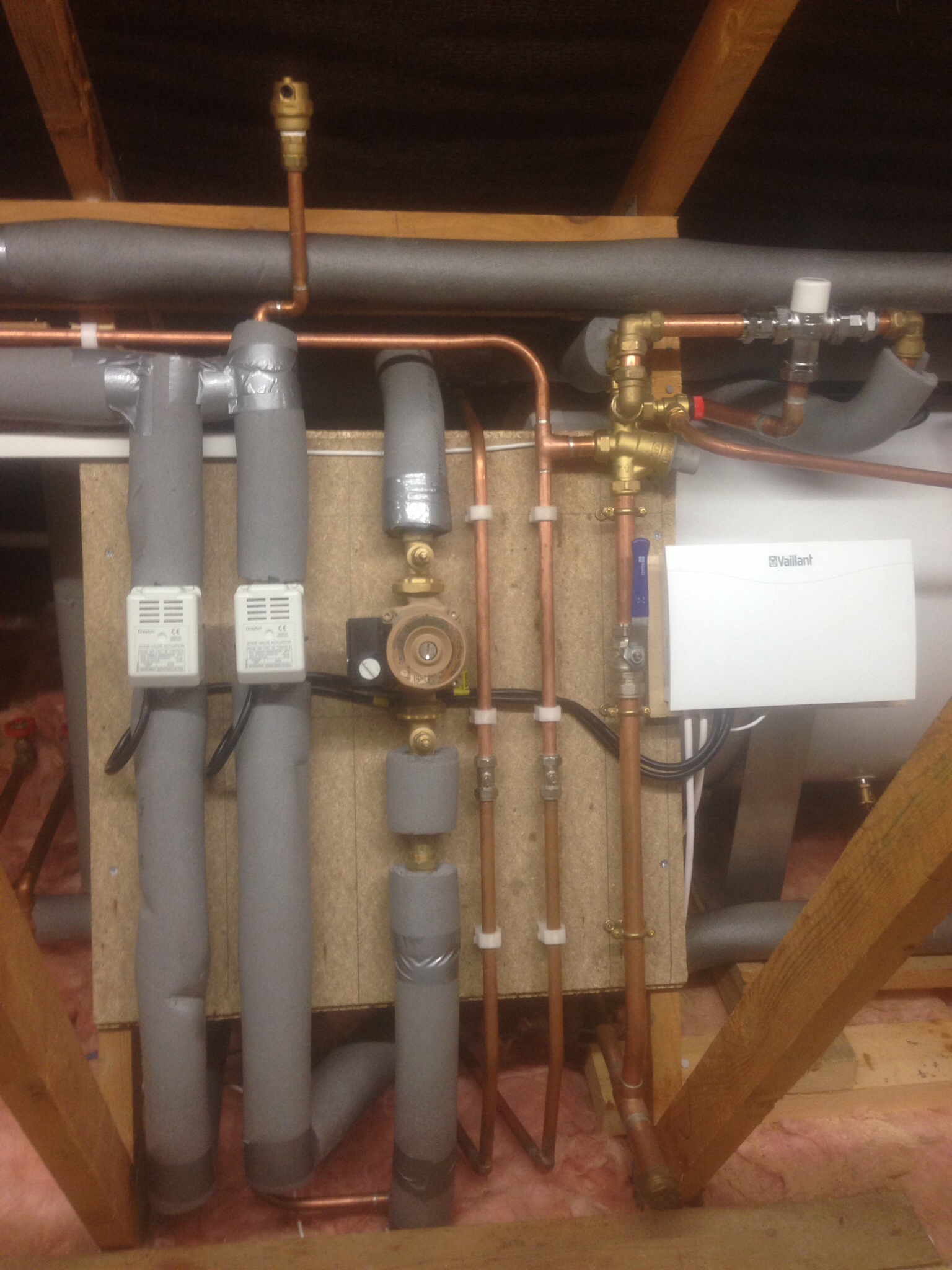
Cranking it up to get a good chunk of hot water is the only thing you can do at the moment because the boiler can't shift heat into the TS quick enough at the moment, because of that PHE and the TMV on the TS return ( prob ) being set wrong or failed altogether. If that has failed or is set wrong then even to get DHW the whole TS will be trying to heat up, rather than just the top 1/3rd. Pointless fretting as it'll only get better with an overhaul.
-
It won't be . When set up properly it'll just be coming on, topping up the top of the TS, and then knocking back off until needed again. That would be 'summer mode' where you don't want to run heating. If you want heating then the boiler must be allowed to run to offset whatever heat is being lost from the house. It will still only heat what is necessary, it's just set up terribly at the moment, and when it's doing things it's the wrong things.
-
LPG (until Mains gas available) or Oil?
Nickfromwales replied to JohnW's topic in Underfloor Heating
Holy ? Was the ASHP 24 carat gold plated, and decorated with unicorn feathers? I think you need a serious look again over this lot as you've obviously been given some duff info here. Seems an ASHP would be much cheaper for space heating and DHW preheat, Scrap the "intelligent heating controls" and put that money towards PV. Why the multifuel stove? If you want a stove then just have a gas ( LPG ) / electric dial fuel stove / range. That would save a lot of cost and complexity IMO, so more £££'s to go towards the PV . Do you have any quotes or designs you can upload ? Please remove any sensitive information first My 2 cents:- ASHP. HP UVC. Buffer tank and DHW pre heat. Preheat optional as you can live without it. Down to available plant room space for the two cylinders. PV into both / and ASHP to reinforce ( reduce ) grid consumption. LPG cooking if you don't like electric. Job done and cheap as chips to run. -
Bath Surround / Boxing In, and concealed pipework
Nickfromwales replied to Onoff's topic in Bathrooms, Ensuites & Wetrooms
If your really that concerned then exactly how much 'bounce' is there? Are you mistaking the layers compressing slightly underfoot for bounce? As I know you pretty well by now, a solution. Get a 4x2 cut it 300mm short of ceiling height. Drill the end to take some 10mm SS threaded bar. Use that with a couple of nuts andxwashers to create an 'acro prop' and sit the threaded bar on a bit of SS flat bar. Use that, pushing from the ceiling down, gently, to take any slack out during screening and grind the threaded bar off after the screed is dry. -
Bath Surround / Boxing In, and concealed pipework
Nickfromwales replied to Onoff's topic in Bathrooms, Ensuites & Wetrooms
That lot won't budge a mm. . The two brackets laying flat over the membrane, I'd stick a couple of short stainless bolts through them to make pins that the screed will hold and that's that. I take it you've not looked at tanking properly yet . The areas you fear may split are all junctions. The tanking kit comes with long strips like band-aids which stretch and flex with the wall / floor 'fault lines' so such a problem cannot occur. The tanking solution is like rubber when it's cured rather than brittle like paint, hence why your using it. Just put a good few layers on, allowing to dry in between, and it'll be bombproof. . Have you opened the tanking kit yet? Or haven't you bought it yet? -
Bath Surround / Boxing In, and concealed pipework
Nickfromwales replied to Onoff's topic in Bathrooms, Ensuites & Wetrooms
The chase isn't fun if you catch them . -
Inevitable !
-
Better than expecting a child
-
You wouldn't possibly be having a Sunamp PV if you have an ASHP . You'd maybe instead be going for a Sunamp dual port that takes in wet heat as well as PV based electricity. That way you'd maximise the efficiency of feeding it with heat energy when the PV isn't up to it. Far less parts and complexity too, that all said bearing in mind that Jeremy has the flagship model and the available range of Sunamp units has grown significantly of late.
-
They do pierce it but tend to fill the hole they create as the membrane stretches to allow it to pass through. Not a problem. With liquid screeds it would be frowned upon.
-
Yup. Prob best to drop it to 2bar before the pour .
-
Cold water has acclimatised to the ambient temperature and expanded a bit that's all. .
-
Tres bien ?
-
No dust ! Ordinary dash should be available in small bags, but if filling 15mm then 10mm chippings should be fine.
-
Never heard of it or promoted its use. Get your boiler checked for clean combustion so you know it's mixtures etc are set up right and carry on without it afaic.
-
10mm is a bit big if he's filling 12mm. Depends on how much tile adhesive is going over it afterwards.
-
Or a bag of dash if there's one handy. Adding sand dries it out.


