
Nickfromwales
-
Posts
30353 -
Joined
-
Last visited
-
Days Won
297
Everything posted by Nickfromwales
-

MVHR Decisions...what to do?
Nickfromwales replied to Thorfun's topic in Mechanical Ventilation with Heat Recovery (MVHR)
Rearrange these letters to form an opinion; fcunigk pisne's pssi pu, rberewy -
At 7kW, it's less than a hob or decent shower? Showers don't soft-start either.
-
MVHR Decisions...what to do?
Nickfromwales replied to Thorfun's topic in Mechanical Ventilation with Heat Recovery (MVHR)
Just don't ask EsaveP..... Harold could fall into a bucket of tits and come out sucking his thumb -
MVHR Decisions...what to do?
Nickfromwales replied to Thorfun's topic in Mechanical Ventilation with Heat Recovery (MVHR)
Depends on a well thought out design, and I know the Brink ( which Nick @ CVC will likely suggest ) can run as a balanced, harmonised pair to keep the entire system at equilibrium. -
MVHR Decisions...what to do?
Nickfromwales replied to Thorfun's topic in Mechanical Ventilation with Heat Recovery (MVHR)
Writing.................................................wall... -
MVHR Decisions...what to do?
Nickfromwales replied to Thorfun's topic in Mechanical Ventilation with Heat Recovery (MVHR)
I've just sepcified 2x Brink 325's where a 400 would 'just about do it', but the difference in strangling the ducts back to one unit would make for a less-than-pleasant-to-live-with solution. Instead I opted for 2 parallel setups strategically sharing the whole house config and then the ducts to atmosphere ( 160mm for the 325's ) will be T'd together to give 2x 180mm ducts to atmosphere. One is set to be at 60% duty and the other to 40% so I know there's ample headroom for efficient boost ( still not maxing the units out ) and the system will be very quiet in operation to boot. The issue about 1 big FO unit being run to the hilt is noise ( audibility at the terminals to be precise ) so decide if you can deal with noise in the bedrooms and whether or not that was a wise decision.... -
That would mean a 3kW load on top of the max nominal operating scope of the HP, so ~2.5kW + 3kW, so would attract a makers label stating ~5.5kW if it had an immersion. Theoretically lol.
-
If laminate flooring, then a suitable foil kit instead of a wire, and either lay straight onto the boards, or level first and then lay the foil + laminate / engineered floor. Any leveller under the foil needs to be 100% dry before being covered!!
-
1db lower than average conversation level too. ??
-
There is very little in it tbh, cost wise. I’d be tempted to take a punt on one of those cheap New Home units on eBay tbh, and if it lasts 10-12+ years then happy days. Depends if you’re going for RHI though and a suitable qualifying HP so the maths need to add up.
-
Not with a smaller cylinder and a quicker recharge / recovery time being beneficial
-
You can get 'slimline' UVC's which retain the smaller footprint, but the OP actually has their UVC so needs to work with what they've got For 400L, 500L and above I always put two smaller separate wall mountable expansion vessels in ( 2x35L for a 500L is my go to size as you can never have too much expansion, and the uplift is pennies ). That gets things up off the floor, or even up to a second storey or attic is not unheard of / completely permissible. Agree this is a candidate for a 7kW HP so as to add to the longevity and speed up the UVC recovery times a little. @Roz Just have a boost switch for the immersion and set that to heat up when you think you'll need extra 'volume'. 30 min / 60 min / 120 min boost settings are the norm, and are fool proof too as you don't have to go back afterwards and switch it off if you forget. Link
-
From the Marmox WS; Quote, "The unique patented surface of Marmox Multiboards allows tiles of a much heavier weight to be safely and securely fixed to walls. Being completely impermeable to water, they are doubly useful in tiled areas prone to moisture such as kitchens and bathrooms where they will act as a moisture barrier protecting the walls and floor. Multiboards can be used to insulate and waterproof walls, floors and ceilings and noticeable benefits will be gained by using any thicknesses of 10mm and above."
-
If fitted properly, the insulated boards can be used as DPM
-
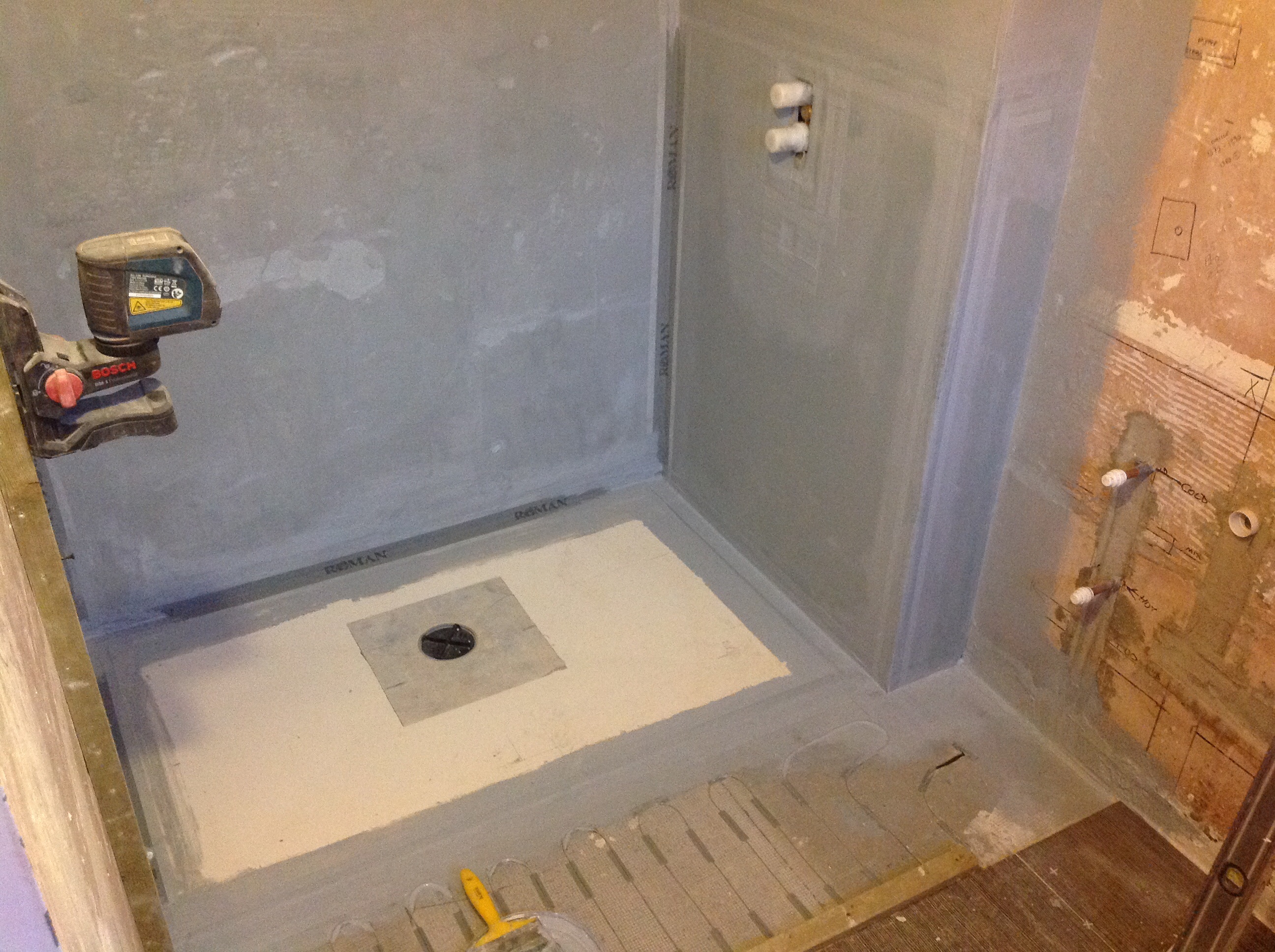
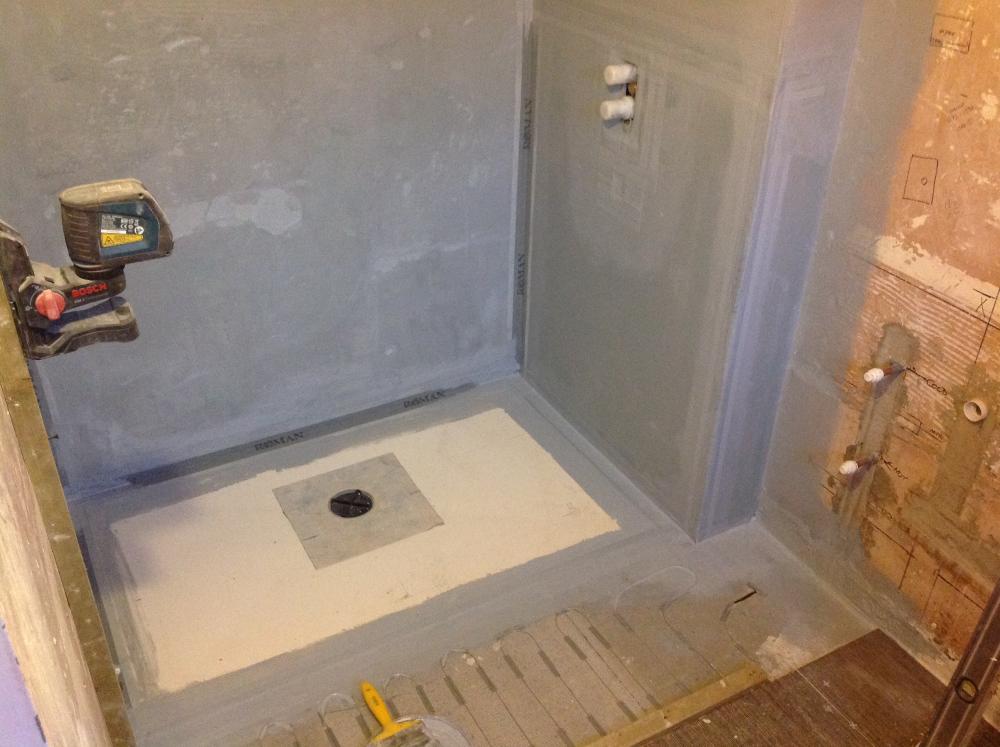
I used them on this job, which ad an un-insulated 150mm concrete slab. The insulation boards run up to the edge of the shower former, and insulate the UTH wire from the sub-floor below. Not great, but shit-loads better than heating the concrete floor with an UTH setup !!!! You'll be looking about 40p in the pound going south if you carry on with your proposal.
-
Use tile insulation backer boards to level the floor, and then you get a good method to both level and insulate the slab prior to accepting the finished floor covering. What finish do you have intended?
-
https://www.solarwatt.com/solar-batteries/myreserve/myreserve-efficiency
-
correct. So, the info I supplied will help jump the DNO hoops if the size / export is an issue ( bearing in mind it ( the house ) should be designed to self-consume what it produces ). An ac system / hybrid will all have to be added together and the sum presented to the DNO for approval as the grid tied capacity. Massive PV + AC batteries = high likelihood of getting a no-no from the DNO, albeit you CAN be lucky IF the infrastructure is good / very good.
-
No. DC direct from panels to batteries, then that parallel grouping to an AC inverter. AC only house with zero conversion losses.
-
Can you tuck something like this up under the tile? Link That would get sealed to the tile with black CT1 / similar frame sealant and will provide a barrier from wind blown rain, plus a drip into the gutter that should solve the problem.
-
Yes, typically Fronius if DC batteries ( Solarwatt for eg ). Plus they don't charge off the grid at all, and are designed to mothball themselves at the lower discharged rate until the PV starts producing excess again. The downside with the Lux / A/C systems is you have to include them in your DNO application. So, if you can get ~4kWp per phase, for eg, adding 7.2kWh or 9.6kWh of A/C batteries may well get your connection refused. If you install D/C batteries then they are on the consumer side, not the grid side, and you can have as much as you like without declaring them on your PV > DNO application. PV costs money to install, yes, but I can't exactly see that these systems don't aid the core goals myself . I've just been involved in an NZEB build, which smashed PH, and NZEB, and finally attained ZEB recognition, with an RER of 37% and negative 2.3T carbon p/a...( in a massive 6 bedroom / 6 bathroom all electric dwelling), and that would not have been possible without the PV or the battery system ( plus one of the best and most anal site managers I've ever met !! ). Do they not look at the RER? I'm not sure what is actually in the PH / PH+ to do / not to do list. Not directly conflicting / associated with PH / PH+, but my point is the loss of at least 13-15% from an A/C system, if installing batteries, is easily preventable and more in line with that 'core ethos'.
-
8kWp would be ample, and as said you can limit the export with something like a SolarEdge inverter ( 12 year warranty as it uses dry capacitors instead of the weaker wet ones ). You’d probably be a good candidate for a domestic battery at that size array, even if you have an EV, as the house can fully utilise the PV + batts, and you can use the car off Octopus overnight / off peak selectively. Thinking a domestic system will charge a car has been what I’ve discussed mostly with clients lately, eg as in I t’s simply not viable ( 10kwh domestic battery vs 70kWh EV battery = no chance ever ) but they still believe!! In summer use the car battery for absorbing any excess in the really sunny ( few days ) we get and otherwise load shift off octopus / other for the known ridiculously high loads like EV’s. You can even load shift DHW off an off peak tariff if you size the DHW capacity to do that. Lots of ways to skin a cat. NB: try to use D/C batteries as A/C losses will fly in the face of PH+. Out of curiosity, why PH+? It gives you a lot of hoops to jump through that will require some additional spending to comply with.
-
ASHP/Plumbing Quote Help Please
Nickfromwales replied to canalsiderenovation's topic in Air Source Heat Pumps (ASHP)
If it wasn’t you, it would have been @SteamyTea that jumped on it lol -
ASHP/Plumbing Quote Help Please
Nickfromwales replied to canalsiderenovation's topic in Air Source Heat Pumps (ASHP)
Crossed with the old boy. -
ASHP/Plumbing Quote Help Please
Nickfromwales replied to canalsiderenovation's topic in Air Source Heat Pumps (ASHP)
You can set the lower immersion to do a purge once every 7 days, and that can be set to happen during off-peak times eg Octopus 5p/kWh / other similar tariff. The OP mentions an intention to employ PV, so the extra volume in the larger tank will be a friend not an enemy. The routine temp can be the cutoff point of what the HP will economically deliver, say 50oC, and that can be set to recharge the cylinder once a night off Octopus with enough capacity to not need further input for the whole following day. I would suggest that for the winter so the PV ( roughly 25% gross kWp over winter so no excess will be available after the household base / vampire loads ), looks after the house only, so ~12.5p for DHW per 24hrs. In the summer, halve the nighttime recharge time and leave headroom for diverting any excess, with the caveat that the OP would have to learn when to manual boost ( via the HP only ) for when the DHW is used in duress. Living with the system will quickly give a pattern to follow. Not at the lower temperature Check the MI's and you'll read that the capacity is stated at the typical storage temp of north of 65oC. The difference in heat energy between 50oC and 65oC over the additional ~200L is 'huge', but is the margin of headroom that you have to store any excess. That excess will then offset the amount of overnight recharge, so if you're clever you can play the numbers to your advantage. A smaller cylinder will have reduced scope for; 1) load-shifting, and 2) absorbing excess PV. In a time where you do NOT want to be exporting, even when getting Octopus's 5.2p/p/kWh rebate, this is a no brainer. As mentioned elsewhere, the smaller cylinders will have to be kept super hot to be at their rated capacity / delivery, so will have significantly higher losses.