Temp
-
Posts
10641 -
Joined
-
Last visited
-
Days Won
43
Everything posted by Temp
-
If you understand the planning process, and can draw, you can apply for full PP yourself but I wouldn't recommend it first time around. An Architectural Technician or Plan drawer will be cheaper than an Architect but check what experience they have.
-
Yes next step is to get Full Planning Permission. Do NOT start work until you have got your CIL exemption sorted out in writing. It's a multi step process. One slip and you might be hit with £20,000 bill. https://www.cornwall.gov.uk/environment-and-planning/planning/planning-policy/adopted-plans/community-infrastructure-levy-cil/ Was introduced in January this year. The rate varies with location from £0 to £400 per square foot. See the charging schedule. Self builders are exempt if you follow the process... https://www.gov.uk/guidance/community-infrastructure-levy#Self-Build-Exemption
-
Perhaps anyone not quite 60 could get their parents to order the PV :-)
-
Couldn't make it up.... https://inews.co.uk/news/environment/renewable-energy-vat-increase-solar-panels-battery-storage/ Environment Renewable energy: Proposals to add full 20% VAT to solar panels and battery storage The changes are set to come in from 1 October HMRC have introduced higher VAT rates for the installation of some renewable and sustainable energy sources In brief HMRC has proposed a price hike for a number of sustainable energy sources Prices would be higher, going from 5% to 20% VAT HM Revenue and Customs (HMRC) is set to introduce higher VAT rates for the installation of a number of renewable and sustainable energy sources, such as solar panels and biomass boilers. The government body responsible for collecting taxes, announced a hike in rates from 5 per cent to 20 per cent for machinery costs when the technology costs of installation are above 60 per cent. Previously, households that chose to install solar photovoltaic (PV), battery storage or biomass boilers, benefited from a reduced VAT rate of 5 per cent, however their material costs are higher than the new limit. The changes are set to come in from 1 October. Exceptions to the legislation, for which the 5 per cent VAT will still be available, are for residential installations for recipients aged 60 or over or receiving certain benefits, and for housing associations.
-
I also think you need professional advice but may not be easy to find someone with all the experience. In return for your loan (which would be deducted from her estate for IHT) you might consider asking her to leave a share of the house to your own children rather than to you. That way you also reduce any IHT payable on your own death. If you don't like that idea you might be tempted to ask her to gift "your" share to your children now, but beware there are complicated tax rules when gifting property. They might end up having to pay IHT tax _now_ rather than when she dies. What I don't know is how well decoupled the two issues would need to be. I think it would only work if it was a loan not a purchase of shares in the house. Some info on gifting property here.. https://www.saga.co.uk/magazine/money/personal-finance/giving/tax-and-gifting-property Its not clear what happens about the CIL exemption if a self builder doesn't own all of the property. I know build to let properties don't qualify so I think it likely your mother will need to own more than say 50% of the new house? In addition she will need to live in it for at least 3 years to qualify for the CIL exemption for self builders. I would hope the council wouldn't penalise you if she had to move into a nursing home or worse within the three years.
-
Think they are called window T handles. https://www.interiorhardware.com/window-hardware/tilt-and-turn-handles/tilt-turn-window-handle-stainless-steel-85mm-8520830mrs.html https://www.interiorhardware.com/window-hardware/window-handle/window-handle-t-brushed-nickel-with-antique-white-porselein-110mm-1340110agn.html
-
Jim Lawrence stuff looks similarly elegant but I couldnt see a window latch like that on their web site. https://www.jim-lawrence.co.uk/window-latches
-
Be careful on double openers the two handles don't foul each other.
-
It's not hard to go over budget so you need to think what you would do if the money runs out. It's hard to get a self build mortgage on a half built house. I know it's more expensive but I favour spending borrowed money first and keeping cash in reserve if possible. You can always make a large(r) mortgage repayment at the end if you have cash left. I would be concerned that over the next few years the UK housing market and banks willingness to lend may change making it harder to borrow more in say a year's time than it is now. The BoE has already warned that interest rates may rise more frequently than people are expecting. Think they expect the first rise to come this summer.
-
possible a major refurb/complete rebuild of ruin
Temp replied to scottishjohn's topic in General Construction Issues
Do the planners believe residential use has been abandoned? If so they will treat any proposal as a new house rather than a replacement. That may have S106 consequences although you should be exempt from the CIL as a self builder. -
Welcome. I recommend "How to find and buy a building plot" by Roy Speer and others. Try for most recent edition but some things may still be out of date. Has the plot already got planning permission? Measure the plot, is it the dimensions claimed on the paperwork/title plan? Are all the features (fence posts, walls, distances to other buildings etc) in agreement with the title plan? Are there services nearby? Who owns any land between plot and services? Any services under or over that will need moving? Who owns any grass verge between plot and road? Are any of the services at capacity/need upgrading before you will be allowed to connect to them? Is it uphill to the nearest sewer? Any restrictive covenants in the title deeds? Any rare animals/wildlife/archeology? Will soakaways work? If not are you allowed to put rainwater into the sewer? For not what will you do with it? Any known ground condition issues? Mine workings, contamination etc Any footpaths or neighbours claiming a right of access? Does the asking price make financial sense? Eg Would the cost of the plot plus cost to build end up more/less than the finished house is worth? Sure there are others.
-
Overage - applicable to future owners
Temp replied to edsr's topic in Party Wall & Property Legal Issues
Also worth a read.. https://www.taylorvinters.com/article/five-essential-factors-overage-agreements -
Overage - applicable to future owners
Temp replied to edsr's topic in Party Wall & Property Legal Issues
I think it would also be reasonable for any "tax that accrues as a result of the development (eg the CIL or similar tax introduced in the future)" to be split in proportion to the overage. Otherwise projects could easily become unviable. Elsewhere on the forum someone posted data showing the CIL averages something like £20 per house. -
In addition to Street view see if there are any tracks on the satellite view.
-
I know the access already existed but I think you only need PP for a new access if its a classified road eg If its not an A or B road then I don't think you need PP but may still need permission for a "dropped kerb". You don't always need PP for a hard surface either. You can avoid that by preventing rainwater running onto the road and deal with it on site. So it depends which way the ground slopes. If it slopes away from the road I don't think you need worry. It's quite allowed to lay tarmac if you collect the run off and feed it to a soak away or just let it soak onto the lawn. PS The dropped kerb thing is more to do with ensuring the pavement is strong enough to protect services that might be under it. Applies even if there is no actual kerb stone I believe.
-
Tin roof sheds can get very hot in summer. Not sure what to recommend. My shed stays impressively cool but it's got a concrete floor and tiled roof. Walls are oak boards, air gap, membrane, WBP, studwork filled with cheap loft insulation, more WPB.
-
Was it just the sign off that got missed or did they never notify/pay Building Control? How big is it? I think they probably should have been notified (even if the building is small, less than 15/30 sqm) because there is both drainage and electrical work? The electrician probably should have notified the BCO on his own even if the builders didn't notify them for the building. Ask if he did that? You could cover you backside by asking about getting retrospective Building Control Approval but that might open a can of worms. I would recommend getting a qualified electrician to do a "Periodic Inspection Report" to identify any electrical safety issues.
-
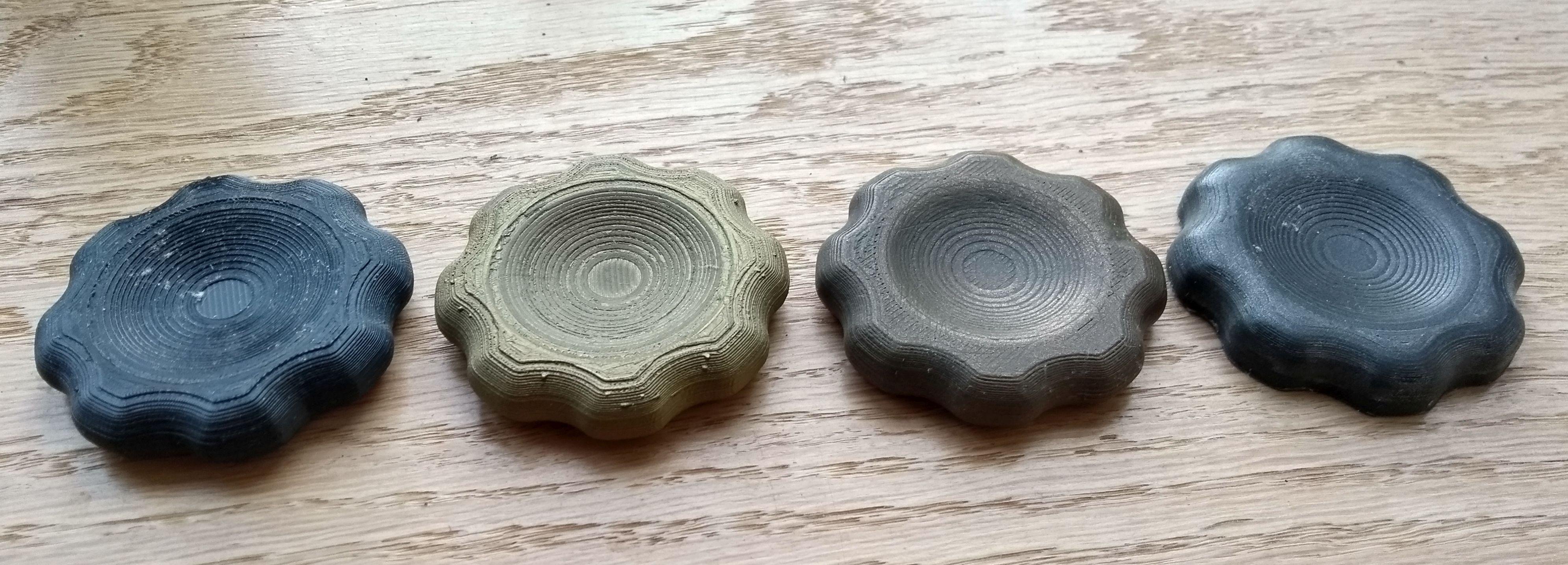
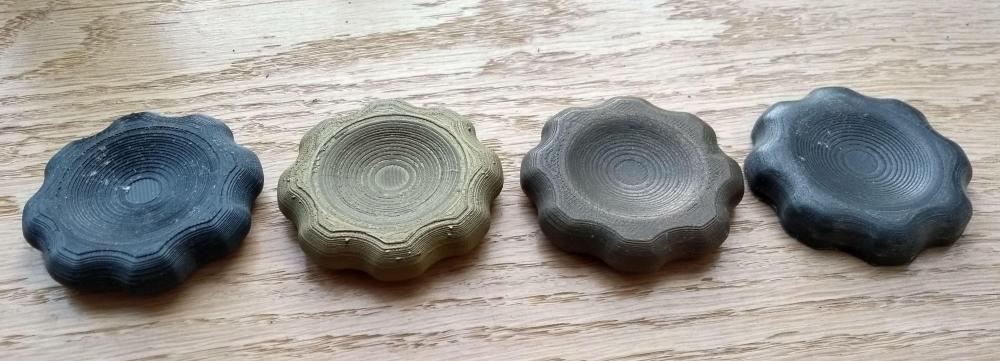
Last picture for the day.. Comparison of different filaments. Left to right.. Black PLA+ (As printed but I see it has some white fluff on it or something) Bronze coloured PLA (no actual bronze in it. As printed) Bronze filled PLA (80% real bronze, sanded and "polished") Iron filled PLA (80% real iron, sanded and "polished") Polished in quotes because it's not really hard enough to take polish. I tried T-Cut and Brasso. All were printed with 0.3 layer height and are about 45mm across. I'd like to try copper or brass filled PLA and may have found a source for cheap samples to play with.
-
Reasonable video here on different materials. PETG might be easier than ABS but I don't know much about it..
-
The default for fusion 360 is save to the cloud but it's only a few extra clicks to export to your hard drive as well and I do both. Most CAD programs have tools for collaborative projects and document management - which I don't need - but I can imagine they only work with the cloud.
-
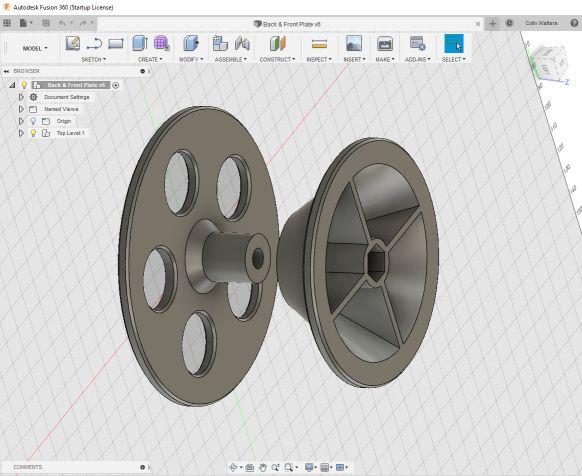
Here is the rest of the spool holder mentioned. These two parts took about 30mins in total to draw up in total using Fusion 360. They are 100-120mm in diameter. The left hand one took 2 hours to print. The right hand will probably take about 2.5 hours. The axle will be some 8mm threaded rod and I plan on fitting an M8 Nut into the hexagonal recess on the right. I'm finding fusion 360 and Cura incredible given both are free for home users. Fusion 360 has impressive tools that make some things really easy. I'm thinking of trying something complicated like a glider wing with elliptical dihedral, elliptical sweep and wash out (eg twist). The lofting tools should make it all reasonably straightforward. Others have used vase mode to 3D print similar small chuck gliders.
-
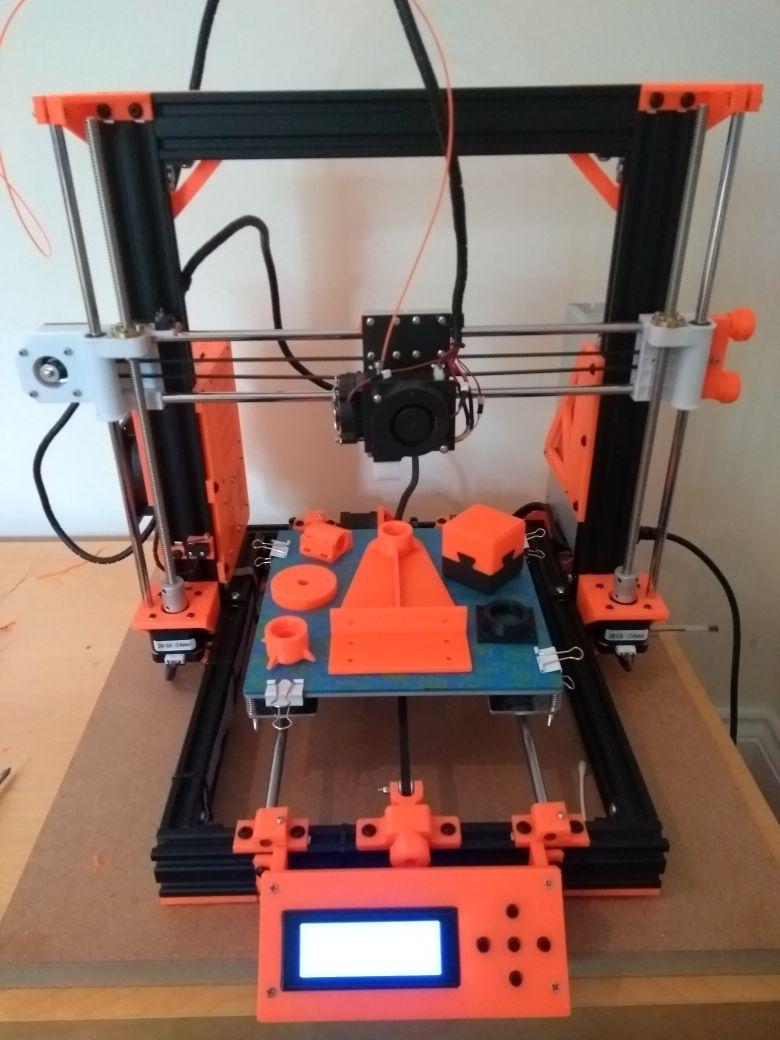
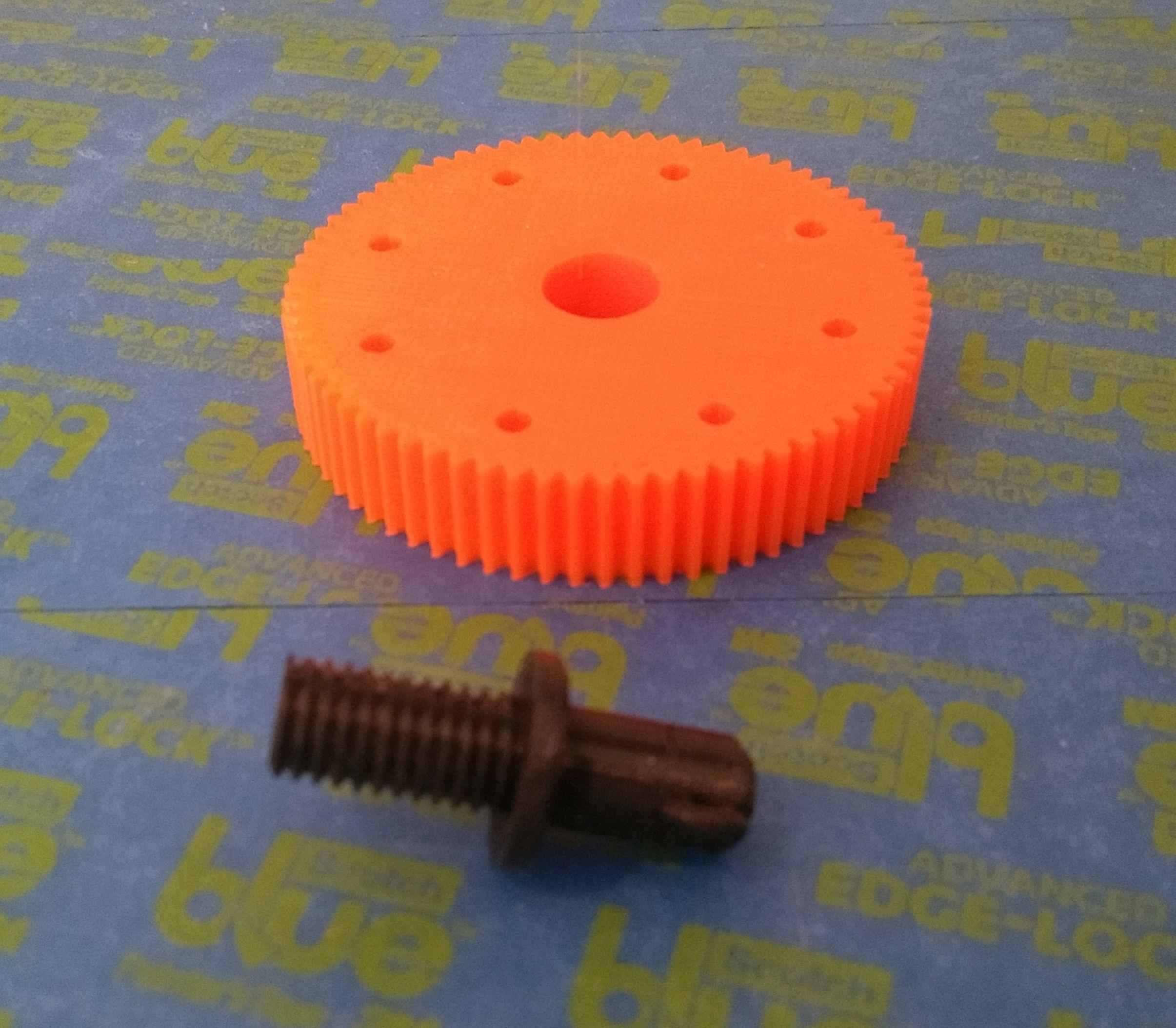
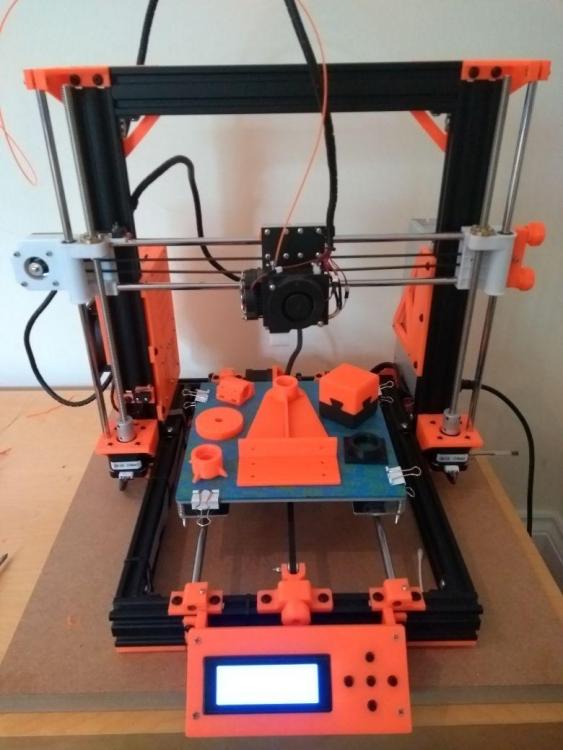
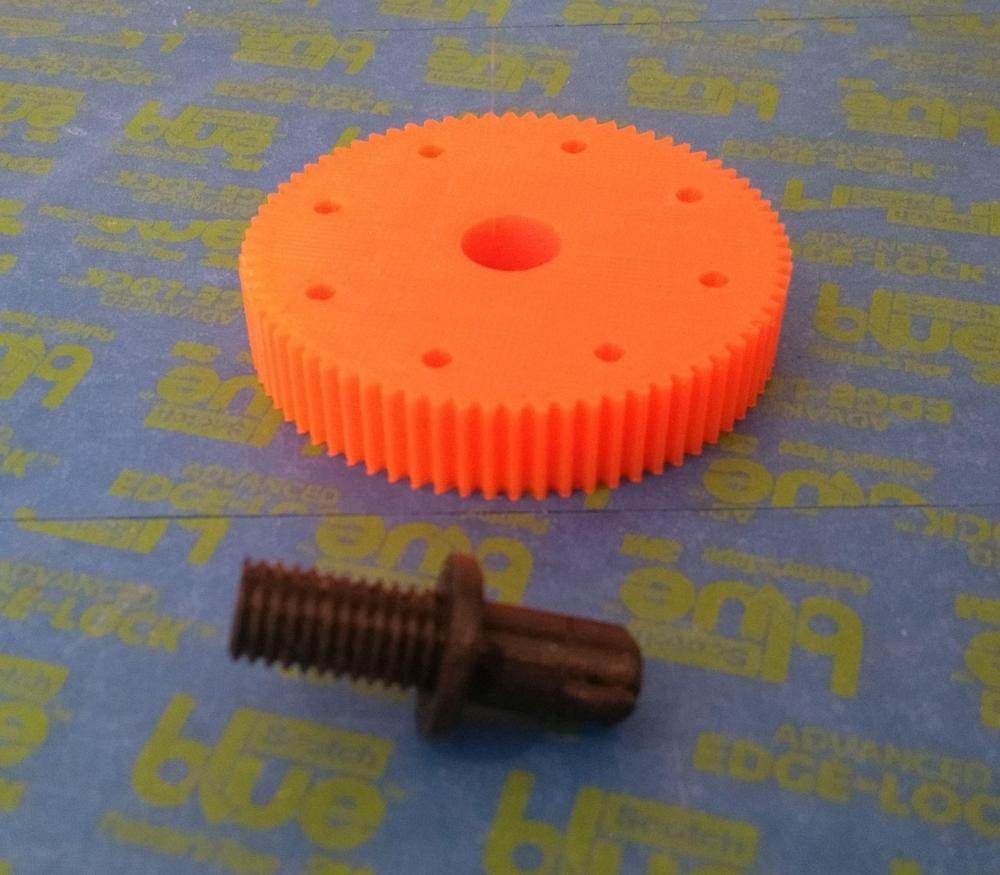
Sorry about the picture quality but my phone isn't great. Here is a photo of my A8 after the upgrade to a metal frame, together with some parts printed on it since upgrading. Everything in orange on the printer was printed on the stock printer before tearing it down to upgrade. Took a lot of print time! The impossible dovetail was printed on the stock printer with a 0.3mm clearance between the two parts. It slides apart a bit too easily so perhaps I could have allowed less, say 0.2mm? The large part in the middle took 3.5 hours to print at 0.3mm layer height. It's part of a spool holder I'm making. Here is a gear and a part with a thread. The tooth pitch on the gear is only about 2mm. It mates nicely with it's partner but I've not tried running them together at speed or testing for wear. Would be OK for a hand cranked toy but I think it would needed to have a much coarser pitch to have any life in a motorised device. The threaded part has an M8 thread. Wasn't very clean when printed but I managed to screw an M8 metal nut onto it easily by hand. It will hold up for what I wanted it for but it's not going to be as strong as an injection moulded nylon bolt would be. It was printed with the part vertical so the threads are made of lots of incomplete circles that overhang and relies on layer adhesion for strength. Again larger thread diameters would probably work a lot better. Fusion 360 has tools that make gears and threads really simple.
-
My Anet A8 came with a hot bed and has ABS settings in the menu. I use the hotbed set to around 60C for PLA. Not sure what temperature ABS needs but it might take a long time for my hot bed to get up there. Mine runs on 12V and I think some people upgrade to a 24V system to improve the warm up time. My success rate with PLA is up to about 80-90%. eg most of the time I get usable prints but almost all have some minor defects. I'm certainly still ironing out the bugs. The two most annoying problems I have are: Warping. This can cause two problems. 1) The edges of flat objects lift off the bed so the base of the object isn't flat. worse case the head hits the print and the whole print comes unstuck. This can usually be fixed by adding a brim or raft around the object (Cura will do it automatically) so the lifting occurs away from the object. 2) Warping in mid air. Sometimes when printing something with an overhang the perimeter curls up. For example if printing a sphere after say 5-10 layers the unsupported edges curl up above the nozzle instead of staying flat. I need to do some more investigating to fix this. Could be I'm using too high a hot end temperature. Seems worse with PLA+ than PLA. The iron filled PLA was also a lot worse then the Bronze filled for some reason. I ended up wasting most of the iron sample trying to solve the problem. Circles on the first layer not sticking. When drawing the first layer the outlines of holes and other curves tend to pull off the bed as if the filament is shrinking. Slowing the printer right down to a crawl helps but I think I also have an issue with retraction - the extruder retracts the filament when moving from one circle to the next. I noticed that the problem occurs most when starting the next circle. I think the filament might be retracting too far so that when starting the next circle it takes awhile to get the flow going again. Sometimes the miss printed filament gets in the way and I have to abort the print. Usually if it gets past the first layer the rest is OK. Be prepared for long print times. Cura will estimate it for you but tends to under estimate print time by about 20%-30% If it says 2 hours I allow 3 hours including set up time or having to restart due to first layer issues.
-
I've not tried to print ABS but I've heard it's difficult. Some people say you need to put the printer in a temperature controlled cabinet but not sure how essential that is. I've printed PLA, PLA+ and some samples of metal filled PLA. Don't like PLA+ as it seems to warp a lot. Any overhangs can curl up higher than the nozzle which can hit it later. The Antique Bronze filled PLA printed ok but straight off the printer it looks like brown plastic. Sanding it exposes the metal but the effect isn't as good as I had hoped. Apparently putting prints in a rock tumbler with brass nuts improves the finish so I'm going to try that. The iron filled PLA isn't very impressive either straight off the printer. It's rather grey. It does stick to a magnet though. I plan to try rusting it to get an aged look. Be prepared for a steep learning curve. I still struggle to get some things to print. The first layer is frequently the problem. I've got a glass plate to make the bed dead flat and have tried hairspray, prittstick and blue painters tape on the bed. These are the three main things people recommend to improve adhesion. Blue tape seems to work best for me. One thing I had to learn was how to design parts so you don't need supports. Sometimes it's just faster or necessary to cut something in two in CAD, print both parts and super glue them together. Will try to post some photos when I get home.