Temp
-
Posts
10641 -
Joined
-
Last visited
-
Days Won
43
Everything posted by Temp
-
20% reduction due to difuse shading by a TV aerial wire...
-
Hi new member, help with 45 degree & other neighbours planning issues
Temp replied to Sara's topic in Introduce Yourself
When considering a planning application the planners are officially only allowed to consider "valid planning reasons" for refusal or rejection. This doesnt include things like the impact on the value of your house or loss of a view. It doesnt directly include an individuals need but may do so if they can show there is a lack of suitable housing in the area to meet their need - which is usually the case when someone is disabled or from certain other minority groups. Forget a solicitor as there is nothing they can really do. If you want to fight it i would spend money on a planning consultant. Remember you only have a limited time to object. Once approved there is really nothing you can do in practice. Unless they block your driveway they can park where they like. Consider making an application for a dropped kerb to widen your driveway? -
Looks like you arecright though. I thought when the loops were upto temperature the mixer didn't just recycle more from the loops but also sent more unused hot flow back to the boiler. So I expected the return from the mixer to get hot. As that's not happening it must be as you say eg the bypass is opening. I have a Reliance mixer as well but its a different model.
-
The Reliance blender is a fairly standard model so should be fine. If something was switching off the motorised valve feeding the UFH but leaving the boiler running that might explain why the bypass is opening?
-
Sorry I didn't notice that distinction in your OP. Some pictures of the manifold and mixer might help. It does sound like there is another bypass somewhere that is opening to allow hot flow back to the boiler when the mixer shuts down. On our system there is a bypass built into the mixer so there is only one return path. Some mixers have a minimum ratio so always take some hot flow.
-
Loft Height 2.15m - Any creative solutions?
Temp replied to Omariqy's topic in Lofts, Dormers & Loft Conversions
Are you allowed to have a ridge beam bridging the insulation in a loft these days? eg Is Option (c) "Beam at Ridge" with insulation between the rafters allowed?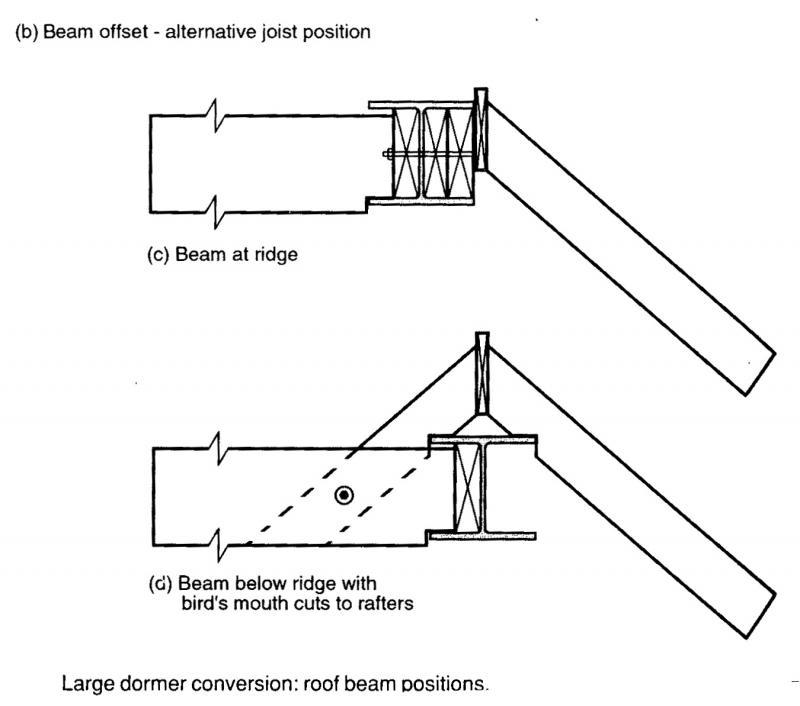
-
In order to make 40 degree water for the UFH the mixer takes water at 65 and blends it with 30 degree water from the UFH. The calculator here.. https://www.spiraxsarco.com/resources-and-design-tools/calculators/water-mixing/water-mixing .predicts that the ratio needed to make 40C will be.. 28.6% Hot flow at 65C 71.4% UFH Return at 30C So quite a high percentage is returned to the boiler raising the return temperature. The boiler return is going to be the same percentages but the other way around so.. 71.4% Hot flow at 65C 28.6% UFH Return at 30C and that makes 55C as you are seeing. Do you need the boiler flow to be so hot? Normally >60 C is recommended to avoid legionnaires disease but its sometimes possible to run it a bit cooler and install a timer and stat that heats it to 65C say once a month. Depending on the tank design it can also be possible to dose the system with chemicals but I think this needs a tank that has a heat exchanger on the output rather than the input of the tank. Lowering the boiler flow 5 or 10C will lower the return by roughly the same amount.. 1) If you lower the boiler flow to 60C the mix ratio to make 40C changes to.. 33.3% Hot flow at 60C 66.6% UFH Return at 30C and the return becomes 66.6% Hot flow at 60C 33.3% UFH Return at 30C The return temperature should fall to about 50C. Some boilers say <54C is needed to be in condensing mode. 2) If you lower the boiler flow to 55C the mix ratio to make 40C changes to.. 40% Hot flow at 55C 60% UFH Return at 30C and the return becomes 60% Hot flow at 55C 40% UFH Return at 30C The return temperature should fall to about 45C. You could try out these lower boiler flow temperatures for awhile and see if there are any noticable issues such as the DHW being too cold or perhaps a room heated by a rad being too cold when its very cold outside. Our system runs a TS at 55C which is about as low as we want to go before my wife complains the shower mixer is maxed out.
-
We have B&B on both floors of our house. Has Insulation and screed on top and plasterboard below. Never had any blocks crack or fall down. Love it for the solid feeling.
-
Its quite possible for a plot to be "outside the development boundary" but at the same time "not isolated". I reckon the planning officer decided it wasn't isolated as defined by the court case.. Then his boss took a look and decided to over rule him on the grounds that it was outside the development boundary. If you are building a "paragraph 80" house it is presumably going to be a significant building with budget to match. I think its work employing a planning consultant to handle the application. I wonder if the planners needs feel a house must be isolated in order for the exemptions in para 80 to apply?
-
Welcome to the forum.
-
CIL implications
Temp replied to Deejay_2's topic in Self Build VAT, Community Infrastructure Levy (CIL), S106 & Tax
In general its normally best to apply for planning for everything you want to do at the outset. Not least as this maximises how much can be zero rated for VAT. -
CIL implications
Temp replied to Deejay_2's topic in Self Build VAT, Community Infrastructure Levy (CIL), S106 & Tax
Are you going to live in this house? In which case you shouldn't have to pay the CIL as you can claim the exemption for self builders. -
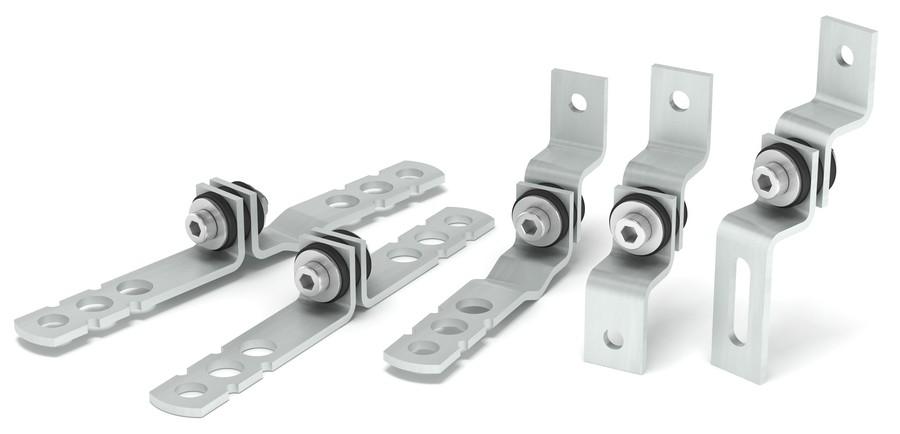
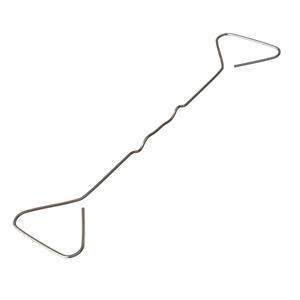
Normally you use wall "ties ties" of which there are many types. Some look like a bow tie made of wire. The kinks or twists in the middle forms a drip bead to stop any water tracking across the tie. There are noise reducing wall ties but I've no idea how effective they are at reducing noise transmission. They also look expensive.. https://www.ancon.co.uk/products/wall-ties-restraint-fixings/acoustic-wall-ties
-
Adding cladding to porch - permission required?
Temp replied to Senzubeansoup's topic in Planning Permission
+1 If under 3 sqm you could probably knock the whole porch down and rebuild it without need planning permission. I would just get on and do the clading. Take photos first and ideally annotate one set with dimensions so nobody can argue you've changed it in some other way such as making it a lot bigger. If a someone was to complain to the planners and they felt that planning permission was required they would first send you a letter. The letter will look scary and talk about enforcement action etc but dont panic as its intended to persuade you to engage with the planners. What you do is call up and ask what you need to do. Most likely they will say you need to make a retrospective Planning Application and they will wave it through. Sometimes they have to be seen to follow the due process when someone makes a complaint. Other times they just want the application fee. I recommend making up a test panel with a few slips and mortar and let it dry fully to be sure of a good match to the house. A slight difference in mortar colour can change the way the bricks look quite a bit. Do the neighbours have similar rendered porches or are theirs brick? -
Neighbours resin drive attached to our property
Temp replied to Becks1974's topic in Party Wall & Property Legal Issues
If your neighbour isn't disputing the location of the boundary i would get it marked in some way then find someone that can cut it back to the marks and reinstate the drainage. I suspect the neighbour might be guilty of causing a statutory nuisance by causing the damp. Unfortunately nobody will take action against him for you and you don't really want to be paying out for legal costs. I only mention it because it might focus his mind if he gets stroppy. You can tell him if he just let's you get on with it you won't have to take him to court for causing a statutory nuisance with all the legal costs that would cause him. -
Smart meter wont connect - metal cabinet
Temp replied to ollie's topic in Consumer Units, RCDs, MCBOs
Google finds.. https://forum.ovoenergy.com/smart-meters-136/i-ve-been-told-i-can-t-get-a-smart-meter-fitted-due-to-metal-casing-around-my-electricity-meter-area-why-8985 I've been told I can't get a smart meter fitted due to metal casing around my electricity meter area - why?
-
Not 100% sure what this is about but.. Conservatories come under different building regs to other rooms. In general they can have more glass and less insulation provided an exterior grade door is retained between the house and conservatory. In addition any heating has to be seperately controlled to the main house. If someone has knocked through or removed the door in the past, or if this is part of your current plans, you may need to demonstrate the resulting new/larger room meets the regs as a whole. Last time I looked there were several calculations you could do to prove this. You start with the easier sums and if they show you dont meet the regs there are more complicated calculations you can do that take into account insulation elsewhere in your house. So the BCO could be saying that no application has been made for this in the past or that he doesn't think you have submitted enough information with the current application or something else along these lines. If you are knocking through into the conservatory as part of the extension and your Architect has been paid to do the Building Control Application drawings then he should do these calculations to insure compliance with Part L.
-
If the wall is over 11m long I think it will also need an expansion joint/gap. This is literally a narrow vertical cut in the wall bridged with telescopic wall ties.
-
Now I've seen the drawing.. The left hand wall on your drawing above is quite long. Long walls need buttressing which is normally provided by interior walls. So its probably the bit of wall on the other side of the door to the point you marked that the BCO is interested in. Is that where the SE added a wind post? The resolution isn't good enough to make out. This stuff is in Approved Document A around page 28 but takes some working out. Edit: Now I look again I see that probably is where he's put the wind post (marked RWP).
-
I think ours just has some sort of foam sheet in it but it's on the sheltered side of our house. I think a low modulus sealer is recommended.. https://www.sealantsonline.co.uk/ProductGrp/Dowsil-791-expansion-joint-silicone-sealant
-
My guess is the BCO was in a rush and just didn't have time to check if you actually had any lintels over 3m. That will be from his normal list of things to ask for. It's not uncommon for the most critical lintel to be designed by the SE and the same family of lintels be used for the other smaller windows (eg same depth and width just different length). But note its not always the longest lintel that is the most critical. I would ask the SE to provide calculations for the one that might need replacing and possibly recommend a family of lintels for the windows. Tell him BCO says he doesn't need calculation for lintels under 3m. The SE might decline and insist on doing load calculations for all of them because you are effectvely asking him to take on risk without doing sums he feels are needed. Not 100% sure what the "return less than 665mm for the store room" is but it sounds like it might be a pier/pillar or short length of wall perhaps between two windows or a window and a door. Theses are typically areas where the loads are concentrated. Eg it's got the ends of lintels or other beams resting on it. In some cases the load may be high in relation to the crush strength of lightweight blocks. The SE can do a calculation and tell you exusting blocks are ok or what density of blocks to use if its a new part of the build.
-
Sounds like an expansion gap. They are normally required in long walls over 11m.
-
Self build insurance vs JCT Joint name insurance
Temp replied to aims's topic in Self Build Insurance
I think most self build insurance policies cover accidental damage to neighbouring property. I guess they are thinking about damage to houses and basements not tunnels but perhaps the wording would cover tunnels as well? -
100mm step from house extension into store
Temp replied to Paul Alan's topic in House Extensions & Conservatories
Yes but.. This rule is to stop petrol from a car leaking into the house under a door between the two. The rule was amended years ago so that no step is required if the floor of the garage slopes away from the door. Perhaps ask the BCO if you could you put the step between store and car parts of the garage? That would appear to meet the regulations and keep the floor in the store the same height as the house. The floor of the store woukd need to be concrete so it doesnt allow fuel under itself. -
+1 Should be ok. I recommend writing a letter to the builder just to document what you are doing and how the final cost will be split. The builder should bill you ex VAT and reclaim the VAT he pays the window company from HMRC himself.